
A thoroughbred in active training in the United States costs roughly $2,000 to $5,000 a month to keep — about $24,000 to $60,000 a year once race months and extras land — completely separate from the purchase price. The trainer’s day rate of $50 to $120 a day is the anchor line; veterinary work, farrier, shipping, and race-day fees bill on top. In New York the all-in number runs to at least $50,000 a year, per the New York Thoroughbred Horsemen’s Association; on a smaller regional circuit it can be roughly half that. Buying in runs from $50 for a micro-share, to $5,000–$50,000 for a claiming horse, to $20,000 and up at auction — our breakdown of what a racehorse actually costs covers that side. But ask most of the industry and the purchase price is the only number you’ll get, and it’s the wrong one to fixate on: the purchase is a single event; the monthly bill is the rest of your life as an owner. Understanding the monthly burn — not the sticker price — is what tells you whether you can actually afford this.
The short version
- A horse in full training runs about $2,000–$5,000 a month (≈ $24,000–$60,000 a year) — the trainer’s day rate is the floor, not the ceiling.
- The day rate ($50–$120/day) covers stall, feed, and daily care. Vet, farrier, shipping, and race-day fees are extra — and they are where budgets break.
- The bill does not pause for a horse that isn’t running. Only a farm layup meaningfully drops it, and even then it never hits zero.
The short answer: what a thoroughbred costs per month
I am not going to give you one number and call it the truth, because the honest answer has a range built into it. The monthly cost of owning a racehorse in active training at an American track is roughly $2,000 to $5,000. The single largest line is the trainer’s day rate, which runs from about $50 a day at a smaller track to around $120 at a major one, according to the owner-cost estimates published by Thoroughbred OwnerView, the resource run jointly by The Jockey Club and the Thoroughbred Owners and Breeders Association. At 30 days, that day rate alone is roughly $1,500 to $3,600 a month. Then come the costs the day rate does not include — veterinary care, the farrier, shipping to the races, and jockey and entry fees on race day — and how to watch your horse run live. Those extras are not rounding error. In a heavy month they can rival the training bill itself.
Imagine your colors on the horse at the front.
Not a bet. Not a ticket. Yours. Thousands of everyday fans own a piece of a racehorse. The free guide is how they started.
What you will not find in most operator marketing is that second half of the math. The entry price gets the headline; the monthly carry gets a shrug — see the full annual cost of owning a racehorse and our affordable ownership budget-floor debunk. Below is the part nobody puts in the brochure.
The month-by-month line items
A monthly racehorse bill is really seven or eight separate bills wearing one envelope. Here is the full set, with honest ranges. Treat the day-rate line as the anchor — it is the figure I can source precisely — and the rest as typical bands that move with your horse’s schedule and health.
Monthly line-item breakdown
| Line item | Quiet month | Typical month | Heavy month | What drives it |
|---|---|---|---|---|
| Trainer day rate | ~$1,500 | ~$2,400 | ~$3,600 | Track tier and trainer; $50–$120/day × ~30 |
| Veterinary | under $100 | $300–$800 | $1,500+ | Routine vs. lameness work, scoping, joint injections |
| Farrier | $0 | $150–$300 | $300+ | Shoeing cycle (every 4–6 weeks); plates on race days |
| Feed / supplements | included | $0–$150 | $200+ | Most sits inside the day rate; supplements bill on top |
| Shipping (van) | $0 | $0 | several hundred+ | Only in months the horse ships to race or train elsewhere |
| Race-day fees | $0 | $0 | several hundred+ | Jockey mount fee + jockey’s win %, entry/nomination |
| Insurance (amortized) | a few % of value / yr | — | — | Mortality cover, billed annually, spread monthly |
| Administrative / misc | $0–$100 | $100–$300 | $300+ | Owner licensing, association dues, accounting |
Anchors: day-rate range and “vet/farrier not included” per OwnerView; New York all-in ≥ $50,000/yr per NYTHA. Other line bands are typical industry ranges, not single-source figures.
Training day rate — the line that runs whether the horse runs or not
The day rate is what the trainer charges per horse, per day, to keep your animal in the barn: stall, hay, grain, bedding, and the labor of grooms, hotwalkers, and exercise riders. OwnerView puts the range at roughly $50 to $120 a day. It is the most predictable number in ownership and the one people underestimate, because it never stops. Thirty days a month, twelve months a year, a horse in training is billing you whether it is pointing for a stakes race or recovering from a bad step.
Vet, farrier, and dental
Veterinary and farrier work bills on top of the day rate — typically $300–$800 a month for routine vet care and $150–$300 per shoeing cycle. Here is where the brochure math falls apart. Veterinary and farrier fees are not in the day rate. OwnerView is explicit that routine vet work alone can run from under $100 in a quiet month to a meaningful share of the entire training bill when a horse needs real attention. The farrier comes on a four-to-six-week cycle, with racing plates added when the horse runs. Dental and other maintenance arrive on their own schedule. None of it is optional if you want the horse sound — and when racing ends, see what happens when racing ends.
Ship months and race-day fees — the spikes
Some months are flat; some spike hard. A horse that ships to another track to race, or vans to a training center for a freshen-up, adds a transport bill the stay-at-home months never see. Race day brings its own stack: the jockey’s mount fee, the jockey’s percentage if the horse hits the board, and entry or nomination fees. Consider an owner whose colt ships from a Florida winter base to New York for a spring allowance prep. That single month can carry a transport charge, a layover at the new barn, and race-day fees the January bill never touched. The horse did not get more expensive to feed. The schedule got expensive.
Insurance and the costs you amortize
Mortality insurance — coverage that pays out if the horse dies — is typically quoted as a percentage of the animal’s value and billed annually, so it is easy to forget in a monthly budget until the renewal lands. The disciplined move is to divide the annual premium by twelve and carry it every month, alongside any licensing and association fees, so a once-a-year number does not ambush you.
Layup and farm rest — when the bill drops
The only line that meaningfully falls is the one nobody markets: sending the horse to a farm to rest. A layup trades the track day rate for a farm board rate — typically $10 to $20 per day, per the American Quarter Horse Association’s owner-cost guidance, versus $50–$120 at the track. It is the release valve in the whole system, and the honest reason a year of ownership rarely costs twelve months of full training — most horses spend part of the year turned out. The bill drops on a layup. It does not hit zero.
Where the money actually goes in a year
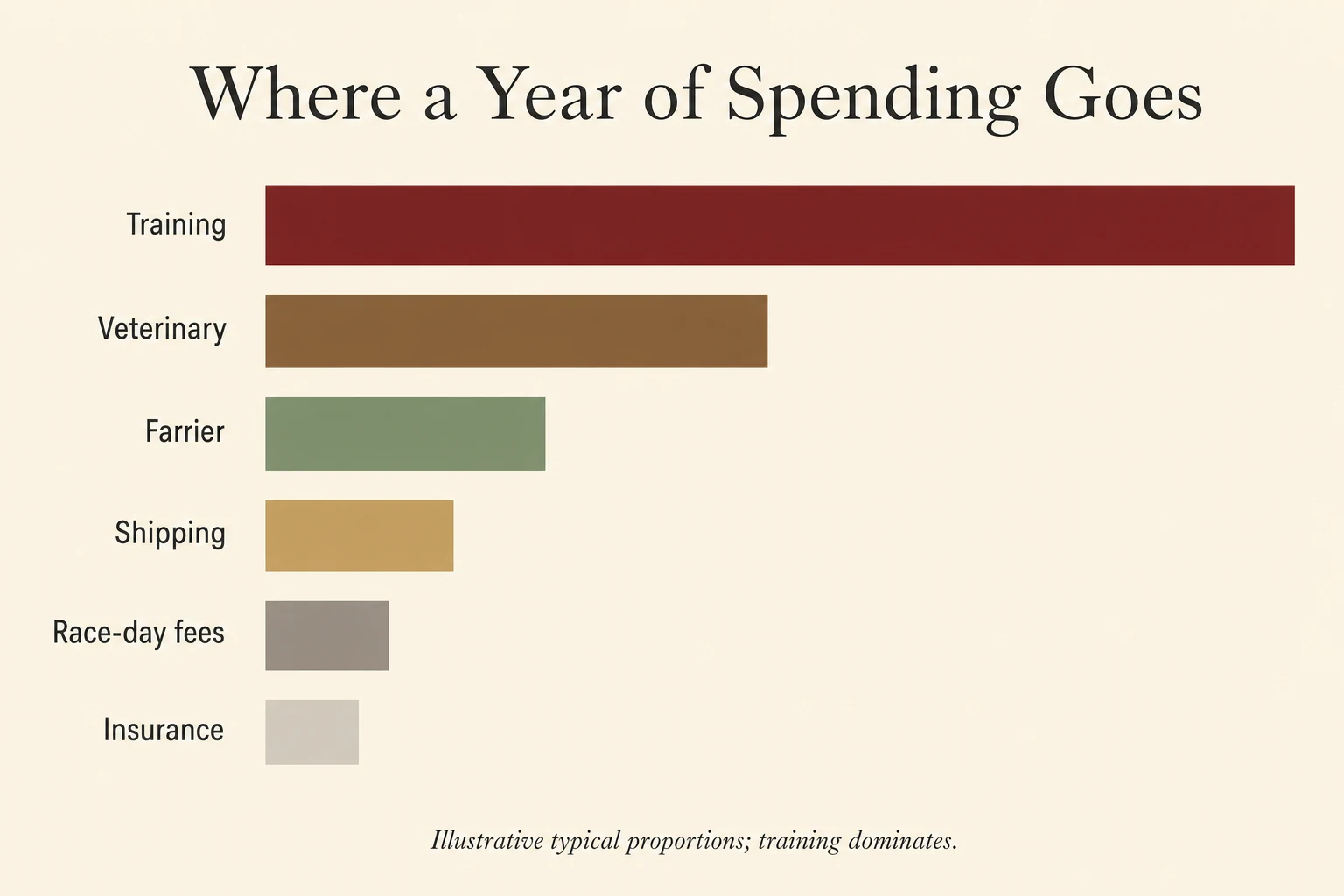
Illustrative typical proportions; training dominates.
Across a full year, one category swallows the rest: training. The day rate, compounded over the months a horse is in active work, is the gravitational center of the budget, with veterinary the usual second and everything else — farrier, shipping, race-day, insurance — sharing what is left. The chart shows the rough proportions. The practical takeaway is simple: to model your annual cost, get the day rate and the number of in-training months right first, then layer the rest on top.
Three real monthly scenarios: active, light, and laid up
The same horse can produce three very different bills depending on what it is doing that month. This is the table I wish someone had handed me first.
Three monthly scenarios
| Scenario | What’s happening | Rough monthly cost | Notes |
|---|---|---|---|
| Active training, no race | Full work at the track, no start | ~$2,000–$3,500 | Day rate + routine vet + farrier |
| Race month | Full training plus a start | ~$3,000–$5,000+ | Adds shipping, jockey, entry/nomination |
| Farm layup | Resting / rehabbing on a farm | materially lower | Farm board replaces track day rate |
A first-time owner who budgets only for the active-training number, then meets a race month and a vet spike in the same thirty days, gets the worst surprise in this sport: a bill that doubled while the horse did exactly what it was supposed to do.
How your monthly cost changes by ownership path

You do not pay the whole bill the same way in every structure. The total is similar; what changes is how much of it lands on you, and how clearly you can see it.
Sole owner: every invoice is yours
Own the horse outright and every line above is yours, in full, every month. The upside is total clarity and control — you see each invoice, you approve each decision. The downside is exposure: a $4,000 month is a $4,000 month, with no one to share it.
Partnership: shared pro-rata, nothing hidden
In a partnership of a handful of named co-owners, the same bills are split by ownership percentage. A quarter share of a $4,000 month is a $1,000 month. The structure does not make the horse cheaper; it makes your slice smaller and, in a well-run partnership, fully visible — you still get the real invoices.
Micro-share: translating an “all-in” fee into true monthly exposure
Fractional and micro-share platforms usually quote a single up-front price that bundles the purchase and a set period of training and care. That is genuinely convenient, and we are not against it. The discipline is to un-bundle it. Take the all-in figure, subtract what is plainly the purchase portion, and divide the remainder by the months it covers. That gives you the true monthly carry on your share — the apples-to-apples number you can hold against the day-rate math above. Consider a buyer who pays a flat micro-share price and assumes it is “done”: when the covered period ends, the monthly bills begin, and the owner who never did that division is the one caught off guard. A good operator’s numbers survive this arithmetic. If a pitch can’t be un-bundled into a monthly figure, that opacity is the answer.
Regional differences: why the same horse costs more in New York than Louisiana
Geography is a real line item. The same horse in the same condition bills differently by circuit, mostly through the day rate and the cost of everything around the track.
Regional circuit costs
| Circuit | Day-rate tendency | All-in monthly tendency |
|---|---|---|
| New York / major East Coast | Higher end (~$100–$120/day) | Highest — NY all-in ≥ $50,000/yr |
| Kentucky | Upper-middle | High in season |
| California | Lower-middle | Moderate |
| Midwest / regional (e.g. Louisiana) | Lower end | Lowest |
New York annual anchor per NYTHA. California and regional bands are directional, not a live quote for every barn.
The lesson is not “race in Louisiana to save money” — purses and opportunity differ too. It is that your monthly budget has to match your circuit. A New York number and a regional number are not the same horse’s bill; they are two different decisions.
What operators leave out of the monthly math

The honest answer. The reason monthly cost is hard to find in plain numbers is not that it is unknowable. It is that the people best positioned to publish it sell lump-sum buy-ins, and a clear monthly burn-rate makes the lump sum look smaller against the years of bills behind it.
This is the heart of our independence. An operator’s job is to get you in; a clear-eyed monthly figure does not help that job. So the FAQ answers the purchase question and goes quiet on the carry. We do the opposite, because the monthly number is the one that decides whether you can do this without it touching your financial plan.
Fewer than 10% of racehorses earn enough in purse money to cover their annual costs. — Thoroughbred Owners and Breeders Association
That is not a reason to avoid ownership. It is the reason to enter it with the monthly bill, not the daydream, in front of you. Treat the costs in this piece as the price of the experience, plan for the layup months, and let any winnings be the upside they actually are. For the full picture of what it costs to buy and own a horse beyond the monthly carry, see our breakdown of what a racehorse actually costs; for whether a fractional share is worth it at all, see our independent answer on buying shares in a racehorse.
Frequently asked questions
How much does it cost to keep a racehorse per month?
A thoroughbred in active training in the US runs roughly $2,000 to $5,000 a month. The trainer’s day rate ($50–$120/day) is the base; veterinary, farrier, shipping, and race-day fees are billed on top and are not included in the day rate, per OwnerView. A race month or a vet spike pushes you toward the high end.
How much does training cost per month for a racehorse?
The day rate alone, at roughly $50 to $120 a day, comes to about $1,500 to $3,600 a month for a horse in full training. That figure covers stall, feed, and daily care — not vet or farrier work.
Is $3,000 a month realistic for a racehorse?
Yes. For a horse in active training on a mid-tier circuit, $3,000 a month is a realistic typical figure. Expect to exceed it in a race month or on a top circuit like New York, where the all-in cost runs to at least $50,000 a year, and to fall below it during a farm layup.
Does the bill stop when the horse isn’t racing?
No. Day-rate, vet, and farrier costs continue whether or not the horse starts. The only meaningful reduction comes from a farm layup, which replaces the track day rate with a lower farm board rate of roughly $10–$20 a day — but never reaches zero.
Have a question this piece didn’t answer? We’re building Race Horse Ownership 101 to give prospective owners the straight numbers the industry tends to round off. Start here for the honest version.
— Race Horse Ownership 101
About the Author

Calvin Johnson is a Thoroughbred racehorse owner, day trader, and independent racing analyst with more than a decade of firsthand ownership experience. He has participated in nearly every common structure in horse racing — fractional platform shares, traditional syndicates, LLC partnerships, claiming ventures, and outright ownership — across more than two dozen horses. Calvin writes about racehorse ownership the same way he approaches markets: by studying risk, incentives, fees, and whether the people controlling the deal are aligned with the investors behind it.
- Calvin Johnsonhttps://racehorseownership101.com/author/calvin-johnson/

- Calvin Johnsonhttps://racehorseownership101.com/author/calvin-johnson/

- Calvin Johnsonhttps://racehorseownership101.com/author/calvin-johnson/

- Calvin Johnsonhttps://racehorseownership101.com/author/calvin-johnson/