
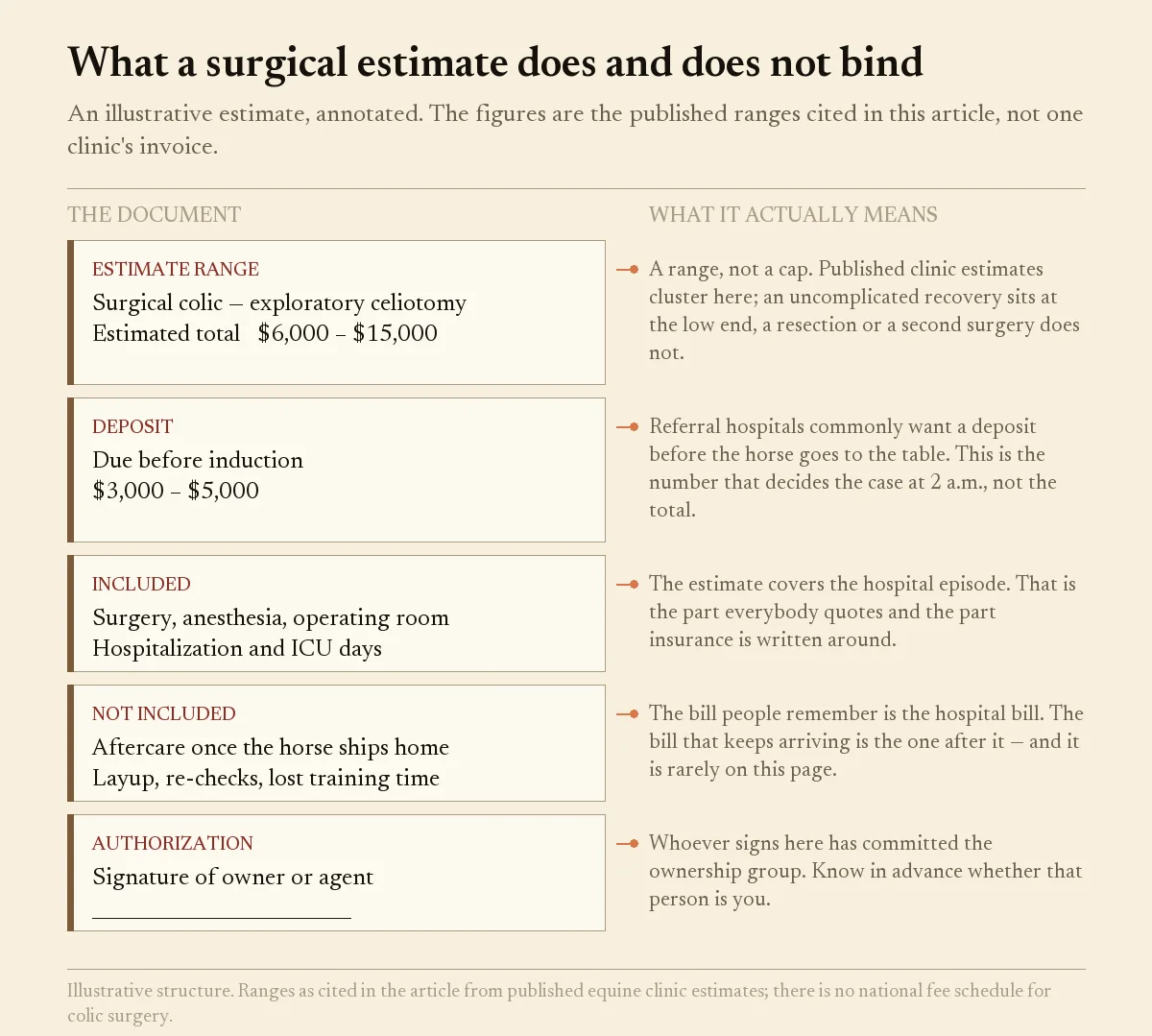
Colic surgery on a horse runs roughly $6,000 to $15,000 at a referral hospital, and most facilities want $3,000 to $5,000 in hand before the horse goes to the table. Those are the figures equine clinics publish themselves — there is no national fee schedule for the procedure, which is part of why the number lands so hard. The band widens fast: an uncomplicated recovery sits at the bottom of it, a bowel resection or a second surgery does not, and totals reported nationwide including pre- and post-operative care reach about $20,000. None of that covers what happens after the horse ships home. And the decision is rarely as simple as whether you can afford it, because in most ownership structures the person the surgeon needs a yes from is not you.
The short answer
- Published equine clinic estimates put colic surgery at $6,000–$15,000 for the hospital episode, with a $3,000–$5,000 deposit due before induction.
- A 2025 University of Kentucky survey of 4,915 US horse owners found the most commonly named maximum for emergency colic surgery was $5,000 — about where a surgical bill starts, not where it ends.
- Major medical insurance is an annual-capped add-on to a mortality policy, not an emergency fund. Aftercare and lost training time sit outside it entirely.
What colic surgery costs, in the numbers clinics publish
Equine referral hospitals that publish their own colic surgery estimates cluster between $6,000 and $15,000 for the hospital episode, before any aftercare. That much is close to industry consensus, and I have no argument with it. An uncomplicated case — the horse goes in, the obstruction is corrected, the recovery is boring — commonly settles around $6,000 to $8,000. A complicated one runs past $10,000, and nationwide figures including everything before and after the surgery are reported as high as $20,000.
The billionaires would prefer you didn’t know this.
You can own a racehorse with a group of people just like you — and the insiders wrote down how. Free guide, ten minutes.
Here is the part the clinical pages tend not to spell out for an owner. The published estimate describes the hospital episode, and the hospital episode is not the transaction you are actually entering. That transaction has three parts:
- A deposit that decides whether the surgery happens at all, due before anything begins.
- A bill that arrives later and is not capped by the estimate you were quoted.
- A recovery period that generates its own costs on a completely separate invoice.
The deposit is the one worth memorizing. At 2 a.m. the question is not what the surgery will eventually total — nobody knows that yet, including the surgeon. The question is whether you can produce several thousand dollars in the next twenty minutes. I have watched owners discover, in that exact moment, that the money was theoretically available and practically not.
What a colic surgery bill covers, line by line
| Line item | What it is | Where it sits |
|---|---|---|
| Deposit before induction | $3,000–$5,000, commonly required before surgery begins | Paid by you up front, credited against the total |
| Surgery and anesthesia | The exploratory celiotomy itself | Inside the published estimate |
| Hospitalization and ICU days | Post-operative monitoring at the clinic | Inside the estimate, and the main variable within it |
| Resection or second surgery | Compromised bowel removed, or the horse goes back in | Pushes the total past the top of the band |
| Aftercare at home | Layup, stall rest, re-checks, feed changes | Outside the estimate entirely |
| Lost training time | The horse is still billing and no longer earning | Outside every estimate and most policies |
The gap between what owners plan to spend and what surgery bills
A 2025 University of Kentucky survey of 4,915 US horse owners found the most commonly named maximum for emergency colic surgery was $5,000 — below the bottom of the range clinics publish. The study, published in Equine Veterinary Education by researchers at the Martin-Gatton College of Agriculture, Food and Environment and the Maxwell H. Gluck Equine Research Center, drew usable responses from all fifty states. More than 60% of owners put their ceiling at $5,000 or less. The same group’s companion paper in JAVMA found demand for several equine veterinary services to be price-sensitive in a way that veterinary economics had largely assumed it was not.
$5,000 — the most commonly named maximum US horse owners would spend on emergency colic surgery, against a published surgical range starting near $6,000.
Gibson et al., Equine Veterinary Education, 2025 (n = 4,915)
Read that as a pricing finding and it says owners are unrealistic. I read it the other way. Four thousand nine hundred people independently landed on a round number that nobody in the industry ever quoted to them, because the industry does not put the real one in front of buyers before they own a horse. Vet clinics publish procedure explainers. Syndicate prospectuses describe upside. Almost nothing published for a prospective owner says: budget for a five-figure emergency that arrives with no warning and needs a decision inside an hour.
The practical consequence is that the gap gets discovered at the worst possible moment — on the phone, at night, with a horse in pain and a surgeon waiting. That is not a good time to learn what your own ceiling is.
Surgical colic and medical colic are two different bills
Most colic episodes never reach surgery: Texas A&M’s Veterinary Medical Teaching Hospital puts lifetime colic incidence at roughly one horse in ten, with only a small share of those cases requiring an operation. The word “colic” covers both, which is exactly why owners conflate the two costs and then budget for the wrong one.
A medical colic is treated standing, often on the farm or with a short hospital stay — fluids, pain management, monitoring. A surgical colic means the horse goes under general anesthesia and the abdomen is opened. The financial distance between those two outcomes is not incremental. It is the difference between an annoying vet call and the largest single invoice most owners will ever receive on a horse.
Medical colic and surgical colic, side by side
| Medical colic | Surgical colic | |
|---|---|---|
| What happens | Treated standing — fluids, analgesia, monitoring | General anesthesia, the abdomen is opened |
| Where | The farm, or a short hospital stay | A referral hospital with a surgical theater |
| Who decides | Usually the trainer with the attending vet | Whoever holds authorization under your agreement |
| How insurance sees it | An ordinary veterinary claim, if covered at all | The claim major medical is written around |
| The cost driver | Duration and how often it recurs | Complications, hospital days, and aftercare |
Who actually authorizes colic surgery when you own a share
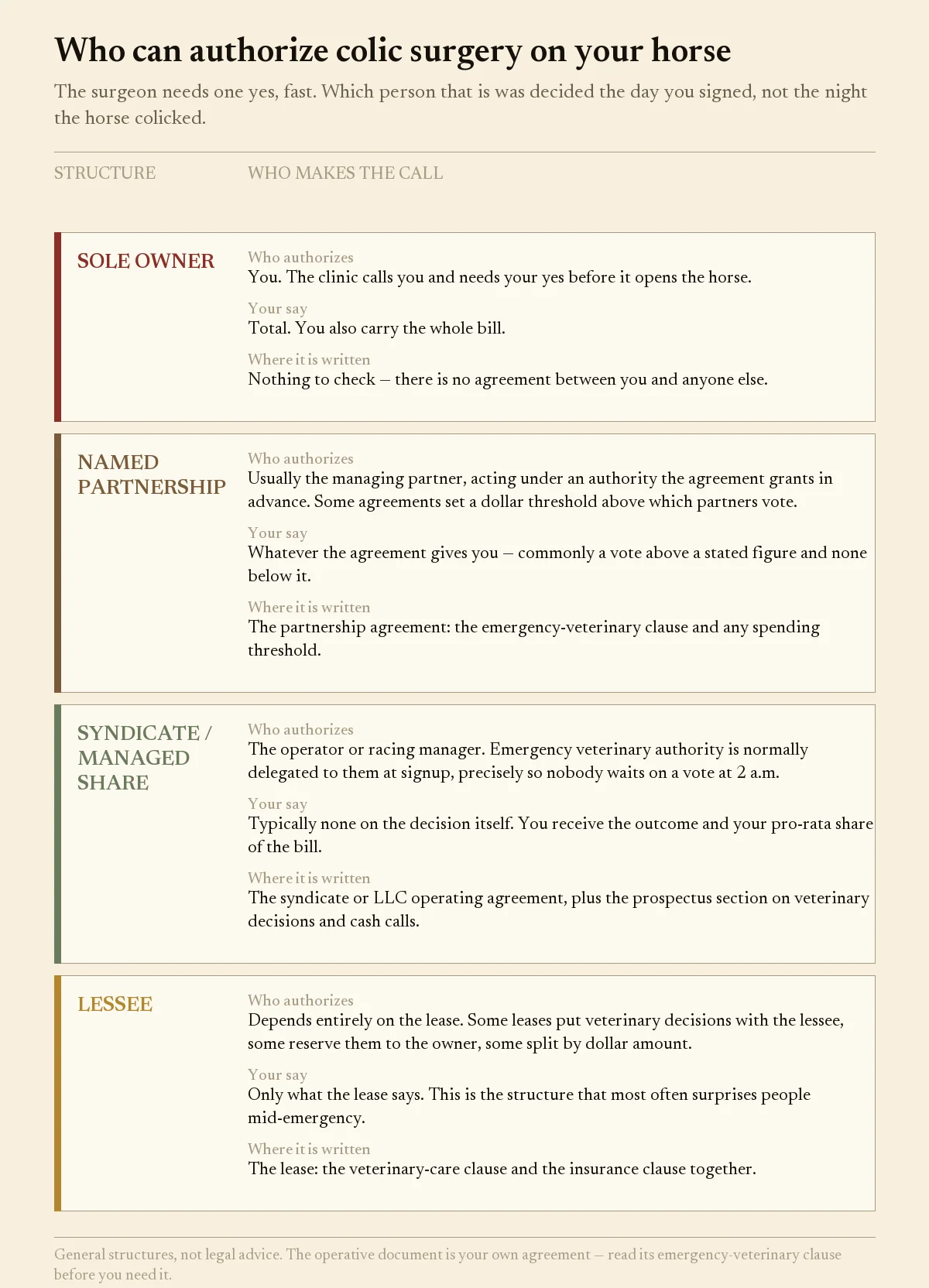
In a syndicate or a managed partnership, the person who authorizes colic surgery is normally the operator or racing manager, not the individual shareholder. That authority is delegated at signup, and it is delegated deliberately — a surgeon cannot wait while fourteen people are telephoned for a vote, and a horse with a strangulating lesion does not have the evening.
I do not think that delegation is wrong. It is the only arrangement that works at 2 a.m. What I object to is how rarely anyone tells a new shareholder it exists. People buy into a syndicate believing they have bought a say, and the first time they discover the true shape of their say is when an invoice arrives for a decision they were told about afterward. The clause is usually there in the operating agreement. Almost nobody reads it before signing, because nothing in the sales process points at it.
Before you join anything, read two clauses together. They tell you who spends your money and how fast you have to produce it, and they belong on the list of things you check when you vet a syndicate or partnership manager:
- The emergency-veterinary clause — who may authorize treatment, and above what figure, if any, you get a vote.
- The cash-call clause — how quickly your share of an unplanned bill becomes payable, and what happens if you cannot meet it.
What a major medical policy actually pays
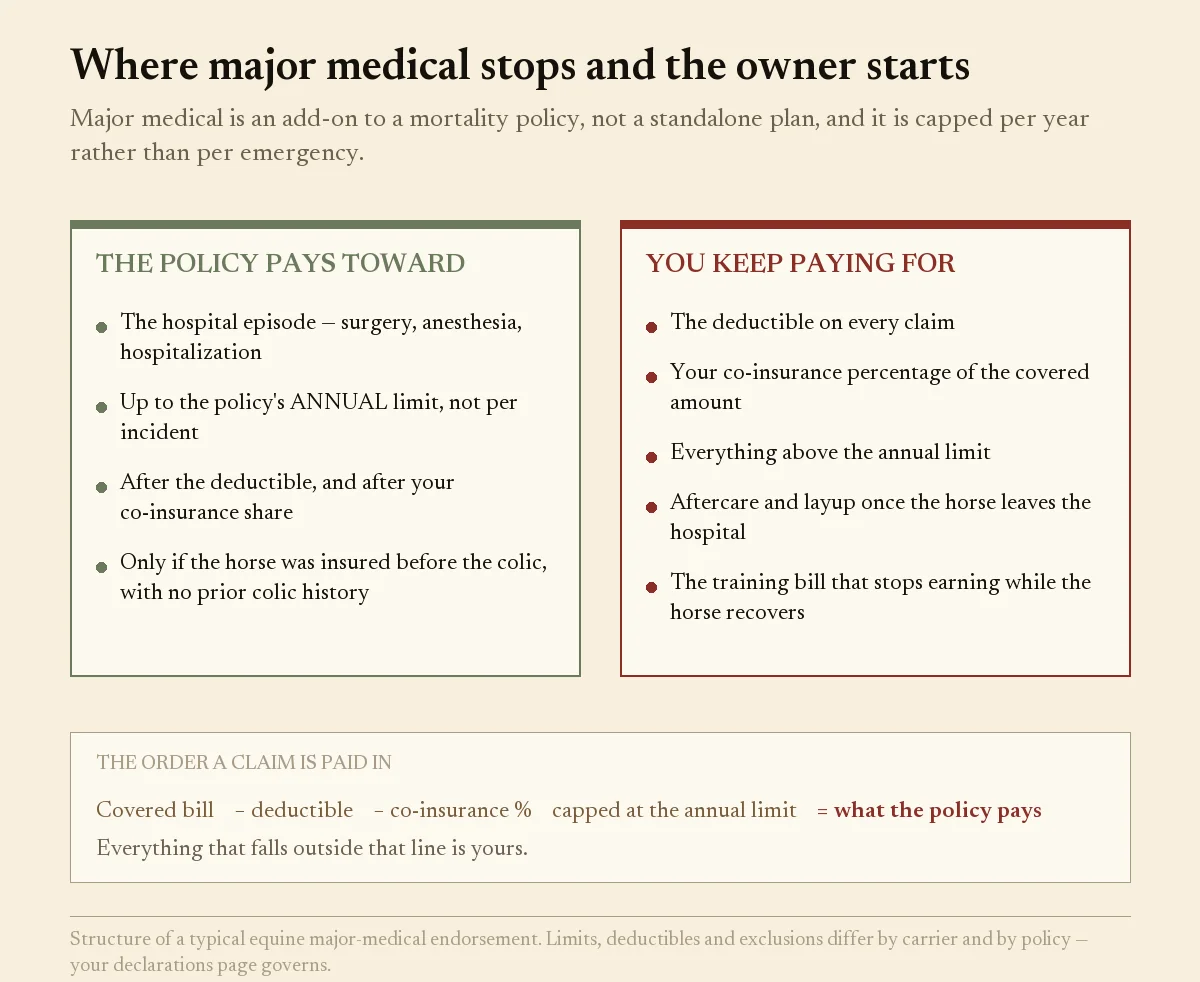
Equine major medical is an add-on to a mortality policy, carrying an annual limit, a per-claim deductible and a co-insurance share — it is not an emergency fund that pays a colic bill in full. You cannot generally buy it standalone. The mortality policy is the host; major medical rides on it, and if the mortality cover lapses or the horse ages out, the medical cover goes with it.
Three features of that structure catch owners out, and none of them are hidden — they are simply never explained at the point of sale. The limit is annual, not per incident, so a horse that colics in March has less protection in November. The deductible applies to every claim. And eligibility usually turns on the horse having no prior colic history, which means the second episode is often the uninsured one. We have written the policy mechanics up in detail in our guide to major medical and colic insurance, and the boundary between medical and mortality cover in our breakdown of racehorse mortality insurance.
What still hits your wallet after the policy pays
After a major medical claim settles, the owner still carries the deductible, the co-insurance share, anything above the annual limit, and every dollar of aftercare once the horse leaves the hospital. That last category is the one nobody prices in advance, and it is the one that runs longest.
A horse recovering from abdominal surgery is not in training. It is standing somewhere, eating, being checked, and generating a bill that produces no possibility of earnings while it does. The training clock stops. The ownership clock does not. For a syndicate member the arithmetic is quieter but identical — your monthly share continues, drawn against a horse that cannot run. Our month-by-month breakdown of what a Thoroughbred costs to keep is the baseline that keeps running underneath all of this, and the annual carry figures are what an extended layup quietly extends.
The honest bottom line: insurance is built to stop a colic surgery from being financially catastrophic. It is not built to make it free, and it does nothing at all about the months afterward. Both of those are yours.
When owners decline surgery
Some owners decline colic surgery, and the reasons are a mixture of money, prognosis and the horse’s age and job. I am not going to pretend that decision is always about welfare, or always about cost, because it is usually about both at once and the proportions are private.
What I will say plainly is that there is an insurance wrinkle most owners meet for the first time in the middle of it. Equine policies commonly require the owner to pursue treatment that would reasonably save the horse. Elect euthanasia instead of a surgery the insurer considers viable, and a mortality claim can be affected. Whether that applies to you depends entirely on your policy wording, and the time to read that clause is a quiet afternoon, not a phone call from a clinic. Ask your agent to show you exactly where it sits in your contract and what it requires of you.
The decision itself deserves more respect than a cost article can give it. The preparation, though, is entirely mechanical, and it is what separates an awful night from an awful night made worse. Three facts, none of which take an hour to establish, and all of which are impossible to establish at 2 a.m.:
- What you can actually produce as a deposit tonight, not in principle.
- Who signs the authorization — you, a managing partner, or an operator.
- Your annual major medical limit, and whether this year has already drawn on it.
Is colic surgery worth it?
There is no honest yes-or-no. “Worth it” is a comparison between a published hospital band of $6,000 to $15,000 — plus a $3,000 to $5,000 deposit before induction — and what you can actually produce tonight, what your major medical annual limit still has left, and who is allowed to sign. A 2025 University of Kentucky survey of 4,915 US owners found the most commonly named maximum for emergency colic surgery was $5,000, and more than 60% put their ceiling at $5,000 or less: below the bottom of the range clinics publish. That gap is the decision, not a verdict on the horse.
Insurance does not close it. Major medical is an annual-capped add-on to a mortality policy, not an emergency fund. Aftercare, lost training time, and anything above the limit stay with the owner. Some policies also require the owner to pursue treatment the insurer considers viable, which is why reading that clause on a quiet afternoon matters more than any forum thread titled “is colic surgery worth it.” The mechanical checks sit above: the deposit, the signature, the remaining annual limit. Those three facts decide more than a feeling about the horse.
What to read next
- What a Thoroughbred actually costs to keep, by month — the running baseline a layup extends.
- Major medical and colic insurance — what the endorsement covers and where it stops.
- Racehorse mortality insurance — the policy major medical has to ride on.
- What it actually costs to own a racehorse — the sourced annual picture.
About the Author

Calvin Johnson is a Thoroughbred racehorse owner, day trader, and independent racing analyst with more than a decade of firsthand ownership experience. He has participated in nearly every common structure in horse racing — fractional platform shares, traditional syndicates, LLC partnerships, claiming ventures, and outright ownership — across more than two dozen horses. Calvin writes about racehorse ownership the same way he approaches markets: by studying risk, incentives, fees, and whether the people controlling the deal are aligned with the investors behind it.
- Calvin Johnsonhttps://racehorseownership101.com/author/calvin-johnson/

- Calvin Johnsonhttps://racehorseownership101.com/author/calvin-johnson/

- Calvin Johnsonhttps://racehorseownership101.com/author/calvin-johnson/

- Calvin Johnsonhttps://racehorseownership101.com/author/calvin-johnson/