A horse sale agreement protects a retired racehorse only as far as the person who signs it. The two clauses that carry the most weight are a no-slaughter provision and a resale-notification provision — the pair the Retired Racehorse Project requires on every Makeover Marketplace sale, where the buyer agrees not to knowingly sell the horse to a kill buyer or let him go through public auction for less than $1,000, and agrees to make a reasonable effort to tell the seller when the horse is available again. A plain bill of sale carries neither. Whether either clause reaches the next buyer down the line is genuinely unsettled, and that one fact should change how you sell: your protection sits in the terms you write and the buyer you choose, not in the lawsuit you are picturing.
The honest answer, up front
- A bill of sale transfers a horse. It does not protect one. Those are two different jobs, and most templates only do the first.
- The two clauses worth insisting on are no-slaughter/no-auction and resale notification. The Retired Racehorse Project requires both on Makeover Marketplace sales, and nothing stops a private seller from requiring the same.
- Write the agreement assuming it binds your buyer and no one after him. That assumption pushes you toward the things that actually work: terms your buyer has a reason to honor, and a buyer you would be willing to call in three years.
What a horse sale agreement can and cannot do
A horse sale agreement is a private contract between one seller and one buyer, which means it governs that buyer’s conduct and stops there. The Retired Racehorse Project says this plainly about its own Marketplace listings: all sales are private contracts between the buyer and seller, and the organization does not participate in the transaction or take a commission. That is worth sitting with, because it describes every private OTTB sale in the country. There is no registry enforcing your terms, no governing body auditing what happened to the horse, and no automatic mechanism that follows him to his next home.
The Sport of Kings has a side entrance. Here’s the key.
Regular people own racehorses — together, in partnerships — and stand in the paddock like they were born there. The free guide shows you the way in.
The document does two things well. It records exactly what the buyer promised, in writing, at the moment they had the strongest reason to agree, and it gives you a defined position to stand on later rather than a recollection of a conversation in a barn aisle. What it does not do is travel. The buyer you sold to can sell again, and the person who buys from him never signed anything of yours.
Why a plain bill of sale leaves an OTTB unprotected
A standard bill of sale records that a named horse changed hands for a stated price on a stated date, and it is silent on everything the seller of a retired racehorse actually worries about. The free templates that dominate search results are built for a clean transfer of title, and they ask for the things a transfer needs: the parties, the horse’s registered name and registration number, the purchase price, the date, and two signatures. That is a transaction document, and it is perfectly good at the job it was designed for. Nothing in it looks past the closing.
The two provisions to add to a bill of sale

The gap between transferring a horse and protecting one
An owner selling a sound seven-year-old off the track is not worried about who bears the risk of loss between Friday and Saturday. They are worried about year three, when the buyer’s circumstances change and the horse becomes a line item somebody wants to remove quickly. Every protective clause below exists to put a speed bump in that moment, and a bill of sale has no opinion about it at all.
What a bill of sale covers and what it leaves out
| The document handles | The document ignores |
|---|---|
| Who is selling and who is buying | Who the horse may be sold to next |
| The horse’s identity and registration | Whether the horse may go through public auction |
| The purchase price | Whether you are ever told he is for sale again |
| The date, the signatures, the transfer of title | Whether you get a chance to take him back |
| Whatever else the two parties choose to write in | What happens if the buyer breaks his word |
The clauses OTTB sellers ask about most
Four clauses do nearly all of the protective work in an OTTB sale agreement: no-slaughter, resale notification, right of first refusal, and buy-back. They are often discussed as if they were interchangeable, and they are not — two of them restrict the buyer, and two of them give you a way back in.
The no-slaughter clause
A no-slaughter clause is a written promise by the buyer not to send the horse into the slaughter pipeline, usually drafted to cover the practical route rather than the destination. That distinction is the whole craft of the clause. “Buyer will not send the horse to slaughter” is easy to sign and hard to pin down, because almost nobody sells a horse to a slaughterhouse directly. RRP’s version names the mechanism instead, and it is the better model: the buyer will not knowingly sell to a kill buyer, and will not allow the horse to go through public auction below a stated price.
The price floor is the part people miss. Setting a dollar threshold under which the horse cannot be run through a sale ring is a blunt instrument, and blunt is the point: it removes the low-end auction route without requiring anyone to prove intent.
The resale-notification clause
A resale-notification clause requires the buyer to tell you when the horse is going back on the market, and it is the most underrated term on this list. It does not restrict what the buyer may do. It buys you information, early, at the only moment when information is still useful.
Draft it with the three things that make notice real: a trigger, a method, and a window. The trigger is when the horse is offered for sale, not when he is sold. The method is something you will both still have in three years, which in practice means email to a stated address. The window is a defined number of days before the horse leaves. A clause that says the buyer will “let the seller know” has no trigger, no method, and no window, and it will be honored exactly as far as the buyer’s memory and goodwill carry it.
Right of first refusal against a buy-back
A right of first refusal gives you the chance to match a third party’s offer before the horse is sold to them; a buy-back gives you the right to repurchase at a price fixed in advance. First refusal costs nothing until it triggers, and then it costs whatever the market says. A buy-back is predictable, which cuts both ways: write $1 to make it painless and you have a term a buyer may resist honoring; write market value and you have written yourself a bill you may not want in five years. Neither does anything unless you find out the horse is for sale, which is why notification is the clause that switches the other two on.
How the four protective clauses compare
| Clause | What it actually does | What it does not do | Use it when |
|---|---|---|---|
| No-slaughter / no-auction | Bars your buyer from the kill-buyer and low-end auction routes, ideally with a stated price floor | Follow the horse to an owner who never signed it | Always. This is the floor, not the ceiling |
| Resale notification | Gives you early warning that the horse is going back on the market | Stop the sale, or oblige the buyer to sell to you | Always. It is what makes every other clause usable |
| Right of first refusal | Lets you match a third party’s offer before the horse leaves | Set your price, or work if you are not notified | You would take the horse back but cannot commit to a figure now |
| Buy-back at a set price | Fixes the repurchase price in advance, removing the negotiation | Stay comfortable for either side as years pass | You are confident you want him back and can name the number today |
What the Retired Racehorse Project requires of its sellers
The Retired Racehorse Project requires sellers to put two specific protections into the transfer-of-ownership agreement for every Makeover Marketplace sale. Sellers must include this language, or its equivalent, in their contracts: that the buyer agrees to make a reasonable effort to notify the seller when the horse is made available for sale in the future, and that the buyer will not knowingly sell the horse to a “kill buyer” or allow the horse to be sold at public auction for less than $1,000.
Two sentences, required on every sale, from an organization with no financial stake in the transaction. That is the closest thing the OTTB market has to a published standard — and it is available to any private seller who cares to use it.
Notice what RRP does not do. It does not mandate a particular contract format, and it offers a free basic bill of sale template for sellers who want one. It requires the substance and leaves the paperwork open. A private seller can copy that approach exactly: take whatever bill of sale you were going to use, and add the two provisions.
Why a program’s contract does not cover your private sale
RRP’s requirement binds sellers using the Makeover Marketplace and has no application to a sale you arrange through a Facebook group or a trainer’s phone. This is the most common misunderstanding I run into on the topic: owners assume that because aftercare organizations exist, some layer of protection attaches to the animal permanently. It does not. Non-profit aftercare organizations may run their own adoption approval process on top of a sale, but those terms live in their contracts and govern their placements. Your private sale is governed by your document and nothing else.
Building your own OTTB sale agreement
The right set of clauses for an OTTB sale depends almost entirely on how well you know the buyer, and that assessment is usually less flattering when made away from the barn than in it. Scale the terms to how much you can actually verify.
The minimum, for a buyer you can verify
For a buyer your trainer knows, or a rider whose barn you can visit, the two RRP-style provisions are a reasonable floor: no-slaughter with an auction price threshold, and resale notification with a real trigger and method. You are not insulting anyone by asking. A buyer who intends to keep the horse loses nothing by signing terms about selling him.
The stronger set, for a buyer you cannot
Selling to someone you found online, at distance, with no shared contacts, calls for the return clauses as well as the restrictive ones, and for a stated consequence rather than a bare prohibition. A clause with a named remedy attached reads differently at signing than a clause that simply forbids something. It tells the buyer you expect the term to mean something, and it gives you a defined position if it is broken.
What a resale-notification clause needs to say

Consider an owner selling a nine-year-old gelding two states away to a buyer who answered an ad. Everything about the conversation is fine. The reference checks out. Eighteen months later the buyer’s job moves and the horse goes on a sale page the owner never sees. Nothing in that sequence involves bad faith — and nothing in it is caught by a document that has no notification clause in it.
Which clauses to ask for, by buyer type
| Who is buying | Minimum terms | Add if you can | The risk you are managing |
|---|---|---|---|
| Rider or barn your trainer vouches for | No-slaughter with auction floor; resale notification | Right of first refusal | Circumstances change faster than relationships do |
| Accredited aftercare or adoption organization | Read their contract and keep a signed copy | Ask how their own resale terms work | Assuming their protections are yours |
| Private buyer found online, at distance | Both restrictive clauses, plus notification with a defined window | First refusal or buy-back, plus a stated remedy | You will not hear anything unless the document makes you hear it |
| Buyer who resells horses as a business | Everything above, in writing, before the trailer arrives | Attorney review | Resale is the plan, not the contingency |
What is worth paying an equine attorney to look at
Everything here is editorial guidance from an owner’s perspective, and none of it is legal advice or a substitute for it. Contract law is state law, the enforceability of these terms is not something a publication can settle for you, and an hour of an equine attorney’s time is cheap against a term that does not do what you assumed. Spend that hour when you are writing a remedy or a fixed buy-back price, when the horse is crossing state lines, or when the sum involved is large enough that you would actually pursue it.
What you can actually do if a clause is broken
If a buyer breaks a no-slaughter or notification clause, your realistic options are the ones you built into the document before you signed it, and they are narrower than most sellers expect. Whether a no-slaughter clause reaches a person who was never party to your agreement is an open question — it turns on state law and on facts, and RHO101 is not going to resolve it for you in a blog post. What can be said is what the document does on its face: you hold a promise from the person who signed, plus whatever remedy you wrote next to it.
The practical value of these clauses runs almost entirely in the other direction. A notification clause does its work in the months before anything goes wrong, by making a phone call the path of least resistance for your buyer. The no-slaughter clause does its work at signing, by telling you something about a buyer who hesitates over it. If you are relying on either one after the horse is gone, the protection already failed at the point where it was strongest.
When each clause actually does its work
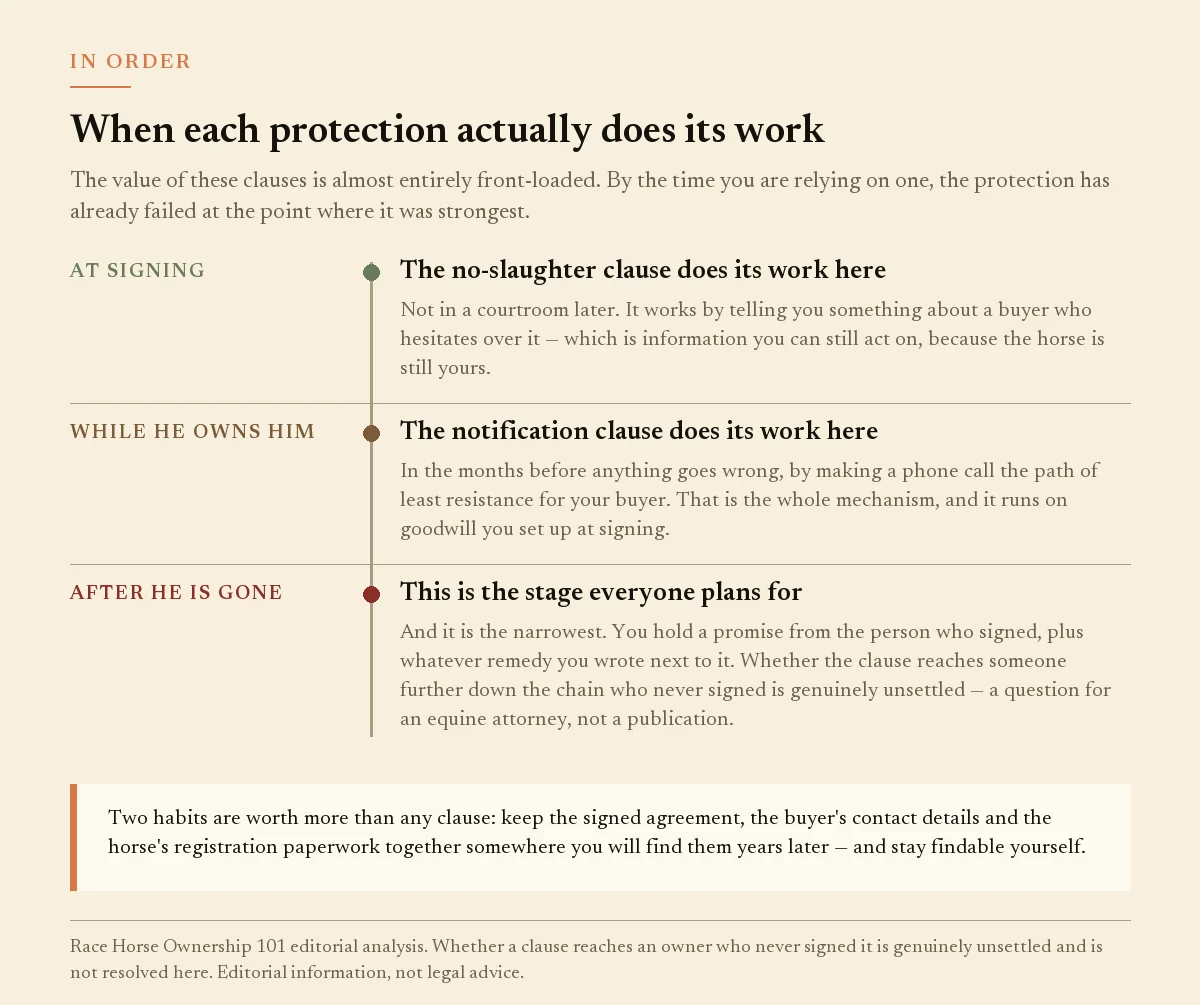
Two habits are worth more than any clause. Keep the signed agreement, the buyer’s contact details, and the horse’s registration paperwork together somewhere you will find them years later. And stay findable yourself: a notification clause pointing at an email address you abandoned in 2021 cannot be honored even by a buyer who wants to. For the wider map of where OTTBs go, our guide to the aftercare system covers the pathways out of racing; Michigan State University’s Animal Legal & Historical Center maintains a public collection of state statutes related to horse slaughter if you want to see the picture in your own state.
Questions owners ask about OTTB sale agreements
The questions below come up on nearly every private OTTB sale, and the answers are the ones most sellers wish they had before they signed rather than after.
What is a no-slaughter clause for horses?
A no-slaughter clause is a written promise from the buyer not to route the horse into the slaughter pipeline. The stronger versions name the mechanism rather than the outcome: the Retired Racehorse Project’s required language bars the buyer from knowingly selling to a kill buyer and from allowing the horse to be sold at public auction for less than $1,000. Naming the auction route and a price floor gives the clause something checkable, where a general prohibition on slaughter gives you a term that is difficult to apply.
Can you enforce a no-slaughter clause after you sell the horse?
Against the buyer who signed it, you hold a contractual promise and whatever remedy the agreement specifies. Against someone further down the chain who never signed, the position is genuinely unsettled and depends on state law and on the facts, which is a question for an equine attorney rather than a publication. Sell as though the clause covers your buyer only, because that is the assumption that leads to the better document and the better buyer.
What should a horse resale-notification clause include?
A resale-notification clause needs a trigger, a method, and a window: notice when the horse is offered for sale rather than after he is sold, delivered by a stated method such as email to a named address, a set number of days before he leaves. RRP requires that the buyer make a reasonable effort to notify the seller when the horse is made available for sale in the future. Adding the three specifics turns that principle into a term both sides can follow.
Does the Retired Racehorse Project contract apply to private sales?
No. RRP’s requirements apply to sales made through the Makeover Marketplace, and the organization states that all such sales are private contracts between the buyer and seller in which it does not participate and takes no commission. A sale you arrange independently is governed only by the document you and your buyer sign. The requirements are still the most useful published model available, and copying them into your own agreement takes two sentences.
What is the difference between first right of refusal and a buy-back clause?
A right of first refusal lets you match another buyer’s offer before the horse is sold to them, at whatever price that third party has put on the table. A buy-back clause fixes your repurchase price in the original agreement, so the number is settled years before you use it. First refusal keeps your options open at an unknown cost; a buy-back gives you a known cost and less flexibility. Both are inert unless a notification clause tells you the horse is for sale.
The protection is the paperwork you write before the trailer comes
Selling a retired racehorse well is a paperwork problem more than a market problem. The market end is hard enough on its own: the OTTB resale market leaves sellers with very little bargaining room, and the alternative to selling carries a monthly cost that does not stop. That combination is why the contract matters: an owner under financial pressure to place a horse quickly is the owner least likely to slow down and add two clauses.
The habit that protects the horse is the same one that protects you in a syndicate deal, which is reading the agreement before you sign it rather than after. RRP asks its sellers for two sentences. Any private seller can ask for the same two, plus an email address that will still work in five years.
About the Author

Calvin Johnson is a Thoroughbred racehorse owner, day trader, and independent racing analyst with more than a decade of firsthand ownership experience. He has participated in nearly every common structure in horse racing — fractional platform shares, traditional syndicates, LLC partnerships, claiming ventures, and outright ownership — across more than two dozen horses. Calvin writes about racehorse ownership the same way he approaches markets: by studying risk, incentives, fees, and whether the people controlling the deal are aligned with the investors behind it.
- Calvin Johnsonhttps://racehorseownership101.com/author/calvin-johnson/

- Calvin Johnsonhttps://racehorseownership101.com/author/calvin-johnson/

- Calvin Johnsonhttps://racehorseownership101.com/author/calvin-johnson/

- Calvin Johnsonhttps://racehorseownership101.com/author/calvin-johnson/