Retirement horse boarding — carrying a retired racehorse on a farm instead of at the track — runs roughly $300 to $600 a month, working from the $10 to $20 per day the American Quarter Horse Association puts on basic farm keep. The alternatives are a lump sum or a queue. A lifetime sanctuary like Old Friends suggests a $10,000 donation, which covers about a retiree’s first year of feed, veterinary care, and board. An accredited adoption organization absorbs the retraining bill instead, but takes horses on its own intake criteria and its own timetable. Three routes, three different shapes of obligation: one open-ended and monthly, one closed and up front, one cheap in cash and expensive in control. Which door you use is usually decided by your partnership agreement, not chosen at the last start.
The honest answer, up front
- Farm board is the only route with no end date. At $10–$20 a day it is cheap per month and unlimited in duration — a horse retired sound at five can live another twenty years.
- A sanctuary donation buys a finish line. It is the largest single number in this piece and the only one that closes the obligation.
- Adoption is the cheapest route in cash and the least certain in timing. Accredited organizations run waitlists; “no, not this month” is a capacity answer, not a verdict on your horse.
What retiring a racehorse costs, route by route
A retired racehorse costs an owner either a monthly board bill of roughly $300–$600, a one-time sanctuary donation in the $10,000 range, or the price of waiting for an accredited adoption slot. Those are the three real exits, and the industry agrees on the shape of them: our guide to the aftercare system maps the same four pathways out of racing that every accredited organization works from. Where the published material goes quiet is on the arithmetic of choosing between them.
Racing’s best-kept open secret: you don’t have to just watch.
Ownership groups let regular people own a share of a real racehorse. The free guide explains how it works, in ten minutes.
The reason it goes quiet is structural. Sanctuaries and adoption groups publish suggested donations because they are fundraising, not quoting. Boarding farms quote by the day because rates move with hay and labor. Nobody in the chain has a commercial reason to lay the three routes side by side and tell an owner which one is cheaper over ten years, because the honest comparison makes the open-ended option look worse than it feels in month one. That comparison is what this piece is for.
The three retirement routes, compared
| Route | Up-front cost | Ongoing monthly | Who controls the horse | What ends your obligation |
|---|---|---|---|---|
| 1. Owner-paid farm board | None — you already own him | ~$300–$600 (farm keep at $10–$20/day, per AQHA) | You | Nothing. It ends when you sell, place, or lose the horse |
| 2. Lifetime sanctuary | Suggested donation — $10,000 at Old Friends, about a first year of care | None once the horse is accepted | The sanctuary, permanently | Acceptance. The obligation transfers |
| 3. Accredited adoption organization | Little or none — the organization carries retraining | Your board bill until the horse is accepted | The organization, then the adopter | Acceptance — subject to intake criteria and a waitlist |
Board figures derive from the American Quarter Horse Association’s farm-keep guidance of $10–$20 per day; the sanctuary benchmark is Old Friends’ own suggested intake donation. Regional and care-level variation is real and is not captured by a single national band.
Why the bill doesn’t stop when the racing does
A retired racehorse still bills every month, because the cost of a horse is the cost of keeping an animal alive, not the cost of running him. The training bill falls sharply — the day rate that anchors a racing budget runs $50 to $120 a day, per Thoroughbred OwnerView, against $10 to $20 for farm keep — but it lands on a floor rather than at zero. Owners tend to model the drop and forget the floor.
The letdown period after the last start
Letdown is the months a horse spends decompressing from race fitness before anyone can retrain or rehome him, and the owner pays board through all of it. A horse coming out of a racing barn is fit, grain-fed, and stalled twenty-two hours a day. Turning that animal into one who can live out, hold weight on forage, and stand quietly for a farrier takes time, and the calendar does not care whether the horse is earning. This is the stretch that surprises people: the racing has ended, the retirement has not begun, and the bill arrives anyway.
The partnership agreement gap
Most syndicate and partnership agreements say nothing about who funds retirement, which means the cost falls to whoever holds control when the racing stops. Read the paperwork on a fractional share and you will find purchase terms, management fees, decision rights, and a sale clause. Aftercare is frequently absent. We have argued before that the retirement clause is one of the most revealing things in a syndicate or partnership agreement, and it is revealing precisely because so few operators include one. An agreement that is silent on retirement has not left the question open; it has answered it in favor of the majority holder.
Consider a minority partner in a five-percent share who wants the horse pensioned at a named farm. Without a written aftercare clause or a right of first refusal, that partner has an opinion, not a mechanism. The practical move is to price retirement before you buy in — a retirement reserve inside the partnership costs each member a rounding error per month, and it is the difference between a plan and a scramble.
Route 1 — you keep paying for retirement horse boarding
Carrying a retired racehorse yourself costs about $300 to $600 a month at the $10–$20 daily farm rate the American Quarter Horse Association uses for basic keep, and that figure has no expiry date attached to it. It is the route most owners default into, usually without deciding to, because doing nothing is a choice that bills monthly.
What farm board covers, and what bills on top
Farm board buys grass, hay, water, turnout, and someone laying eyes on the horse daily — the same bundle the track day rate covers, minus the training. What sits outside it is the same list that sits outside a trainer’s day rate: veterinary work, the farrier, and anything that goes wrong. The difference is that a retired horse generates far less of it. No race-day medication, no joint maintenance to keep a campaigner sound, no shipping. A pensioned horse is a cheap horse right up until he is an expensive one.
What retirement horse boarding costs per month
| Line item | What it runs on a retired horse | What drives it |
|---|---|---|
| Farm board | ~$300–$600 a month | AQHA farm-keep guidance of $10–$20 a day; region and care level move it |
| Veterinary (routine) | Vaccines, dental, worming — and little else | No race-day medication, no joint maintenance on a horse who isn’t running |
| Farrier | A trim cycle rather than racing plates | Most pensioned horses go barefoot; the cycle runs roughly six to eight weeks |
| Feed and supplements | Usually inside board; seniors and hard keepers bill on top | Age and dentition, not training load |
| Insurance | Most owners drop mortality cover | Cover on a horse with no earning capacity rarely pencils |
| Emergency veterinary | Unbudgetable — the reason to hold a reserve | Colic and laminitis do not consult your budget |
Board range per AQHA’s farm-keep guidance. The remaining lines are qualitative on purpose: we could not source a defensible national figure for each, and an invented band is worse than an honest description.
How long owners end up carrying a retired horse
The carrying period is measured in years, not months, because a Thoroughbred retired between four and seven has most of his life ahead of him. That is the number owners never run. Six hundred dollars a month is a manageable line on a household budget and a six-figure commitment across two decades, and both statements are true at the same time. The monthly figure is the one that gets quoted; the duration is the one that decides whether the plan survives.
The honest answer. Farm board is not the cheap route. It is the route with the smallest monthly number and no exit clause, which is a different thing. The distinction becomes visible somewhere around year two or three, when the running total passes what a sanctuary would have asked once.
There is a harder version of this arithmetic that owners meet when a retired horse breaks down in the field rather than on the track, and the choice becomes veterinary spending against quality of life. We have written separately about why racehorses get put down, and the same economics sit underneath a pensioned horse. Planning the retirement budget is partly planning for that.
Route 2 — sanctuary placement
A lifetime sanctuary converts an open-ended monthly bill into a single donation: Old Friends, the retirement farm in Georgetown, Kentucky, suggests $10,000, roughly a retiree’s first year of feed, veterinary care, and board. It is the largest single number an owner meets in aftercare and the only one that ends the obligation rather than deferring it.
What an intake donation actually covers
An intake donation is a contribution toward a horse’s lifetime care, not a purchase of it, and the distinction matters for what an owner should expect. The suggested figure covers approximately the first year. A horse pensioned at five may live another two decades on that farm, which means the donation funds the opening chapter and donors fund the rest. Sanctuaries are candid about this. It is the reason they ask for the donation at all rather than simply accepting the horse.
For an owner comparing routes, that reframes the $10,000. Against the $300–$600 monthly alternative it looks like eighteen to thirty months of board. Against a twenty-year obligation it looks like a discount, and the sanctuary is absorbing the difference out of charitable money. Whether that is the right call is a real question, and it deserves to be asked in those terms rather than treated as a fee schedule.
Accreditation, eligibility, and waitlists
Accreditation is the single filter worth applying, and the Thoroughbred Aftercare Alliance is where an owner checks it: the TAA has granted more than $40.7 million to accredited organizations since 2012, across roughly 86 groups operating around 180 facilities. Accreditation means the facility has been inspected against a code of standards for care, safety, and business practice. A well-meaning farm without it may be fine and may not, and an owner handing over a horse for life has no practical way to audit the difference alone.
More than $40.7 million granted to accredited aftercare organizations by the Thoroughbred Aftercare Alliance since 2012 — funded by donations, not by the sport’s purses.
Capacity is the other constraint, and it is the one that catches owners who wait. Sanctuary space is finite, intake is often prioritized toward horses who cannot be ridden, and a sound gelding who could have a second career is usually pointed at the adoption network instead. That is a reasonable allocation of scarce pasture. It is also a reason to ask about a specific farm’s criteria while the horse is still racing rather than the week you need an answer.
Route 3 — accredited adoption placement
Placing a horse with an accredited adoption organization moves the retraining cost off the owner’s ledger entirely, which makes it the cheapest route in cash and the least certain in timing. The organization takes the horse, funds the letdown and retraining, and places him with an adopter. What the owner gives up is control of where the horse lands and when.
What the organization absorbs, and what you still pay
An adoption organization absorbs retraining, veterinary rehabilitation, and placement; the owner keeps paying board until the horse is actually accepted. That last clause is the whole cost of this route. An application is not an intake date. Between the decision to retire and the day the trailer arrives, the horse is still on your bill at farm-board rates, and a queue of two months costs roughly what a queue of two months costs — $600 to $1,200 at the rates above.
Adoption fees exist on the other side of the transaction, charged to the adopter rather than the owner, and they do not offset the organization’s cost of getting a horse ready. That gap is filled by grants and donors, which is why accredited groups can afford to be selective and why the accreditation network the TAA funds is doing the structural work here.
The retraining timeline before a horse is adoptable
Retraining runs in months, and the industry publishes its own marker for where retraining begins: the Retired Racehorse Project treats a horse as still untrained at no more than 15 rides since leaving the track. Everything past those fifteen rides is professional work somebody pays for. We covered the market consequence of that gap in our piece on why ex-racehorses are hard to rehome: a sound horse is not a sellable riding horse, and the distance between them is measured in board months. Handing the horse to an organization is, in economic terms, buying your way out of those months by giving up the horse’s destination.
What each route costs in the first year
A year of retirement costs about $3,650 to $7,300 on owner-paid farm board, against the $10,000 Old Friends suggests as a one-time sanctuary donation. Those board figures are the AQHA daily range multiplied out across 365 days. The sanctuary number sits above both — and buys every year after it.
First-year cost by retirement route
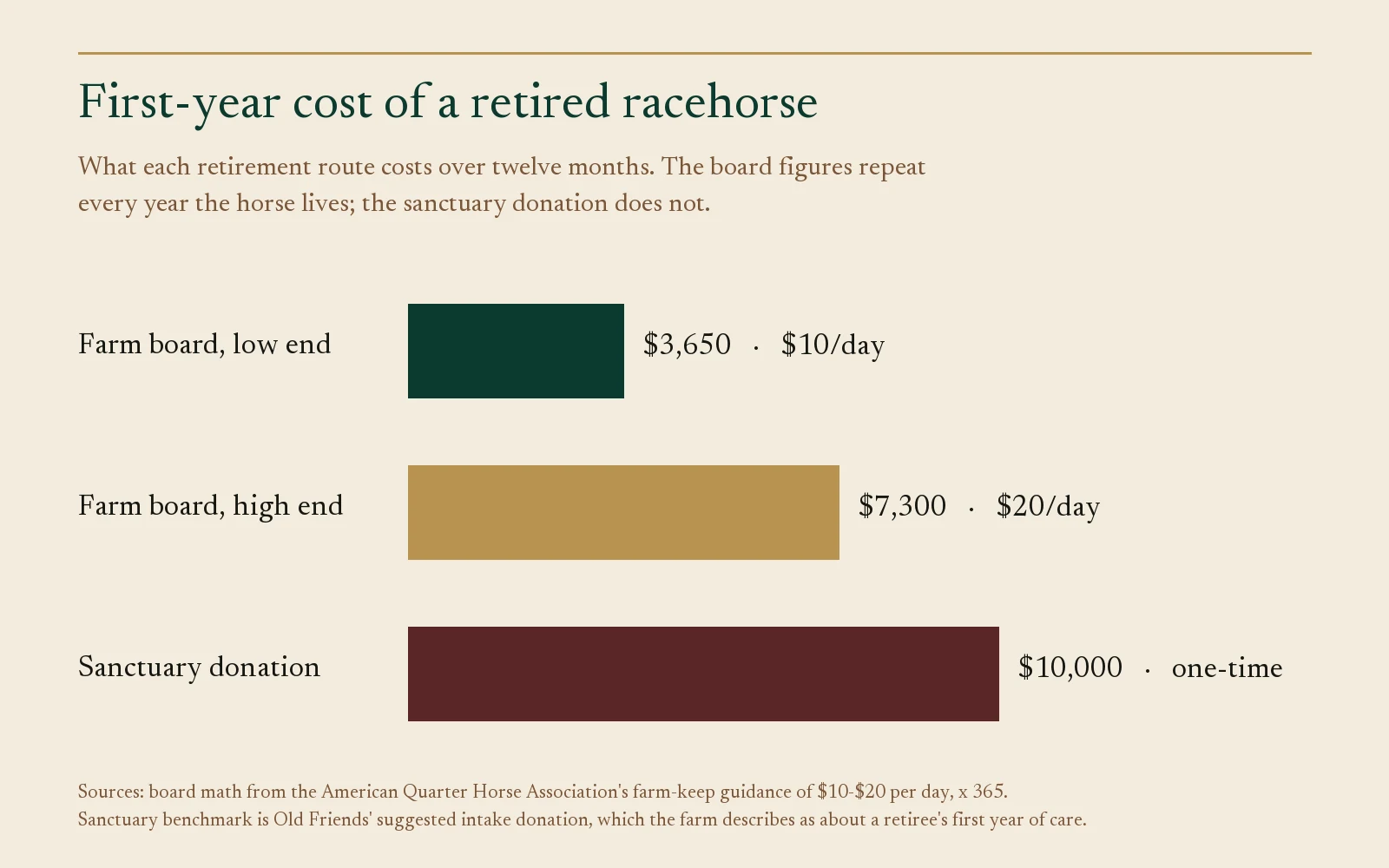
That is the comparison worth holding. The board columns repeat every year for as long as the horse lives; the sanctuary column does not repeat at all. An owner choosing on the monthly number alone is comparing a subscription to a purchase and reading the subscription as cheaper.
A retirement cost checklist for owners
The work that makes retirement affordable happens while the horse is still racing. Five steps, in order:
- Read the aftercare clause before you buy in. If the agreement is silent on retirement, the decision belongs to whoever holds control, not to you.
- Price the monthly carry against the horse’s likely lifespan, not against next year. Multiply the board figure by the years, then decide whether the number is one you can hold.
- Ask specific farms and organizations about criteria now. Intake standards and waitlists are knowable in advance and unknowable in a hurry.
- Fund a retirement reserve inside the partnership. A small monthly set-aside across all members costs less than any of the three routes costs one member alone.
- Confirm accreditation before the horse moves. Check the receiving organization against the Thoroughbred Aftercare Alliance’s accredited list, and check it yourself.

None of that requires a lawyer or a large budget. It requires deciding how the ending works while the horse is still winning, which is the same discipline that separates owners who model the monthly cost of a horse in training from owners who discover it.
Frequently asked questions
How much does it cost to retire a racehorse?
Retiring a racehorse costs either about $300–$600 a month indefinitely on owner-paid farm board, a suggested one-time donation of around $10,000 at a lifetime sanctuary such as Old Friends, or the board you keep paying while an accredited adoption organization works through its waitlist. The monthly route has the smallest number and no end date; the sanctuary route has the largest number and ends the obligation.
How much is retirement horse boarding per month?
Retirement horse boarding runs roughly $300 to $600 a month, working from the $10–$20 per day the American Quarter Horse Association puts on basic farm keep. Region, care level, and whether the horse lives out or comes in at night all move the figure, and a farm quoting well below that range is usually quoting self-care.
Who pays for racehorse retirement?
Donors pay for most of it. The Thoroughbred Aftercare Alliance has granted more than $40.7 million to accredited organizations since 2012, funded by industry contributions and fundraising rather than by purses. An individual owner pays only what the partnership agreement requires, which in many agreements is nothing — and that silence is why the charitable system carries the load.
Is pasture board enough for a recently retired racehorse?
Not immediately. A horse straight out of a racing barn has been stalled, grain-fed, and in hard work, and needs a letdown period before full-time turnout suits him. Most farms transition a new retiree gradually rather than putting him out on grass the week he arrives, and the transition months bill at board rates whether or not the horse is doing anything.
Have a question this piece didn’t answer? We’re building Race Horse Ownership 101 to give prospective owners the straight numbers the industry tends to round off. Start here for the honest version.
— Race Horse Ownership 101
About the Author

Calvin Johnson is a Thoroughbred racehorse owner, day trader, and independent racing analyst with more than a decade of firsthand ownership experience. He has participated in nearly every common structure in horse racing — fractional platform shares, traditional syndicates, LLC partnerships, claiming ventures, and outright ownership — across more than two dozen horses. Calvin writes about racehorse ownership the same way he approaches markets: by studying risk, incentives, fees, and whether the people controlling the deal are aligned with the investors behind it.
- Calvin Johnsonhttps://racehorseownership101.com/author/calvin-johnson/

- Calvin Johnsonhttps://racehorseownership101.com/author/calvin-johnson/

- Calvin Johnsonhttps://racehorseownership101.com/author/calvin-johnson/

- Calvin Johnsonhttps://racehorseownership101.com/author/calvin-johnson/
