The Thoroughbred Aftercare Alliance (TAA) is a Lexington, Kentucky nonprofit that accredits, inspects, and funds the organizations that take racehorses after their last race — it does not take horses itself. The TAA has granted more than $40.74 million to accredited organizations since 2012, and its most recent reported cycle distributed $4.7 million among 86 accredited organizations, up from $1 million among 23 at inception. Accreditation is not a badge an organization buys. It requires an application, facility inspections at every site housing Thoroughbreds, and adherence to a five-part Code of Standards, with re-accreditation on a recurring cycle and random inspections in between. For an owner, the practical meaning is narrower than most people assume: accreditation tells you a facility was inspected. It does not tell you your horse has a place there.
The honest answer, in three lines
- The TAA accredits and funds aftercare organizations. It is not a rescue, an adoption agency, or a placement service for your individual horse.
- Accreditation is a facility-and-governance audit against a published Code of Standards. It is not a guarantee of capacity, and it is not a guarantee about where the horse goes after its next owner.
- The accredited roster is re-set every year. Verify an organization on the TAA’s current list on the day you hand the horse over, rather than from a claim made months earlier.
The short answer: what the TAA is, and what it isn’t
The Thoroughbred Aftercare Alliance is an accrediting and grant-making body, founded in 2012 and based in Lexington, Kentucky, that inspects aftercare organizations against a published Code of Standards and distributes industry-wide funding to the ones that pass. It holds no horses of its own. When a racing organization, a sale company, or a syndicate says a retired horse “went to an accredited aftercare organization,” the TAA is the body that did the accrediting — a farm, a retraining program, or a sanctuary did the taking. That distinction is the single most common misreading I see among owners approaching retirement for the first time, and it changes what you should be asking for. You are not asking the TAA to take your horse. You are asking a specific accredited organization whether it has room, and using accreditation as evidence that the organization has been inspected.
Imagine your colors on the horse at the front.
Not a bet. Not a ticket. Yours. Thousands of everyday fans own a piece of a racehorse. The free guide is how they started.
The industry consensus on the TAA’s role is straightforward and worth stating plainly before adding anything to it: it is the sport’s central aftercare accreditation body, its standards are public, and its inspections are real. Where the institutional description stops short is on the owner’s side of the transaction — what accreditation obliges an organization to do for your horse, and what it obliges you to keep doing after the trailer leaves.
How TAA accreditation actually works
TAA accreditation requires a written application, on-site inspection of every facility that houses Thoroughbreds for the organization, and demonstrated compliance with a Code of Standards covering five areas. Organizations are re-accredited on a recurring cycle rather than permanently, with random inspections between cycles to confirm standards are held continuously. This is the part of the system that does real work for an owner: it means a plaque on a barn wall reflects somebody having walked the barn.
The five areas are broad by design, because accredited organizations do different jobs. A retraining program that moves horses into second careers and a sanctuary that provides permanent care are held to the same governance and welfare standards, but they are not doing the same work — which is why matching your horse to the right kind of accredited organization matters more than finding any accredited organization.
The five areas the TAA Code of Standards covers
| Code of Standards area | What it governs | What an owner can infer |
|---|---|---|
| Operations | Governance, financial controls, organizational record-keeping | The organization is run as an accountable entity with financial controls |
| Education | Staff and volunteer knowledge, training practices | The people handling your horse have been assessed against a standard |
| Horse health care management | Veterinary and farrier protocols, health record-keeping | There is a documented care standard your horse enters into |
| Facility standards and services | Physical premises, housing, turnout, safety | Every site holding Thoroughbreds has been physically inspected |
| Adoption policies and protocols | How horses are placed, screened, and tracked onward | There is a stated process for where the horse goes next — read it |
The last row is the one to read closely. Adoption policies and protocols are where an organization states what happens on the second transfer — whether it retains a right of first refusal, whether it follows up, and whether it can take the horse back. Two accredited organizations can both pass this standard while having very different answers, and the answer is the thing that determines whether your horse is traceable in three years.
What the TAA actually funds
The TAA distributed $4.7 million to 86 accredited organizations in its most recent reported grant cycle, against roughly $1 million to 23 organizations when it started in 2012. Cumulatively it reports more than $40.74 million granted since inception, to a network its 2025 announcements describe as covering approximately 20,000 Thoroughbreds retrained, retired, and rehomed across roughly 175 to 180 facilities.
TAA annual grants, 2012 versus 2025
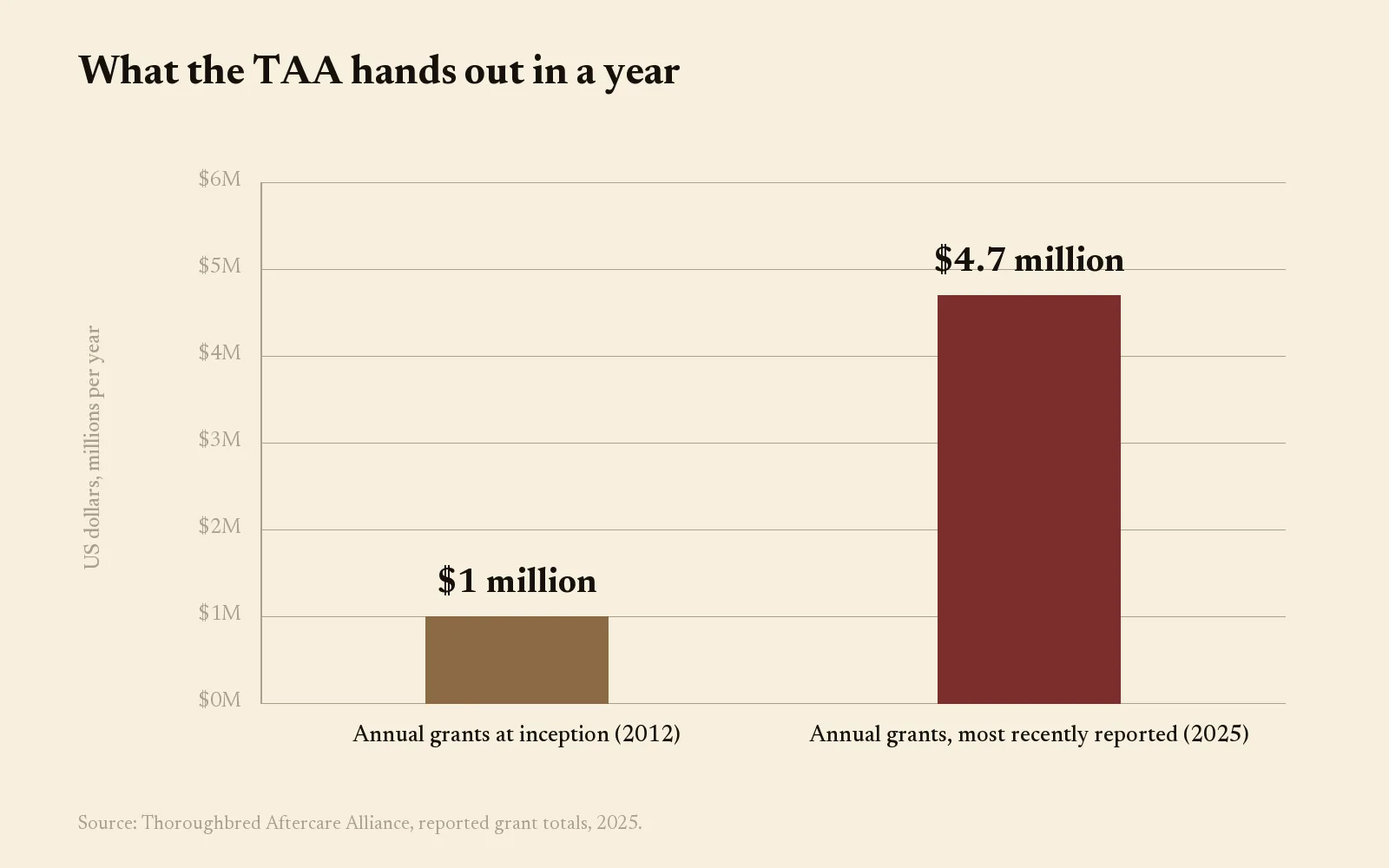
Divide those figures and the scale of the safety net becomes clearer than any of the announcements make it. At $4.7 million across 86 organizations, the average grant is roughly $54,650 per organization per year. Across the program’s life, $40.74 million against approximately 20,000 horses works out to about $2,000 per horse — arithmetic on the TAA’s own published figures, not a TAA statistic.
Two limits on that number, and both matter. The horse count is cumulative across more than a decade while the grant total is also cumulative, so the ratio describes the program’s history rather than any single year. And accredited organizations raise most of their own money; TAA grants supplement operating budgets rather than funding a horse’s care. Set $2,000 against what a year of board, feed, and veterinary attention costs and the conclusion is not that the TAA is failing — it is that the TAA was never designed to pay for your horse’s retirement. Our breakdown of what it costs to retire a racehorse is the number that actually governs your decision.
Accreditation is an inspection regime, not an endowment. It tells you the barn was checked. It does not tell you the bills are paid.
What accreditation covers, and what stays your responsibility
TAA accreditation certifies the organization, not the outcome for your individual horse — which means several obligations owners assume have transferred have not. The gap is not hidden; it is simply not the thing the TAA’s own materials are written to explain, because their job is to describe a standard rather than to advise a seller.
TAA accreditation: covered versus still yours
| What accreditation does establish | What it does not establish |
|---|---|
| The organization met a published Code of Standards | That the organization has space for your horse right now |
| Every facility housing Thoroughbreds was inspected | That your horse will stay at the facility you inspected |
| Documented veterinary and farrier protocols exist | That a specific treatment plan for your horse’s condition exists |
| A stated adoption and placement process exists | That the horse is tracked after its next owner takes it |
| The organization received TAA grant funding | That the grant covers your horse’s cost of care |
| The organization was accredited as of a given year | That it is accredited today — the roster is re-set annually |
Consider an owner whose four-year-old bows a tendon in the spring and is retired sound enough to ride but not to race. She finds an accredited retraining program two states away, likes what she reads, and ships the horse in June. She has done more diligence than most owners do. What she has not done is ask whether the program retains a right of first refusal on the next sale — and eighteen months later, when the horse changes hands again, she has no standing and no notification. Nothing in that sequence involves the organization failing its accreditation. The gap was in what she asked before the trailer left.
Your horse’s three realistic exits
Most retiring racehorses leave through one of three routes — an accredited aftercare organization, a private sale or direct rehome, or a sanctuary placement — and only the first carries any inspection regime at all. The route most owners actually take is the second, which is worth being honest about: the private rehome is fast, it is free, and it is the one with no independent record of where the horse ends up.
Three exits for a retiring racehorse, compared
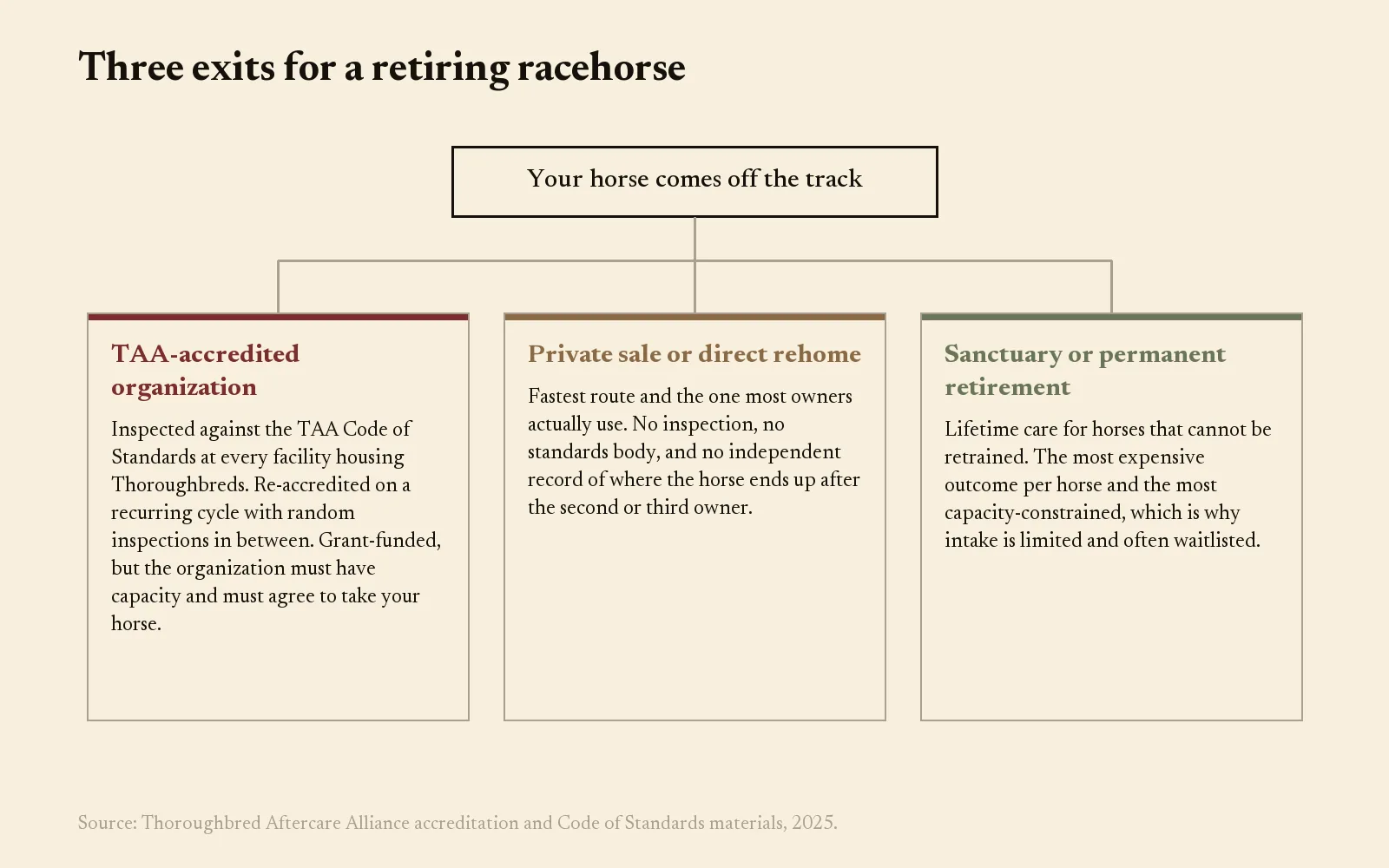
The accredited route is harder to use than it looks, and the reason is capacity. An accredited organization has to have a stall, a budget line, and a plausible second career for the specific horse you are offering. A sound horse with a rideable temperament is a very different proposition from one that needs lifetime pasture care — and horses in the second group are exactly the ones whose owners find the accredited network full. That is the same structural pressure that makes it so hard to sell a retired racehorse, and it shows up months earlier than most owners plan for.
Soundness drives which door is open. A horse managing a chronic condition such as laminitis belongs in a sanctuary conversation from the outset, and starting that conversation early is the difference between a placement and a scramble.
How to find and verify a TAA-accredited organization
The TAA publishes its current accredited-organization directory on its own site, and that live list is the only verification that means anything on the day you transfer a horse. An operator’s claim, a press release, and a farm’s own website are all downstream of it, and all can lag it by a year. Because roughly 49 organizations were accredited or re-accredited in a single 2025 cycle out of a network of 86 to 87, the roster genuinely moves year to year. An organization accredited in 2023 is not necessarily accredited now.
The pre-handoff verification checklist
| Step | What to do | What a bad answer looks like |
|---|---|---|
| 1. Confirm current accreditation | Find the organization on the TAA’s live accredited directory, today | “We’re TAA accredited” with no listing you can find |
| 2. Confirm capacity in writing | Get a named contact confirming they will accept this specific horse | A general invitation to apply, treated as acceptance |
| 3. Read the adoption protocol | Ask for their written placement and follow-up policy | No written policy, or one that ends at the first adopter |
| 4. Ask about right of first refusal | Establish whether they can take the horse back later | “That’s not something we track” |
| 5. Match the program to the horse | Confirm they take horses with your horse’s soundness profile | A retraining program accepting a pasture-sound horse without comment |
| 6. Document the transfer | Written transfer of ownership, plus complete veterinary records | A handshake and a shipping date |
Step four is the one owners skip. A right of first refusal is the only mechanism that keeps you connected to the horse after the next owner, and it costs nothing to ask for at the point of transfer — while being effectively impossible to add afterward.
How to check an operator’s aftercare claim
A syndicate or partnership that markets an aftercare commitment should be able to name the accredited organization it uses, and that name is independently checkable against the TAA directory in under a minute. Aftercare language appears in a great deal of ownership marketing because it answers a real anxiety honestly held by prospective owners. The language is easy to write; the named relationship is not. The pre-signing workflow — clause types, the TAA directory check, and the difference between a named partner and a placement obligation — is in how to verify a syndicate’s accredited-aftercare claim.
My view is that three questions separate a real commitment from a marketing line, and none of them are hostile to ask before you sign:
- Which organization, by name? A commitment that cannot name its aftercare partner has a sentiment where an arrangement should be.
- Who pays, and how much? Aftercare has a cost. Ask whether it comes from the partnership’s budget, from the operator, or from the horse’s residual sale value.
- What happens if the horse is not rideable? Retraining placements are much easier to arrange than lifetime care. An operator whose plan only works for sound horses does not have a plan.
None of this requires assuming bad faith. Plenty of operators support accredited aftercare genuinely and can answer all three questions in a paragraph. The point is that you can check, in public, before you commit money — and that checking is the cheapest diligence available to a prospective owner.
Common questions about the Thoroughbred Aftercare Alliance
What is Thoroughbred aftercare?
Thoroughbred aftercare is the organized system of retraining, rehoming, and permanent-retirement care for racehorses after their racing careers end. In North America it runs largely through nonprofit organizations — retraining programs, adoption farms, and sanctuaries — funded by a mix of their own fundraising, industry contributions, and grants from bodies such as the TAA. Roughly 175 to 180 facilities operate within the TAA-accredited network alone, and the accredited network is only part of the total picture, since many horses are rehomed privately outside it entirely.
Does the TAA take horses directly?
No. The Thoroughbred Aftercare Alliance accredits, inspects, and grants funding to aftercare organizations; it does not own facilities or accept horses itself. An owner retiring a horse contacts an accredited organization directly, and the TAA’s role from the owner’s side is providing the directory and the assurance that the organization has been inspected against the Code of Standards.
How many organizations are TAA accredited?
The TAA’s 2025 announcements put the accredited network at 86 to 87 organizations across approximately 175 to 180 facilities in North America, with 49 organizations accredited or re-accredited in the cycle announced in October 2025, per BloodHorse’s reporting on that cycle. The figures move between announcements because accreditation runs on cycles rather than being permanent, which is precisely why an owner should check the current directory rather than rely on a remembered count.
Is TAA accreditation permanent?
No. Accredited organizations are re-accredited on a recurring cycle and are subject to random inspections between cycles to confirm the Code of Standards is upheld continuously. For an owner this has one practical consequence: verify accreditation on the TAA’s current directory at the time of transfer rather than trusting a claim, a plaque, or an older press release.
What to read next
The TAA is one component of a system that starts long before a horse retires, and understanding the whole of it is what turns a scramble into a plan. Our guide to what happens to your racehorse after racing covers the aftercare system end to end, including the second-career pathways an accredited retraining program is trying to reach. From there, the cost of retiring a racehorse gives you the number to plan against, and why retired racehorses are so hard to sell explains the market pressure behind every full waiting list you will encounter.
If you are still deciding whether to buy in at all, budget for the exit before you budget for the purchase. The owners who place horses well are the ones who priced retirement into the arithmetic at the start.
About the Author

Calvin Johnson is a Thoroughbred racehorse owner, day trader, and independent racing analyst with more than a decade of firsthand ownership experience. He has participated in nearly every common structure in horse racing — fractional platform shares, traditional syndicates, LLC partnerships, claiming ventures, and outright ownership — across more than two dozen horses. Calvin writes about racehorse ownership the same way he approaches markets: by studying risk, incentives, fees, and whether the people controlling the deal are aligned with the investors behind it.
- Calvin Johnsonhttps://racehorseownership101.com/author/calvin-johnson/

- Calvin Johnsonhttps://racehorseownership101.com/author/calvin-johnson/

- Calvin Johnsonhttps://racehorseownership101.com/author/calvin-johnson/

- Calvin Johnsonhttps://racehorseownership101.com/author/calvin-johnson/