Buying racehorse shares at the 50% level costs far more than the number on the listing. A half-interest advertised at $1.5 million implies a $3 million horse, and your share of keeping that horse in training at a major American track starts at about $25,000 a year — roughly $2,100 a month, before insurance on a seven-figure animal and before a single unplanned bill. The whole-horse figure underneath that is the New York Thoroughbred Horsemen’s Association’s floor of at least $50,000 a year for a horse at a major track. What the sticker price will not tell you is whether half the horse buys you any say in what happens to it. On an even split, the honest answer is usually no.
The short version
- The sticker is the small number as a ratio and the large one in dollars. At least $25,000 a year of carry follows a $1.5 million half-interest, and no clause caps it.
- Fifty percent is not control. An even split with no tie-breaker gives each half a standing veto; one with a managing-owner clause gives you none of the racing decisions.
- The buyer at $1.5 million can end up with less filed disclosure than the buyer at $206, because a private half-interest sale carries no offering circular.
What a flash-sale racehorse share offer actually is
A flash-sale racehorse share offer is a time-limited listing of a stake in a horse that is already racing, sold either as a registered security or as a private co-ownership interest — and the two give the buyer very different protection. Fractional ownership itself is a legitimate and now-ordinary way into the sport: pooling turns a six-figure animal into a decision a lot of people can make, and what fractional horse ownership actually means is the same in a flash sale as it is on any other day. The flash sale changes one thing only, and it is the thing that matters most: how long you have to read.
The Sport of Kings has a side entrance. Here’s the key.
Regular people own racehorses — together, in partnerships — and stand in the paddock like they were born there. The free guide shows you the way in.
Two structures get sold under the same banner, and a listing rarely says which one you are looking at.
- A registered offering. A company owns the horse, and the platform sells interests in that company. Most of these are registered with the SEC under Regulation A, which means a filed offering circular exists and you are entitled to read it.
- A private transfer of a co-ownership interest. An existing owner sells you a defined percentage of the animal itself. There is a bill of sale, a co-ownership or partnership agreement, and no regulator in the room.
At micro-share prices the first structure is almost always the one on offer. At a half-interest in a graded-stakes-placed runner, the second becomes far more likely, because a single large tranche sold to one buyer is not a public offering. That inversion runs through everything below.
The $1.5 million headline: what that number actually buys
A $1.5 million price on half a racehorse buys a 50% ownership interest and nothing else — it implies a $3 million valuation for the whole animal, and it includes no part of the training, veterinary or insurance bills that begin the day the transfer clears. Whether it includes anything beyond the animal is a question the listing has to answer in writing: a share of the operating reserve, a share of any breeding rights already sold, the balance of an insurance policy already in force, and any prize money the horse has earned but not yet been paid. Each of those is worth real money and each is separately negotiable, which is why silence on them is not a rounding error.
The cleanest way to see what a tranche size does is to hold the horse constant and change only the slice. Below is the same $3 million runner bought two ways.
A 50% stake and a 5% share on the same horse
| What you are buying | 50% at $1,500,000 | 5% at $150,000 |
|---|---|---|
| Entry price | $1,500,000 | $150,000 at the same valuation; an offered 5% usually prices above pro rata, because the raise also funds sourcing and offering costs |
| Your share of annual keep | At least $25,000 | At least $2,500 |
| Mortality insurance | Your half of a privately quoted premium on a seven-figure horse | Your twentieth, usually folded into the offering price |
| Unplanned bills | Your half of every one, with no cap | Limited in practice by the size of the stake |
| Decisions you vote on | Whatever the agreement says — possibly all of them, possibly none | None, in almost every fractional offering |
| Getting out | Find a buyer for half a racehorse, or wait for the horse to sell | Wait for the horse to sell; limited or no secondary market |
What you still owe after the sale closes
The bill that follows a 50% purchase starts at roughly $25,000 a year, because a thoroughbred in training at a major American track costs at least $50,000 a year to keep and half of that is yours whether the horse runs or not. The anchor line is the trainer’s day rate, which runs from about $50 a day at a smaller track to around $120 at a major one according to the owner-cost estimates published by Thoroughbred OwnerView, the resource run jointly by The Jockey Club and the Thoroughbred Owners and Breeders Association. Veterinary work, the farrier, shipping, and jockey and entry fees on race days bill on top of it.
A graded-stakes-placed horse sits at the expensive end of every one of those lines. It is stabled at a major track, it ships to compete, and it is being managed toward races that carry entry fees rather than toward the cheapest available spot. I would treat the published floor as a floor and nothing more.
The year-one bill on a half-interest, line by line
| Line | Whole horse, per year | Your half | Basis |
|---|---|---|---|
| Trainer’s day rate | $18,250–$43,800 | $9,125–$21,900 | $50–$120 a day over 365 days, per Thoroughbred OwnerView |
| Vet, farrier, shipping, entry and jockey fees | Billed on top of the day rate | Your half of each | Thoroughbred OwnerView |
| All-in at a major track | At least $50,000 | At least $25,000 | New York Thoroughbred Horsemen’s Association |
| Mortality insurance | Not quotable from published rate cards above $100,000 of insured value | Your half of whatever is actually quoted | Allen Financial published thoroughbred rate card; rates fall as value rises |
| Surgery, layup, and anything unplanned | No budget line exists | Your half, with no cap | — |
Insurance is the line first-time half-owners miss, and it is the one I would price before anything else. Mortality cover on a racing thoroughbred has historically run at around 5% of the insured value a year — the Thoroughbred Owners of California owner handbook puts the rate for racehorses at “around 5 percent of the value insured,” with better numbers on higher-valued horses. The published carrier rate cards stop at $100,000 of insured value, so nobody publishes the number for a seven-figure runner. What is certain is the shape of it: the rate falls, the premium does not, and on a $3 million valuation the annual premium is a five-figure sum before you halve it. Ask for the policy and the renewal quote in writing, not the reassurance.
Fewer than 8 to 10 percent of racehorses generate enough in purse money to cover their costs, per the Thoroughbred Owners and Breeders Association. A graded-stakes record moves a horse toward the good end of that distribution. It does not move the horse out of it.
Year-one carry, measured against what you paid
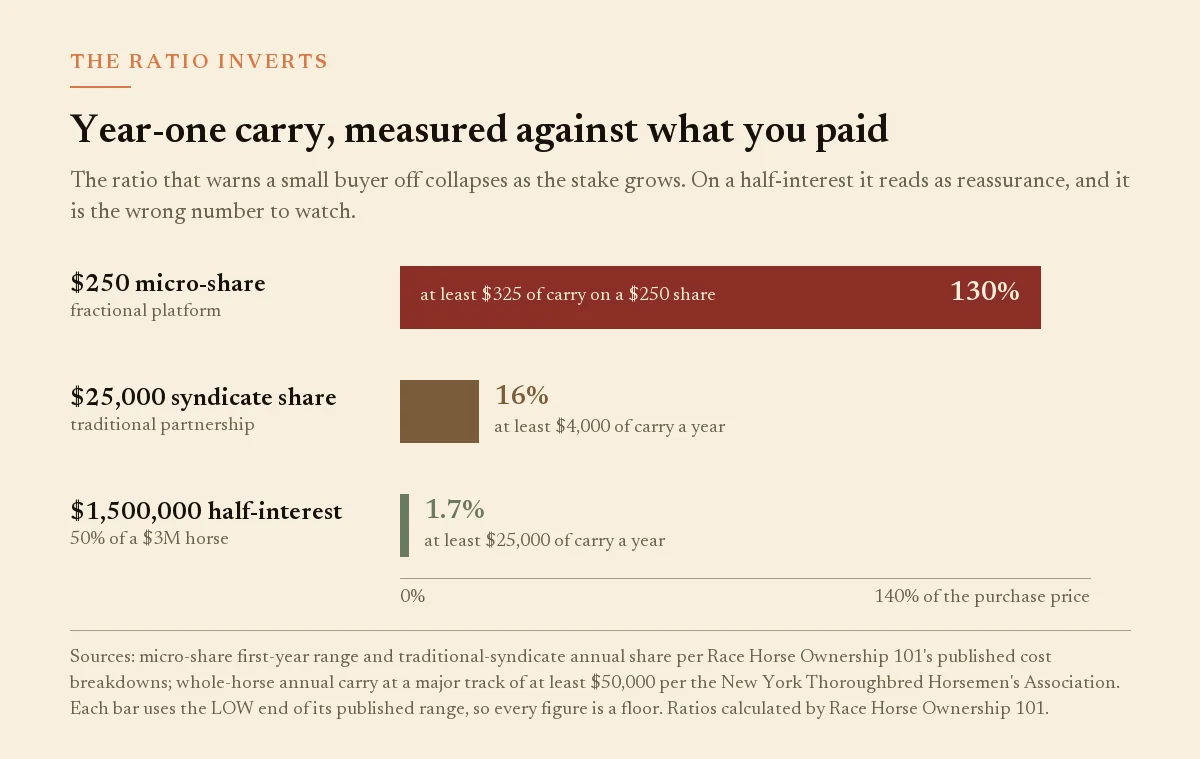
That chart is the argument of this piece in one frame. Everything the publication has written about small shares — including our own work on what $100 shares actually cost you — turns on the ratio between the sticker and the carry, because at $250 the carry is several times the price and the buyer never sees it coming. At $1.5 million that ratio reads as comfort. It should not. The percentage falls because the denominator grew, and the number that will actually arrive in your mail is larger than it has ever been, with nothing in the structure to stop it growing.
Fifty percent is the worst number in a co-ownership agreement
A 50% stake gives you either a permanent veto or no vote at all, because an even split has no majority in it — and whichever way the agreement resolves a disagreement is the only thing that decides which of those two you bought. This is the part of a large-tranche purchase that almost never appears in the listing, and it is worth more attention than the price.
Run the two outcomes an even split can produce.
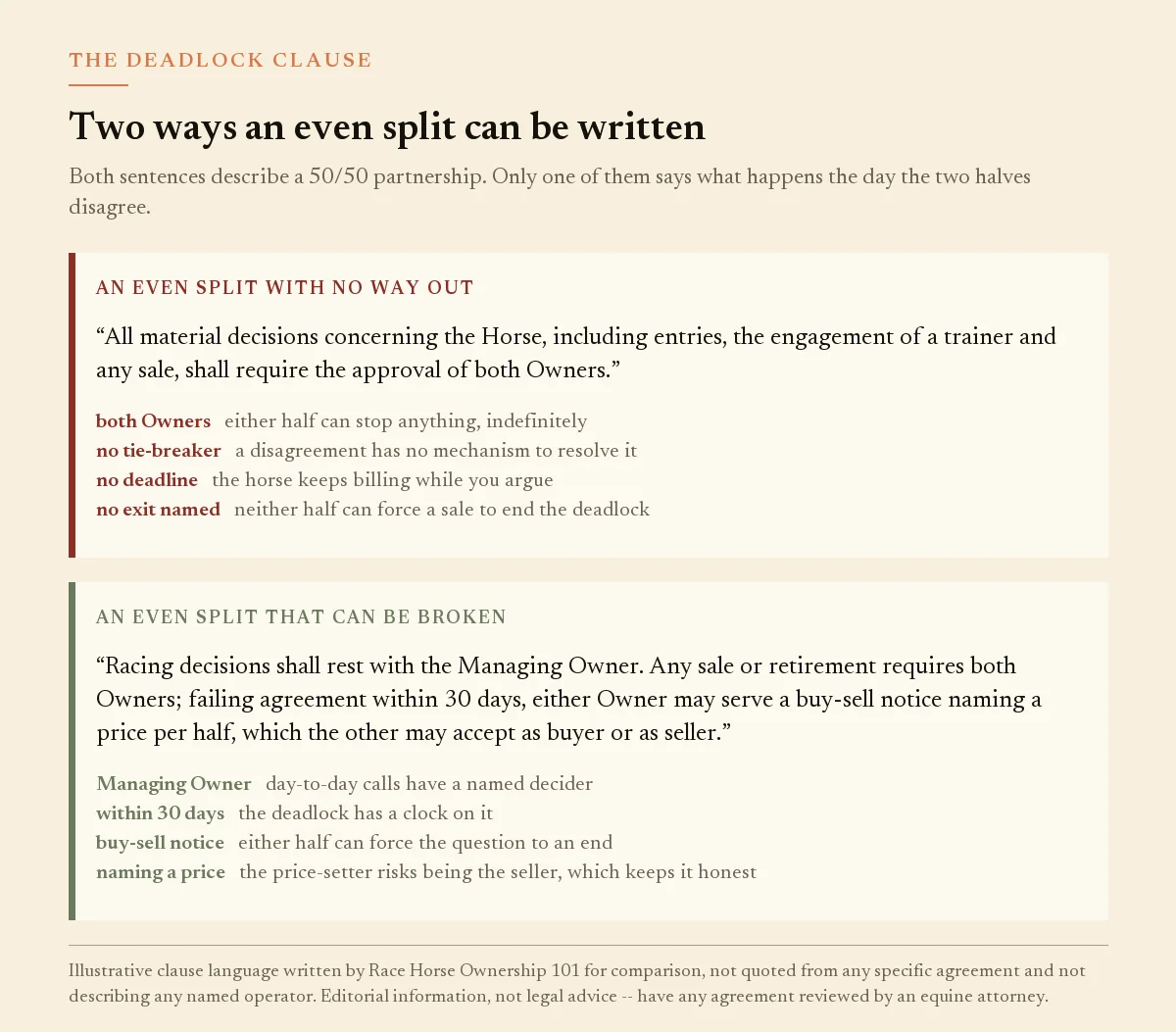
- Both owners must approve material decisions. Neither of you can enter the horse, change trainers, authorize surgery or accept an offer without the other agreeing. That reads as protection until the day you disagree, at which point the horse continues to bill both of you while nothing can be decided.
- A managing owner holds the racing decisions. The deadlock disappears and so does your say. You have paid half the purchase price for none of the calls, and the agreement is working exactly as drafted.
Both versions are common and both are defensible. Neither is what a buyer paying seven figures usually assumes they are getting.
Consider an owner who buys half of a stakes-placed four-year-old in a weekend sale, intending to point the horse at a specific race the following spring. The managing partner wants a summer campaign on a different circuit. Nothing improper has happened, nobody has broken the agreement, and there is no mechanism in it to settle the question. The horse trains on, the bills arrive at both addresses, and the disagreement is resolved eventually by whoever gets tired first. The clause that would have prevented this costs nothing to include and is absent from a great many agreements.
An even split is the only ownership percentage where both parties can be right and nothing can happen.
The fix is a tie-breaker, and it is standard drafting in every other kind of two-party venture: a managing owner for day-to-day calls, a deadline on disputed decisions, and a buy-sell provision that lets either side name a price at which they are equally willing to buy or to sell. Our guide to what is actually in a racehorse syndicate or partnership agreement covers the clause families in full; on an even split, the deadlock clause is the one to find first. The same question governs the end of the horse’s career, which we cover separately in who decides when a syndicate racehorse retires to stud.
Two ways an even split can be written
At $1.5 million you may get less disclosure than at $206
A $206 fractional share usually arrives with an SEC-qualified offering circular; a privately negotiated half-interest usually arrives with a bill of sale and whatever the seller volunteers. That inversion sits at the center of large-tranche buying, and it surprises people who assume that spending more buys more protection.
Under Regulation A, a company can offer up to $75 million in any 12-month period under Tier 2, and the buyer of a $206 share gets all of the following whether they read it or not.
- An offering statement filed on Form 1-A, containing the offering circular.
- Review and qualification of that circular by SEC staff.
- Financial statements audited by an independent accountant.
- Annual, semiannual and current reports filed on an ongoing basis.
Our cornerstone guide on how to read a syndicate prospectus like an insider is a guide to reading exactly that document, and the reason it is worth reading is that somebody was legally obliged to get it right.
A private sale of a half-interest sits outside all of it. There is no offering circular, no qualified risk-factor section, no audited financials and no continuing reports — there is a contract, and the diligence is yours to generate. That is not a scandal; it is how private asset sales work in every market. It does mean the first question about a flash-sale listing is a structural one rather than a financial one, because the answer determines what you are entitled to be shown. If the answer is a private sale, the bill of sale and the co-ownership agreement are the entire disclosure package, and a generic template leaves out most of what a racehorse buyer needs.
Exit: who actually buys half a racehorse?
The exit on a 50% racehorse interest is narrower than the exit on a micro-share, because very few buyers are willing and able to write a seven-figure check for half an animal they will not control. Fractional platforms at least have a large pool of small buyers and, in some cases, a limited secondary market. A half-interest has neither. In practice there are three doors, and a buyer should know which ones the agreement actually opens.
Here are the three, and what each one depends on.
- Your co-owner. This is why a buy-sell provision matters so much: without one, the person most likely to buy your half has no obligation to name a price and every reason to wait.
- A third party. Subject to whatever right of first refusal or transfer-consent clause the agreement contains, and a consent clause with no reasonableness standard is effectively a lock.
- The horse itself being sold. At a price nobody can predict, since what a racehorse is actually worth moves with form, soundness and the breeding market rather than with what you paid.
If the horse is retired rather than sold, the money question becomes an aftercare question, and TAA accreditation is the standard worth writing into the agreement before you need it.
A lease is worth mentioning as the structure people reach for once the illiquidity lands, and it answers a different question than ownership does — our explainer on what a lease interest actually means sets out where it fits.
Red flags in a flash-sale share listing
| What the listing does | What it usually means | What to ask for |
|---|---|---|
| Quotes a price with no annual cost figure anywhere | The carry has not been calculated for you, and may not have been calculated at all | A written 24-month budget from whoever will send the bills |
| Runs a countdown timer | The deadline is a sales instrument, not a feature of the horse | The agreement, and enough time for a lawyer to read it |
| Describes the stake as an investment or projects a return | Either a securities-compliance problem or a marketing overreach | The filed offering document, if one exists |
| Will not say whether this is a registered offering or a private sale | You cannot tell what disclosure you are owed | A direct answer, in writing, before anything else |
| Names no trainer, or will not confirm the trainer stays | The economics you were shown may not be the economics you get | The current day rate and the trainer-change clause |
| Silent on veterinary history and current insurance | The two largest sources of unplanned cost are undisclosed | The vet records, the policy, and the renewal quote |
What to do before the timer runs out
Five checks decide whether a flash-sale tranche is worth answering, and each of them ends in a document rather than an impression. A check you cannot complete inside the window is itself the answer, which is the one genuine advantage a buyer has against a countdown clock.
The pre-purchase sequence, in order
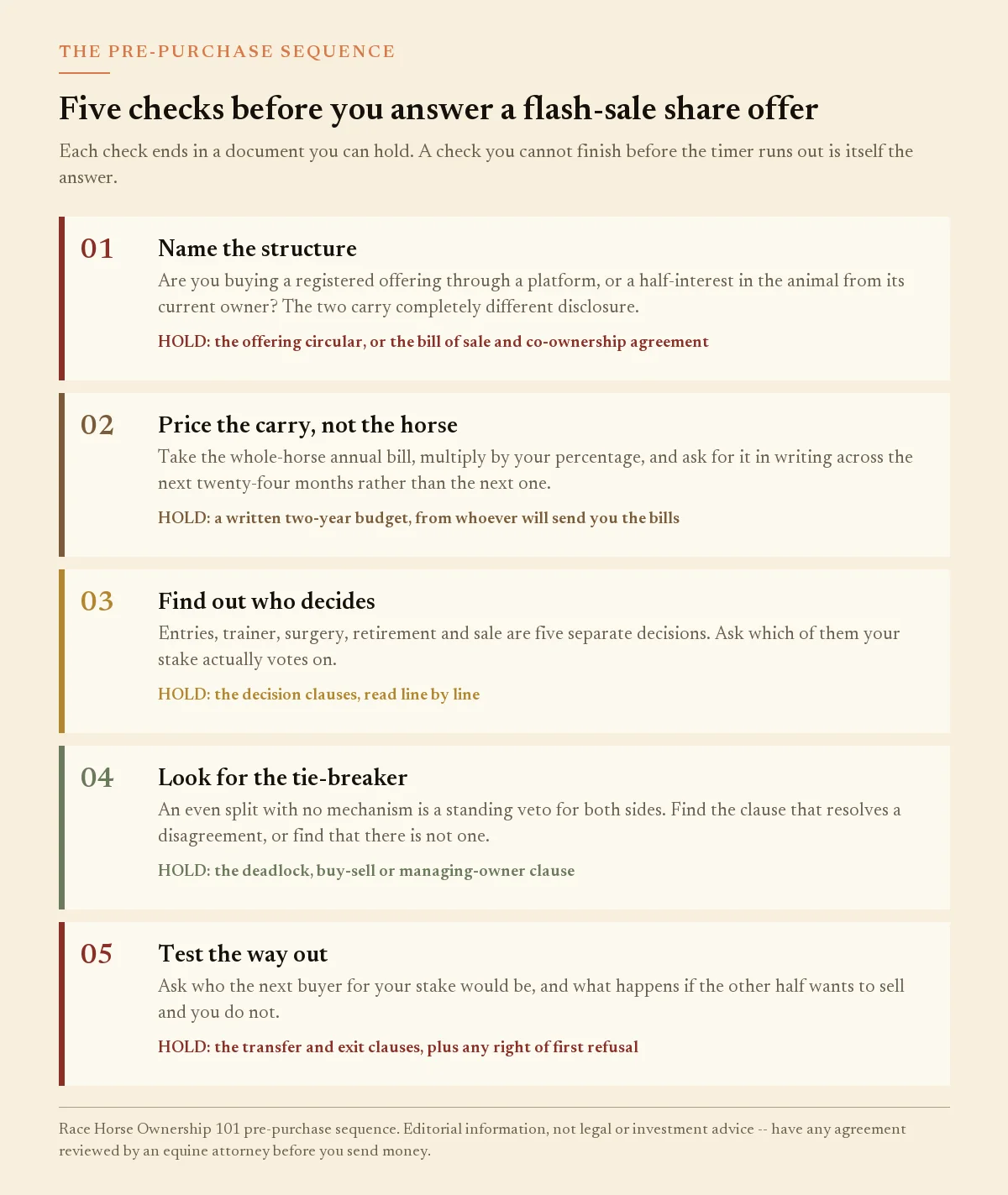
Eight questions to ask before you wire anything
- Is this a registered offering with a filed offering circular, or a private sale of an interest in the animal?
- What is the whole-horse budget for the next 24 months, in writing, and who prepared it?
- Does the price include a share of the operating reserve, earned-but-unpaid purse money, or any breeding rights already sold?
- Is the horse insured today, at what value, at what premium, and does the policy transfer?
- Which decisions does my 50% actually vote on — entries, trainer, surgery, retirement, sale?
- What happens if the two halves disagree, and is there a deadline or a buy-sell provision?
- Can I transfer my interest, to whom, and is anyone’s consent required?
- Why is the current owner selling half of a horse that is running well?
The eighth is the one I would ask first and listen to hardest. A good answer exists — an owner rebalancing after a large purchase, a partnership dissolving, an estate settling, a syndicator taking money off the table on a horse whose value has run ahead of its record. A vague answer on a seven-figure asset is information in itself.
Common questions about buying racehorse shares
Can you buy 50% of a racehorse?
Yes. A half-interest is a normal and long-established way to own a thoroughbred, and most racing partnerships are built from exactly this kind of divided interest. What differs from a micro-share is the paperwork: at 50% you are usually buying a co-ownership interest in the animal itself rather than a security in a company that owns it, which means the co-ownership agreement rather than an offering circular defines what you can do.
What does a 50% racehorse share cost per year?
Budget at least $25,000 a year, or roughly $2,100 a month, for a horse in training at a major American track — that is half of the at-least-$50,000 annual figure published by the New York Thoroughbred Horsemen’s Association. Insurance on a high-value horse sits on top of it, as does your half of any surgery, layup or other unplanned cost. None of those figures is capped by the agreement unless you negotiate a cap into it.
Does owning 50% of a racehorse give you control?
No — 50% is a minority of nothing and a majority of nothing, so control depends entirely on the agreement. If material decisions need both owners, each of you holds a veto and a disagreement can stall indefinitely. If a managing owner is named, that person makes the racing calls and your half-interest carries the cost without the decision. Find the deadlock and managing-owner clauses before you accept either arrangement.
Is buying racehorse shares a good investment?
Treat it as entertainment with an outside chance of upside rather than as an investment. Fewer than 8 to 10 percent of racehorses earn enough in purse money to cover their costs, per TOBA, and a large tranche does not change that base rate — it changes only how much of the shortfall is yours. Our independent answer on whether buying shares in a racehorse is worth it works through that question at every price point.
Can you sell a half-share in a racehorse?
Only if you find a buyer, and there is no posted market for one. The realistic buyers are your co-owner, a third party the agreement permits, or nobody until the horse itself is sold. A right of first refusal, a transfer-consent clause or the absence of a buy-sell provision can each narrow that further, which is why the exit clauses deserve reading before the price is agreed rather than after.
The honest answer
A 50% share in a good horse is a real thing to own, and for a buyer who can absorb the money it can be a genuinely good way to be in the sport at a level most owners never reach. The reason to slow down has nothing to do with the price. Two protections a small buyer takes for granted — a filed disclosure document, and a carry that stays small in absolute terms — both disappear at this end of the market, and whatever replaces them has to be negotiated into the agreement by you, before the timer expires. Price the carry at $25,000 a year and rising, find the deadlock clause, and ask why the seller is selling.
— Race Horse Ownership 101
About the Author

Calvin Johnson is a Thoroughbred racehorse owner, day trader, and independent racing analyst with more than a decade of firsthand ownership experience. He has participated in nearly every common structure in horse racing — fractional platform shares, traditional syndicates, LLC partnerships, claiming ventures, and outright ownership — across more than two dozen horses. Calvin writes about racehorse ownership the same way he approaches markets: by studying risk, incentives, fees, and whether the people controlling the deal are aligned with the investors behind it.
- Calvin Johnsonhttps://racehorseownership101.com/author/calvin-johnson/

- Calvin Johnsonhttps://racehorseownership101.com/author/calvin-johnson/

- Calvin Johnsonhttps://racehorseownership101.com/author/calvin-johnson/

- Calvin Johnsonhttps://racehorseownership101.com/author/calvin-johnson/