A racehorse bill of sale needs everything a generic equine template already has — parties, horse, price, signatures — plus five clauses those templates never carry: transfer of the Certificate of Foal Registration, the HISA owner-registration handoff, a lien representation, a veterinary condition that has to be satisfied before closing, and a paperwork deadline with a stated consequence. The Jockey Club charges no fee to record a transfer of ownership, and it advises buyers not to complete a purchase until the certificate has been transferred by the previous owner or assigned by the previous Certificate Manager. That sequence is where free templates fail racehorse buyers. A bill of sale can be entirely valid, signed by both sides, and still leave you holding a horse you cannot register in your own name or enter in a race.
🔑 The honest answer, up front
- A generic horse bill of sale covers the sale. It does not cover the registration — and in Thoroughbred racing the registration is what makes the horse yours on paper.
- The Jockey Club records ownership transfers for free and asks that the certificate never be mailed back. But it is the seller who has to sign or assign it, and the only moment you can insist is before you pay.
- A claim is not a private sale. In a claiming race there is no bill of sale at all — the rulebook moves the horse, on its own timing and its own conditions.
What an equine bill of sale actually does
An equine bill of sale is the document that transfers ownership of a horse and records the terms of that transfer: who sold, who bought, which animal, for how much, and what each side promised about it. It is a receipt and a contract at the same time. As a receipt it proves the sale happened on a date, for a price, between two named parties — which matters for insurance, for tax, and for anyone who later asks how you came to own the horse. As a contract it is the only place the promises live. If the seller told you the horse had never had a joint injection, that statement is worth something if it is written into the bill of sale and worth very little if it was said in a barn aisle. Nothing else in a private horse sale performs this job.
Imagine your colors on the horse at the front.
Not a bet. Not a ticket. Yours. Thousands of everyday fans own a piece of a racehorse. The free guide is how they started.
What it does not do is move the horse’s racing identity. That is a separate act, handled by a separate body, on the seller’s signature — and it is the part a template farm has no reason to know about.
When a racehorse purchase needs one — and when there isn’t one at all
A private sale, a bloodstock-agent purchase and a syndicate share buy-in all need a written bill of sale; a claim does not, because the racing rulebook moves the horse instead. Those four routes cover almost every way a first-time owner ends up with a runner, and only one of them hands you a document to negotiate.
- Private sale. Horse to horse, owner to owner, often at a training centre or farm. You draft the bill of sale, or the seller hands you theirs. This is the case with the most room to protect yourself and the most room to get it wrong.
- Agent-brokered purchase. The commission structure changes; the paperwork obligation does not. A bloodstock agent acting on your behalf should be producing a bill of sale for your signature, not a handshake and an invoice.
- Public auction. The sale company’s own conditions of sale govern, and they are printed in the catalogue. You are agreeing to their terms, not negotiating yours — read them before you raise a hand.
- Claiming. No bill of sale exists. You file a claim before the race and the transfer happens under the track’s rules.
The four routes and what each costs in money and control are laid out in our independent guide to buying a racehorse. This piece is about the paperwork that closes the deal on the two routes where you actually hold a pen.
What every equine bill of sale should include
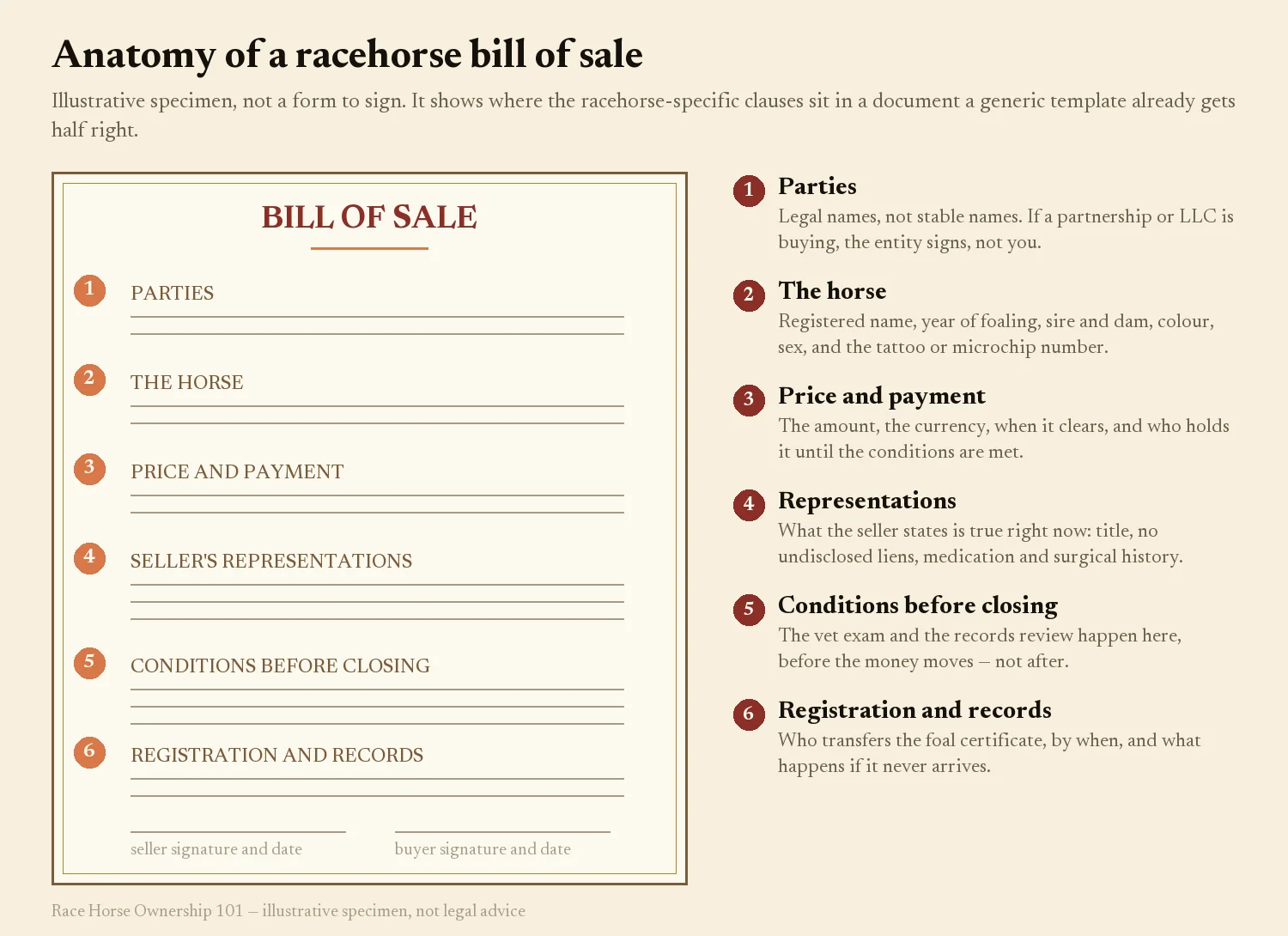
Every equine bill of sale is built from six blocks: the parties, the horse’s identity, the price and payment terms, the seller’s representations, the conditions that must be met before closing, and the signatures. Get these right and you have a competent horse sale document. The free templates handle roughly four of the six well, and the two they handle badly are the two that cost money when a deal goes wrong.
The six blocks a bill of sale is built from
| Block | What it has to contain | What goes wrong without it |
|---|---|---|
| Parties | Legal names and addresses of buyer and seller. If an LLC, partnership or stable is buying, the entity is named and an authorised person signs for it. | A stable name is not a legal person. Signing personally when the entity is the buyer blurs who actually bought the horse — a question you do not want opened later. |
| The horse | Registered name, year of foaling, sire and dam, colour, sex, and the lip tattoo or microchip number. | "One bay filly, four years old" identifies several thousand horses. Identity disputes are unwinnable without it. |
| Price and payment | The amount, the currency, when funds clear, and who holds them until conditions are satisfied. | Money that has already moved is money you are asking for back. That is a materially weaker position. |
| Seller’s representations | What the seller states is true now: that they hold title, that no undisclosed liens exist, and the horse’s known medication and surgical history. | An assurance given in a barn aisle leaves no record. If it is not written down, there is nothing to point at later. |
| Conditions before closing | The veterinary examination, the records review, and the registration transfer — each with a deadline and a stated outcome if it fails. | A condition satisfied after payment is not a condition. It is a hope. |
| Signatures and date | Both parties, dated, with counterparts permitted if you are not in the same room. | A deadline measured from the date of signing cannot be counted if nobody wrote the date down. |
Knowing what you are buying matters as much as knowing what you are signing. If the horse is young enough that its label is doing work in the negotiation, our breakdown of the foal, yearling and two-year-old stages covers what each stage actually tells you.
What a racehorse bill of sale has to add
A racehorse bill of sale adds five clauses a generic equine template omits: the foal-certificate transfer, the HISA owner registration, a lien representation, a veterinary condition tied to closing, and a deadline with a consequence attached. Each exists because a Thoroughbred in training is not simply an animal you now own — it is a registered, regulated athlete whose right to race depends on records held by two organisations that were not party to your sale.
The foal certificate is the thing that actually moves
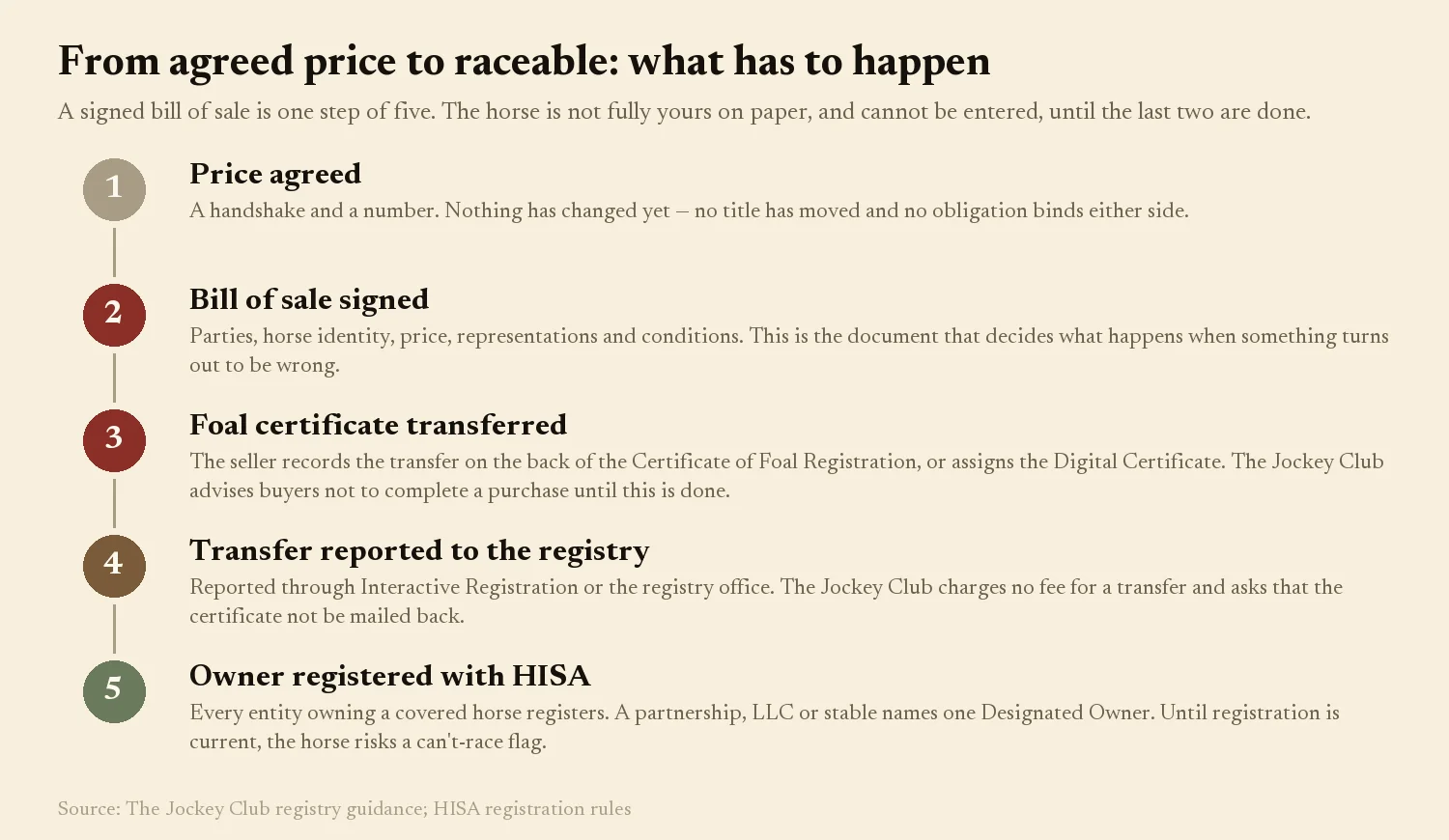
The Certificate of Foal Registration is the Thoroughbred’s identity document, and transferring it is a separate act from signing your bill of sale. The back of the certificate carries blank spaces for recording transfers of ownership, and The Jockey Club asks that breeders and owners record the transfer there before the horse changes hands. For foals of 2018 and later the certificate is digital: it sits with a Certificate Manager, who assigns it to the next party through Interactive Registration.
Two details from that guidance are worth carrying into your negotiation. The Jockey Club charges no fee for a transfer and asks that the certificate not be mailed back to the registry. And it states plainly that no one should complete the purchase of a Thoroughbred until the certificate has been transferred by the previous owner or assigned by the previous Certificate Manager. That is the registry telling buyers, in its own words, to make the paperwork a condition of payment rather than a favour to be chased afterwards.
HISA registration does not travel with the horse
Every entity that owns a covered horse must register with HISA in its own right — the seller’s registration does not pass to you with the animal. HISA requires owners of covered horses to register, and where a horse is owned by more than one person, or by an LLC, corporation, stable or partnership, one of the owners must serve as the Designated Owner on the HISA portal. Responsible persons also carry ongoing duties: updating a covered horse’s location within 24 hours and reporting equine fatalities within 72 hours.
This is the clause most likely to be missing from a document that otherwise looks professional, and the one with the most immediate consequence. HISA enforces its registration rules with "can’t race" flags — a horse whose connections are not compliant is at risk of being unable to run until they are. A buyer who closes on a Friday and discovers this the following week has bought a training bill, not a runner.
A lien representation is a promise, not a search
A seller’s statement that a horse is free of liens is a promise you are relying on, not evidence that anyone looked. Horses in training accumulate the kind of debts that attach to them — unpaid training bills, veterinary accounts, farrier work — and the person best placed to know about them is the person selling. So the clause does two jobs at once: it puts the seller’s assurance in writing, and it makes any later discovery a breach rather than a surprise you absorb. Ask who checked and where, get the answer written down, and treat "free and clear" on its own as the beginning of that conversation rather than the end of it.
The veterinary condition belongs before closing, not after
A pre-purchase examination protects you only if the bill of sale makes the sale conditional on its outcome. The clause needs three things: who performs the examination, what standard the horse has to meet, and what happens if it does not — deposit returned, sale void, or price renegotiated. Access to the horse’s existing records matters as much as the exam itself, which is where the repository of radiographs and endoscopic findings earns its place in the negotiation. An examination performed after the money has cleared is a diagnosis, not a protection.
A deadline with something attached to it
The fifth addition is the smallest and the one most often left out: every paperwork obligation in the document gets a date and a stated consequence. "Seller shall transfer the registration" is an intention. "Seller shall transfer the Certificate of Foal Registration within five business days of closing, failing which the escrowed balance is released to buyer" is an obligation. The difference costs nothing to write and decides what you can do about it in the one situation where it matters.
Generic template versus racehorse bill of sale
| Clause | Generic equine template | What a racehorse purchase needs |
|---|---|---|
| Horse identity | Name, colour, sex, age, sometimes a microchip field. | Registered name, year of foaling, sire and dam, and the lip tattoo or microchip. |
| Registration papers | Usually absent, or one line saying papers will be provided. | Named certificate, named transfer mechanism, a deadline, and a consequence if it is missed. |
| Regulatory registration | Absent. Sport-horse forms have no reason to contemplate it. | HISA owner registration by the buyer, and a Designated Owner named where the buyer is an entity. |
| Liens | Sometimes a bare "free and clear" sentence. | An express representation covering training, veterinary and farrier accounts, with a stated remedy. |
| Veterinary examination | Often framed as "sold as is". | A condition precedent: named vet, agreed standard, and what happens if the horse does not meet it. |
| Medication history | Rarely addressed. | A representation covering known joint injections, surgeries and current treatments. |
Claiming versus private sale: why a claim has no bill of sale
In a claiming race the horse changes hands under the track’s rules rather than a negotiated contract: the buyer files a claim before the race, and the transfer happens without either party signing a bill of sale. There is no document to draft, no representation to extract and no veterinary condition to insert. You are buying on the past performances and whatever your own eyes told you in the paddock.
What has changed is the moment of transfer. The historical rule was blunt: once the horse broke from the gate the claimant owned it whatever happened, though the previous owner kept the purse money from that race. Voided-claim rules have since narrowed that. By the Paulick Report’s account of the same rules, the California Horse Racing Board amended its claiming rules in 2013 to void the claim of a horse a regulatory veterinarian found unsound when the race was over, and to void claims where a horse bled through the nostrils or failed a post-race drug test. HISA’s claiming rules extended that kind of protection more consistently — horses that pass post-race evaluation transfer to the new owner and trainer as they leave the test barn.
In a private sale your protection is a clause you negotiated. In a claim your protection is a rule someone else wrote, and you get whichever version the jurisdiction happens to have.
That is the trade, and it is worth understanding before you decide which route suits you. The mechanics of filing, the claim box and the timing are covered in our walkthrough of how claiming a horse actually works.
Four lines in a seller’s draft worth stopping for
Four phrases recur in seller-drafted bills of sale — "sold as is", "seller shall transfer the papers", "free and clear of all liens", and a horse described only by colour and age — and each does less work than a buyer assumes. None of them is a trick. They are what you get when a document is written to record a sale rather than to survive one going wrong.
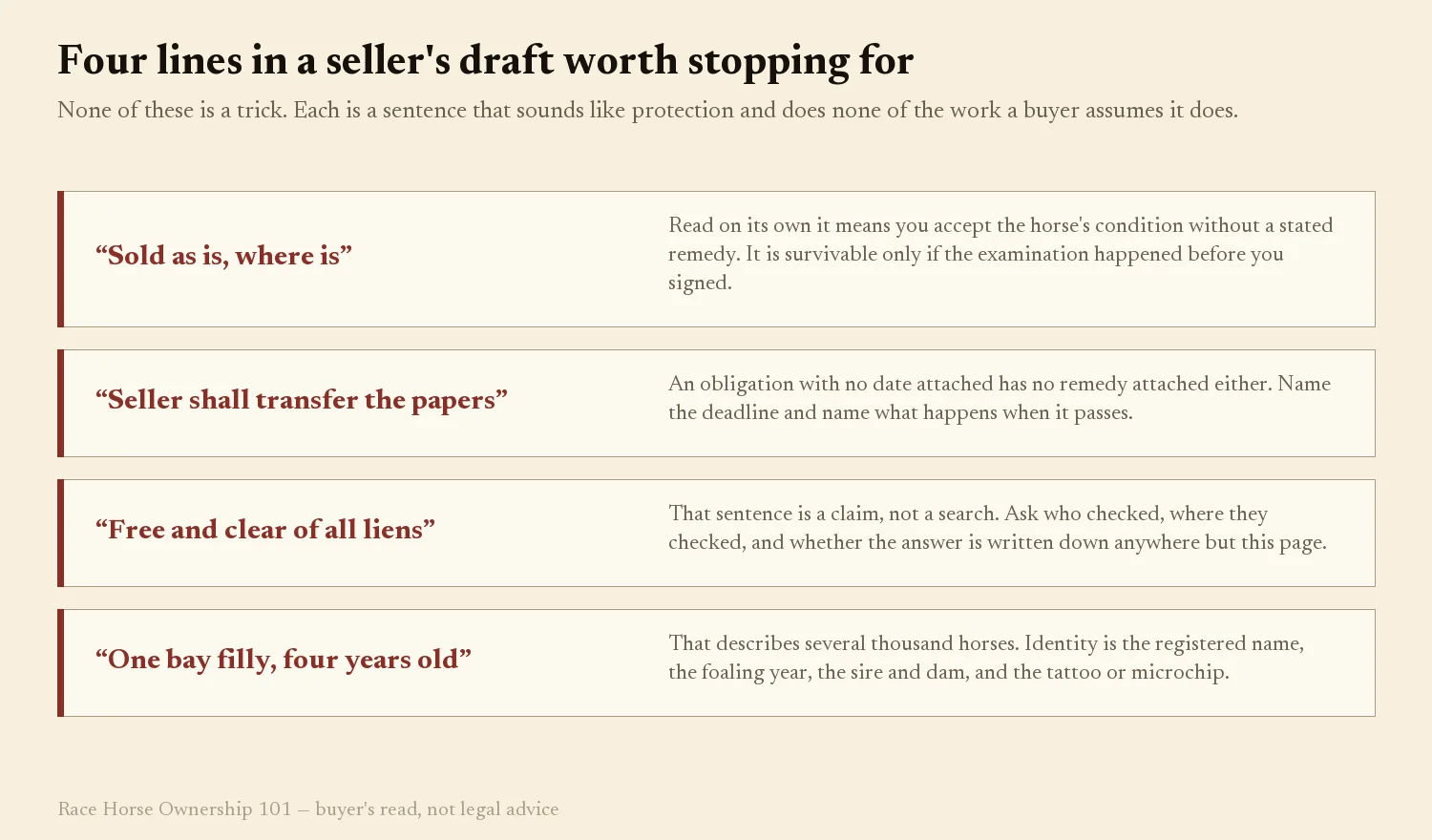
Consider a first-time owner who agrees a price on a four-year-old gelding at a training centre, signs the seller’s one-page form on a Friday and wires the money that afternoon. The form says the seller will forward the registration papers. It does not say when, and it does not say what happens if they never arrive. Three weeks later the horse is eating at the buyer’s expense, the trainer cannot enter it, and the only lever left is a phone call the seller has stopped returning. Nothing in that sequence required bad faith on anyone’s part. The document simply never contemplated the possibility.
Your pre-signing checklist
Ten checks cover the ground between an agreed price and a signature you will not regret. Work through them before the money moves, because every one of them is easier to insist on while the seller still wants the sale.
- Both parties named as legal persons, with the entity — not you personally — signing if an LLC or partnership is buying.
- The horse identified by registered name, year of foaling, sire and dam, and tattoo or microchip.
- The price, the currency, and the date funds clear, all stated.
- Who holds the money until the conditions are satisfied, and on what instruction it is released.
- A seller representation of clear title and no undisclosed liens covering training, veterinary and farrier accounts.
- A representation covering known medication history, joint injections and surgeries.
- A pre-purchase examination made a condition of the sale, with the vet named, the standard agreed, and the outcome if the horse fails it stated.
- Repository access, or the horse’s records, provided before you are committed.
- The Certificate of Foal Registration transferred or assigned by the seller, with a deadline and a consequence written in.
- Your own HISA registration underway, and a Designated Owner identified if you are buying as an entity.
A note on what this is
This is a buyer’s checklist, not legal advice, and we do not supply a template. A bill of sale is a contract, its treatment varies by state, and the money involved in a racehorse purchase justifies an hour of an equine attorney’s time. Take this list to that meeting. Being able to ask specific questions is most of what makes the hour worth paying for.
Questions buyers ask
Four questions come up more than any others about an equine bill of sale: whether it has to be notarised, whether you can draft it yourself, how buy-back clauses work, and what happens when the registration papers never arrive.
Does an equine bill of sale have to be notarised?
Notarisation requirements are set at state level and we are not going to give you a national answer, because there is not an honest one to give. This is the question where a template site will tell you something confident and generic, and it is the question where being wrong is most expensive. What notarisation does, where it is used, is evidence that the signature is genuine — it is not what makes the document effective. Ask an attorney licensed in the state where the sale closes.
Can I write my own bill of sale?
You can, and for a modest private purchase people routinely do. The risk is not the drafting — it is the omission. The six baseline blocks and the five racehorse-specific additions above are what a self-drafted document tends to miss, in roughly that order. If you write your own, write the conditions and the deadlines first and the courtesies afterwards.
What about a buy-back or first-refusal clause?
Sellers who care where a horse ends up sometimes ask for a right of first refusal on resale, or a right to take the horse back rather than see it run in a low-level claimer. These are negotiable and often reasonable. Two things decide whether the clause is workable: whether it is triggered by an event you can both identify, and whether it survives the horse being claimed out of a race — which is not something either of you controls.
What if the registration papers never arrive?
Your position depends entirely on what the bill of sale said would happen. If it named a deadline and a consequence, you have a remedy to enforce. If it said the seller would transfer the papers and nothing more, you have an argument. The Jockey Club’s guidance points the same way — treat the transfer as something completed at the purchase, not chased after it.
What to read next
The bill of sale is one step in buying a racehorse; these four cover the decisions on either side of it.
- How to buy a racehorse — the four routes in, what each costs in money and control.
- How to claim a horse — the route where the rulebook does the paperwork for you.
- What a bloodstock agent does — who is representing whom in a private purchase.
- Foal, yearling and two-year-old — what you are actually buying at each stage.
About the Author

Calvin Johnson is a Thoroughbred racehorse owner, day trader, and independent racing analyst with more than a decade of firsthand ownership experience. He has participated in nearly every common structure in horse racing — fractional platform shares, traditional syndicates, LLC partnerships, claiming ventures, and outright ownership — across more than two dozen horses. Calvin writes about racehorse ownership the same way he approaches markets: by studying risk, incentives, fees, and whether the people controlling the deal are aligned with the investors behind it.
- Calvin Johnsonhttps://racehorseownership101.com/author/calvin-johnson/

- Calvin Johnsonhttps://racehorseownership101.com/author/calvin-johnson/

- Calvin Johnsonhttps://racehorseownership101.com/author/calvin-johnson/

- Calvin Johnsonhttps://racehorseownership101.com/author/calvin-johnson/