
When a horse trainer is suspended, the horses in that barn cannot breeze or race until each one is transferred to another licensed trainer and that transfer is registered with HISA — and if the suspension runs longer than 30 days, the horse also has to be physically moved to a barn run by someone unaffiliated with the suspended trainer. Not the assistant who has been doing the work all along, and not a family member: the Horseracing Integrity and Wagering Unit names both as ineligible to receive the horses. What the rule does not require is the part owners get wrong in the other direction. Your horse does not have to leave the racetrack. It has to leave that barn, and you have roughly until your next entry to arrange it.
The short version
- A transfer of training to another licensed trainer, registered with HISA, is what lets the horse work or run again. Owner custody is not a substitute.
- Past 30 days, the horse physically changes barns — and the assistant trainer, family members and anyone affiliated with the suspended trainer are specifically excluded as destinations.
- None of this touches your training agreement. The regulator moves the horse; the contract decides what you still owe, and no rule caps it for you.
I ran into the edge of this while writing our piece on what HIWU rulings actually mean for an owner. I could tell you what a ruling said, what it did to the purse and what it did to the trainer’s record. I could not tell you what you are supposed to do with your horse on Monday morning. The published record is thick with who got suspended and thin to the point of silence on what the owner does next. This piece is the part that was missing.
What a trainer suspension actually does to the horses in the barn
A trainer suspension stops the horses in that barn from breezing or racing, but it does not stop them being fed, groomed or galloped — under HISA’s provisional-suspension guidance a suspended trainer may still care for and exercise the horses already in the barn. That surprises most owners, and it is worth sitting with, because it explains why a suspension can look from the shed row like almost nothing has changed while the racing side of your ownership has stopped dead.
Imagine your colors on the horse at the front.
Not a bet. Not a ticket. Yours. Thousands of everyday fans own a piece of a racehorse. The free guide is how they started.
Four things change the moment the ruling lands. The horse cannot participate in a timed and reported workout — a breeze — or in a covered horserace. The trainer cannot claim horses or bring new ones into the barn. The trainer cannot work as an agent or an exercise rider for covered horses. And the trainer’s name and operation come off the signage at the racetrack. Everything else about the daily routine can carry on, which is precisely the trap: nothing about the barn’s appearance tells you the clock is running on your entries.
What a suspended trainer can and cannot do
| Activity | During a provisional suspension |
|---|---|
| Feed, care for and exercise horses already in the barn | Permitted, with limited exceptions |
| Breeze or race those horses | Not permitted until the horse is transferred |
| Claim a horse or bring new horses into the barn | Not permitted |
| Work as an agent or exercise rider for covered horses | Not permitted |
| Display signage carrying their name or operation at the track | Not permitted |
Read that table as an owner rather than as a trainer and the practical consequence is clear. Your horse is being looked after. Your horse is also, for racing purposes, parked — and it stays parked until you do something about it.
The 30-day line decides whether your horse moves barns
The length of the suspension is the number that decides how much disruption you are facing: a suspension of 30 days or fewer requires a registered transfer of training, while a suspension longer than 30 days requires the horse to be physically relocated to a barn under the care or control of a trainer unaffiliated with the suspended one. Both cases require the transfer to be registered with HISA in accordance with its procedures before the horse can work or run.
A suspension of 30 days or fewer, against one that runs longer
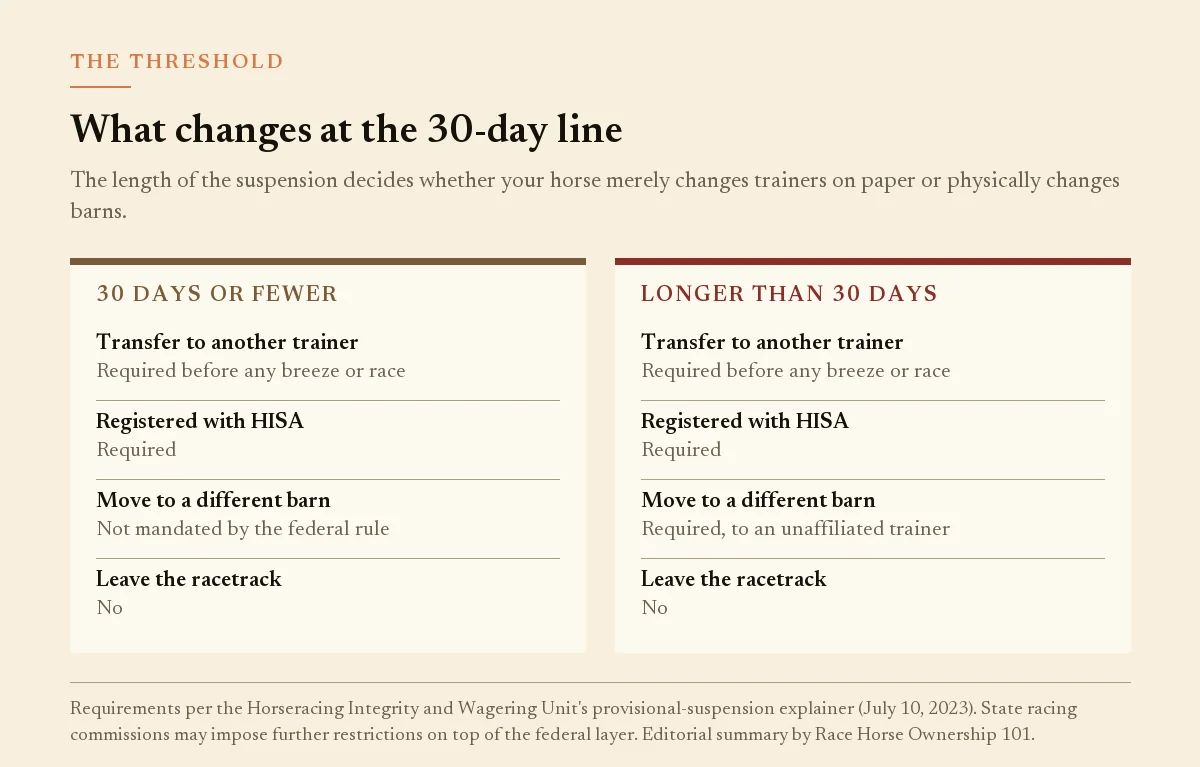
The last row of that panel is the one I would put in front of any owner who is picturing a van and a four-hour drive. Relocation means another barn. It does not mean another racetrack. A stall down the shed row, under a trainer with no connection to the suspended one, satisfies the requirement — which is worth knowing before you accept a plan that ships your horse three states away and bills you for it.
Who is allowed to receive your horse
Your horse must go to another licensed trainer who is not affiliated with the suspended one, which specifically rules out that trainer’s assistant trainers, family members, and any other individuals affiliated with the trainer. That exclusion is set out in HIWU’s explainer on what happens when a covered person is provisionally suspended, and it is the clause owners guess wrong most often. The guess is an understandable one: the assistant has been running the shed row, knows the horse, and is standing right there.
The transfer rule, split into its three working parts
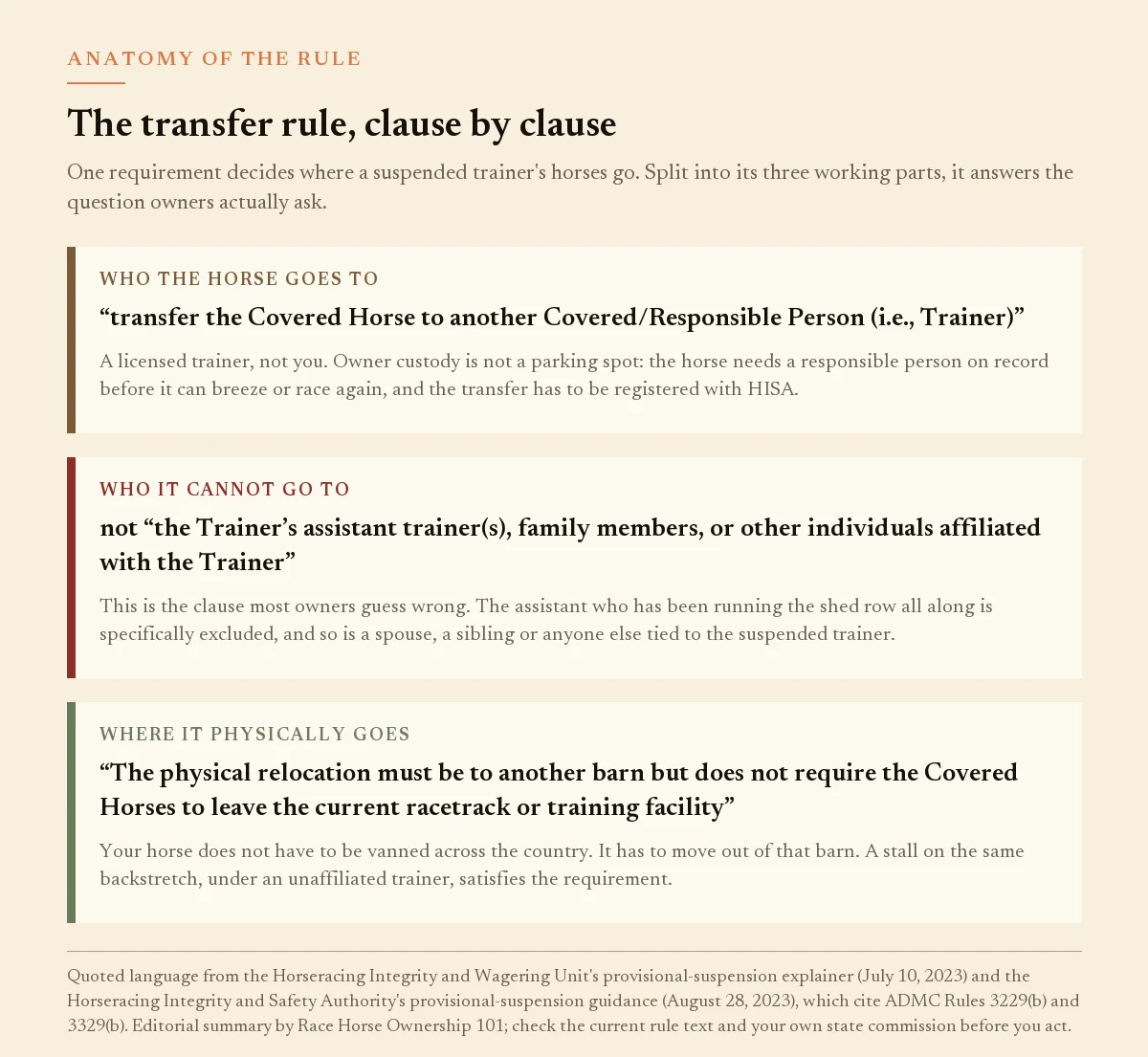
Owner custody does not work as a holding pattern either. The requirement is a transfer to another covered or responsible person — in practice, a licensed trainer — because the rules need someone on record who carries the responsibility for that horse. You can own the horse and pay for the horse and still not be able to enter it.
Then there is the second regulator, and this is where the published answer stops being tidy. HISA sits on top of a state licensing system it did not replace. Every trainer who receives your horse still holds a state license, and state commissions write their own rules about who may hold one and under what circumstances. Kentucky’s licensing regulation, 810 KAR 3:020, effective August 4, 2026, treats a license held by “a spouse, immediate family member, or other person in a similar relationship to the licensee” as a potential conflict of interest for the review committee and the chief state steward to rule on. That is the state layer arriving at the same suspicion the federal rule states outright, by a different route.
What we could not verify: state commission rules on transfers during a suspension are not uniform, and we found no single published standard that holds across jurisdictions. Read your own commission’s rules, or ask the racing office to point you at them, before you assume the federal answer is the whole answer. That is a two-phone-call job and it is worth doing on the day the ruling lands.
Provisional suspension, period of ineligibility, and a state ruling are three different states
A provisional suspension is a temporary measure imposed before a case is resolved, while a period of ineligibility is the sanction that follows an adjudicated one — and the difference changes what HIWU says it will enforce against you as an owner. Under HISA’s guidance, the ownership-transfer requirements in the rules are not enforced during a provisional suspension, but they are enforced during a period of ineligibility. If your trainer also holds a piece of your horse, that distinction is not academic.
The three states an owner has to tell apart
| State | Who imposes it | What it means for your horse |
|---|---|---|
| Provisional suspension | HISA / HIWU, before a case is resolved | Transfer of training required before any breeze or race; ownership-transfer requirements not enforced during this period |
| Period of ineligibility | HISA / HIWU, after adjudication | Transfer of training required; ownership-transfer requirements are enforced |
| State commission ruling | Your state racing commission, under its own rules | Varies by jurisdiction; sits on top of the federal layer rather than replacing it |
So the first question to ask when a ruling appears is which of those three things you are looking at, ahead of how long it runs, because that answer determines whether your ownership interest is in scope at all. A headline will almost never tell you.
What happens when the horse itself is suspended
A provisionally suspended covered horse may still jog and gallop, but it may not participate in a timed and reported workout or a covered horserace. The restriction attaches to the animal rather than to the human, so changing trainers does not lift it — a point worth understanding before you spend a week arranging a transfer that will not solve the problem in front of you.
Read the ruling, not the headline. A suspended trainer and a suspended horse are separate states with separate remedies, and news coverage routinely runs them together. The document tells you which one you have.
Training bills, shipping, and who actually pays for the move
A suspension does not cancel your training agreement: the day rate you owe the suspended trainer runs until the horse actually leaves that barn, and the van, plus the new trainer’s rate, are yours from the day it arrives. No rule in the federal framework reallocates those costs, and I have never seen a standard training agreement that treats the trainer’s own suspension as a triggering event.
Consider an owner with one horse in a mid-sized barn who reads about the ruling in a trade publication on a Tuesday, spends four days finding a trainer with an open stall, and moves the horse the following Monday. That owner has paid the suspended trainer for six days of care that produced no racing, paid a van bill, and started a new day rate — and none of it is recoverable, because none of it was breached. The bills are all legitimate. They just all belong to the owner.
The honest answer on cost: the regulator moves your horse and leaves the invoice where it fell. Ask for a closing invoice with an agreed cutoff date before the horse walks out, because a bill negotiated after the fact, with a trainer who has just lost his license to run horses, is a much harder conversation.
If you own a share, the decision may not be yours
In a syndicate or partnership, the choice of where the horse goes usually belongs to the managing owner or the manager rather than to the individual members — and the document that says so is the one you signed at the start. Trainer selection is one of the standard reserved powers, which means a minority member with a strong view about the new barn may have no mechanism for acting on it.
This is the moment the paperwork earns its keep, and it is why what is actually in a syndicate or partnership agreement matters long before anything goes wrong. Two clauses decide your position: the one naming who selects the trainer, and the one setting how quickly the manager has to tell you something material has happened. A manager who learns of a suspension on Monday and tells the members on Friday has cost you four days of entries. Whether that is a breach or simply how the agreement is written is a question the agreement answers, not a question you get to argue afterwards. Our independent checklist for vetting a syndicate manager puts notification timing among the questions to ask before you join, and this is the scenario it is asking about.
What to do in the first 72 hours
The work in the first three days is sequential, not parallel: you cannot line up a receiving trainer sensibly until you know whether the suspension crosses the 30-day line, and the transfer does not count until it is registered with HISA. Doing it in the wrong order is how owners end up moving a horse twice.
The owner’s first-72-hours sequence, in order
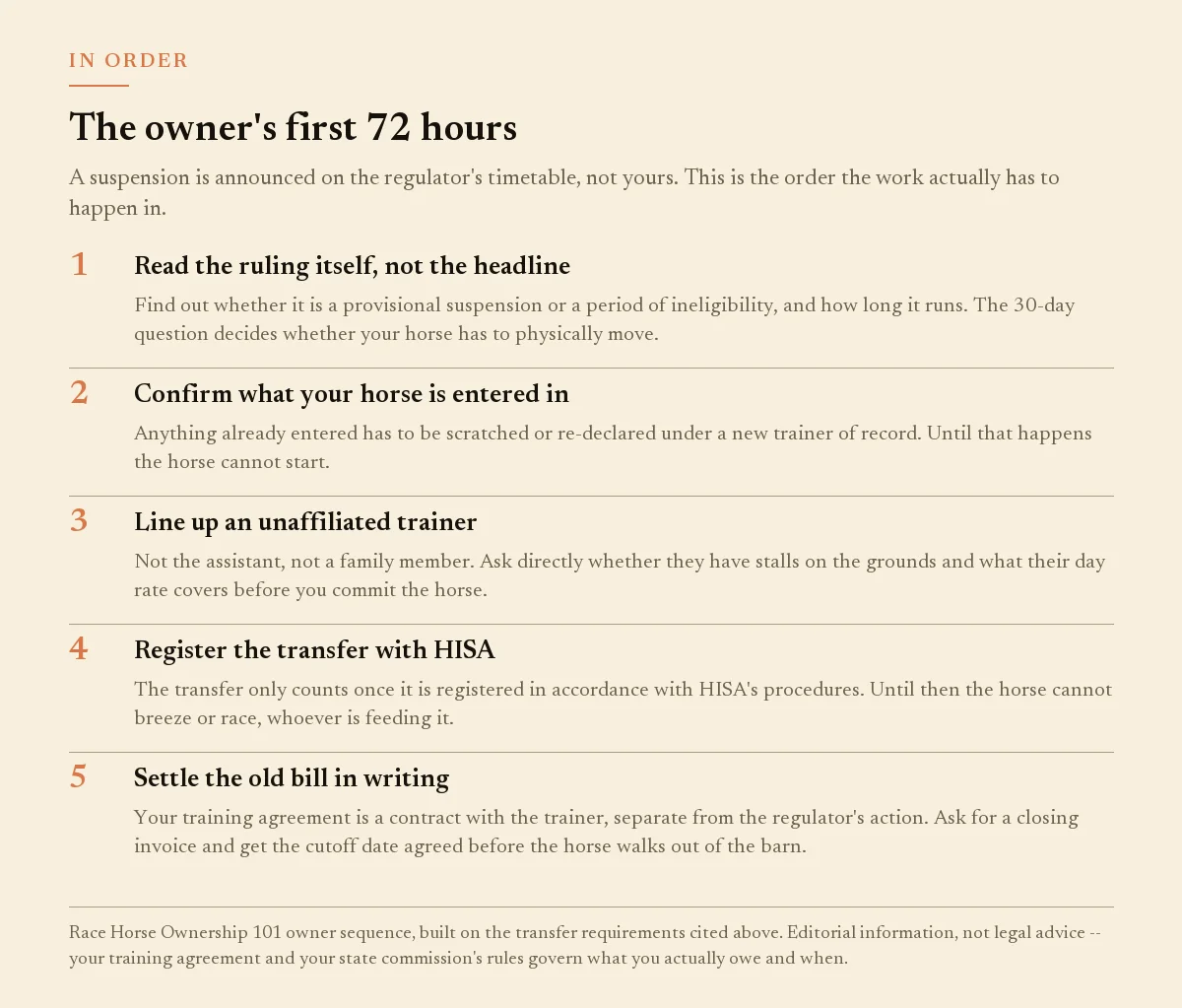
Three things to get in writing while you are doing it, because each one is cheap to obtain now and expensive to reconstruct later:
- Confirmation that the transfer is registered. Not that it has been submitted. Registered.
- A closing invoice from the old barn with an agreed cutoff date. Settle what the day rate stops on before the horse ships.
- The new trainer’s day rate and what it covers. A rushed move is exactly when an owner accepts a rate nobody has itemized.
Common questions when a trainer is suspended
Can I move my horse immediately?
Yes — you own the horse, and nothing in the suspension prevents you moving it to another licensed trainer. What governs the timing in practice is the receiving trainer having a stall available and the transfer being registered with HISA, because until that registration is done the horse cannot breeze or run wherever it is standing.
Can the assistant trainer take over the barn?
No. HIWU’s guidance specifically excludes the suspended trainer’s assistant trainers, family members and other affiliated individuals from receiving the horses. The receiving trainer has to be genuinely unaffiliated, which is the entire point of the requirement — a barn that changes only its nameplate has not changed.
Does anyone have to approve the transfer?
The documented federal requirement is registration rather than approval: the transfer must be registered with HISA in accordance with its procedures. Your state racing commission licenses trainers separately and may have its own notification or approval rules, and those differ by jurisdiction, so confirm with your commission rather than assuming the federal step is the only one.
What happens to horses that stay in the barn?
They can be cared for and exercised, and if the suspension runs 30 days or fewer they can stay where they are physically standing. What they cannot do is breeze or race, because that requires a transfer of training to another responsible person. Past 30 days they have to move barns regardless of whether you intended to run them.
Am I still paying training bills while the trainer can’t race?
Yes, until the horse leaves the barn. Your training agreement is a contract with the trainer and it is unaffected by the regulator’s action against them; the day rate covers care, and the care is still being provided. Nothing in the federal rules shifts that cost, and nothing recovers the entries you lost.
The part nobody puts in the headline
Trainer suspensions get covered as reputational stories — who, what substance, how long. For the owners in that barn the story is administrative and it has a deadline: a transfer of training, registered with HISA, and past 30 days a physical move to an unaffiliated barn. Our owner’s guide to HISA covers how the federal layer came to sit above the state commissions in the first place, and the current regulations are published in full, which is more than most owners realize.
The rule that matters most to you is the one about the assistant trainer, and it is the one nobody explains at the time. The person who knows your horse best is the person the regulator will not let you hand it to.
About the Author

Calvin Johnson is a Thoroughbred racehorse owner, day trader, and independent racing analyst with more than a decade of firsthand ownership experience. He has participated in nearly every common structure in horse racing — fractional platform shares, traditional syndicates, LLC partnerships, claiming ventures, and outright ownership — across more than two dozen horses. Calvin writes about racehorse ownership the same way he approaches markets: by studying risk, incentives, fees, and whether the people controlling the deal are aligned with the investors behind it.
- Calvin Johnsonhttps://racehorseownership101.com/author/calvin-johnson/

- Calvin Johnsonhttps://racehorseownership101.com/author/calvin-johnson/

- Calvin Johnsonhttps://racehorseownership101.com/author/calvin-johnson/

- Calvin Johnsonhttps://racehorseownership101.com/author/calvin-johnson/