The OBS March Sale of Two-Year-Olds in Training is Ocala Breeders’ Sales’ select juvenile auction, held each spring in Ocala, Florida, and it sells horses that are already broken, already galloping, and close enough to a first start to run later the same season. The 2026 renewal sold 443 head for $72,050,000 across three days, March 10 to 12 — a record gross, a $162,641 average and an $85,000 median, with 123 horses failing to meet their reserve. Those are strong figures, and they are the seller’s figures. The number a first-time buyer should sit with is the median, because it says a select two-year-old at OBS March costs roughly what a yearling costs at Keeneland September — and you are bidding on the evidence of one short breeze, filmed six days earlier.
The short version
- March is the select session. April is bigger, June is bigger still and carries a horses-of-racing-age section, and there is an online sale in January. Which session you belong in is the first decision, not the last.
- The under-tack breeze is real evidence about a narrow question. It is one timed work on one morning, and it is silent on distance, on soundness, and on what it took to produce the time.
- If what you want is a horse that runs this year, claiming is the cheaper and better-documented route to the same outcome. A two-year-old sale is not the only ready-to-run path, and for a lot of first-time owners it is not the right one.
Two-year-old sales get covered as market news: a record gross, a seven-figure hip, a line from the sale company. That coverage is accurate, and it is written for people already in the business, so it answers their question — is the market up? — rather than the prospective owner’s, which is whether any of this is for them. We think that for most first-time owners the answer is no, and that the honest alternative sits in a claiming barn rather than at another auction. That argument only works if you know what OBS March is, so start there.
What the OBS March sale actually is
The OBS March sale is a three-day public auction of two-year-old Thoroughbreds already in training, run by Ocala Breeders’ Sales in Ocala, Florida, and preceded by an under-tack show at which every catalogued horse works once, timed and filmed. A two-year-old in training is a horse in the calendar year after its yearling year: broken, galloping, and near enough to a first start that it can race in the same season. That is the whole difference from a yearling sale. At Keeneland September you buy a horse and wait roughly a year, paying to keep it the entire time. At OBS March you buy a horse somebody else has already broken and conditioned, and you pay for that work in the price.
You’re already studying the sport. Own a piece of it.
Every question you’re asking is one owners ask every morning at the barn. The free guide takes you from fan to owner.
The rest of the sale’s shape follows from that one fact. Because the horse has already worked, the catalogue can publish a time — and because the catalogue publishes a time, the room prices horses off it.
What the 2026 sale actually sold
OBS March 2026 sold 443 head for a record $72,050,000, at a $162,641 average and an $85,000 median, with 21.7 per cent of the horses through the ring failing to meet their reserve. Both halves of that matter. The gross and the average are what the trade press led with, and they were genuinely strong: OBS’s own closing recap called it a record, seven horses made seven figures, and BloodHorse reported the same result. The median is the figure that describes the horse you would actually be bidding on, and at $85,000 this is not a soft room.
OBS March 2026 in five numbers
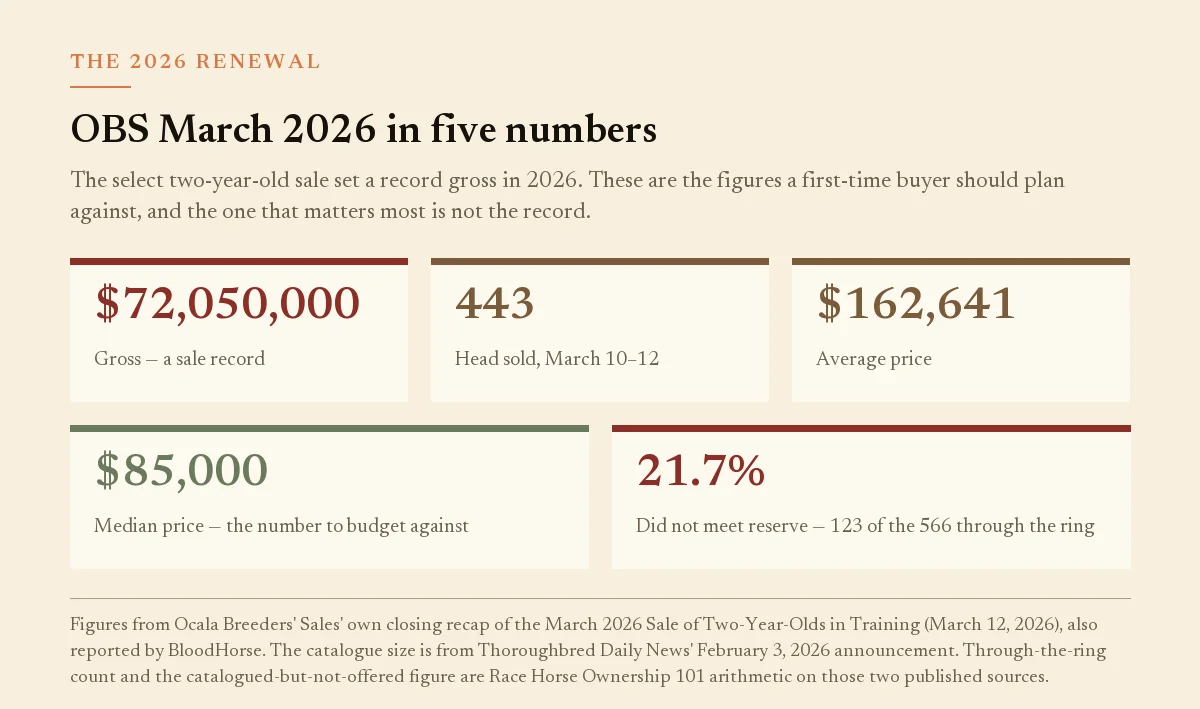
One number on that panel is ours rather than the sale’s, and it is worth showing the working. Thoroughbred Daily News reported a catalogue of 816 head when the book came out in February. In March, 443 sold and 123 were bought back, which puts 566 through the ring. The other 250 or so were catalogued and never offered.
Horses come out of a two-year-old catalogue for ordinary reasons — a shin, a temperature, a consignor who decides the horse is worth more in a later session — so the gap is attrition rather than a warning sign. It still changes how you plan. Roughly three in ten of the hips you circle in February will not be in the ring in March, and a trip built around four specific horses can end with nothing to bid on.
The session map: March, April, June and the January online sale
OBS runs four two-year-old and racing-age sales across the year, and they are not a prestige ladder: March is the select session, April is larger, June is larger still and adds horses already racing, and January is an online sale. A buyer who has decided to buy “at OBS” without deciding which OBS has not yet made a decision.
The 2026 OBS two-year-old and racing-age calendar
| Sale | 2026 dates | Under-tack show | What is in it |
|---|---|---|---|
| OBSOnline January two-year-olds and horses of racing age | January 26–30 | January 22 (optional) | Online sale; juveniles alongside horses already racing |
| March Sale of Two-Year-Olds in Training | March 10–12 | March 4–7 | The select juvenile session; 816 catalogued |
| Spring Sale of Two-Year-Olds in Training | April 14–17 | April 6–11 | Four sale days against March’s three, on six under-tack mornings |
| June Sale of Two-Year-Olds and Horses of Racing Age | June 16–18 | June 9–13 | The largest catalogue, 981 head with supplements, plus a racing-age section |
The useful point there is the shape of the catalogues rather than the calendar. March is the smallest and the most selective, which is why its median sits highest. June carries 981 head against March’s 816 and is the only one of the three with a section for horses that have already started. Our reading is that this makes June, not March, the session most first-time individual buyers should look at first.
What an under-tack breeze time does and does not tell you
The under-tack show is a public workout held days before the sale, at which each catalogued two-year-old breezes once under a rider while the time is recorded and the work is filmed. For OBS March 2026 it ran March 4 to 7, six days before the first horse sold, and that gap is worth holding on to. The evidence you are bidding on was created before the sale week began, and it is one work — whatever happens to a young horse between a Saturday morning breeze and a Tuesday afternoon in the ring happens after the number was set.
The time is a real signal, and it is the thing a yearling sale cannot give you. A horse that works well under a rider on a racetrack is telling you something a yearling standing in a shed row cannot. The trouble is what the room does with the number. A breeze time is a single measurement, quoted to hundredths, printed on a page where everything else is a description — and precision reads as authority. It is the same failure of attention that makes a sale-wide average feel more informative than a median.
What the under-tack show measures, and what it leaves out
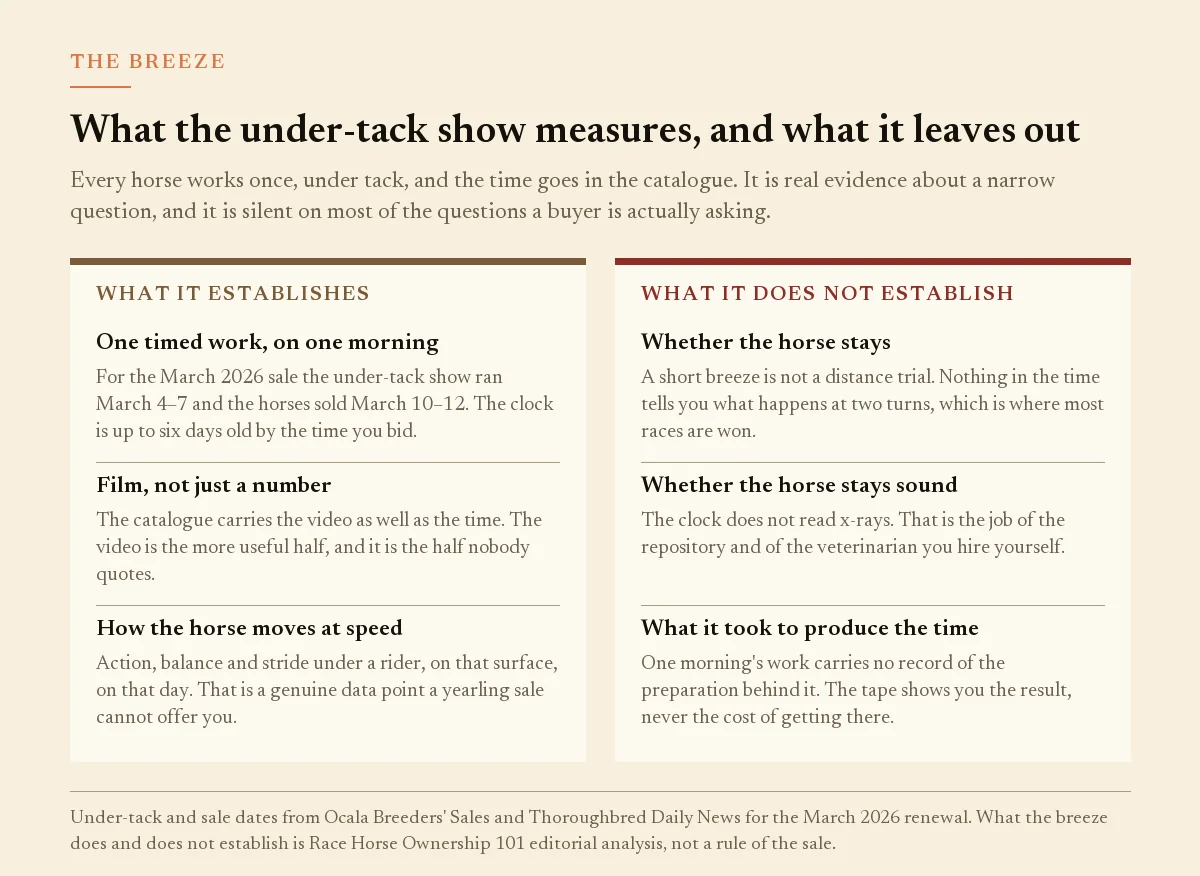
Watch the video, then read the time. A buyer who reads the clock first has already decided what to look for in the film.
The film shows how the horse produced the number: where it changed leads, whether it was in front of itself, what it did in the gallop-out after the clock stopped. Those are the things a trainer will ask about, and none of them are in the time. The catalogue gives you both, and only one gets quoted.
Who is bidding against you at a two-year-old sale
Many horses in a two-year-old-in-training catalogue were bought as yearlings by pinhookers, whose business is to resell rather than race, so the price at OBS March must clear what somebody else already paid plus a year of carrying the horse. We have taken that arithmetic apart in our guide to pinhooking, and who it is actually for. The figures there cover the weanling-to-yearling leg rather than the yearling-to-juvenile one, so do not transpose them — but the structure holds either way. A pinhooker pays a price, carries the horse through board, veterinary work, shoeing and a sales preparation, and needs the hammer to clear all of it plus commission before there is a profit.
None of that is a criticism. Pinhookers do work the market needs, and the horse in front of you is a better-presented, better-educated animal for having passed through their hands. It is a warning about what the room is built for: you are the end user in a sale organised around resale, and the person bidding against you did this arithmetic before they sat down. Whether you want a juvenile at all is the prior question, and we have set it out in our comparison of a yearling against a two-year-old for partnership buyers.
OBS March against Keeneland September
OBS March’s 2026 median of $85,000 was higher than Keeneland September’s 2025 median of $80,000, which means a select two-year-old in training is not the cheaper way into ownership — it is the faster one. Those are different sales in different years and it is not a like-for-like price. Most first-time buyers still get the comparison backwards. The assumption is that a yearling is the expensive prestige purchase and a juvenile is the practical alternative; on the published medians, the select juvenile session is the dearer room.
What the difference buys is time and information. A yearling bought in September will not start for roughly a year, and you pay to keep it for that year before you learn anything. Keeneland September is twelve sessions wide, and its 2025 sale-wide average of $175,807 described almost none of the horses in it — the same warning applies at Ocala. A juvenile bought in March has been broken, has galloped and has worked in public, and you are paying somebody else’s carrying cost to skip the waiting.
A juvenile in training, a yearling, or a horse already running
| Buying at OBS March | Buying at Keeneland September | Claiming a horse in a race | |
|---|---|---|---|
| What you are buying | A two-year-old already broken, galloping and breezed in public | A yearling roughly a year from a first start | A horse currently racing, at the track’s tag |
| Most recent published median | $85,000 (2026 sale) | $80,000 (2025 sale) | Tags commonly run from about $2,500 to $75,000 or more |
| Time until it can start | Later the same season | Roughly a year, at your expense | Immediately — it is already entered |
| What you see before you commit | One timed breeze, on film, plus the repository | Conformation, pedigree and the repository | A racing record, past performances and published workouts |
| Who you are bidding against | Pinhookers, agents and end users | Agents, breeders buying back, partnerships assembled in advance | Other licensed owners, filing claim slips before post time |
| The main risk | A time that flatters one morning | A year of bills before you learn anything | You own whatever was wrong with the horse |
The other ready-to-run path is a claiming barn
If what you want is a horse that runs this year, claiming is the cheaper and better-documented route: tags commonly run from about $2,500 to $75,000 or more, and you are buying a horse with a racing record rather than one work. This is the section a sale company will never write, so we will. Claiming races are the workhorse of American racing, and every horse in one is for sale that day at the same price; the mechanics are in our guide to how you claim a horse, step by step.
A claim gives you something the sale ring cannot: a public record. The horse has run, against named horses, at a named class, more than once, and you can see what it did when it was asked to do the job twice in a month. Against that, an under-tack breeze is one data point produced under ideal conditions by people who are motivated to produce it.
What a claim does not give you
There is no repository and no pre-purchase exam. You file the slip before the race, and if the horse breaks down during it, you have bought it anyway.
That is the trade the two paths make with each other. A sale gives you a veterinarian’s report and no racing record; a claim gives you a racing record and no veterinarian. The drop in class that made a horse look like a bargain is frequently a drop for a reason, and the reason becomes yours at the gate. Claiming buys information, and what it costs is the right to change your mind.
What due diligence looks like at a two-year-old sale
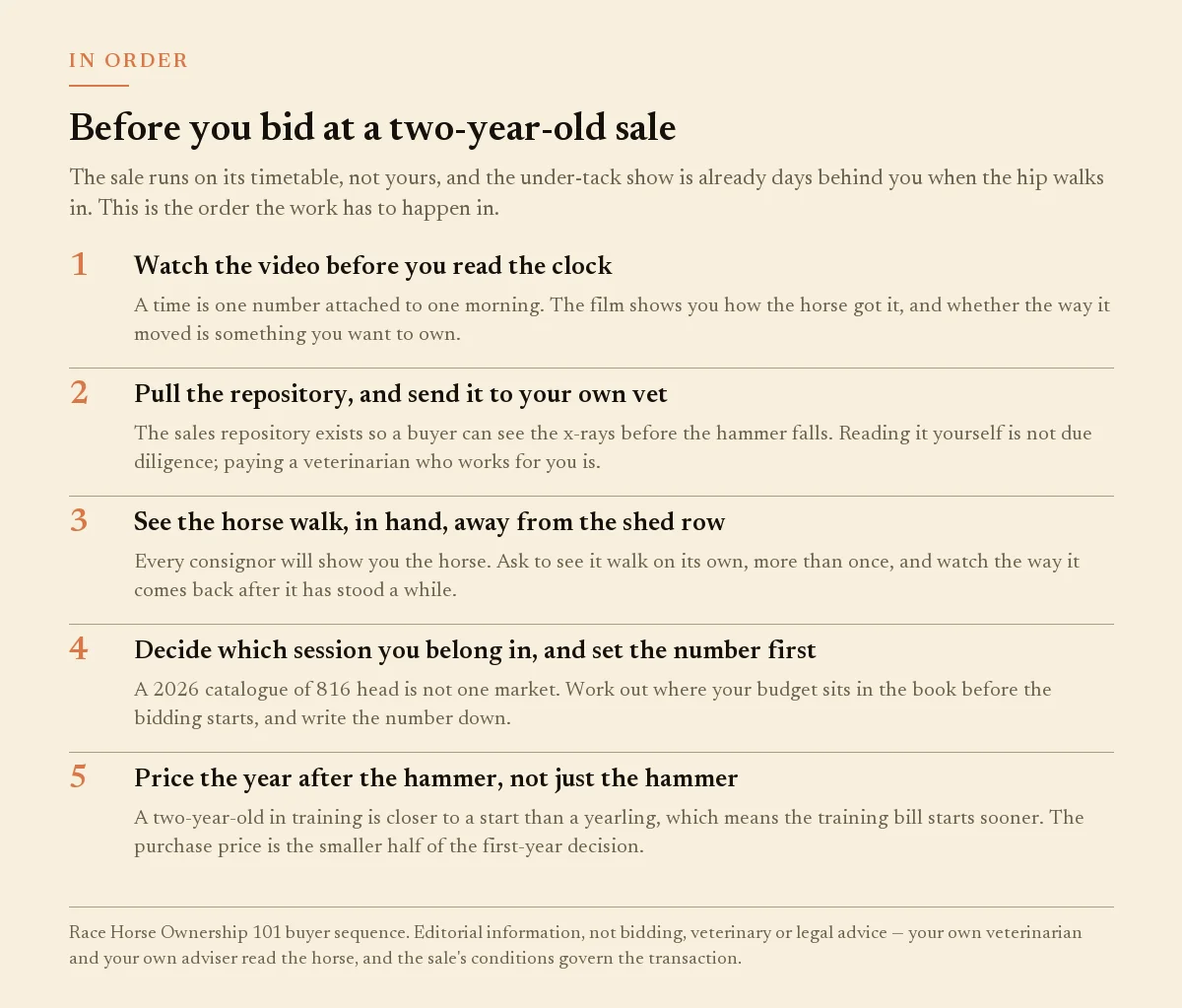
Due diligence at OBS March is the same repository-and-veterinarian process as any Thoroughbred auction, plus one layer a yearling sale does not have: the under-tack video. The sales repository and the pre-purchase exam are where the medical case is made or lost. You pull the repository, you send it to a veterinarian working for you rather than for the consignor, and you accept that a set of x-rays is a snapshot and not a warranty. Reading the catalogue page properly is the other half of the job.
What is different is that a juvenile has a work history, and a history is something a veterinarian can ask questions about. A horse in training since the autumn that worked well in March has stood up to something. One in training the same length of time that worked slowly may be slow, or may have been handled carefully for a reason. The repository is where you find out which, and that answer is worth more than the eighth of a second between the two on the board.
The buyer’s sequence before you bid
Should a first-time owner bid at OBS March?
For most first-time individual owners the honest answer is no — not because the sale is bad, but because March is the most selective and most professional room on the OBS calendar, and the cheapest lesson is not there. If this is the first horse you have bought on your own account, buy one you can watch run first: a claim out of a race, with a trainer who has seen the horse work, or a share in a partnership where somebody else’s money sits alongside yours. Our guide to every ownership path lays them out side by side.
There are good reasons to go anyway, starting with the fact that you can watch every horse in the catalogue work before you spend a dollar. If you do, go with three things settled:
- A trainer who has bought at Ocala before, and who will be standing next to you when the hip walks in.
- A number, written down, that you will not pass. The one you set in the pavilion is not a number, it is a mood.
- A decision about which session you belong in, made in front of the catalogue rather than in the room.
Common questions about the OBS March sale
When is the OBS March sale, and when is the under-tack show?
The 2026 OBS March Sale of Two-Year-Olds in Training ran March 10 to 12, with the under-tack show over the four mornings of March 4 to 7, starting at 8 a.m. each day and working through the catalogue in hip order. OBS publishes its calendar a season ahead and the dates move year to year, so confirm the current renewal against the OBS sales calendar before booking anything.
What is the difference between the OBS March, April and June sales?
March is the select session: the smallest catalogue, at 816 head in 2026, and the highest prices. The April Spring Sale ran April 14 to 17 in 2026, over four sale days, with under-tack shows across April 6 to 11. The June Sale of Two-Year-Olds and Horses of Racing Age ran June 16 to 18 with under-tack June 9 to 13, catalogued 981 head including supplements, and is the only one of the three with a section for horses that have already started. OBS also runs an online January sale of juveniles and horses of racing age.
What does “under tack” mean at a two-year-old sale?
Under tack means the horse works carrying a rider and a saddle rather than being led or stood up for inspection. At an under-tack show every catalogued horse breezes once in public a few days before the sale, and both the time and the video go into the catalogue. It is the one piece of athletic evidence a two-year-old sale offers that a yearling sale cannot, and it is a single work on a single morning.
Is a two-year-old in training cheaper than a yearling?
Not at the select sessions. OBS March’s 2026 median was $85,000; Keeneland September’s 2025 median was $80,000. Those are different sales in different years, so read it as a shape rather than a price index — but the common assumption that a juvenile is the budget alternative to a yearling does not survive the published medians. What the money buys is a horse that can run in the same season, and one public workout you can watch before you bid.
Do I need a trainer or a bloodstock agent to buy at OBS March?
Check the bidder-registration terms with OBS directly; the sale sets its own conditions. The more useful question is whether you should bid unaccompanied, and the answer is no. Somebody has to look at the horse, watch the work, read the repository with a veterinarian and know what a consignor’s answer means. Our guide to what a bloodstock agent does and how they are paid covers when the fee earns itself; a trainer who has bought at Ocala before does much of the same job.
What to read next
- How to buy a racehorse: every ownership path explained — the hub this piece sits under.
- Keeneland November, explained — the breeding-stock room, and the horses-of-racing-age section that starts most of these questions.
- Why an owner puts a horse in a claiming race — the other side of the claim you might file.
Two-year-old sales sell speed you can watch. That is a real advantage over a yearling sale, and it is a narrow one. In March 2026 it cost a median of $85,000, and it came with one timed work recorded six days before the hammer fell.
About the Author

Calvin Johnson is a Thoroughbred racehorse owner, day trader, and independent racing analyst with more than a decade of firsthand ownership experience. He has participated in nearly every common structure in horse racing — fractional platform shares, traditional syndicates, LLC partnerships, claiming ventures, and outright ownership — across more than two dozen horses. Calvin writes about racehorse ownership the same way he approaches markets: by studying risk, incentives, fees, and whether the people controlling the deal are aligned with the investors behind it.
- Calvin Johnsonhttps://racehorseownership101.com/author/calvin-johnson/

- Calvin Johnsonhttps://racehorseownership101.com/author/calvin-johnson/

- Calvin Johnsonhttps://racehorseownership101.com/author/calvin-johnson/

- Calvin Johnsonhttps://racehorseownership101.com/author/calvin-johnson/