The Keeneland November Breeding Stock Sale is where the American thoroughbred industry restocks itself: 1,891 horses sold for $237.5 million across eight days in 2025, at an average of $125,572 and a median of $60,000. Keeneland calls it the world’s most important auction of its type, and it is cheaper to buy into than the September yearling sale most prospective owners have already read about. Big, prestigious and comparatively affordable is a combination that pulls first-time buyers toward the catalogue. It should slow them down instead. What passes through that ring is mostly broodmares, weanlings and breeding rights, bought by people whose business is producing and trading horses rather than racing them. If you want a horse to run for you, five of the catalogue’s six sections have nothing to sell you.
The short version
- November is a mixed sale. One catalogue sells broodmares, broodmare prospects, weanlings, horses of racing age, stallion prospects, and shares in stallions.
- It is cheaper than Keeneland September on both measures, and the discount is a description of what is for sale rather than a bargain.
- If you are buying a horse to race next season, the section that fits you is the smallest one in the book.
What the Keeneland November sale is
The Keeneland November Breeding Stock Sale is an eight-day public auction in Lexington, Kentucky, where breeding stock and breeding rights change hands: 1,891 horses sold for $237,456,400 through the ring in 2025. Keeneland catalogues broodmares, broodmare prospects, weanlings, horses of racing age, stallions, stallion prospects and shares in a single book, which is what makes it a mixed sale rather than a yearling sale. Buyers are largely commercial: breeding farms replacing mares, pinhookers buying foals to resell, and bloodstock agents acting for both. The 2025 renewal was the highest-grossing November since 2007, with an average of $125,572 and a median of $60,000, and it ran alongside roughly $8.9 million in post sales for a combined figure near $245.9 million. The 2026 sale runs November 3 to November 10.
Imagine your colors on the horse at the front.
Not a bet. Not a ticket. Yours. Thousands of everyday fans own a piece of a racehorse. The free guide is how they started.
That last detail matters more than it looks. A sale held in November is held after the racing season and after the yearling sales, at the point in the year when a breeding operation knows which mares it wants to keep and which it wants to move. The calendar is built around the breeding shed, not around the racetrack. Everything else about the room follows from that.
What is actually for sale in a mixed catalogue
A mixed catalogue sells six distinct kinds of property, and only one of them is a horse you could enter in a race next spring. Reading the November book without knowing which section you are in is the most common way a newcomer ends up bidding on something they did not intend to own. A broodmare in foal and a weanling colt can sit within a few pages of each other and represent completely different businesses, different holding periods and different bills.
Two of those categories are not animals you can take home at all. A stallion share is a fractional ownership interest in a breeding stallion, and a season is the right to send one mare to him in a given year. Both are traded at November, and both are useful only if you have mares to breed. If you have been reading about how to read a thoroughbred sale catalog, the page-reading skill transfers directly here; the sections are what change.
What the November catalogue contains, section by section
| Catalogue section | What it actually is | Who is typically buying it |
|---|---|---|
| Broodmares | Mares in foal, or ready to be bred next spring | Commercial breeding farms restocking |
| Broodmare prospects | Fillies and mares leaving racing for a breeding career | Breeders buying a pedigree, often in partnership |
| Weanlings | Foals of that year, roughly six to eleven months old | Pinhookers buying to resell as yearlings |
| Horses of racing age | Horses that can be entered and run next season | Racing stables, trainers and racing owners |
| Stallions and stallion prospects | Colts and horses retiring to stud | Stud farms and stallion syndicates |
| Stallion shares and seasons | Breeding rights — not a horse at all | Breeders securing access to a sire |
Only the fourth row describes a horse that can carry your silks in the coming season, and it is the thinnest part of the book. If I were walking a first-time buyer through that catalogue, I would have them read the section header before the pedigree every time. The pedigree tells you what the animal is bred to do; the section tells you whether it can do anything for you at all.
Why the room is full of breeders, pinhookers and agents
No auction house publishes a breakdown of how many bidders are individual owners, so treat any confident percentage you read as invention — including ours. What can be said honestly is structural: five of the catalogue’s six sections sell property that only a breeding or trading business has a use for, and the published buyer and consignor records read accordingly.
Keeneland’s own 2025 recap names the operations that spent more than $3 million: trainer Wesley Ward, MWG, Dixiana Farm and the Raging Torrent Syndicate. Those are trainers, farms and syndicates buying to breed, trade or race at scale. On the selling side, Taylor Made Sales Agency sold 258 horses for $42,172,400 to lead all consignors for the 28th time since 1987. A single agency moving 258 head through one auction is the signature of a trade market, not a retail one.
The room is not hostile to a first-time owner. It is simply indifferent to one, because almost nothing in it was catalogued with that buyer in mind.
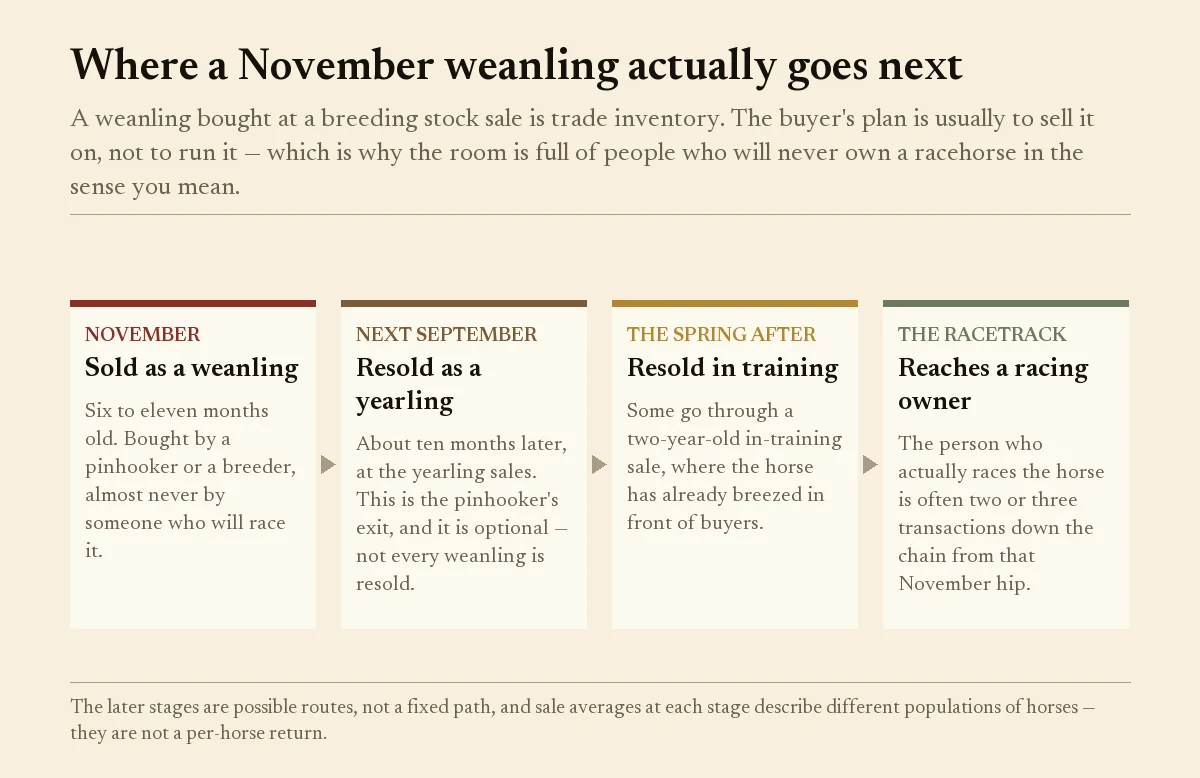
The weanling section makes the point most clearly. A weanling is a foal of that year, and nobody buys one to race it soon, because it is two to three years from a starting gate. Most weanling buyers are engaged in pinhooking: buying to resell at a profit at the following autumn’s yearling sales. Keeneland November 2025 set a record weanling average of $109,745, with 58 weanlings making $300,000 or more. Those are inventory prices paid by traders.
Where a November weanling actually goes next
November is cheaper than September, and that is the tell
Keeneland November’s 2025 median was $60,000 against Keeneland September’s $80,000, so the breeding stock sale sat a quarter below the yearling sale at the midpoint. Industry coverage treated both sales as strong markets, and on the headline numbers they were: November grossed its most since 2007, and September’s $531.5 million was the highest gross ever recorded at a thoroughbred auction anywhere. The interesting part is what sits underneath those headlines.
Keeneland November vs September 2025: average and median
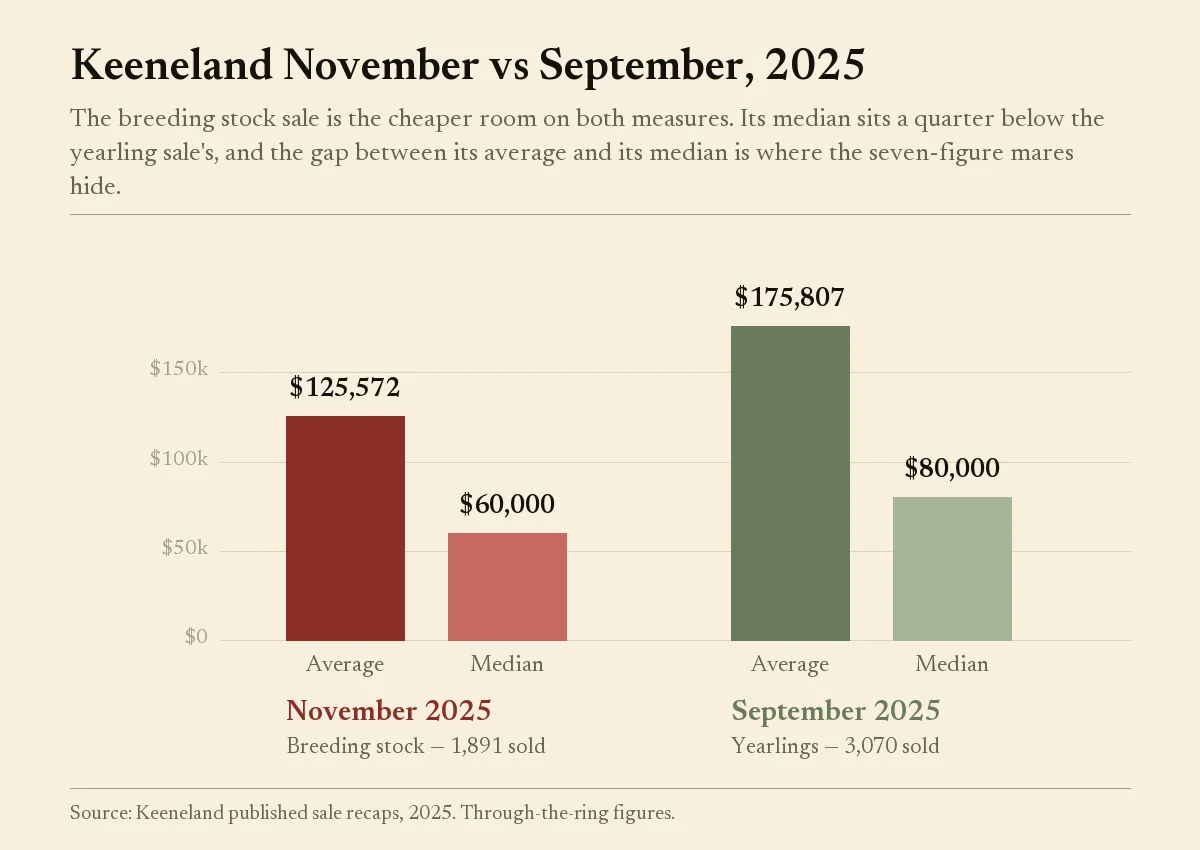
November’s average of $125,572 is more than double its $60,000 median. A gap that wide means a small number of very expensive horses are carrying the average, which is exactly what the sale reported: 18 horses made seven figures, the most since 2017, led by the Group 1 winner Lush Lips at $3.7 million. Eighteen out of 1,891 is under one percent of the catalogue.
Read that the right way round. The median tells you what a typical November hip costs; the average tells you that the sale’s reputation is built on horses you are not bidding on. A cheaper median here is not a discount on the same product. It is a different product, and much of it is a producing asset with its own annual bills — board, veterinary care and a stud fee every year it is bred — rather than something that might win a purse.
Which sale fits which buyer
For a first-time owner buying a horse to race, Keeneland September is the better-matched auction, because everything in it is a yearling that will be old enough to run the following year. The comparison below is the one I would want on a single page before deciding which catalogue to request.
Keeneland November and September compared
| Criterion | November Breeding Stock Sale | September Yearling Sale |
|---|---|---|
| 2025 dates | November 4–11, eight days | September 8–20, twelve sessions |
| What sells | Broodmares, weanlings, racing stock, stallion shares | Yearlings only |
| Horses sold, 2025 | 1,891 | 3,070 |
| Average / median, 2025 | $125,572 / $60,000 | $175,807 / $80,000 |
| Typical buyer | Breeders, pinhookers, bloodstock agents | Racing owners and agents, buyers from 33 countries |
| Time to a first start | Two to three years for a weanling; never for a broodmare | Usually the following season |
| Best fit for | Breeding, pinhooking, restocking a farm | A first-time owner buying a horse to race |
One caution on names. A sale being called a yearling sale does not make it a thoroughbred sale: the Lexington Selected Yearling Sale, held in the same city, is a Standardbred auction rather than a thoroughbred one. Confirm the breed and the sale type before you request a catalogue, not after.
Should a first-time owner bid at a breeding stock sale?
For most first-time owners a breeding stock sale is the wrong auction to bid at, and the reason has nothing to do with the quality of the horses. Five of the catalogue’s six sections sell something you cannot race, and the sixth competes against buyers who have been valuing racing stock professionally for years. Consider a prospective owner who reads that the November median is $60,000, decides the entry point looks manageable, and comes home with a lovely in-foal mare. They have not bought a racehorse. They have bought a breeding operation with a foal due in the spring, a board bill that runs whether or not anything goes right, and a horse that will never start again.
Matching your goal to the room
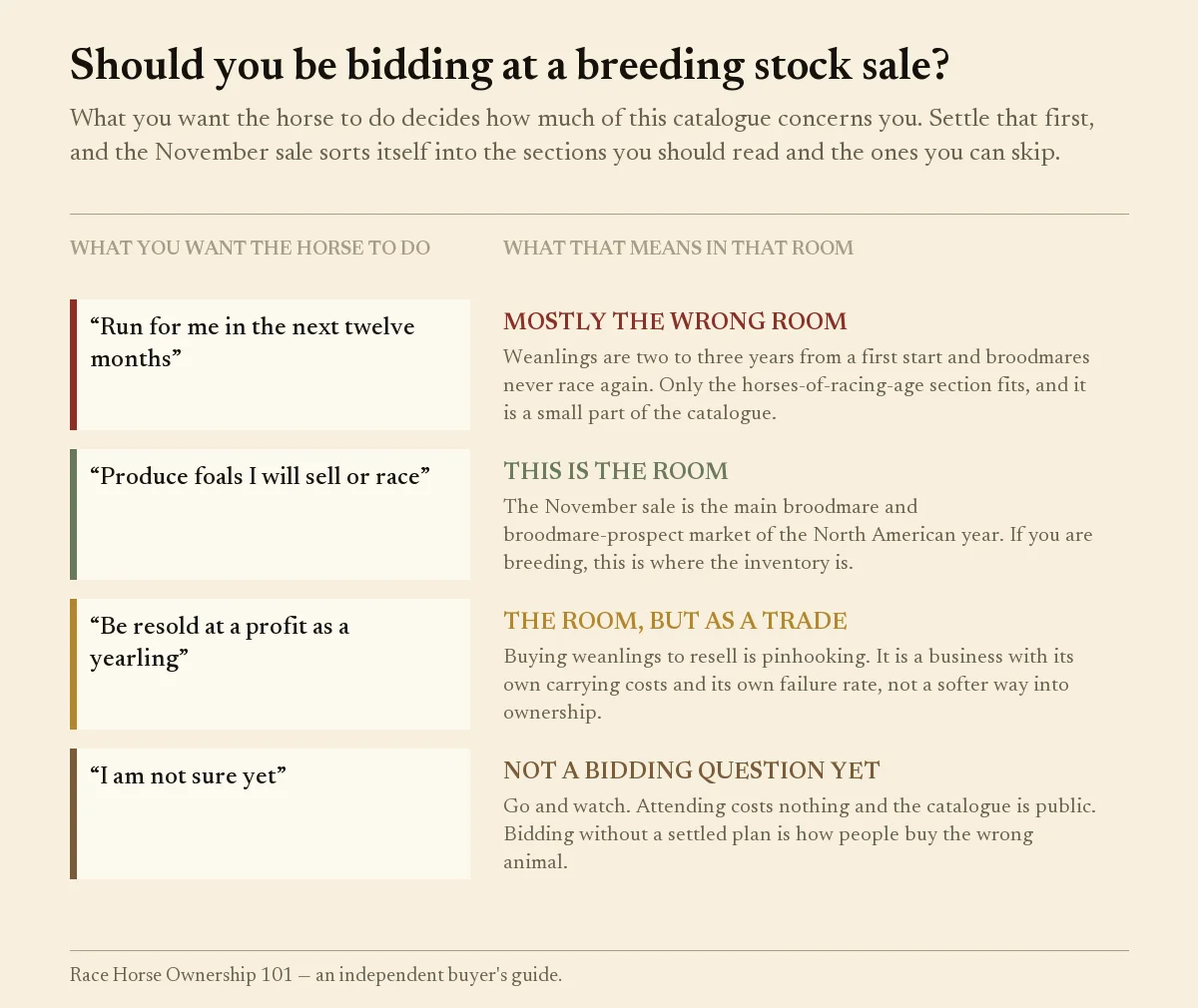
My own view is that the week is worth attending and the paddle is not worth lifting. The catalogue is published in advance, the sessions run across eight days, and a public auction is one of the few settings where you can watch experienced buyers value horses in real time and see what they were willing to pay. Go, watch, read hips against the prices they fetch, and buy nothing. We would rather a reader spend a November learning how the market prices a pedigree than spend it acquiring one. If you are still weighing the entry points, our guide to every path into racehorse ownership sets the auction route against the alternatives.
What due diligence looks like when the catalogue is mixed
Due diligence at a mixed sale is not one process but three, because a broodmare, a weanling and a horse of racing age each fail in different ways. A broodmare needs a reproductive examination and an honest account of her produce record and her current pregnancy. A weanling is assessed on conformation, physical development and radiographs, with the understanding that a great deal will change before it is a yearling. A horse of racing age needs a full pre-purchase workup, including a look at its racing and veterinary history.
All three lean on the repository, the set of veterinary films and reports a consignor files for buyers to review before bidding. Our walkthrough of what the sales repository holds and how to read it covers the mechanics. The thing I would plan around is the timetable rather than the money. Inspection happens in the days before a session, veterinary opinion has to be arranged ahead of it, and the hammer does not wait for a vet who was never booked.
Common questions about the Keeneland November sale
When is the Keeneland November sale?
The 2026 Keeneland November Breeding Stock Sale runs from Tuesday, November 3 to Tuesday, November 10, an eight-day auction spanning two weeks. The 2025 renewal ran November 4 to 11. Keeneland publishes the catalogue and the session schedule on its November sale page ahead of each running.
What is a breeding stock sale?
A breeding stock sale is an auction of the animals and rights used to produce racehorses rather than to race them: broodmares, mares retiring from the track, that year’s foals, stallion prospects, and shares and seasons in stallions. Some breeding stock sales, Keeneland November among them, also catalogue a smaller section of horses of racing age. The defining difference from a yearling sale is that most of what is offered will never start in a race for its buyer.
Is Keeneland November cheaper than Keeneland September?
Yes, on both standard measures. In 2025 Keeneland November returned an average of $125,572 and a median of $60,000, against September’s $175,807 average and $80,000 median. The gap reflects a different mix of property rather than better value, and a broodmare bought at the lower median carries breeding costs the yearling does not.
The honest answer
Keeneland November is a real market doing serious business, and the reason it looks accessible is that its buyers are professionals shopping for inventory at inventory prices. A first-time owner is welcome to attend and welcome to bid. Whether they should is a question the catalogue answers before the auctioneer does: check which section the hip is in, and check what you intend the horse to do. When those two answers disagree, the room is telling you something, and 1,891 horses sold at a $60,000 median is not an invitation.
— Race Horse Ownership 101
About the Author

Calvin Johnson is a Thoroughbred racehorse owner, day trader, and independent racing analyst with more than a decade of firsthand ownership experience. He has participated in nearly every common structure in horse racing — fractional platform shares, traditional syndicates, LLC partnerships, claiming ventures, and outright ownership — across more than two dozen horses. Calvin writes about racehorse ownership the same way he approaches markets: by studying risk, incentives, fees, and whether the people controlling the deal are aligned with the investors behind it.
- Calvin Johnsonhttps://racehorseownership101.com/author/calvin-johnson/

- Calvin Johnsonhttps://racehorseownership101.com/author/calvin-johnson/

- Calvin Johnsonhttps://racehorseownership101.com/author/calvin-johnson/

- Calvin Johnsonhttps://racehorseownership101.com/author/calvin-johnson/