The Lexington Selected Yearling Sale is a Standardbred auction — harness horses, trotters and pacers — conducted by Lexington Selected Yearling Sale, LLC and held 5–8 October 2026 at the Fasig-Tipton Sales Pavilion in Lexington, Kentucky. It is not a Thoroughbred sale, and “Selected” is not a tier in some Thoroughbred auction ladder. In 2025 it sold 890 yearlings for about $61 million, the fourth-highest gross in the sale’s history. Across town that same autumn, the Thoroughbred yearling market ran on a different scale entirely: Keeneland September grossed $531.5 million on 3,070 head at a $172,833 average. If you are shopping for a flat racehorse and this sale surfaced in a calendar search, you have the wrong sport’s auction. If harness ownership is genuinely on your list, you have a market where the average yearling costs roughly 40% of a Keeneland September average.
The honest answer, in three lines
- The word “Selected” in this sale’s name describes a Standardbred auction company, not a grade of Thoroughbred yearling.
- The sale is held in the Fasig-Tipton pavilion, which is why the name reads as a Thoroughbred fixture to anyone scanning a sale calendar. The building’s owner and the sale’s conductor are different parties.
- Breed decides the sale. Check the registry named in the catalog before you check anything else.
What the Lexington Selected Yearling Sale actually is
The Lexington Selected Yearling Sale is North America’s principal Standardbred yearling auction, run by Lexington Selected Yearling Sale, LLC at the Fasig-Tipton Sales Pavilion in Lexington. The horses cataloged there are bred to race in harness — trotting or pacing in front of a sulky — not to be ridden by a jockey at Keeneland or Churchill Downs. That single fact governs everything else about the sale: the sires, the buyers, the price bands, the trainers standing at the back rail, and whether you should be there at all.
Imagine your colors on the horse at the front.
Not a bet. Not a ticket. Yours. Thousands of everyday fans own a piece of a racehorse. The free guide is how they started.
The confusion is understandable, and it is structural rather than anyone’s fault. The sale takes place in a building that carries the name of a Thoroughbred auction house. It happens in Lexington, in yearling season, weeks after the biggest Thoroughbred yearling sale in the world has finished in the same city. Its name uses a word — “selected” — that Thoroughbred sale companies also use to signal a graded catalog. A prospective owner three weeks into researching how to buy a horse has no reason to know that any of this points at a different sport.
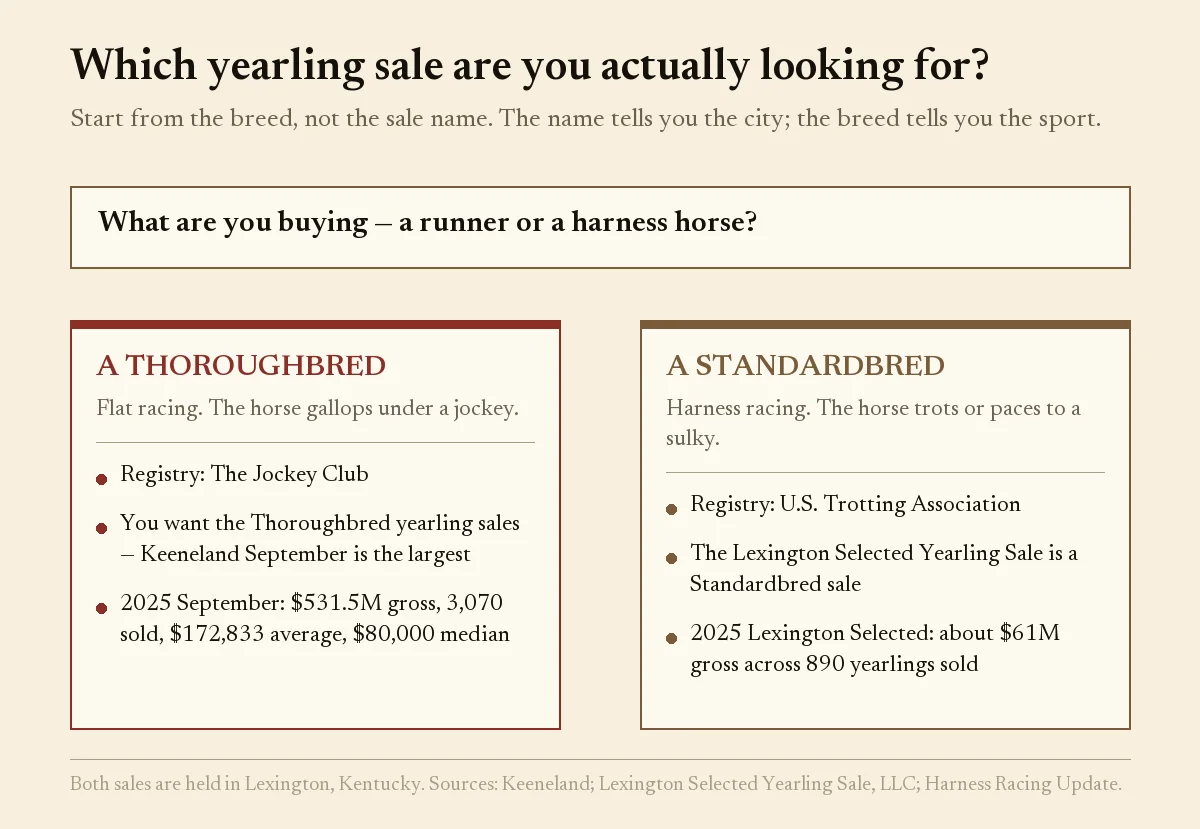
Which yearling sale are you actually looking for?
Why “Selected” does not mean what a Thoroughbred buyer assumes
“Selected” in the Lexington Selected Yearling Sale is part of a company’s name, not a quality tier a Thoroughbred buyer can read across from one auction house to another. Sale companies across both breeds use words like selected, select, premier and preferred to describe catalogs they have curated, and none of those words carries a standard definition that travels between companies. There is no industry body that certifies what a “selected” catalog must contain.
This matters more than it sounds. A first-time buyer reading a calendar of sale names is doing exactly what the names invite: treating them as a ladder, and trying to work out which rung suits a first purchase. The names are not a ladder. They are marketing surfaces, each written by the company that owns the sale, each meaning whatever that company decided it means that year.
A sale name tells you who is running the auction. It does not tell you what you are qualified to buy there.
The useful reading of any catalog is the one we set out in our guide to reading a Thoroughbred sale catalog before you bid: the page, the conditions of sale, and the vet’s report tell you what the horse is. The cover tells you nothing.
What the two Lexington yearling markets did in 2025
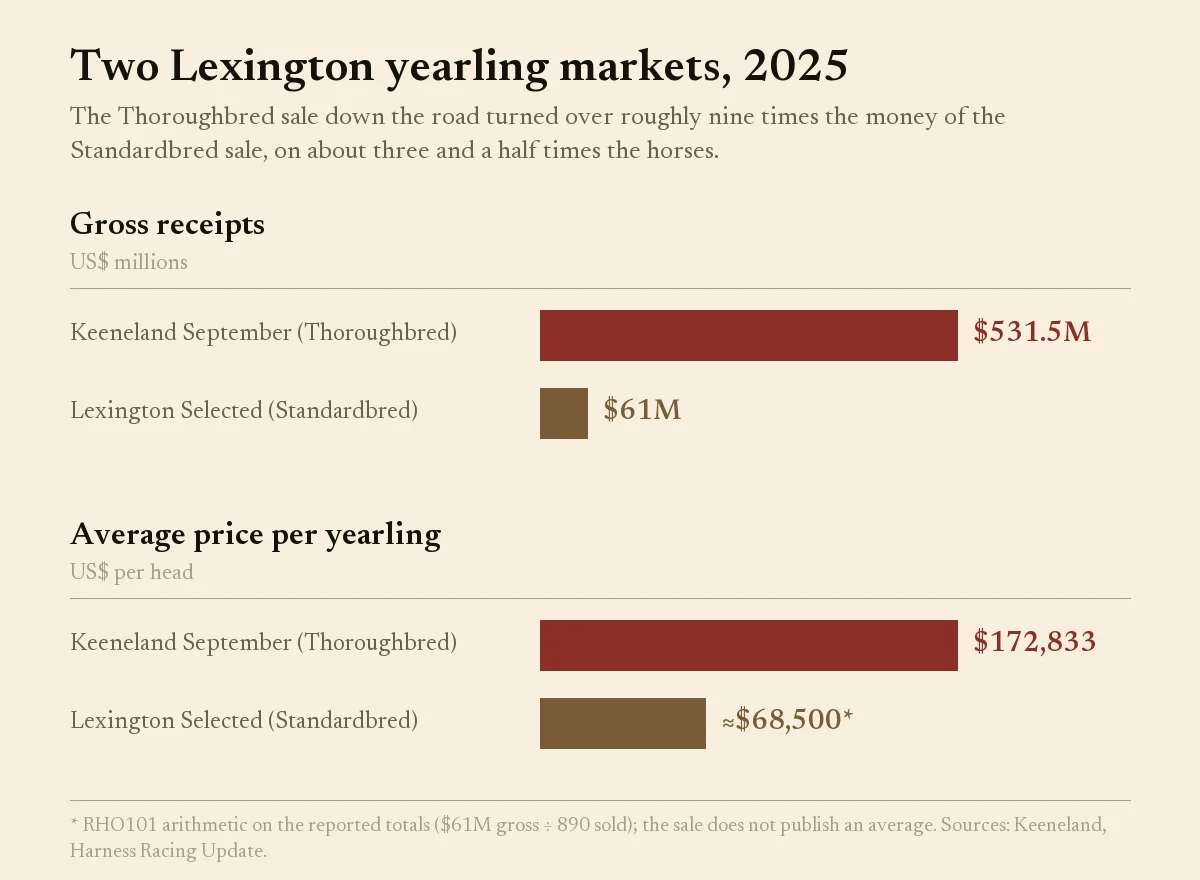
In 2025 the Lexington Selected Yearling Sale grossed about $61 million across 890 yearlings, while Keeneland September grossed $531.5 million across 3,070 — roughly nine times the money on about three and a half times the horses. Both are real, functioning markets. They are simply not the same market, and the distance between them is the clearest thing a prospective owner can learn from putting them next to each other.
Two Lexington yearling markets, 2025
Lexington Selected and Keeneland September, 2025 results
| Lexington Selected Yearling Sale | Keeneland September Yearling Sale | |
|---|---|---|
| Breed | Standardbred (harness) | Thoroughbred (flat) |
| Conducted by | Lexington Selected Yearling Sale, LLC | Keeneland Association |
| Venue | Fasig-Tipton Sales Pavilion, Lexington, KY | Keeneland, Lexington, KY |
| Month | October | September |
| 2025 gross | About $61 million | $531.5 million |
| 2025 yearlings sold | 890 | 3,070 |
| 2025 average | Not published (about $68,500 on the reported totals) | $172,833 |
| 2025 median | Not published | $80,000 |
| Cataloged | Not published in the sources reviewed | 4,686 |
What the price gap tells you about the two sports
A Standardbred yearling at the sport’s flagship sale cost roughly 40% of what a Thoroughbred yearling cost at Keeneland September in 2025 — about $68,500 against $172,833. That gap is the honest headline of this comparison, and it is worth more to a prospective owner than any amount of tier decoding.
Where I would push back on the obvious conclusion is the leap from a cheaper purchase to a cheaper year. Acquisition is the smaller half of the arithmetic in either sport. A horse’s training, veterinary, farrier, shipping and entry bills arrive every month whether the yearling cost $60,000 or $600,000, and those recurring costs are where most owners’ budgets actually fail — which is why our annual cost breakdown spends far more space on the bills than on the purchase price. A lower average sale price is a genuine difference between the two markets. It is not, on its own, evidence that the cheaper sport is affordable.
About $68,500
The average price per yearling at the 2025 Lexington Selected sale, on the reported $61 million gross across 890 sold — against $172,833 at Keeneland September.
Who should actually be looking at a Standardbred yearling sale
A Standardbred yearling sale suits a buyer who has decided they want harness racing — the sulky, the pari-mutuel harness circuit, that community of trainers and drivers — and not a buyer who arrived there looking for a cheaper way into flat racing. The two sports share an animal and almost nothing else about the ownership experience.
Consider a first-time owner who has spent a winter reading about Thoroughbred partnerships, then finds a $40,000 yearling at a Standardbred sale and reasons that the same money buys more horse. It might. But the trainers they researched do not train harness horses. The tracks they planned to visit on a race day do not card harness races. The partnership structures they compared were written for Thoroughbred syndicates. Every piece of preparation they did points at a different sport, and a lower hammer price does not carry any of it across.
That is not an argument against harness ownership. It is a well-run sport with a lower cost of entry and a real, established owner base. It is an argument against choosing a sport by accident because a sale name looked familiar. If a lower entry cost is the driver, the honest comparison to make first is against the fractional and partnership routes we cover in what low-cost racehorse shares actually cost you — which keep you in the sport you were researching.
Reading a sale name without being misled
A sale name reliably tells you three things — the conducting company, the location and roughly when it runs — and reliably tells you nothing about breed, price band or whether the catalog suits a first-time buyer. Sorting the two categories takes a minute and removes most of the confusion that sale calendars create.
What a sale name tells you, and what it does not
| The name usually tells you | The name never tells you |
|---|---|
| Who conducts the sale, or the venue it runs in | Which breed is cataloged |
| The city or region | The price band you should expect |
| Roughly when in the year it falls | Whether the catalog suits a first purchase |
| That the company has curated the catalog in some way | What that curation actually required |
| What the conditions of sale bind you to |
The same discipline applies to what you are buying, not just where. A yearling, a weanling and a two-year-old in training are three different purchases with three different risk profiles, and the sale name will not distinguish them either — we set the differences out in the racehorse age stages explained for buyers.
How to check you are at the right sale before you spend anything
Four checks — breed, conducting company, conditions of sale, and dates — answer whether a sale is the one you want, and all four are free and published on the sale’s own material. I would rather a buyer lose ten minutes on this than a flight, a hotel and a wasted vetting appointment.
Four checks before you travel to a horse sale
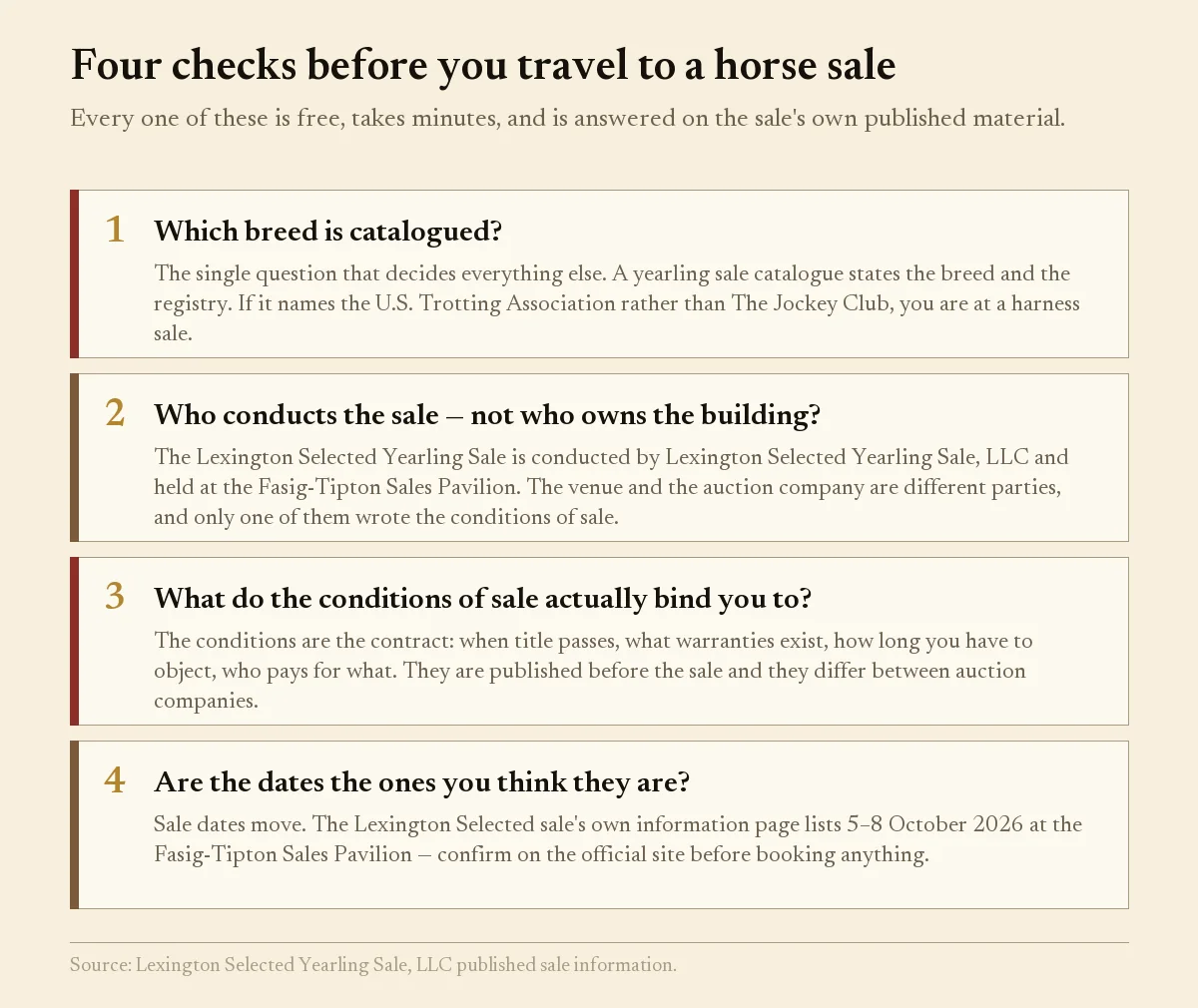
The venue check is the one that catches people here. Fasig-Tipton owns the pavilion; Lexington Selected Yearling Sale, LLC conducts the sale inside it. The conditions of sale you agree to when you raise a hand are the conducting company’s, not the building owner’s, and they are the document that decides when title passes and what recourse you have if the horse is not what the page said.
If you clear those four checks and land on the Thoroughbred side, the next question is which ownership route you are buying through at all — outright, partnership, syndicate or claim. That is the ground our guide to every racehorse ownership path covers, and it is worth settling before a catalog is open in front of you.
Common questions about the Lexington Selected Yearling Sale
Is the Lexington Selected Yearling Sale a Thoroughbred sale?
No. The Lexington Selected Yearling Sale catalogs Standardbreds — harness horses that trot or pace in front of a sulky. Thoroughbred yearlings sell at separate auctions run by separate companies, the largest of which is Keeneland September, held in the same city a few weeks earlier.
Why is it held at the Fasig-Tipton pavilion if it isn’t a Fasig-Tipton sale?
Because the pavilion is a venue that can be booked, and it sits in the center of the Kentucky bloodstock world. Lexington Selected Yearling Sale, LLC conducts the auction; the Fasig-Tipton Sales Pavilion is where it happens. Buyers should read the conditions of sale published by the conducting company, not assume the venue’s usual terms apply.
When is the Lexington Selected Yearling Sale?
It runs in early October. The sale’s own information page lists 5–8 October 2026 at the Fasig-Tipton Sales Pavilion, and the 2025 renewal ran over five sessions ending 3 October. Sale dates and session counts move between years, so confirm on the official sale site before booking travel.
Are Standardbred yearlings cheaper than Thoroughbred yearlings?
At the flagship sales in 2025, yes — about $68,500 average at Lexington Selected against $172,833 at Keeneland September. Purchase price is only the entry fee, though. Training, veterinary, farrier and shipping bills arrive monthly in both sports, and those recurring costs decide whether an ownership budget holds.
The bottom line for a Thoroughbred buyer
If you are buying a Thoroughbred, the Lexington Selected Yearling Sale is not your sale, and no amount of catalog study will change that. The name is a coincidence of vocabulary and venue, and it has almost certainly cost more than one prospective owner an afternoon of research and possibly a trip.
What we would do
Before spending an hour on any sale, open its catalog and find the registry it names. The Jockey Club means you are looking at Thoroughbreds. The U.S. Trotting Association means harness. Everything else in the sale’s marketing — the tier word in its title, the venue, the month — is downstream of that one line.
The number worth carrying out of this piece is the one in the table: 890 yearlings, about $61 million, in a building whose name belongs to somebody else.
About the Author

Calvin Johnson is a Thoroughbred racehorse owner, day trader, and independent racing analyst with more than a decade of firsthand ownership experience. He has participated in nearly every common structure in horse racing — fractional platform shares, traditional syndicates, LLC partnerships, claiming ventures, and outright ownership — across more than two dozen horses. Calvin writes about racehorse ownership the same way he approaches markets: by studying risk, incentives, fees, and whether the people controlling the deal are aligned with the investors behind it.
- Calvin Johnsonhttps://racehorseownership101.com/author/calvin-johnson/

- Calvin Johnsonhttps://racehorseownership101.com/author/calvin-johnson/

- Calvin Johnsonhttps://racehorseownership101.com/author/calvin-johnson/

- Calvin Johnsonhttps://racehorseownership101.com/author/calvin-johnson/