The Keeneland September Yearling Sale produced the highest gross ever recorded at a Thoroughbred auction anywhere in 2025: 3,070 yearlings sold for $531.5 million, at a $175,807 average and an $80,000 median. Those are the figures every recap quoted, and they describe a sale most first-time owners will never bid in. September is not one auction. It is twelve sessions across two weeks, divided into books, and the last session of 2025 sold 230 yearlings at a $15,653 average on a $9,000 median. The number that should set your budget is not the sale’s. It is your session’s.
The short version
- September sells one thing: yearlings. If you want a horse that can run next season, this is the right room, and it is the room the November breeding stock sale is not.
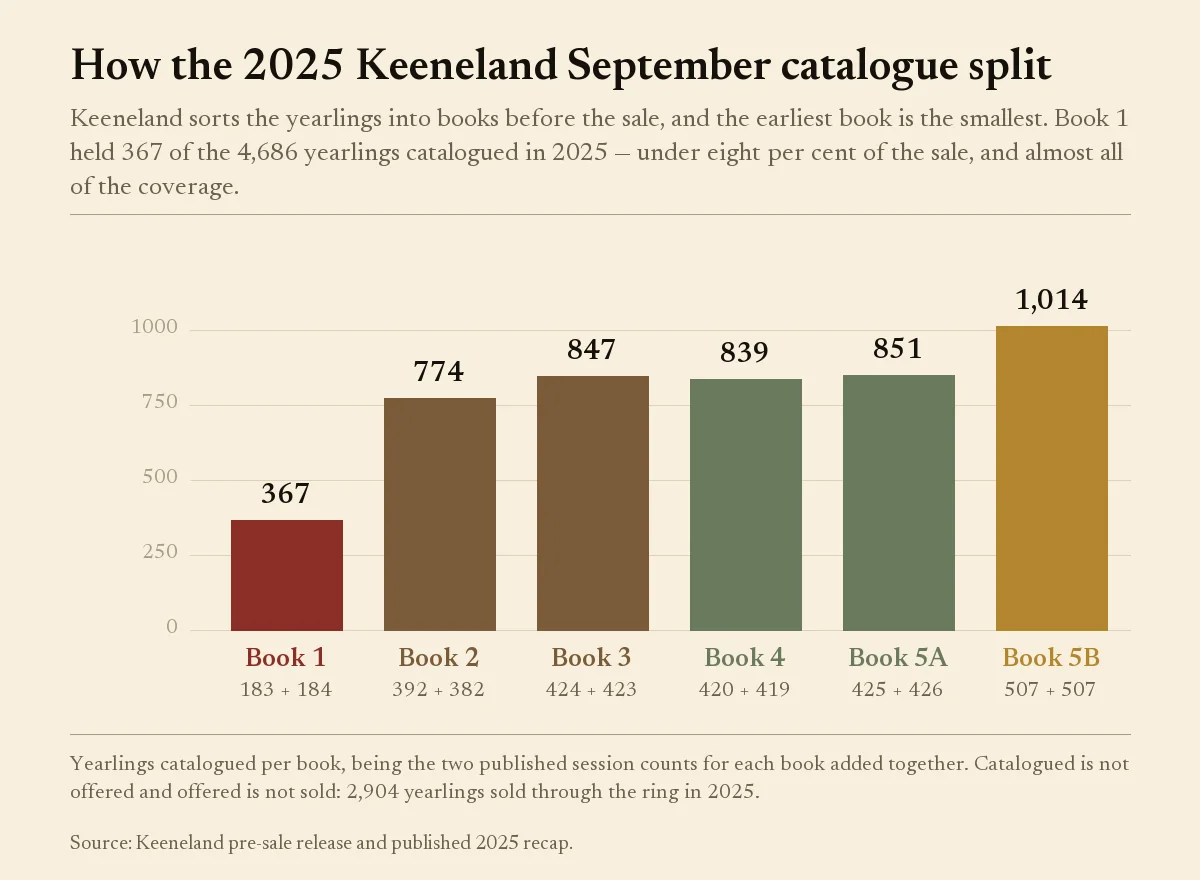
- The books are a price ladder, not a prestige ladder. Book 1 was 367 of 4,686 catalogued yearlings in 2025 — under eight per cent of the sale.
- The sale-wide average is the wrong planning number. Sessions differ by an order of magnitude, and nobody at Keeneland is going to tell you which one you belong in.
What the Keeneland September Yearling Sale is
The Keeneland September Yearling Sale is a twelve-session public auction of yearling Thoroughbreds held each September in Lexington, Kentucky. In 2025 it catalogued 4,686 yearlings — 2,398 colts and 2,288 fillies — across sessions running September 8 to September 20, and sold 2,904 of them through the ring for $510.5 million; post-sale transactions lifted the final tally to 3,070 horses and $531.5 million. A yearling is a horse in the calendar year after the year it was foaled: too young to race, and roughly a year away from a first start. Keeneland divides the catalogue into numbered books, and the book a hip lands in reflects what its consignor expects it to bring. The 2026 sale runs September 14 to September 26.
You’re already studying the sport. Own a piece of it.
Every question you’re asking is one owners ask every morning at the barn. The free guide takes you from fan to owner.
The date is the first thing worth understanding. A September yearling is old enough to be judged on its physical self and still young enough that nobody knows anything. There are no race records in that catalogue — only a pedigree, a conformation, a set of X-rays and a price, and the price is set by people who trade horses for a living.
What is actually for sale, and what is not
Keeneland September sells yearlings and nothing else, which makes it the simplest catalogue Keeneland publishes. Every hip is the same kind of animal at the same stage of life. That is a real advantage for a first-time buyer: at a mixed sale you have to work out what you are bidding on before you can decide whether you want it. Here the only questions are which horse and how much.
What it does not sell is anything that can earn next month. A yearling bought in September will not start until the following year at the earliest, and many never start as two-year-olds at all. Between the fall of the hammer and a first race sits roughly a year of training bills, vet work and board with no purse income against it. Buyers who want a runner sooner shop the two-year-olds-in-training sales instead, a trade-off we have broken down in yearling versus two-year-old for partnership buyers.
How the books work, and why they are not a prestige ladder
Keeneland September is catalogued into books running from Book 1 to Book 5B, and the book a yearling sits in is a commercial forecast rather than a quality verdict. Consignors submit horses, Keeneland’s team inspects and sorts them, and the earliest sessions get the pedigrees and physicals expected to draw the deepest bidding. Everything else about a session follows from that sort.
The start times are the tell nobody explains. In 2025 Book 1 began at 1 p.m., Book 2 at 11 a.m., and every session from Book 3 onward at 10 a.m. A one o’clock start exists because Book 1 sells slowly — each hip is walked, examined and bid over. A ten o’clock start with more than 500 catalogued exists because those sessions have to move.
Keeneland September 2025: books, dates and catalogue size
| Book | 2025 dates | Session start | Yearlings catalogued per session |
|---|---|---|---|
| Book 1 | Monday–Tuesday, Sept. 8–9 | 1 p.m. | 183 and 184 |
| Book 2 | Wednesday–Thursday, Sept. 10–11 | 11 a.m. | 392 and 382 |
| Book 3 | Saturday–Sunday, Sept. 13–14 | 10 a.m. | 424 and 423 |
| Book 4 | Monday–Tuesday, Sept. 15–16 | 10 a.m. | 420 and 419 |
| Book 5A | Wednesday–Thursday, Sept. 17–18 | 10 a.m. | 425 and 426 |
| Book 5B | Friday–Saturday, Sept. 19–20 | 10 a.m. | 507 each day |
Read the right-hand column again. Book 1 held 367 of the 4,686 yearlings catalogued in 2025 — under eight per cent of the sale — while Books 5A and 5B together held more than a third of it. The part of Keeneland September that gets written about is the small part. The part a first-time owner is most likely to buy in is the part that runs on the second weekend, at ten in the morning, when the trade press has gone home.
Keeneland September 2025 catalogue by book
The average everyone quotes, and the number underneath it
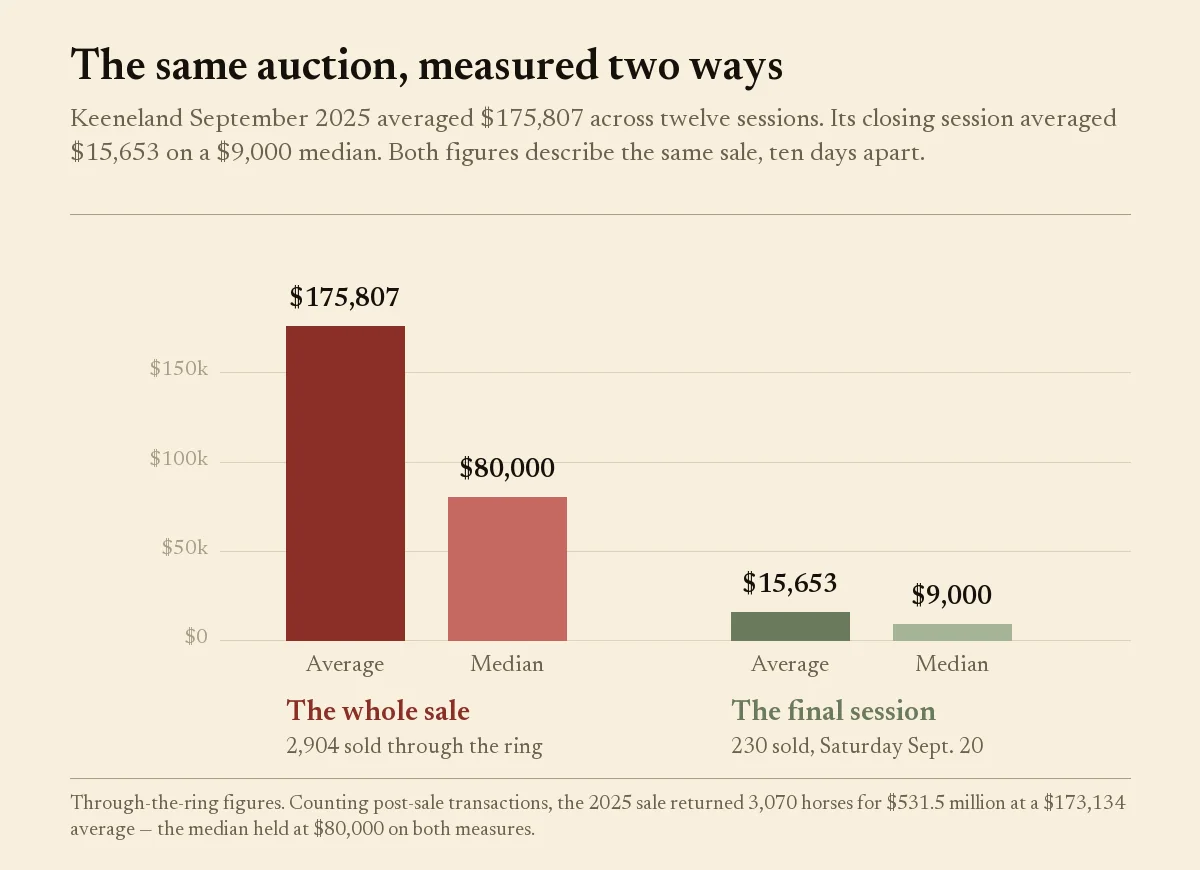
Keeneland September’s 2025 average of $175,807 sat at more than twice its $80,000 median, and the sale’s final session averaged $15,653. That is one auction, ten days apart. The headline figures were genuinely strong and the trade coverage was right to say so: through-the-ring sales rose 23.99 per cent over 2024, the average climbed 16.78 per cent over the previous record of $150,548, the median rose 14.29 per cent over $70,000, and 56 yearlings made seven figures against an old record of 40 set in 2005. A record market is a record market. What no recap does is tell a prospective owner which of those numbers has anything to do with them.
Keeneland September 2025: the whole sale against its final session
| Measure | Whole sale, through the ring | Final session, Sept. 20 |
|---|---|---|
| Yearlings sold | 2,904 | 230 |
| Gross | $510,544,900 | $3,600,000 |
| Average | $175,807 | $15,653 |
| Median | $80,000 | $9,000 |
| Buy-back rate | 22.29% | 20.42% |
Two averages were published for the same 2025 sale. Through the ring it was $175,807; counting the post-sale transactions that lifted the gross to $531.5 million across 3,070 horses, it was $173,134. The gap is $2,673 and it is not the interesting part. The interesting part is that the median held at $80,000 on both measures while the average moved, which is what a median is for: it does not care how much the $3.3 million Gun Runner colt made.
An average is a description of the horses at the top of the catalogue. A median is a description of the sale.
The practical consequence is that the sale-wide average is close to useless as a planning number, and the sale-wide median is only a little better. If you are shopping a Saturday session in Book 5B, the relevant comparison is that session’s own numbers, and in 2025 those were a $15,653 average and a $9,000 median. Budget against $175,807 and you will conclude you cannot afford Keeneland September. Budget against $9,000 and you will not have accounted for what happens after the hammer.
Keeneland September 2025: sale average against the final session
Who fills the room, book by book
The bidders in Book 1 are largely professionals buying for other people’s money, and they are not the bidders you will be sitting among in Book 5. The $3.3 million Gun Runner colt that topped the 2025 sale went to M.V. Magnier, White Birch Farm and Winchell Thoroughbreds — an international bloodstock operation and two established American ownerships, bidding together. That is the shape of the early sessions: agents acting on commission, breeding operations buying back into their own families, and partnerships assembled before anyone walked into the pavilion.
Later books add a different set of buyers. Pinhookers buy yearlings to resell as two-year-olds the following spring, pricing a horse on what a two-year-old sale will pay rather than on what it might win. Regional trainers buy for owners who want a runner on a specific circuit. Small partnerships and first-time individual owners buy here too, and the reason is arithmetic rather than taste.
An illustration. Consider an owner who has budgeted $40,000 for a first yearling and flies in for the Monday opening session, because that is the day everyone writes about. They watch a full afternoon of horses sell above their entire budget, conclude the sale is not for them, and go home — ten days before the sessions where $40,000 buys a well-made horse with a live pedigree. The mistake was not the budget. It was reading the sale as one room.
September or November: two different rooms
September sells yearlings to people who want to race them; Keeneland November sells breeding stock to people whose business is producing horses. The two sales are ten weeks apart at the same address and are routinely confused, usually by a buyer who has noticed that November is cheaper — a $125,572 average and a $60,000 median in 2025 against September’s $175,807 and $80,000. That discount describes what is in the catalogue rather than a bargain, and we have set out the whole comparison in our guide to what breeding stock buyers are actually doing in the November room.
The short form: if you want a horse that can be entered in a race, September is the sale, and November’s horses-of-racing-age section is the narrow exception. One more Lexington trap worth naming: the Lexington Selected Yearling Sale is Standardbred, a different breed in a different sport, and it catches out first-time buyers every autumn.
What due diligence looks like at a yearling sale
Due diligence at Keeneland September runs on three things, and all three are available before the hip walks into the ring: the catalogue page, the repository, and your own eyes on the horse at the consignor’s barn. None of them is optional, and the third is the one first-time buyers skip.
- The catalogue page. Pedigree, produce record and black type, written by the consignor within Keeneland’s formatting rules. It is accurate and it is also a sales document; the skill is knowing what a page leaves out. We walk through that page line by line in how to read a Thoroughbred sale catalog.
- The repository. X-rays and an endoscopic exam lodged by the consignor, read by your own veterinarian rather than the seller’s. This is the highest-value hour a first-time buyer spends, and we cover it in our guide to the sales repository and pre-purchase exam.
- The barn inspection. Yearlings are shown at the consignor’s barn on the grounds for days before their session. Seeing a horse walk, and seeing it more than once, is what the catalogue page cannot give you.
The buy-back rate is worth holding in mind while you do all of this. In 2025, 22.29 per cent of the yearlings that went through the ring did not sell, and the final session offered 289 of the 506 yearlings catalogued for it. Catalogued is not offered, and offered is not sold. The hip you drove to Lexington to see may never reach the ring at all.
Should a first-time owner bid — and in which book?
A first-time owner can bid at Keeneland September. The honest question is not whether the sale will take your money but whether the session you can afford is selling what you want. Our position: the later books are the right room for most first-time individual owners, and arriving without a trainer engaged is a worse mistake than arriving without enough money.
The reason is that a yearling is not a finished purchase. It is the first payment on a year of training, board, vet work and shipping before there is any chance of a purse, and the person who has to house and develop it should have seen it before you bid. A trainer who will not look at your short list is telling you something. So is a trainer who looks at every horse on it and likes them all.
Which Keeneland September book fits which buyer
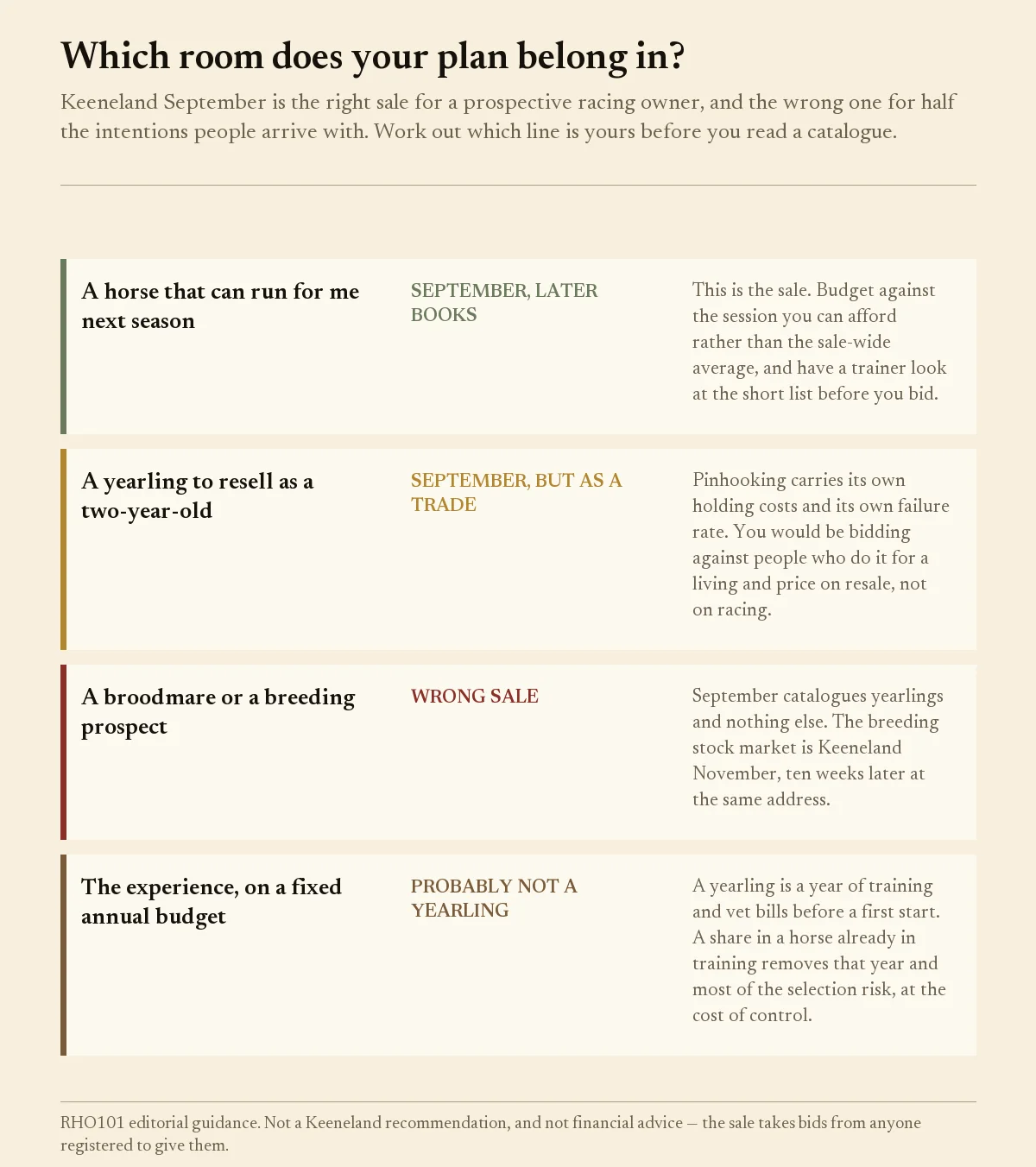
If none of those four lines describes you, the answer may be that a yearling auction is the wrong entry point rather than the wrong session. Buying a share of a horse already in training removes the year of pre-race bills and most of the selection risk, at the cost of control — a trade we set out across every route in our guide to the ways into racehorse ownership.
Common questions about the Keeneland September sale
When is the Keeneland September sale?
The 2026 Keeneland September Yearling Sale runs Monday, September 14 through Saturday, September 26. The 2025 renewal ran September 8 to September 20 across twelve sessions, with one dark day between Book 2 and Book 3. Keeneland publishes the catalogue and the session schedule on its September sale page ahead of each running.
Is the Keeneland yearling sale the same as the September sale?
Yes. Keeneland’s yearling auction is the September sale; the two names describe one event, and the full title is the Keeneland September Yearling Sale. Keeneland’s other headline auction is the November Breeding Stock Sale, which is a mixed catalogue of broodmares, weanlings, stallion shares and a small racing-age section rather than a yearling sale.
Do you need a bloodstock agent to buy at Keeneland September?
No rule requires one, and plenty of horses are bought without one. What a first-time buyer needs is somebody with sale experience on the short list before the bidding starts — an agent on a stated commission, or a trainer who inspects for their own clients. That advice is cheap against a yearling’s first year of bills, and the buyers you are bidding against have it.
Can the public attend the Keeneland September sale?
Keeneland September is a public auction and the catalogue is published online, so attending a session and walking the consignors’ barns is open to anyone taking the sale seriously. Bidding is a separate step from attending, and what it requires is set by Keeneland rather than by us — the sales office is the place to ask before you travel, not a blog.
The honest answer
Keeneland September is the right sale for a prospective racing owner, and the $175,807 average that made every headline in 2025 is not a description of the horse most of them will buy. The sale is twelve sessions wide. It contains a session where a colt makes $3.3 million and a Saturday morning where the median hip makes $9,000, and both of those days are Keeneland September. Work out which session your budget puts you in before you book the flight, and read the catalogue for that session rather than the recap for the sale.
— Race Horse Ownership 101
About the Author

Calvin Johnson is a Thoroughbred racehorse owner, day trader, and independent racing analyst with more than a decade of firsthand ownership experience. He has participated in nearly every common structure in horse racing — fractional platform shares, traditional syndicates, LLC partnerships, claiming ventures, and outright ownership — across more than two dozen horses. Calvin writes about racehorse ownership the same way he approaches markets: by studying risk, incentives, fees, and whether the people controlling the deal are aligned with the investors behind it.
- Calvin Johnsonhttps://racehorseownership101.com/author/calvin-johnson/

- Calvin Johnsonhttps://racehorseownership101.com/author/calvin-johnson/

- Calvin Johnsonhttps://racehorseownership101.com/author/calvin-johnson/

- Calvin Johnsonhttps://racehorseownership101.com/author/calvin-johnson/