
A pre-purchase exam you commission with your own vet — reading the repository films before the hammer falls — is the closest thing you get to the truth about a horse at a sale. The sale catalog is an advertisement. The repository is still only access without a warranty — and even that comes with a warning label most first-time buyers never read.
When I talk with people about to bid at their first yearling or two-year-old sale, the catalog page is what they’ve studied: the pedigree, the black type, the consignor’s name. What they usually haven’t done is open the repository, and they’ve almost never hired their own vet for a pre-purchase exam. That gap is where money gets lost. The films in the repository are posted to help sell the horse. The interpretation that protects you is something you have to go out and commission yourself.
The honest version, in three lines
- The repository is a set of x-rays — a standardized series; Keeneland, for one, requires a minimum of 36 films — usually paired with an endoscopic “scope” of the airway, posted by the consignor and hosted by the sale company.
- The sale company gives you and your vet access to those records. It does not give you a soundness warranty, and it does not read the films for you.
- Your pre-purchase exam is separate: a vet you hire and pay, whose only job is to tell you what the horse and its films mean for you — before the hammer falls and the horse is legally yours.
What a sales repository actually is
A sales repository is a private, sale-run archive where a consignor posts a horse’s recent veterinary records — chiefly radiographs (x-rays), and usually an endoscopic exam of the upper airway — so that registered buyers and their vets can inspect them before bidding. At the major thoroughbred sales, the films are taken within a set window before the sale and submitted as a standardized set; Keeneland, for example, requires a minimum of 36 films built on a series the American Association of Equine Practitioners helped standardize. The repository exists to make inspection efficient and to spare the horse repeated x-rays and scoping by every interested party. What it is not is a guarantee. The sale company hosts the records and grants access; it does not warrant soundness, and it does not interpret the films for you.
Imagine your colors on the horse at the front.
Not a bet. Not a ticket. Yours. Thousands of everyday fans own a piece of a racehorse. The free guide is how they started.
That distinction is the whole reason this piece exists. A repository is a convenience built by the seller’s side of the table. It is genuinely useful — a set of recent, standardized films on the actual horse is far more than most private buyers ever get. But convenience provided by the seller is not the same as due diligence performed for the buyer, and the difference is not academic. It decides who is looking out for your money when you raise the paddle.
The repository vs. your own pre-purchase exam
Two different things wear the word “vet” at a sale, and confusing them is the most expensive mistake a first-time buyer makes. The consignor’s veterinarian took the repository films and works for the seller. The pre-purchase exam is a separate engagement with a vet you retain, whose loyalty runs only to you. The repository is the evidence. Your vet is the person reading it on your behalf, asking the questions the sale company and consignor have no reason to volunteer.
Here is the part that surprises people: the films are provided, but the reading is not. You can pull up a full repository set and see thirty-six gray images that mean nothing without training. A bloodstock vet reading those same films sees a chip in a fetlock, a lucency in a stifle, or an airway that does not open the way it should — and, more importantly, tells you whether any of it should change your bid or stop it.
Who provides what: the repository vs. your vet
| Dimension | The sale repository | Your pre-purchase exam |
|---|---|---|
| Who it works for | The consignor and the sale — it facilitates the transaction | You, the buyer, and no one else |
| What you receive | Provided x-rays and, often, a scope video plus records | An independent read of those films, and usually a clinical look at the horse |
| What it costs you | Nothing beyond registering for access | Your vet’s fee — you commission and pay for it |
| What it promises | Access only. No warranty of soundness | An opinion on what the findings mean for your intended use |
| Interpretation | Not included | The entire point |
If you take one idea from this article, take that last row. The repository hands you the films; your vet is the only person in the process whose job is to tell you what they mean for you. When we say the catalog is the advertisement and the repository is the due diligence, this is the seam we mean — and it is why the reading, not the films, is where you spend money to protect yourself.
What’s in a set of sale x-rays
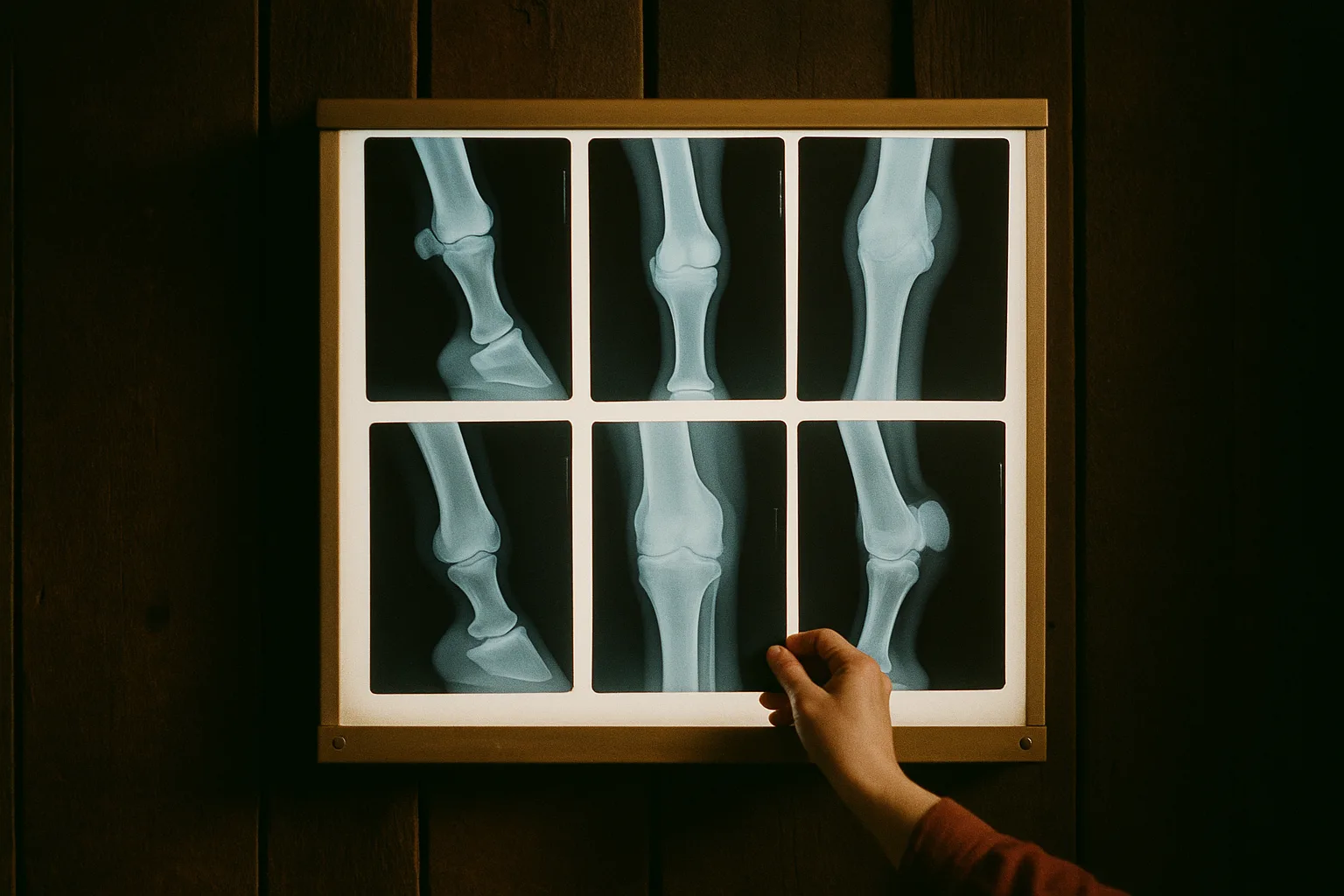
A repository set is not one hero x-ray. It is a standardized series covering the joints that matter most for a racing career — the knees, fetlocks, hocks, and stifles — shot from prescribed angles so that one sale’s films can be compared against another’s. Keeneland’s minimum of thirty-six films is built on a set the AAEP helped define, and the films are recent by rule: taken within roughly three weeks of the sale, not pulled from a yearling’s file two years back. Recency matters, because young horses change fast, and a clean film from last spring tells you little about the horse standing in the barn today.
Radiographs are usually not the whole file. Most repository sets also include an endoscopic exam — the “scope” — a camera look at the upper airway that grades how well the throat opens. Some sets add bloodwork. What the repository almost never includes is the thing buyers most want and can’t have from a static film: a dynamic picture of the horse actually breathing and moving under exertion. A resting scope catches the clearest airway problems and misses subtler ones. This is exactly why your own vet, and sometimes a follow-up exam, still matters after the repository has been read.
How to read a finding
The word that empties the color out of a first-time buyer’s face is “finding.” A finding is simply something the films show that is worth noting — and most horses that sell have at least one. A finding is not a verdict. What it means depends on which structure it sits in, how big it is, whether it is likely to progress, and what you plan to ask the horse to do. That judgment is a licensed vet’s to make, not a buyer’s and not this article’s. What follows is a translation guide, so the terms stop being frightening noise — not a substitute for your own vet’s read on your own horse.
Common repository findings and what they signal
| Finding | What it is | How buyers tend to weigh it |
|---|---|---|
| Joint “chip” (chip fracture) | A small fragment of bone or cartilage in a joint, often related to osteochondrosis | Depends heavily on joint, size, and location. Many are minor and priced in; some are removed arthroscopically before or after sale |
| OCD lesion (osteochondrosis) | A developmental defect in cartilage and bone, commonly seen in hocks and stifles | Ranges widely. Some are cosmetic or resolve; others sit in a joint that carries real workload and matter more |
| Sesamoiditis / sesamoid change | Changes in the small sesamoid bones behind the fetlock | Watched closely — can flag stress on the suspensory apparatus. The grade and the vet’s read drive how much weight it gets |
| Scope grade (laryngeal function, 1–4) | How fully the airway opens; grade 4 is complete paralysis of the cartilage — the classic “roarer” | Grades 1–2 are generally unremarkable; grades 3–4 are a genuine wind concern that can cap value and may need surgery |
Two cautions on that table. First, the grades and their meaning are a veterinarian’s call on the specific horse — a “grade 3” scope described by the American College of Veterinary Surgeons is a starting point for a conversation, not a number you should act on alone. Second, findings interact with age. A change that is expected and minor in a two-year-old can read differently in a yearling, which is one reason the age you buy at changes what the films tell you. That connection is worth understanding before you bid — it is the subject of our companion piece on choosing between a yearling and a two-year-old.
Deal-breaker, livable, or priced-in
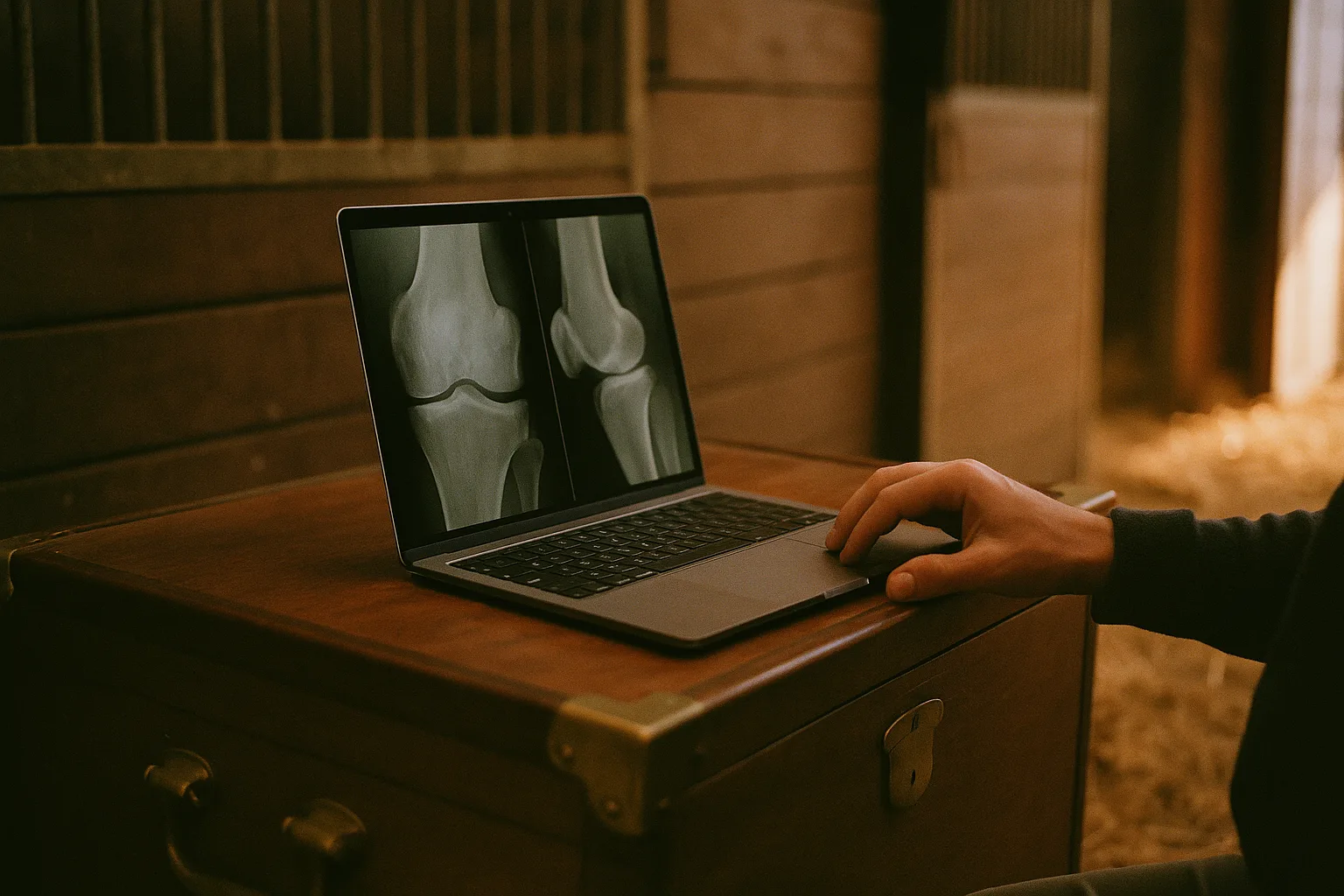
Experienced buyers do not sort findings into “clean” and “dirty.” They sort them into three buckets, and learning to think this way is most of what a good bloodstock vet is teaching you. A finding is a deal-breaker when it threatens the horse’s ability to do the job you’re buying it for — an airway that won’t support a route horse, a joint change likely to progress under training. It is livable when it is real but unlikely to limit the career you have in mind. And it is priced-in when the market already knows about it and the number reflects it — the horse is worth less because of the finding, and if you pay the lower number, you have not been surprised.
Consider a buyer who falls for a colt on the catalog page, loves him in the barn, and then hears from a hired vet that the films show a stifle lesion in a joint that carries load. The vet doesn’t say “don’t buy.” The vet says the finding is real, it sits somewhere that matters, and here is the range of outcomes. That is the moment the exam earns its fee — not by handing down a pass or fail, but by turning a beautiful horse into a priced risk the buyer can actually weigh. The buyer who skipped the exam learns the same fact later, after the money is gone and the horse is theirs.
None of these buckets is fixed. A finding that is a deal-breaker for a would-be classic prospect can be perfectly livable for a horse you intend to run at a claiming level. The same film, the same finding, and two honest, opposite decisions — because the buckets depend on your plan, not just the horse. A repository finding also moves the horse’s value directly, which is why the reading feeds straight into the harder question of what a racehorse is actually worth.
Who pays, and when
The economics are simpler than the medicine. Access to the repository is free once you register with the sale company; the consignor has already paid to produce and post the films. What you pay for is your own vet’s time — pulling and reading the repository set, scoping or examining the horse in the barn if you ask for it, and giving you an opinion you can bid on. Relative to a purchase running into five or six figures, that fee is small. Skipping it to save it is the false economy at the center of this whole subject.
Timing is tight, and it is not on your side. Repository films at a major sale are posted in the days before a horse sells, and your vet needs to read them before the horse walks into the ring, not after. At a sale moving through dozens of hips an hour, that means lining up your vet early, giving them the hip numbers you care about, and accepting that some horses you like will sell before you can vet them. The buyers who do this well treat the repository as a pre-bid deadline, not a post-bid formality.
The sale company grants access to the films. It does not warrant the horse. Those are not the same promise, and only one of them protects you.
Your pre-bid vet checklist
You do not need to read an x-ray. You need to hire someone who can, and ask the right questions around them. Before you bid, walk through this with your vet and, where it fits, the consignor.
- Ask your vet: Have you read the full repository set on this hip, and is anything in it a deal-breaker for the career I have in mind?
- Ask your vet: Is there a finding here that is likely to progress under training, versus one that is stable and cosmetic?
- Ask your vet: Does the scope grade concern you, and would you want a dynamic or follow-up exam before I commit?
- Ask your vet: If this were your money, is this a walk-away, a livable risk, or a fair price given the findings?
- Ask the consignor: Has this horse had any surgery — for example, arthroscopic removal of a chip — and is that reflected in the films?
- Ask yourself: Have I set a number that already accounts for what my vet found, so I am not bidding on the catalog and ignoring the films?
If the horse you want is being sold privately or out of a claiming race, the repository may not exist at all — a different due-diligence problem, and a sharper one. The catalog literacy that comes before any of this, meanwhile, is its own skill; if you have not read our guide to reading a thoroughbred sale catalog, start there and come back, because the catalog page and the repository are the two halves of the same decision. All of it sits inside the larger question of how to buy a racehorse in the first place.
Frequently asked questions
Can I see the repository before the sale?
Yes, once you register. Sale companies open repository access to registered buyers and the veterinarians acting for them, typically in the days before a horse sells. Access to some records — endoscopic video in particular — is gated: a vet may have to name the buyer they represent or arrange access through the consignor. Register early and get your vet credentialed before the session, not during it.
What if there’s no repository, like a private sale or a claim?
Then the burden shifts entirely to you. A private purchase can still include a pre-purchase exam if the seller allows it — negotiate that access before you agree to buy. A claim is the hard case: you claim a horse out of a race sight-unseen and as-is, with no repository and no vetting, and the horse becomes yours in the running of the race, sound or not. That “no PPE, buy as-is” reality is exactly what separates claiming from a repository sale, and it is why the two demand completely different nerves.
Does a clean pre-purchase exam guarantee a sound horse?
No, and any vet worth hiring will tell you so plainly. A pre-purchase exam is a snapshot of one horse on one day, read by one person. It lowers your risk; it does not remove it. Films can be clean and a horse can still go wrong, and a horse with a noted finding can race for years. What the exam buys you is not certainty — it is an informed decision, made before the money leaves your hands instead of after.
One last point, because it is the honest one: this article is education, not veterinary advice. Every horse, every finding, and every buyer’s plan is different, and the only read that should move your bid is the one from a licensed vet you have hired to look at the specific horse. Commission that exam, ask the questions above, and let the films inform the number before you raise the paddle.
— Race Horse Ownership 101
About the Author

Calvin Johnson is a Thoroughbred racehorse owner, day trader, and independent racing analyst with more than a decade of firsthand ownership experience. He has participated in nearly every common structure in horse racing — fractional platform shares, traditional syndicates, LLC partnerships, claiming ventures, and outright ownership — across more than two dozen horses. Calvin writes about racehorse ownership the same way he approaches markets: by studying risk, incentives, fees, and whether the people controlling the deal are aligned with the investors behind it.
- Calvin Johnsonhttps://racehorseownership101.com/author/calvin-johnson/

- Calvin Johnsonhttps://racehorseownership101.com/author/calvin-johnson/

- Calvin Johnsonhttps://racehorseownership101.com/author/calvin-johnson/

- Calvin Johnsonhttps://racehorseownership101.com/author/calvin-johnson/
