
Every thoroughbred foaled in the Northern Hemisphere turns a year older on January 1, which means two yearlings standing in the same sale catalog at the same listed age can be up to 214 days apart in real age. In the 2014 and 2015 British and Irish foal crops, half the crop arrived within 80 days of January 1 and the rest were spread across the four months after that. The gap is measurable in what those horses went on to earn: each additional week after January 1 that a foal was born was associated with a 3% fall in second-year prize money and a 3% rise in the odds of earning nothing at all. What the gap did not do was move the price. At one large British yearling sale, a horse’s age in days had no significant effect on what buyers paid for it. The ring is not discounting for the birth date. The owner is absorbing it.
The short answer
- A January foal and a May foal in the same crop share one official birthday and one catalog age line. The real gap between them can run to seven months.
- That gap tracks with earnings. It does not appear to track with price — which means the buyer, not the market, is carrying it.
- The best available evidence is British and Irish, not American, and it is about averages across thousands of horses rather than about the horse in front of you. Treat it as one input, not a rule.
Why every Northern Hemisphere thoroughbred has a January 1 birthday
Thoroughbred racing assigns every horse foaled in the Northern Hemisphere an official birthday of January 1 in its year of birth, no matter what date it was actually born. A horse foaled on February 2 and a horse foaled on June 20 of the same year are both yearlings on the same day, both two-year-olds on the same day, and both eligible for exactly the same races. The convention comes from nineteenth-century British racing and it survives because the alternative is unworkable: without a single shared date, age-restricted racing would need a rolling eligibility calculation for every runner in every race, and a classic run in May would be contested by horses months apart in official age. Thoroughbred Daily News has written on the universal birthdate and its practical consequences for breeders.
The Sport of Kings has a side entrance. Here’s the key.
Regular people own racehorses — together, in partnerships — and stand in the paddock like they were born there. The free guide shows you the way in.
The rule does its job. Race conditions stay simple, the stud book stays clean, and nobody argues about whether a horse is eligible for a two-year-old maiden. But an administrative date that makes racing legible also flattens something a buyer might want to see. The catalog tells you the crop. It does not tell you where in the crop.
One note before we go on. Southern Hemisphere horses run on the same logic with a different anchor date, so everything below applies to Northern Hemisphere crops only. If you are looking at an imported horse or a shuttle stallion’s stock, the arithmetic changes.
The gap the birthday hides: 214 days inside a single crop
Within one Northern Hemisphere foal crop, the spread between the earliest and latest foal ran to 214 days in the largest study of the question, and half of all foals were born within 80 days of January 1. That is the whole of the thing. The official birthday is one date; the actual births are a four-to-seven-month season, and where a horse falls in that season is a fact about the horse that the age line in the catalog cannot carry.
The shape of that season is not random. The crop clusters early — half of it inside 80 days — which is what you would expect in a sport where the calendar rewards an early arrival. But mares do not all conceive on schedule, some are covered late by design, and a foal that arrives in May is not a mistake — it is the ordinary result of a breeding season that cannot be compressed into eight weeks. So every crop has a front and a back, and every sale catalog mixes them without saying so.
One crop, spread across 214 days
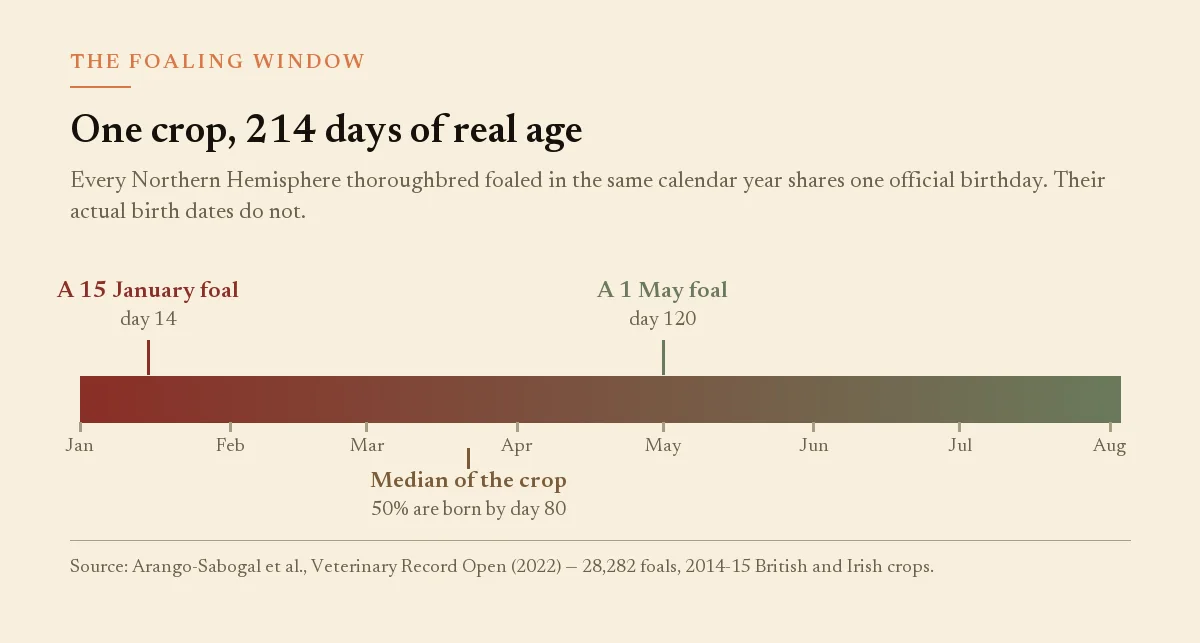
A January foal and a May foal on the same sale day
| Foaled January 15 | Foaled May 1 | |
|---|---|---|
| Official birthday | January 1 | January 1 |
| Age line in the catalog | Yearling | Yearling |
| Days after January 1 | 14 | 120 |
| Days actually lived on a mid-September yearling sale day | 608 | 502 |
| Position in the crop | Ahead of half the crop | Behind half the crop |
A hundred and six days is a long time in a young animal. It is the difference between a horse that has had another winter of growth behind it and one that has not, and at the yearling sales, where much of the judgment is made off a horse walking a shed row, it is the kind of difference that can get read as quality.
What the birth date did to earnings
Later-born foals earned less: in a study of 28,282 foals from the 2014 and 2015 British and Irish crops, every additional seven days after January 1 was associated with a 3% decrease in total second-year prize money and a 2% decrease in the third year. The work, by Arango-Sabogal and colleagues, was published in Veterinary Record Open in 2022 and followed the crop through to the end of its third year, by which point 9,456 of those foals had raced.
What each extra week after January 1 did to earnings
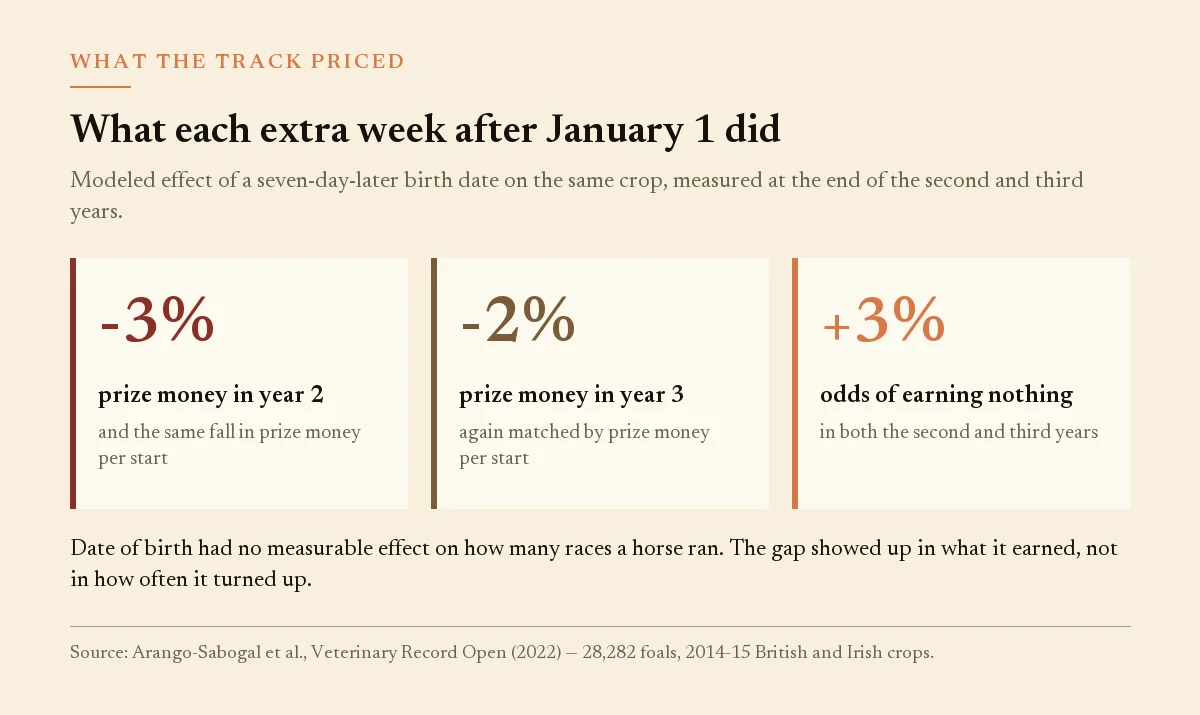
Two details in that result deserve more attention than the headline percentage. The first is where the effect showed up. Date of birth had no measurable association with how many races a horse ran — later foals turned up as often as early ones. The penalty landed on what they earned when they got there, and on the odds of earning nothing at all, which rose 3% per additional week in both the second and third years.
The second is that the authors were careful about what their own data could and could not explain. They noted plainly that environmental factors — the trainer, the choice of races entered — may explain race performance better than sales data does. A birth date predicts nothing on its own. It is one small pressure among much larger ones, consistent enough to show up across 28,282 horses and nowhere near decisive for any single one of them.
The later foals ran just as often. They just earned less when they did.
What the birth date did to the price: almost nothing
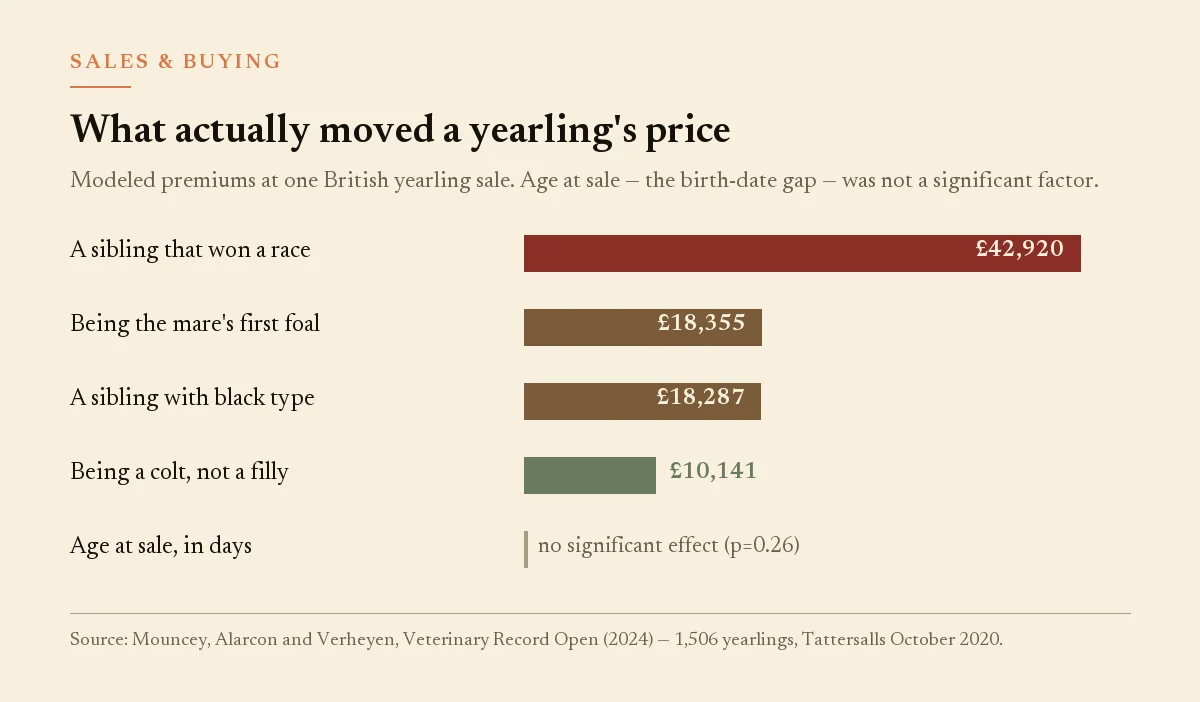
At Tattersalls October in 2020, a yearling’s age in days had no significant association with its sale price — the modeled coefficient was 0.001 with a p-value of 0.26. That result comes from a study of 1,506 yearlings by Mouncey, Alarcon and Verheyen, also published in Veterinary Record Open, which tested foaling date alongside pedigree, sex, consignment and stallion economics and then validated the model against 1,542 yearlings from the following year’s renewal.
What the ring did pay for was pedigree. A sibling that had won a race carried a premium of roughly £42,920. Being the mare’s first foal was worth about £18,355, a sibling with black type about £18,287, and being a colt rather than a filly about £10,141. Stallion covering fee was the other heavyweight. Against that, the number of days a horse had been alive did not register.
What actually moved a yearling’s price at Tattersalls October
Put the two studies side by side and the shape of the problem appears. One says the birth date is associated with what a horse earns. The other says the birth date is not associated with what a horse costs. If both hold, then the market is selling early foals and late foals at the same price for a measurably different expected return, and the person who eats that difference is the person who signs the ticket.
I would not push that further than the evidence goes, and here is where it stops. Both studies are British and Irish. The price study is one sale, in one year, validated against one more — its authors said so themselves, flagging that using data from a single sale could affect how far the result generalizes. American sales have different buyers, different purse structures and different racing calendars, and no equivalent published analysis of a Keeneland or Fasig-Tipton catalog exists that I can point you to. What we have is a strong signal from a large, well-documented dataset in a comparable racing jurisdiction. That is worth knowing. It is not worth treating as a law.
What this means when you are the one bidding
If the sale ring is not pricing the birth-date gap, the buyer has to price it. I read the two findings together as a pricing problem rather than a horse problem, and that changes what a foaling date is for: a number that belongs in the same column as the vet report and the walk video when two horses are otherwise close, rather than a reason to bid or pass on its own.
Consider a buyer choosing between two colts in the same book, by different but comparably priced stallions, with similar pages and similar vettings. One was foaled in early February, the other in late May. On the evidence above, those two horses should not be worth the same money — and if the underbidder is not thinking about it either, they very likely will be. Asking a consignor for the foaling date takes about ten seconds and collects an input the rest of the room has agreed to ignore.
It cuts the other way too, and that is the part worth holding onto. A late foal carries a small statistical headwind that nobody in the ring is charging you for — which means any discount you negotiate for yourself on that basis is yours to keep.
When a late foal is a bargain, and when it is a trap
A late foal is worth buying when the discount is real and the plan is patient; it becomes a trap when the buyer has committed to a calendar the horse cannot meet. The distinction is almost entirely about what you intend to do with the horse in its first eighteen months.
- Reasonable: you are buying to race at three and beyond, you have the budget to let the horse take its time, and the price reflects a horse the market has already looked past for other reasons.
- Reasonable: the horse is physically forward despite the date. Foaling date is a population average, not a measurement of the animal in front of you, and a well-grown May foal has already answered the question the date was asking.
- Risky: your plan depends on early two-year-old starts, a specific sale or race series with a fixed date, or a resale at a two-year-olds-in-training sale where the horse will be asked to breeze against horses months older.
- Risky: you are paying a full-maturity price for a horse that is not yet mature — buying the physical the date explains, at a number that assumes the physical is the horse’s ceiling rather than its current position.
How to find a horse’s actual foaling date
A thoroughbred’s actual foaling date is recorded, not hidden — it is captured at registration and it is the basis on which researchers built both studies above from sale and stud-book records. The work for a buyer is remembering to go and look for it, because nothing in the sale process will put it in front of you.
- Ask the consignor directly, at the barn, before the horse goes through the ring. It is an ordinary question with an ordinary answer, and how readily it comes is itself mildly informative.
- Ask to see the registration paperwork. The foaling date is on the horse’s registration record, and a consignor with nothing to manage will show you.
- Check the date against what you are looking at. A late foal that already looks the part is a different proposition from a late foal that looks late — the date is context for the physical, not a substitute for inspecting it.
- Write it down next to the hip number before the session starts, so you are comparing horses on it rather than remembering it afterward. Our guide to reading a thoroughbred sale catalog covers the rest of what belongs on that sheet.
Questions buyers ask about the January 1 birthday
Why is a horse’s birthday January 1 and not its real birth date?
Because age-restricted racing needs one shared date. Every Northern Hemisphere thoroughbred becomes a yearling, a two-year-old and a three-year-old on January 1, which is what makes it possible to write a race for two-year-olds without calculating each runner’s eligibility individually. The convention comes from nineteenth-century British racing and it applies to registration and race eligibility, not to the horse’s biology.
Does foaling date change what a yearling sells for?
On the best published evidence, no. A study of 1,506 yearlings at Tattersalls October in 2020 tested age at sale in days against price and found no significant association (p=0.26), while pedigree signals and stallion covering fee did most of the work. That finding is from one British sale and has not been reproduced on an American catalog, so treat it as strong evidence rather than settled fact.
Is an early foal always the better buy?
No. The measured effect is an average across tens of thousands of horses and it is small per week — 3% of second-year prize money for each additional seven days. It tells you which way to lean when two horses are genuinely close on everything else. It tells you nothing about whether a particular February foal is better than a particular May foal, and a horse’s page, physical and vetting all carry far more weight than its birth date does.
What to read next
The birth-date gap is one line in a much longer inspection. If you are working out how you want to come into ownership in the first place, start with our guide to every path into racehorse ownership. If you are already reading catalogs, the age stages a racehorse moves through explains what the labels in front of you actually mean, and the weanling stage is where the January 1 rule first starts costing people money.
About the Author

Calvin Johnson is a Thoroughbred racehorse owner, day trader, and independent racing analyst with more than a decade of firsthand ownership experience. He has participated in nearly every common structure in horse racing — fractional platform shares, traditional syndicates, LLC partnerships, claiming ventures, and outright ownership — across more than two dozen horses. Calvin writes about racehorse ownership the same way he approaches markets: by studying risk, incentives, fees, and whether the people controlling the deal are aligned with the investors behind it.
- Calvin Johnsonhttps://racehorseownership101.com/author/calvin-johnson/

- Calvin Johnsonhttps://racehorseownership101.com/author/calvin-johnson/

- Calvin Johnsonhttps://racehorseownership101.com/author/calvin-johnson/

- Calvin Johnsonhttps://racehorseownership101.com/author/calvin-johnson/