Six US racing commissions put workers’ compensation on the owner-licence path, and the rest of the country says nothing about it. Washington, New York, Arizona, California, New Jersey and Oklahoma are the six. Washington is the one that costs money on day one: every owner licence applicant pays a Horsemen’s Labor and Industries subsidy scaled to their share of the horse, $15.00 at 1–10% ownership rising to $150.00 at 96–100%, on top of a $96.00 licence and a $10.00 annual fingerprint fee. Past about 70% ownership that subsidy costs more than the licence it sits on. New York wants a form either way — proof of cover if you employ anyone, an exemption certificate if you do not. The other 26 racing states raise none of this on their licensing pages, and that silence means unpublished, not exempt.
The short version
- Six commissions — Washington, New York, Arizona, California, New Jersey and Oklahoma — attach a workers’-compensation requirement to the owner licence itself. There is no national rule.
- Washington’s subsidy works out at $1.50 for every percentage point of a horse you own, which makes it the one obligation here with a predictable price.
- The licence fee is the wrong number to budget from. In Washington an owner above 70% pays more into the L&I account than for the licence.
- Nothing on this page is horse insurance, and none of it is HISA registration. They are separate obligations with separate paperwork.
- A licensing page that is silent on workers’ comp tells you the commission has not published a rule, not that you are exempt from one.
The short answer: six commissions, not a national rule
Racehorse owners need workers’ compensation in the six states whose commissions say so on the licensing path, and the trigger in most of them is whether you employ anyone at the track rather than whether you own a horse. That distinction does most of the work. An owner with a 4% share of a colt in a syndicate employs nobody; the trainer employs the grooms, and the trainer carries the policy. An owner who hires an exercise rider directly is an employer, and the commission wants to see the cover before it issues the card.
Racing’s best-kept open secret: you don’t have to just watch.
Ownership groups let regular people own a share of a real racehorse. The free guide explains how it works, in ten minutes.
Washington is the exception that makes the rest worth reading. It does not ask whether you employ anyone. It bills every owner licence applicant a subsidy to the Horsemen’s Labor and Industries Account, scaled to the percentage of the horse they own, and it does that whether the owner has ever met a groom. That is a cost attached to ownership itself, which is a different thing from an insurance obligation attached to employment, and it is the reason I would not call any state’s licence cheap before reading the page underneath the fee.
This is not the licence-fee table
The owner licence fee and the workers’-comp obligation are two separate lines, and only the first is easy to look up. Twenty-nine of the 32 US racing states publish a readable owner-licence dollar on their own commission’s site, statute, fee schedule or application form; Maryland and Texas publish part of a schedule, South Dakota no horse-owner figure at all. Our state-by-state breakdown of owner licence fees is the page for that number. This one is the overlay: what else the same commission wants while it processes the same application.
Nor is it the question of who in a partnership has to hold a licence at all, which splits three ways across the country and has its own page here. If you are still choosing an ownership route, the guide to every ownership path puts licensing in the context of the whole purchase.
This is not horse insurance, and it is not HISA
Workers’ compensation covers people who work with the horse; mortality insurance covers the horse. A mortality policy pays you if the animal dies, a workers’-comp policy pays a groom hurt on your payroll, and no commission on this page takes one in place of the other. Neither is HISA registration, a federal requirement that runs alongside the state licence rather than replacing part of it, and neither is the National Racing Compact licence.
What six commissions put on the owner-licence path
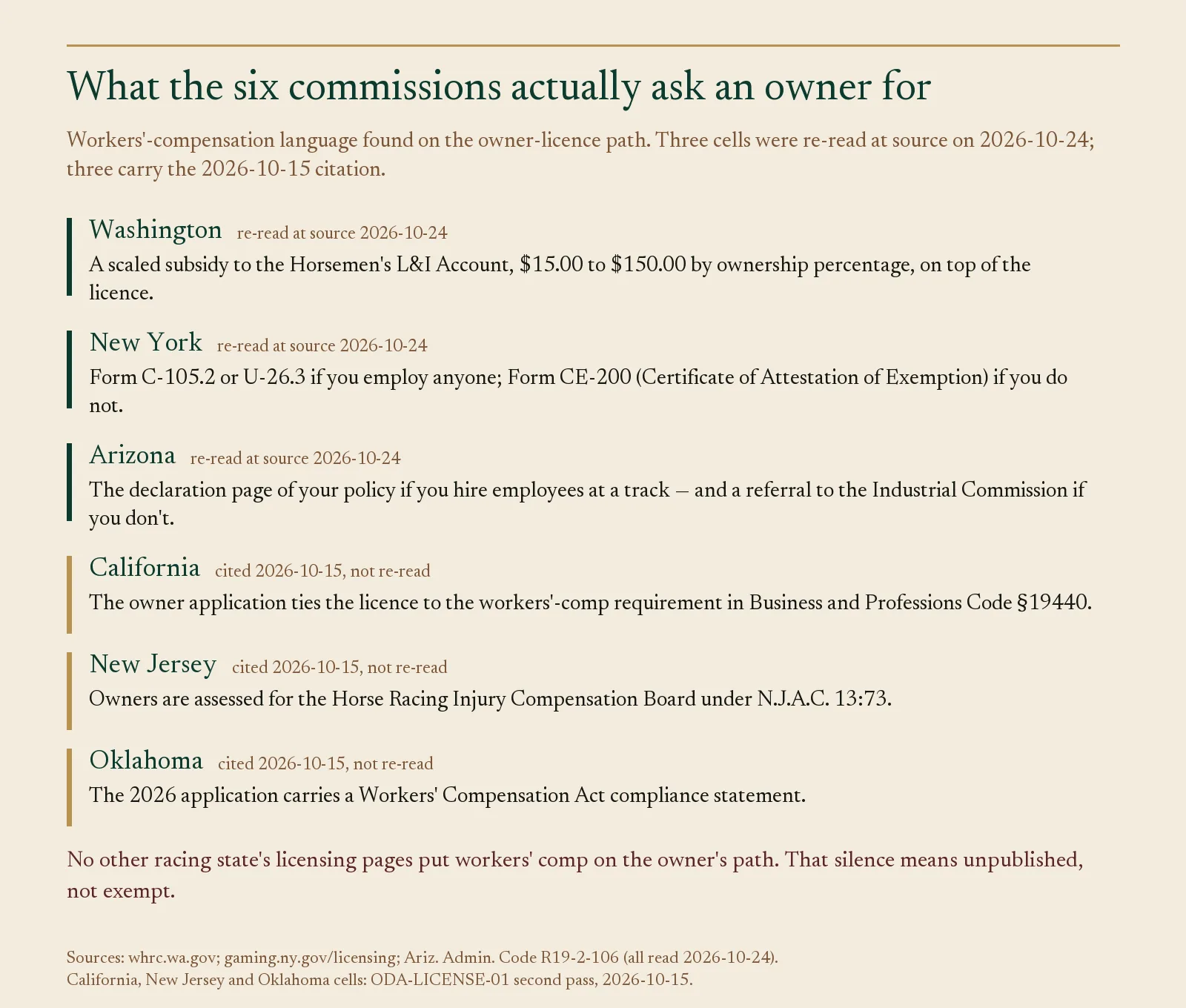
The six commissions ask for four different things, and the difference matters more than the count does. Washington charges a premium. New York, Arizona and Oklahoma want a document. California ties issuance of the licence to a statutory requirement. New Jersey assesses owners for a compensation board rather than asking them to buy a policy at all.
Workers’-compensation language on the owner licence, by state
| State | What the licensing path requires | Dollar figure, where published | Source, and when we read it |
|---|---|---|---|
| Washington | A subsidy to the Horsemen’s L&I Account from every owner applicant, scaled by ownership percentage | $15.00 to $150.00 a year | WHRC owner licence page, read 24 October 2026 |
| New York | Form C-105.2 or U-26.3 if you employ anyone; Form CE-200 exemption certificate if you do not | No separate charge stated | NYS Gaming Commission licensing, read 24 October 2026 |
| Arizona | The declaration page of your policy if you hire employees at an Arizona racetrack | No separate charge stated | Ariz. Admin. Code R19-2-106, read 24 October 2026 |
| California | The owner application ties the licence to the workers’-comp requirement in Business and Professions Code §19440 | No separate charge stated | CHRB form CHRB-4; cited 15 October 2026, not re-read for this piece |
| New Jersey | Owners are assessed for the Horse Racing Injury Compensation Board | Assessment amount not published on the licensing FAQ | NJRC licensing FAQ and N.J.A.C. 13:73; cited 15 October 2026, not re-read |
| Oklahoma | A Workers’ Compensation Act compliance statement on the application form | No separate charge stated | OHRC 2026 application; cited 15 October 2026, not re-read |
Three of those six cells were read at source while writing this page. California, New Jersey and Oklahoma carry the citation from our dataset’s 15 October 2026 pass and were not opened again here. The table says so rather than presenting all six as equally fresh.
The six commissions at a glance
How we built this, and what it does not cover
This is RHO101 original analysis drawn from our own licensing dataset, which covers the 32 states with 2026 Thoroughbred dates and a recognised racing commission. A state earns a row here only when its commission’s own page, application form, statute or regulation raises workers’ compensation on the owner’s licensing path. No cell is inferred from a neighbouring state and none is carried over from a horsemen’s association restating a commission.
The honest edges matter here. The dataset reads licensing pages, so a state could have a workers’-comp rule sitting in its insurance code that never appears where an owner applies: this maps what commissions publish to applicants, not the whole of each state’s law. Washington’s page carries a 2005–2024 copyright line while listing 2026 material, and heads its risk-class column “2025 Rate” in the same block that calls those rates 2026 — so read both as the commission’s wording, not a clean year. None of this is legal advice; an owner unsure whether they count as an employer should ask someone qualified in that state before signing.
Washington: the subsidy that outgrows the licence
Washington’s Horsemen’s L&I subsidy runs from $15.00 for a 1–10% share to $150.00 for 96–100%, in nineteen published bands, and every owner licence applicant pays it. The commission prints the bands as a table rather than a formula, which hides what the table is actually doing: every one of the nineteen figures equals $1.50 multiplied by the top of its band. A 46–50% owner pays $75.00, a 66–70% owner pays $105.00, a sole owner pays $150.00. Once an owner has paid the $150.00 the commission asks for nothing further, so the subsidy is an annual ceiling per owner rather than a charge per horse.
Washington’s L&I subsidy by ownership band
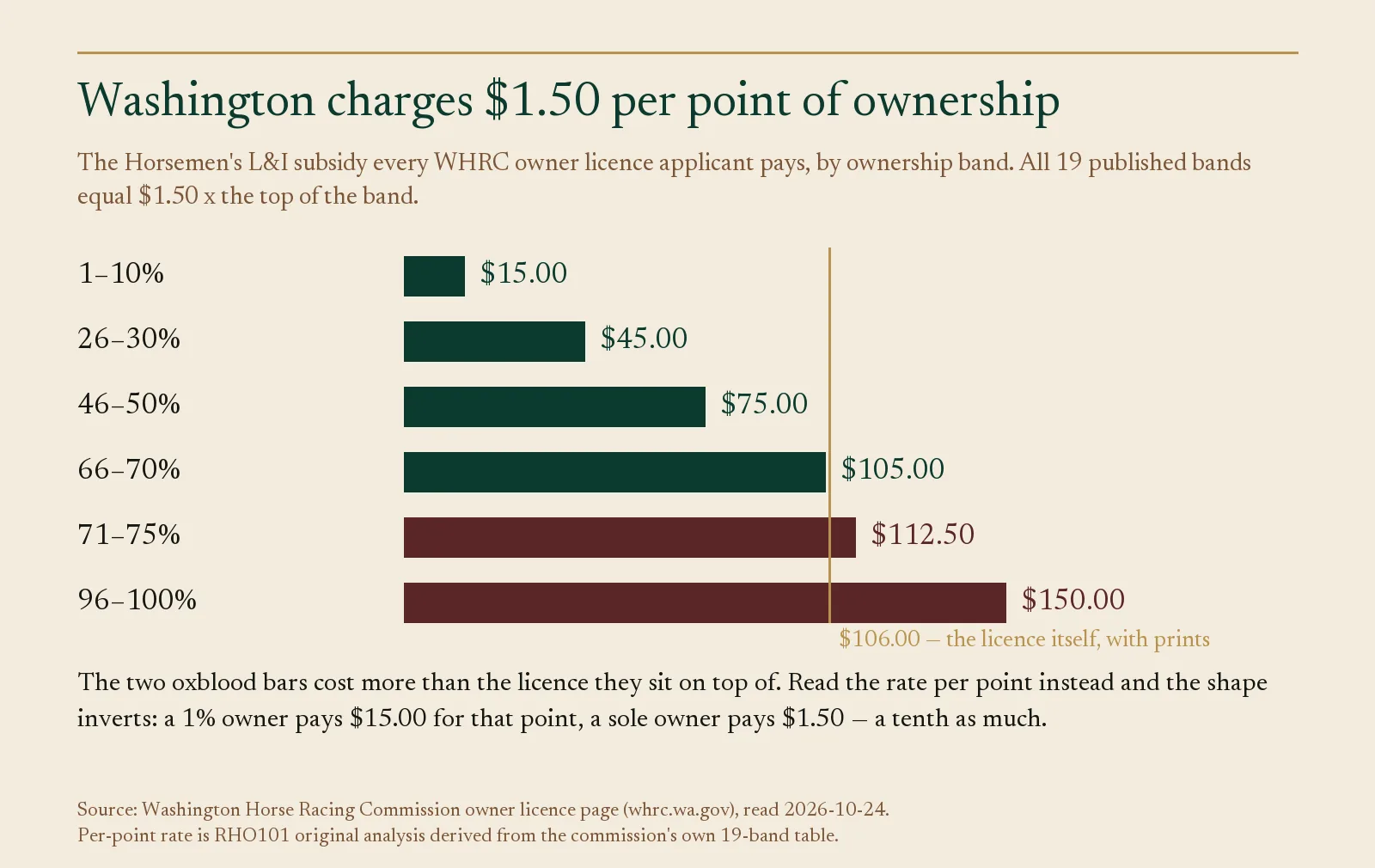
Reading the table as a rate per point changes what it says. A 1% owner pays $15.00 for that single point of ownership. A sole owner pays $1.50 a point. The smallest stake on the horse is charged ten times the rate of the largest one, because the bottom band is ten points wide and every band above it is five. That is a real feature of the schedule and not a rounding artefact, and it falls hardest on exactly the micro-share owners that fractional operators recruit.
Where the subsidy overtakes the Washington licence
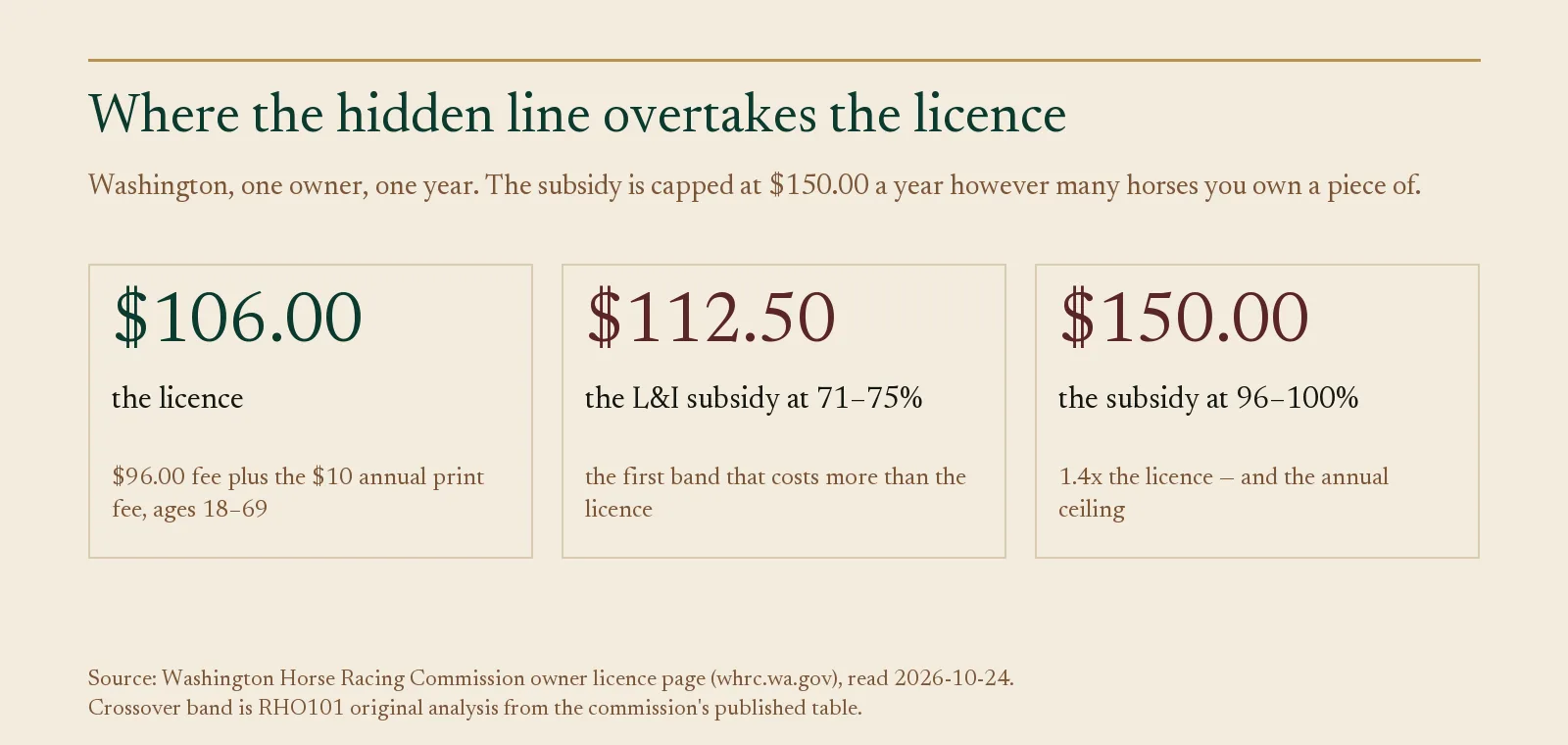
An owner licence in Washington costs $106.00. An owner of more than 70% of one horse pays $112.50 into the L&I account on top of it. The line nobody quotes is the larger of the two.
A second Washington figure is worth knowing before you compare circuits. The commission’s rate table prices risk class 6618 — owners — at $150.00 a year at Emerald Downs and $17.00 a year at Sun Downs, so the ceiling depends on which track the horse runs at. The $150.00 top band matches the Emerald Downs figure exactly. That looks like two tables describing one obligation from different ends, but the page never says so, so take the match as an observation rather than a rule.
New York, New Jersey and California: a form, an assessment, and a statute
New York requires a filing from every owner applicant, including the ones with no employees at all. An applicant who employs anyone files a Certificate of Workers’ Compensation Insurance on Form C-105.2, or a State Insurance Fund Form U-26.3, with the Commission named as the certificate holder; the Commission states that Acord forms are not acceptable proof. An applicant with no employees files Form CE-200, the Certificate of Attestation of Exemption. There is no way to answer the question by ignoring it.
New Jersey pools the obligation instead: owners are assessed for the Horse Racing Injury Compensation Board under N.J.A.C. 13:73, rather than each producing a policy. California’s owner application ties the licence to the workers’-compensation requirement in Business and Professions Code §19440. Both cells come from our dataset’s 15 October 2026 pass rather than a reading taken here, and California’s general licensing-information page does not itself mention workers’ comp — the requirement sits on the application form and in the code section, which is where to check it if California is your circuit.
Arizona and Oklahoma: the declaration page and the statement
Arizona asks a licence applicant to say on the form whether they hire employees or independent contractors, and an applicant who hires employees to work at an Arizona racetrack must hand over the declaration page of their workers’-compensation policy. The rule specifies the declaration page, not a certificate or a broker’s letter. What makes Arizona worth a second look is the enforcement limb: under the same rule the Department notifies the Industrial Commission of Arizona of any applicant who fails to provide that proof, and also of applicants who say they hire independent contractors, so the Commission can look at how those workers are classified. Answering “independent contractors” does not end the conversation in Arizona; it starts a different one.
Oklahoma’s 2026 racing application carries a Workers’ Compensation Act compliance statement, which the applicant signs along with the rest of the form. That cell comes from our dataset’s 15 October 2026 pass and the form is linked in the table above if you want to read the clause before you sign it.
The 26 states that say nothing
Twenty-six of the 32 racing states raise no workers’-compensation language where an owner applies for a licence, and that is the finding most likely to be misread. Silence on a licensing page is a fact about what the commission has published to applicants. It is not a ruling that the state has no workers’-compensation law reaching racing, and it is not permission to employ someone uninsured. Kentucky and Florida are both in that group, and nobody should conclude from this page that a Kentucky owner with a person on their payroll has no obligation.
We publish the gap as a gap because the alternative is filling 26 cells with inference, and an inferred obligation is worth nothing to the owner who has to act on it. If your state is a silent one and you are about to employ anyone around the horse, ask the commission and someone who practises there.
Owner workers’-compensation questions
Do racehorse owners need workers’ compensation?
In six states the commission raises it on the owner-licence path, and in most the trigger is employing someone rather than owning a horse. A fractional owner whose trainer employs the staff files an exemption where one is asked for, as with New York’s Form CE-200. Washington is the outlier: it charges every owner applicant a scaled subsidy whether or not they employ anyone.
What is Washington’s Horsemen’s L&I premium?
It is a subsidy to the Horsemen’s Labor and Industries Account that every WHRC owner licence applicant pays, scaled across nineteen bands from $15.00 at 1–10% ownership to $150.00 at 96–100%. It sits on top of the $96.00 licence and the $10.00 annual fingerprint fee, and it stops at $150.00 a year per owner.
Do I file a CE-200 in New York if I have no employees?
Yes. The Gaming Commission asks an owner applicant with no employees to submit a completed Form CE-200, the Certificate of Attestation of Exemption, with the application. Applicants who do employ someone file Form C-105.2 or Form U-26.3 instead, with the Commission as certificate holder.
Is this the same as insuring my horse?
No. Workers’ compensation covers people who work with the horse. Mortality and major-medical policies cover the horse itself. The two are bought separately, and no commission listed here accepts one as proof of the other.
My state’s licensing page says nothing about workers’ comp. Am I exempt?
Not necessarily. Twenty-six racing states publish nothing on this point where owners apply, which tells you only that the commission has not put a rule in front of applicants. State employment law can still reach you the moment you put someone on a payroll.
What to read next
- Racehorse owner licence fees by state — the sticker price, and the 29 of 32 commissions that publish one.
- Who in a racing partnership has to be licensed — every partner, 5%, or 3%, depending on the state.
- HISA registration for owners — the federal layer that runs alongside the state licence.
- How to buy a racehorse — every ownership path, with licensing in its proper place.
— Race Horse Ownership 101
About the Author

Calvin Johnson is a Thoroughbred racehorse owner, day trader, and independent racing analyst with more than a decade of firsthand ownership experience. He has participated in nearly every common structure in horse racing — fractional platform shares, traditional syndicates, LLC partnerships, claiming ventures, and outright ownership — across more than two dozen horses. Calvin writes about racehorse ownership the same way he approaches markets: by studying risk, incentives, fees, and whether the people controlling the deal are aligned with the investors behind it.
- Calvin Johnsonhttps://racehorseownership101.com/author/calvin-johnson/
- Calvin Johnsonhttps://racehorseownership101.com/author/calvin-johnson/

- Calvin Johnsonhttps://racehorseownership101.com/author/calvin-johnson/
- Calvin Johnsonhttps://racehorseownership101.com/author/calvin-johnson/
