Every owner of a covered horse is required to register with HISA, and a horse becomes covered at its first recorded workout or first race start — which can be long before you ever see it. Registering yourself is a form at the Authority’s registration portal. What catches owners out is what the form then decides. HISA attaches a responsible person to every covered horse, and that person is the trainer, not you. For any horse owned by more than one party it also names a designated owner: one individual who receives everything the regulator sends and reports on everyone else’s behalf. Those two roles carry the liability and the paperwork, and neither one defaults to the person who wrote the check.
The short version
- HISA’s responsible person is your trainer. If a covered horse has no trainer, the role falls to the owner.
- If you own through a partnership, LLC or syndicate, exactly one of you is the designated owner — and that is the only person the regulator talks to.
- A claim updates the record on its own once the race goes official. A private sale does not: the seller has to start the transfer and the buyer has to accept it.
What HISA registration actually requires of an owner
HISA registration is an account you create once at the Authority’s portal, and every owner of a covered horse is expected to hold one. The Authority’s own instruction is that a covered person registers at portal.hisausapps.org/registration, and that all owners of covered horses register in order to reach their horse’s records. Owners fall inside the covered-person definition where the state racing commission requires them to be licensed — the same definition that already captures trainers, jockeys and any veterinarian working on a covered horse. The account gives you standing in the system: the horse’s record, the notifications, the reporting obligations. It does not by itself put you in charge of anything. The account is the door. What matters after it is which of the two roles HISA has attached to your name, and whether the person holding the other one is someone you chose.
You’re already studying the sport. Own a piece of it.
Every question you’re asking is one owners ask every morning at the barn. The free guide takes you from fan to owner.
This is where the search results fail a first-time owner. Type the phrase into Google and you get the registration form itself, HISA’s homepage quick-links, a couple of Jockey Club handouts, and a video showing you which buttons to press. All of that assumes you already know what you are registering for and what the system will do with you afterwards. None of it is written from the position of somebody about to hand over money for a horse. If you want the wider picture of the regulator before the paperwork, we have written separately on what HISA is and what it actually regulates.
Who has to register with HISA
| Role | Registration expected? | What it turns on |
|---|---|---|
| Owner of a covered horse | Yes | Being licensed by the state racing commission. All owners of covered horses register to reach their horse’s records. |
| Trainer | Yes | Named as the responsible person for every covered horse in the barn. |
| Jockey | Yes | Riding covered horses. |
| Veterinarian | Yes | Any veterinarian working on a covered horse must be registered. |
| Racetrack employee with a state licence | Yes, if directly involved with covered horses | Ordinary access to restricted areas — the stable area and the paddock. |
| Racetrack chaplain, jockeys’ agent | Yes | Named specifically by HISA as required to register. |
| Racetrack employee without restricted-area access | No | Exempted where the role carries no ordinary access to the stable area or paddock. |
The list is broader than most prospective owners expect, and that breadth is the point of it. HISA is not building a mailing list. It is building a map of everyone who has hands on a horse, so that when something goes wrong there is a named person attached to each part of it.
A horse becomes covered earlier than most buyers assume
Coverage attaches to the horse at its first recorded workout or first race start, which means it is a property of the animal’s history rather than of your purchase. By the time a two-year-old appears in a sale ring having breezed under the tack, it is already inside the system, already carrying a record, and already pointed at a responsible person who is not you. You are not registering a horse into HISA when you buy one. You are stepping into a file that already exists.
You are not registering a horse into HISA when you buy one. You are stepping into a file that already exists.
The practical consequence is that “has this horse been registered?” is usually the wrong question. A horse that has worked or raced is covered whether or not anybody has been diligent. The better question is who is currently listed against it, and whether that record is going to be accurate the day after you take delivery.
The responsible person is your trainer, not you
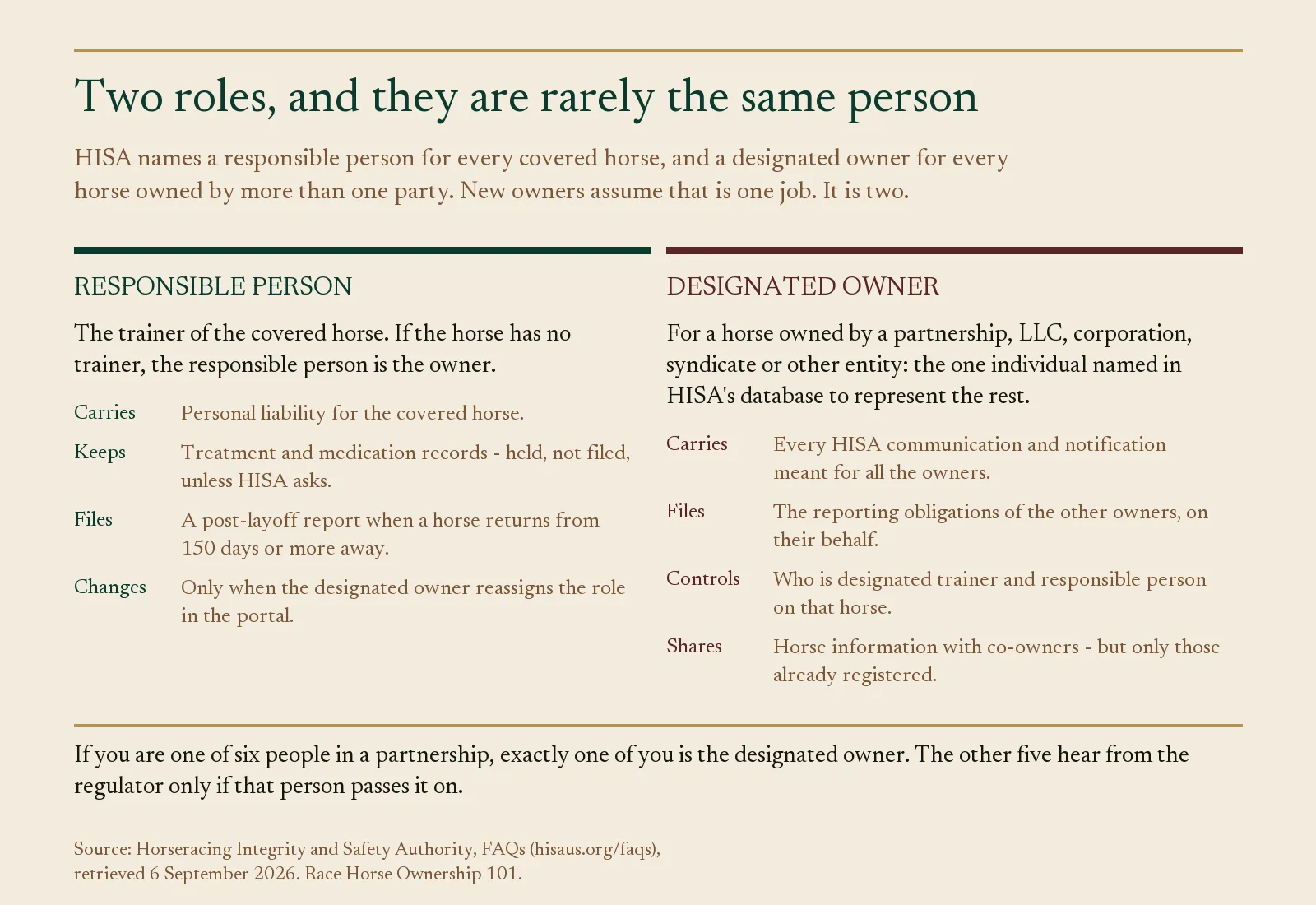
HISA’s definition is short enough to quote: the responsible person is the trainer of the covered horse, and if the covered horse does not have a trainer, the responsible person is the owner. That single fallback clause is the one I would underline for anyone buying into their first horse. For as long as a trainer is attached, the person HISA holds personally liable for that horse is the trainer. The moment there is no trainer — between barns, out on a farm, in the gap after a split with a yard — the role lands on the owner by default. Nobody sends a warning that it has happened.
The role is not ceremonial. The responsible person carries personal liability for the covered horse, keeps treatment and medication records (held rather than filed, unless HISA asks for them), produces a post-layoff report when a horse comes back from 150 days or more away, and has to cooperate with records requests. Consider an owner who moves a filly to a farm for six months while she recovers, assuming the paperwork is dormant because the racing is. It isn’t. If no trainer is attached during that period, the recordkeeping obligation for those months belongs to the person who owns her.
Responsible person and designated owner
How partnerships, LLCs and syndicates actually register
A partnership or LLC cannot register itself with HISA: one member has to register as an individual first, and then create the Entity. That is HISA’s stated sequence for an LLC, a partnership or a corporation. The Entity must carry a default designated owner and a default responsible person from the outset — the structure will not sit there unassigned while everyone decides.
The designated owner, in HISA’s words, is the individual named in the Authority’s database as the representative for the other owners of the covered horse, authorized to receive communications or notifications and to fulfil any reporting requirements on their behalf. Read that as an owner rather than as a lawyer and it says something blunt: for every notification the regulator sends about your horse, there is exactly one inbox, and it is probably not yours. The designated owner can share horse information with additional owners, but only with owners who have registered themselves. An unregistered partner is invisible to the system and dependent on being told.
That person also controls who is designated as trainer and responsible person on the horse. In a five-way partnership where one member happens to have registered first and became the default designated owner, that member holds a lever over the barn relationship that the other four may not realise exists. It is worth settling deliberately rather than by whoever signed up on the first evening.
How each ownership structure maps to the two HISA roles
| Ownership structure | Who registers | Designated owner | Responsible person |
|---|---|---|---|
| Sole owner, horse in training | You, as an individual covered person | Not applicable — the horse is not owned by more than one party | Your trainer |
| Sole owner, no trainer attached | You, as an individual covered person | Not applicable | You, by default, because there is no trainer |
| Partnership | Each partner registers individually to see anything | One named partner, representing the rest | The trainer, changed only via the designated owner |
| LLC or corporation | One member registers first, then creates the Entity | A default designated owner, set on the Entity | A default responsible person, set on the Entity |
| Syndicate or other association | Registration runs through the entity, same as above | One individual named in HISA’s database | The trainer of record |
If you are still deciding which of these structures to enter through, the trade-offs sit alongside the rest of the ownership paths we have mapped. The HISA layer does not change which structure is right for you. It changes what each one quietly assigns.
What happens to the record when you claim a horse
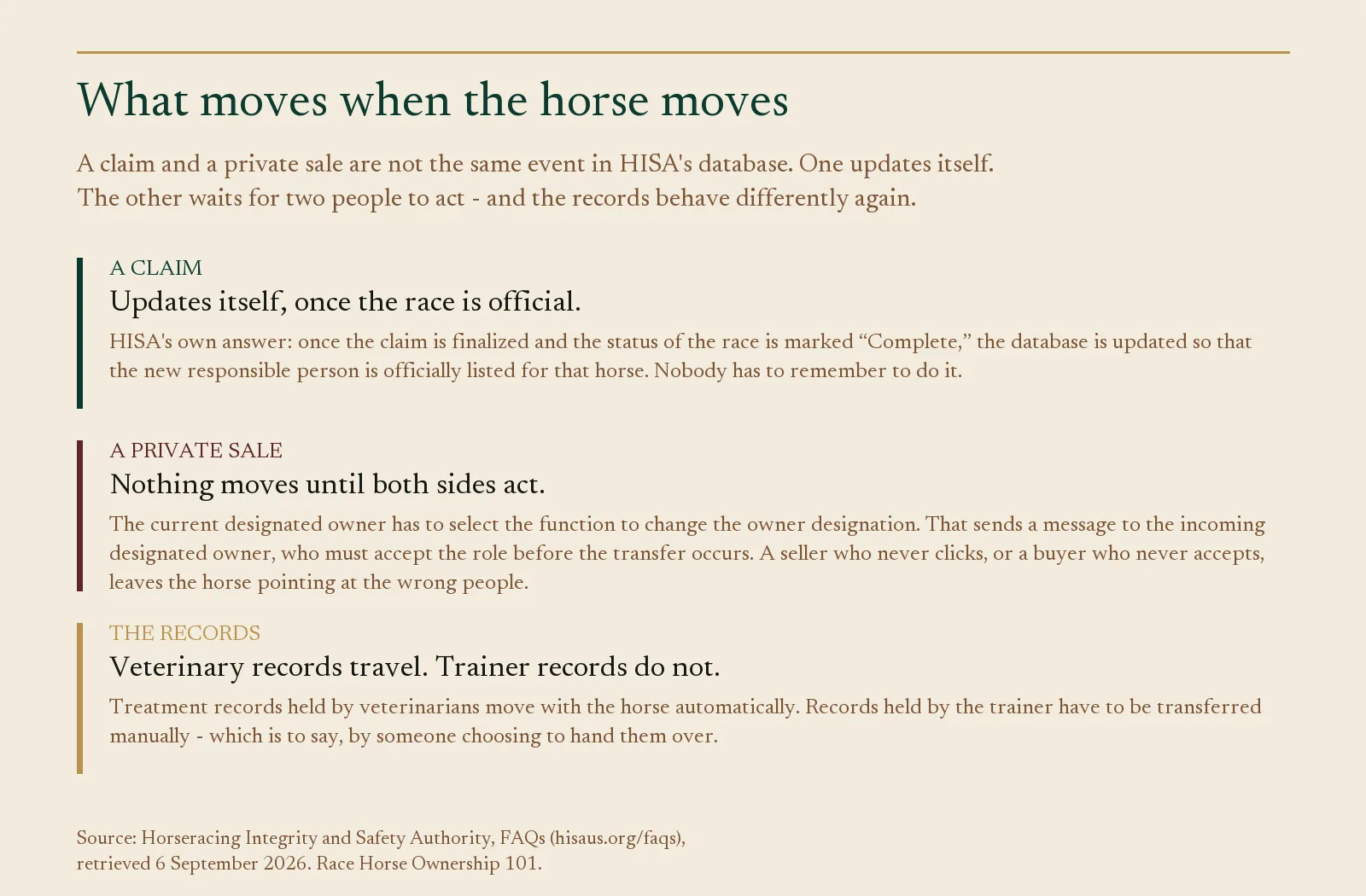
A claim moves the HISA record automatically, without either barn filing anything. The Authority’s answer is that once the claim is finalized and the status of the race is marked “Complete,” the database is updated so that the new responsible person is officially listed for that horse. Nobody has to file anything, and there is no window in which the horse sits pointing at the losing barn. This is the one transfer in racing that the system genuinely handles for you, and it is worth knowing precisely because the other one does not.
The trigger is the race going official rather than the money changing hands, which is a useful detail if you have ever wondered when exactly a claimed horse becomes your problem. The mechanics of the claim itself — the box, the timing, what you are actually buying — sit in our walkthrough of how to claim a racehorse.
How the record moves on a claim or a sale
A private sale is the one that does not move on its own
A private sale transfers only when two people both act. HISA’s process is that the current designated owner selects the function to change the owner designation, which sends a message to the incoming designated owner, who must accept the role before the transfer occurs. Two clicks by two parties, in order, after the deal is done and everyone has moved on to the next thing.
A seller who never clicks, or a buyer who never accepts, leaves a horse pointing at the wrong people in the federal safety regulator’s database.
The records behave differently again, and this is the part I would put in the sale agreement rather than trust to goodwill. Treatment records held by veterinarians transfer with the horse automatically. Records held by the trainer have to be transferred manually — which is to say, by somebody choosing to hand them over. A departing barn has no mechanical obligation to remember, and a buyer who never asks may simply never receive the medication history of the horse they now own.
Take a buyer who agrees a private purchase on a Friday, ships the horse Monday, and assumes the file follows the van. It does not, unless the seller starts the transfer, the buyer accepts it, and the outgoing trainer hands over what they hold. Three separate human actions, none of which appears on an invoice.
What to settle before the money moves
The HISA portal shows you your own horses, not somebody else’s, so none of this is due diligence you can quietly perform from a laptop on a horse you do not yet own. These are questions to put to the seller, the trainer or the partnership while you have not paid yet, which is the only moment anyone answers them quickly.
Questions to ask a seller before you buy or claim
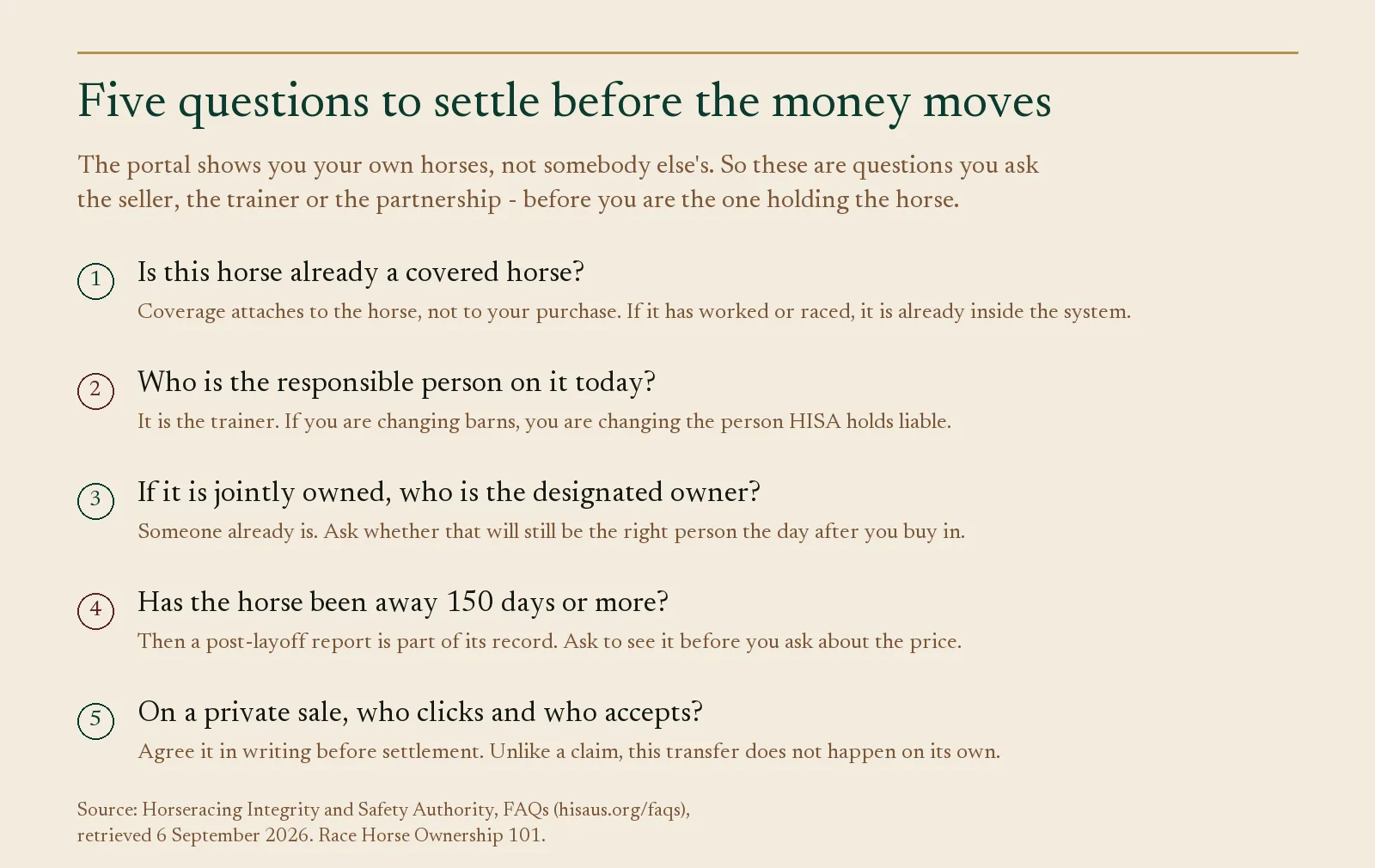
The one I would not skip is the post-layoff question. A horse returning from 150 days or more away generates a report from the responsible person, and that report exists because somebody had to account for the gap. If a seller cannot produce it, or does not know whether it exists, you have learned something about how that horse has been kept as well as about the paperwork.
What HISA’s own pages do not tell you
Two things an owner reasonably wants to know are absent from HISA’s public FAQs, and we would rather say so than guess. The first is cost: the FAQs do not state a registration fee, and we are not going to invent a number for one. What owners actually feel on the bill is the per-start and per-day assessment that funds the programme, which is a different mechanism from registration and which we have broken down separately in our look at what the HISA fees on your owner bill pay for.
The second is consequence. The public FAQs do not spell out what happens to an unregistered covered person, or to a horse that runs without a current record. That silence is not evidence that nothing happens — enforcement sits in the rules and with the racing offices rather than in a summary page — but it does mean anyone quoting you a specific penalty is quoting something they did not get from HISA’s FAQ. Ask where the number came from.
Where this leaves a first-time owner
HISA registration is the easy part, and treating it as the whole task is the mistake. The form takes an evening. What the form does is place you inside a structure that has already decided who is liable for your horse, who hears from the regulator, and what happens to the record the day the horse changes hands. Those decisions are made by default unless you make them deliberately.
So do three specific things before you buy in. Find out who the designated owner will be and whether you are content for it to be that person. Confirm a trainer is attached, because the alternative is that the liability is yours. And on a private sale, write the transfer into the agreement — the seller starts it, you accept it, the outgoing barn hands over its records — because unlike a claim, nothing in that sequence happens by itself.
About the Author

Calvin Johnson is a Thoroughbred racehorse owner, day trader, and independent racing analyst with more than a decade of firsthand ownership experience. He has participated in nearly every common structure in horse racing — fractional platform shares, traditional syndicates, LLC partnerships, claiming ventures, and outright ownership — across more than two dozen horses. Calvin writes about racehorse ownership the same way he approaches markets: by studying risk, incentives, fees, and whether the people controlling the deal are aligned with the investors behind it.
- Calvin Johnsonhttps://racehorseownership101.com/author/calvin-johnson/

- Calvin Johnsonhttps://racehorseownership101.com/author/calvin-johnson/

- Calvin Johnsonhttps://racehorseownership101.com/author/calvin-johnson/

- Calvin Johnsonhttps://racehorseownership101.com/author/calvin-johnson/