A National Racing Compact license does not work in every state. Of the 32 US racing states we mapped, 15 are Compact members, 8 participate but still issue their own state license, 8 do not appear on the Compact’s jurisdictions list at all, and Wyoming’s status conflicts between the Compact’s own pages. You apply for the National Racing License through the Compact itself, at racinglicense.com. What its marketing does not spell out is that the license is a starting point. You still check the rule in the state where your horse will run.
The short version
- The National Racing License costs $225 for three years on the Compact’s own figures, plus each state’s fee where you race.
- 15 of 32 racing states are members. Pennsylvania, Indiana, Illinois, Texas, Iowa, Minnesota, New Mexico and Arkansas participate but still issue their own license.
- New Jersey, a member, says its own state license is not valid in other states.
- The Compact’s two lists of its “24 jurisdictions” do not match each other.
The short answer: a head start, not a national pass
The National Racing License is a multi-state credential that member states have agreed to accept, but it is not a single national license, and in participant states the commission still issues its own. The Compact describes itself as an interstate governmental body authorized by participating states and the FBI to issue a national license to owners, trainers, jockeys and drivers. Its real value is administrative: one application, one set of fingerprints, one background check, with the Compact forwarding your paperwork and state fees to the states you choose.
Racing’s best-kept open secret: you don’t have to just watch.
Ownership groups let regular people own a share of a real racehorse. The free guide explains how it works, in ten minutes.
That is useful, and for an owner who ships horses between several member states it may save real time. But I wouldn’t send a horse to a new state on the strength of a Compact card without reading that commission’s own rule first. The word “national” does more work in the name than the license does on the ground. If you are still deciding how to own a horse at all, start with our guide to every ownership path; this page is for the owner who already knows where the horse will race.
What the Compact is, and what it claims
The National Racing Compact says its license is recognized in 24 jurisdictions, and that figure is the Compact’s own claim, not a finding of ours. Its FAQ puts the cost at $225 for a license that runs three years and expires on December 31, covering fingerprint processing and the service of registering you in the states you ask for. State fees are on top. The Compact’s FAQ is explicit that each commission may charge its required fee for participation in its state, and that some commissions waive that fee for National License holders.
Membership has a specific meaning. A member state has adopted the Compact’s model legislation, which lets its commissioners share the criminal-history information the Compact receives from the FBI, and members have agreed to accept anyone the Compact licenses. A non-member can “participate” at different levels. At the lowest, according to the Compact’s own explanation, the Compact simply forwards your application and fee and the state makes its own licensing decision. Participation can be close to membership or close to a mail-forwarding service, and the list does not tell you which.
Compact member, participant or not listed: the 32 racing states
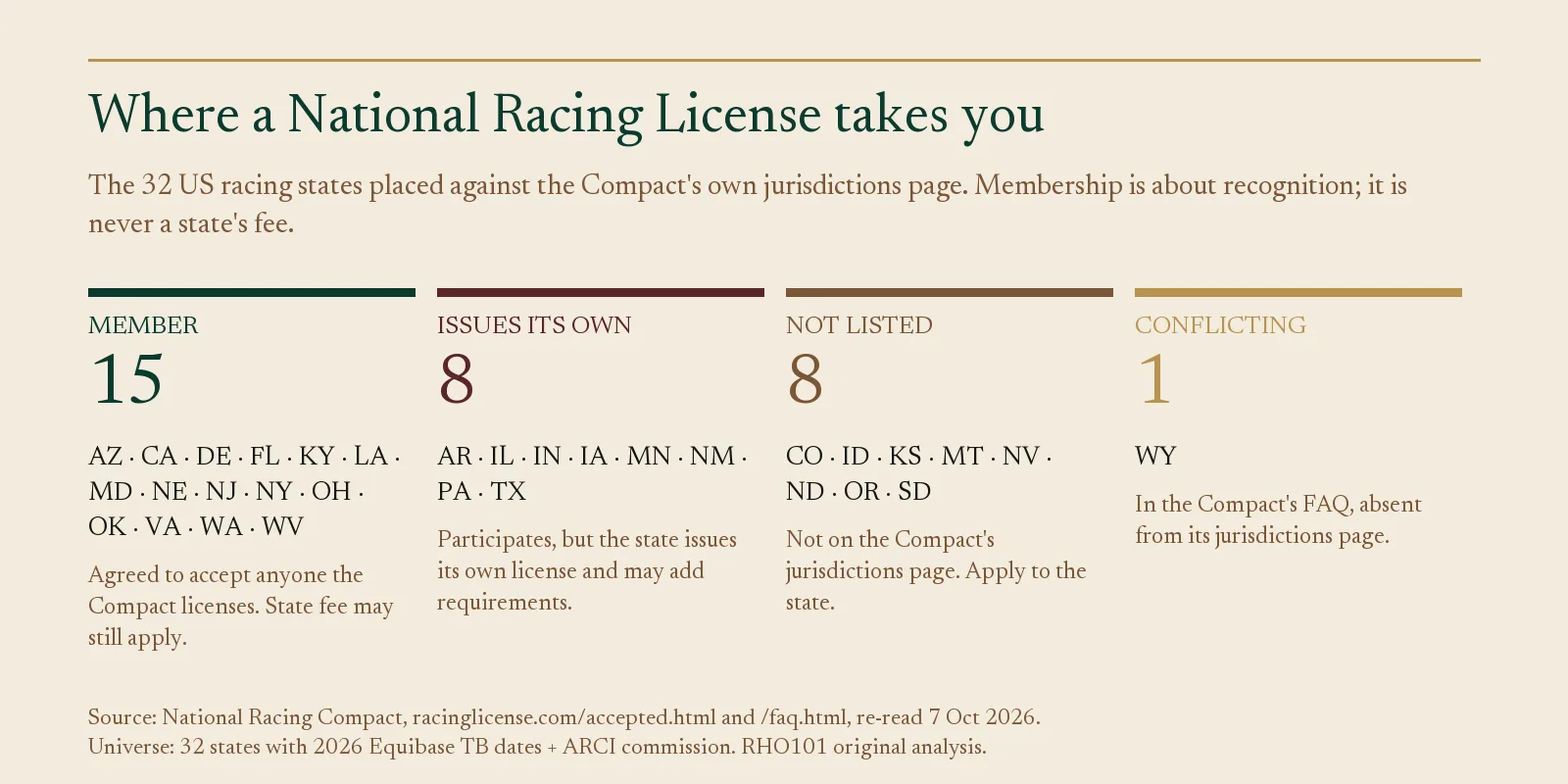
Of the 32 US racing states with 2026 Thoroughbred race dates, 15 are Compact members, 8 are participants that issue their own license, 8 are not on the Compact’s jurisdictions list, and one, Wyoming, is listed on one Compact page and missing from the other. The Compact publishes a list of jurisdictions but does not lay it against the full set of racing states, so the states it leaves out are not visible from its own site.
RHO101 original analysis: we placed each of the 32 US states with 2026 Equibase Thoroughbred dates and an ARCI-listed commission against the Compact’s own jurisdictions page, read in September 2026 and re-read on October 7, 2026. Massachusetts, Michigan and Ontario appear on Compact pages but fall outside this universe (no 2026 Thoroughbred dates, or not a US state), so they are not in the table. A Compact listing tells you about recognition. It is never a state’s fee.
National Racing Compact status of the 32 US racing states
| Compact status | States | Count | What it means for an owner |
|---|---|---|---|
| Member | Arizona, California, Delaware, Florida, Kentucky, Louisiana, Maryland, Nebraska, New Jersey, New York, Ohio, Oklahoma, Virginia, Washington, West Virginia | 15 | Has agreed to accept anyone the Compact licenses. The state may still charge its own fee. |
| Participant that issues its own license | Arkansas, Illinois, Indiana, Iowa, Minnesota, New Mexico, Pennsylvania, Texas | 8 | The Compact can route your application and fee, but the state issues its own license and may have additional requirements. |
| Not on the Compact’s jurisdictions list | Colorado, Idaho, Kansas, Montana, Nevada, North Dakota, Oregon, South Dakota | 8 | Apply to the state commission directly. |
| Conflicting | Wyoming | 1 | Listed as a participant in the Compact’s FAQ; absent from its jurisdictions page. Ask the commission. |
Where a National Racing License takes you (graphic)
The participant states that still issue their own license
Eight of the 32 racing states participate in the Compact but still issue their own state owner license: Pennsylvania, Indiana, Illinois, Texas, Iowa, Minnesota, New Mexico and Arkansas. The Compact’s own footnote says these states issue their own license pending legislation to join, and may have additional requirements. In practice that means a National License holder racing in Pennsylvania still ends up with a Pennsylvania license, under Pennsylvania’s rules, with Pennsylvania’s fee.
Consider an owner based in Kentucky, a member state, who sends a horse to run at Parx in Pennsylvania. The National License gets the paperwork moving, and Pennsylvania may be asked to accept the Compact’s fingerprints rather than take new ones. It does not make the Pennsylvania license unnecessary, and Pennsylvania’s own rules on partnerships apply to the horse while it races there. The owner who assumed “national” meant “done” finds out at entry time.
Even among members, the arrangement varies. Kentucky, for example, accepts either the ARCI multi-jurisdiction owner application or the National Racing License. Nebraska’s 2026 fee schedule lists a $90 National License for owners alongside its $150 three-year state owner license. Read your target state’s licensing page, not the Compact’s map alone.
New Jersey says its own license is not valid in other states
New Jersey’s Racing Commission says plainly that a New Jersey license is not valid in other states, even though New Jersey is a Compact member. That is not a contradiction once you separate the two documents. A New Jersey state license is New Jersey’s. The National Racing License is the Compact’s, and New Jersey has agreed to accept it. What does not exist is a New Jersey license that travels on its own. The commission’s licensing FAQ tells multi-state applicants to submit a copy of an application to each jurisdiction separately.
A state license belongs to the state that issued it. Only the Compact’s own license is designed to travel, and only as far as each state agrees.
The Compact’s own lists disagree, starting with Wyoming
The Compact’s FAQ and its jurisdictions page each say the license is good in 24 jurisdictions, but they do not list the same 24. We are reporting the conflict, not resolving it. The FAQ names Wyoming as a participant; the jurisdictions page does not mention Wyoming at all. The FAQ also lists Michigan and Ontario, while the jurisdictions page lists Massachusetts, Minnesota and New Mexico instead.
Compact FAQ versus jurisdictions page: where the 24 differ
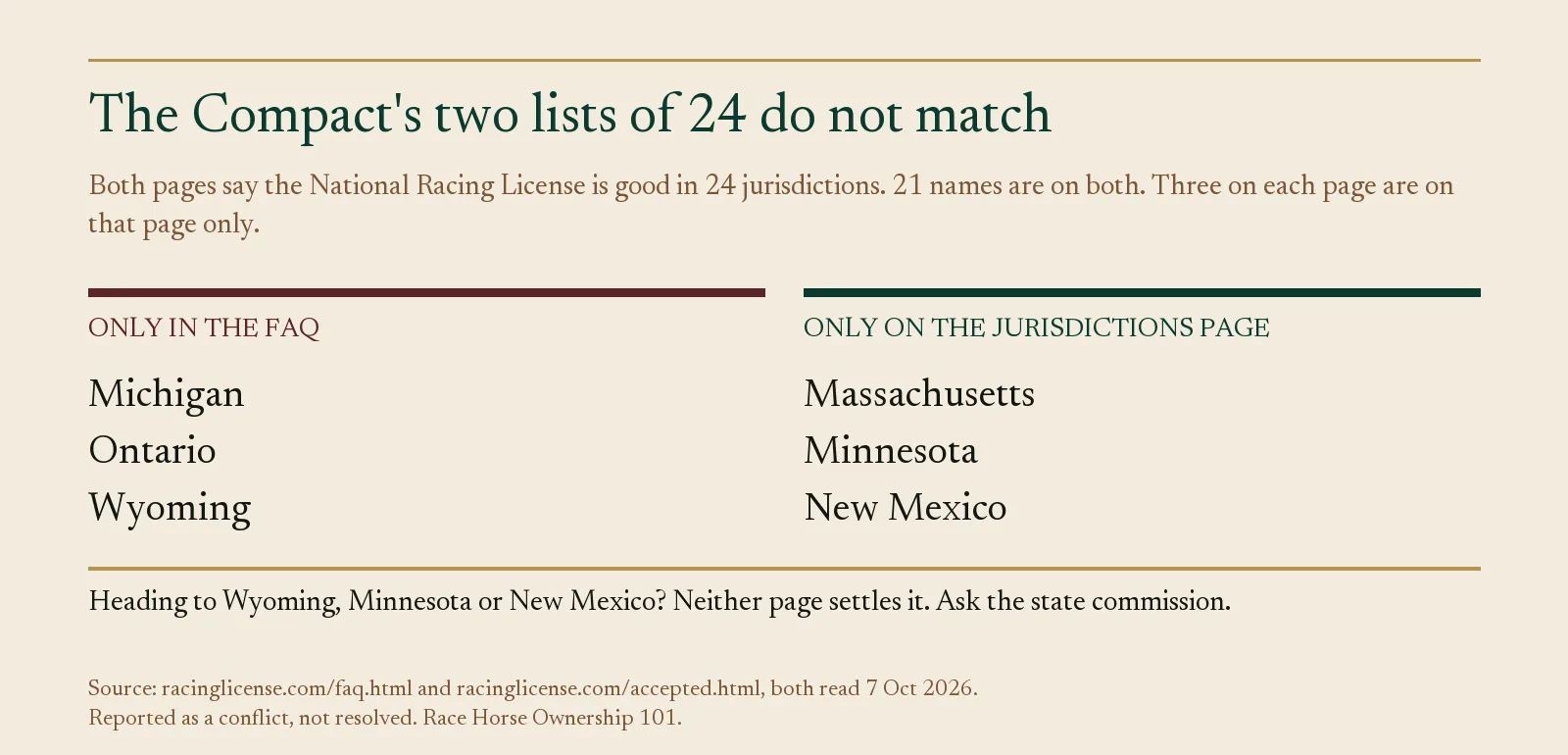
Some of this is probably the ordinary drift of a website maintained over years, and we are not suggesting anything worse. For an owner it still matters: if your horse is heading to Wyoming, Minnesota or New Mexico, neither Compact page settles the question. Phone the commission and ask whether it accepts the National License, issues its own, or both.
A Compact license is not HISA registration
The National Racing License and HISA registration are separate systems, and holding one does not satisfy the other. The Compact licenses you as a participant on behalf of the states that accept it. The Horseracing Integrity and Safety Authority registers you as a covered person in a federal database that follows the horse, which we explain in HISA registration for owners. An owner racing in a member state typically needs both, and the Compact’s one-stop pitch does not cover the federal side.
What the license costs once state fees are added
The Compact’s $225 is only part of the cost, because each state where you race may charge its own fee on top, and only 13 of the 32 racing states publish a readable owner-license fee on the commission’s own site. We set out those 13 fees, and the terms that make them hard to compare, in our owner-license fee comparison. If you are buying into a partnership, the separate question of which partners need a license is a state rule that the Compact does not change.
National Racing License questions
What is a National Racing Compact license?
It is a multi-state racing license issued by the National Racing Compact, an interstate body authorized by participating states and the FBI. It covers owners, trainers, jockeys and drivers, runs three years, expires on December 31, and costs $225 plus each state’s fee, according to the Compact.
Does a national racing license work in every state?
No. Of the 32 US racing states, 15 are Compact members, 8 participate but issue their own license, 8 are not on the Compact’s jurisdictions list, and Wyoming’s status conflicts between the Compact’s own pages.
Do I still need a Pennsylvania, Texas or Illinois owner license?
Yes. Pennsylvania, Texas, Illinois, Indiana, Iowa, Minnesota, New Mexico and Arkansas participate in the Compact but issue their own state license, and the Compact notes they may have additional requirements.
Is a New Jersey owner license valid in other states?
No. The New Jersey Racing Commission’s licensing FAQ says a New Jersey license is not valid in other states. Multi-state owners apply to each jurisdiction, or use the Compact’s National License where states accept it.
How do I apply for a National Racing License?
Through the National Racing Compact at racinglicense.com, which publishes the application, renewal forms and a jurisdiction add-on price sheet. Then confirm with the commission in each state where your horse will run.
What to read next
Licensing comes after you have decided how to own a horse, which is the subject of how to buy a racehorse. The federal side is in HISA registration for owners. A Compact license saves fingerprints and phone calls. It does not answer the question of what the state you are racing in requires, and that is the question to settle before the horse ships.
About the Author

Calvin Johnson is a Thoroughbred racehorse owner, day trader, and independent racing analyst with more than a decade of firsthand ownership experience. He has participated in nearly every common structure in horse racing — fractional platform shares, traditional syndicates, LLC partnerships, claiming ventures, and outright ownership — across more than two dozen horses. Calvin writes about racehorse ownership the same way he approaches markets: by studying risk, incentives, fees, and whether the people controlling the deal are aligned with the investors behind it.
- Calvin Johnsonhttps://racehorseownership101.com/author/calvin-johnson/

- Calvin Johnsonhttps://racehorseownership101.com/author/calvin-johnson/

- Calvin Johnsonhttps://racehorseownership101.com/author/calvin-johnson/

- Calvin Johnsonhttps://racehorseownership101.com/author/calvin-johnson/