A 5% share of a US racehorse’s keep runs roughly $90 to $340 a month — about $1,100 to $4,100 a year — and that is keep only, with no purchase price and no operator fee in it. A 10% share doubles those numbers and a 25% share multiplies them by five. The range is wide because it is honest: the two tier-1 sources I trust most price the same horse’s month very differently, and the gap between them is bigger than most buyers realise.
The Short Answer: What a 5%, 10% or 25% Share Costs Per Month
A 5% share of keep costs about $90 to $340 a month, a 10% share about $179 to $675, and a 25% share about $448 to $1,688. Those are fractions of the barn’s actual invoice stack, not fractions of the sticker price on the horse — which is the single most expensive misunderstanding in fractional ownership. You buy a percentage once. You pay that same percentage of every bill, every month, for as long as the horse is in your colours.
Imagine your colors on the horse at the front.
Not a bet. Not a ticket. Yours. Thousands of everyday fans own a piece of a racehorse. The free guide is how they started.
The first time a capital call landed in my inbox, the number was not 5% of anything I had been shown during the sales pitch. It was 5% of a month in which the horse had shipped twice, had a minor vet workup and been re-shod. Nobody had lied to me. I had simply been quoted one model and billed under another.
The Whole-Horse Bill This Table Scales From
Every racehorse share cost starts as a whole-horse figure and is then divided by the owner’s percentage, which is why a sourced whole-horse model has to come first. If you want that whole-horse version in full, it is the job of our month-by-month breakdown of what a thoroughbred costs to keep, with the twelve-month view in the annual component breakdown. This piece does one thing those two do not: it scales the components to a share.
Two published sources carry the lines. The Thoroughbred Owners of California owner handbook itemises a trainer day-rate of “$50-$110 per course per day, depending on locale and the trainer’s win record,” a farm day-rate of $17 to $50, routine veterinary work at $200 to $300 per horse per month, and shoeing at roughly $90 to $150 with the horse re-shod about every four weeks. At a BloodHorse OwnerView panel, Aron Yagoda put training at “$65 a day to $125 a day depending on where you’re racing,” and Jonathan Green described “another anywhere from $1,000 to $3,000 a month that constitutes veterinary bills, vanning, blacksmith, travel, and race expenses.” I convert those day-rates on a flat 30-day month throughout, and I say so rather than burying it, because a rate quoted per day and a bill arriving per month is the exact point at which most share math goes wrong.
5%, 10% and 25% of Every Monthly Keep Line
| Line (whole horse, per month) | Whole horse | 5% | 10% | 25% |
|---|---|---|---|---|
| Training day-rate, low ($50/day) | $1,500 | $75.00 | $150 | $375 |
| Training day-rate, high ($125/day) | $3,750 | $187.50 | $375 | $938 |
| Routine veterinary | $200–$300 | $10–$15 | $20–$30 | $50–$75 |
| Farrier (one shoeing cycle) | $90–$150 | $4.50–$7.50 | $9–$15 | $22.50–$37.50 |
| Ancillary stack (campaign month) | $1,000–$3,000 | $50–$150 | $100–$300 | $250–$750 |
| Farm/layup month (replaces training) | $510–$1,500 | $25.50–$75 | $51–$150 | $127.50–$375 |
| Monthly total — routine month | $1,790–$3,750 | $89.50–$187.50 | $179–$375 | $447.50–$937.50 |
| Monthly total — campaign month | $2,950–$6,750 | $147.50–$337.50 | $295–$675 | $737.50–$1,687.50 |
| Annual carry (12 months) | $21,480–$81,000 | $1,074–$4,050 | $2,148–$8,100 | $5,370–$20,250 |
Two sanity checks on that table. Team Valor International publishes a US training cost of roughly $64,000 a year, which sits inside my $21,480 to $81,000 whole-horse band — and 5% of $64,000 is $3,200 a year, or $267 a month, comfortably inside my 5% monthly range. An independent model that lands on an operator’s own published number without being built from it is a model worth trusting.
The honest edge runs the other way too. My low annual figure of $21,480 sits well below the $50,000 floor that published all-in anchors cluster around. That is not an error — it is a routine month at the cheapest sourced day-rate, which describes a horse at a small track or spending time on the farm, not a horse campaigning at a premium circuit. The low column is real, but it is not the column most syndicate buyers will live in.
Why the Non-Training Half of the Bill Is Not One Number
Non-training racehorse costs run between $290 and $3,000 a month depending on which published model you read — a spread of 3.4 to 6.7 times on the same horse. This is the finding I did not expect when I built the table, and it is the one that actually explains why share quotes never seem to reconcile.
Itemise it the way the California handbook does and the non-training half is routine vet plus a shoeing cycle: $290 to $450 a month. Take the figure Green gave the OwnerView panel and it is $1,000 to $3,000. Neither is wrong. The itemised view prices routine care on a horse that is in the barn; the stacked view prices a horse that is shipping, running and being worked on. Vanning, travel and race-day expenses exist in one model and simply are not counted in the other. For a 5% owner that is the difference between $14.50 and $150 a month on the same set of invoices; at 25% it is $72.50 against $750.
Routine Month Versus Race-Campaign Month, Compared
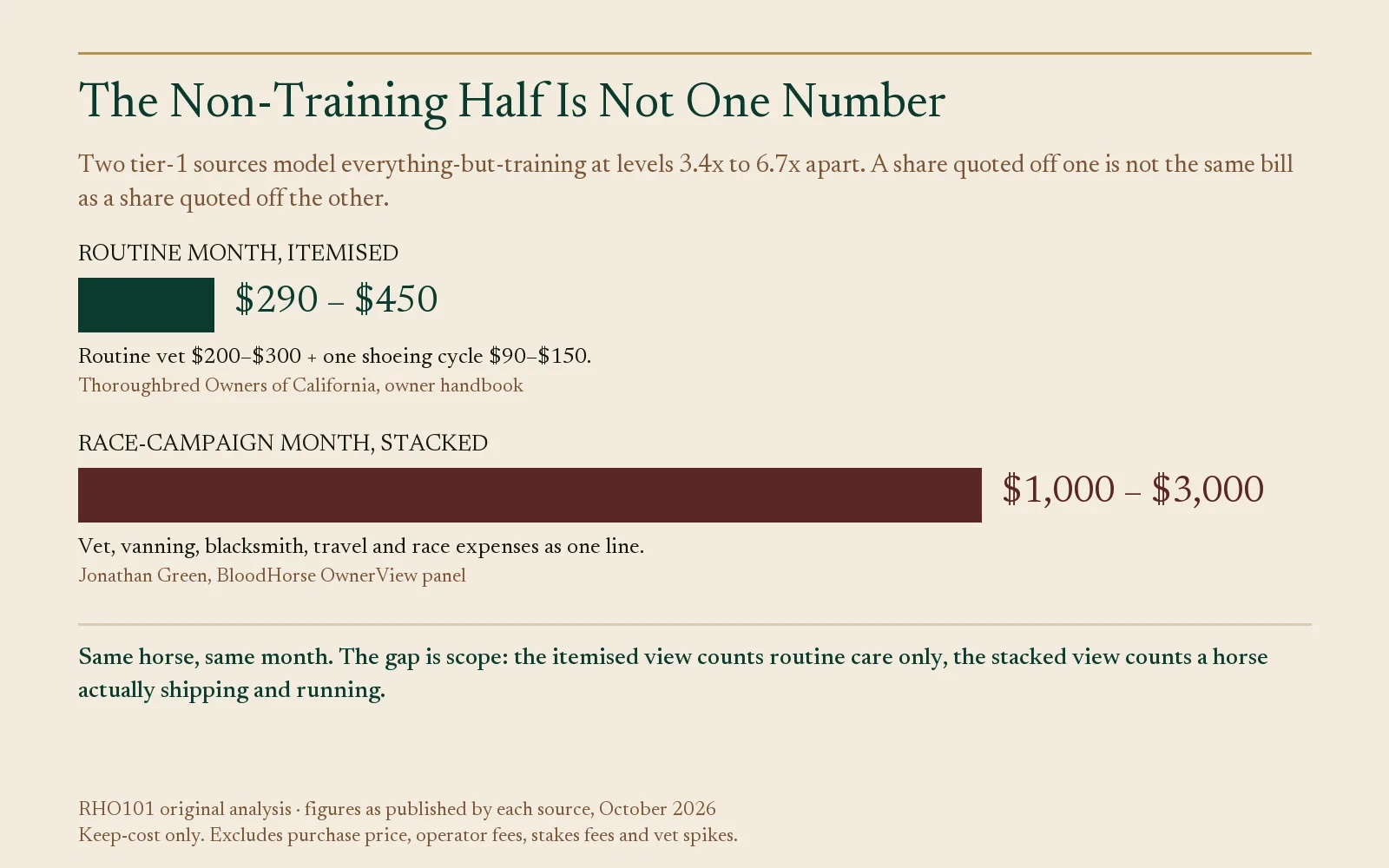
When you are handed a monthly estimate for a share, the question that gets you a useful answer is not “how much?” but “does that number assume the horse is running?” A quote built on routine care will look competitive right up to the month the horse ships to a stakes engagement.
What This Table Does Not Include
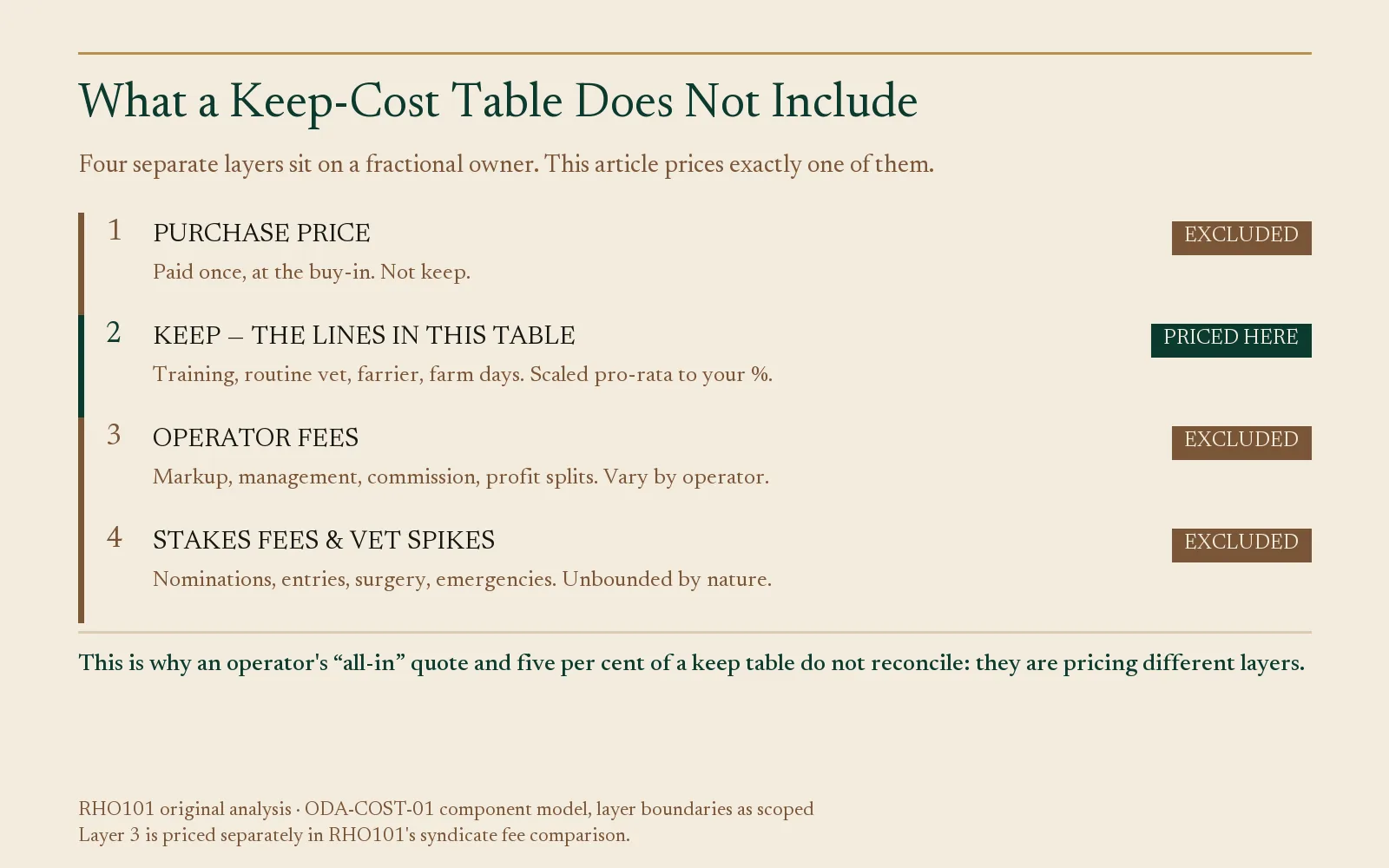
A racehorse keep-cost table prices only one of the four cost layers that sit on a fractional owner, and leaving the other three out is deliberate rather than an oversight. Mixing them is how a buyer ends up comparing a keep estimate against an all-in quote and concluding that one operator is half the price of another.
The Four Cost Layers on a Fractional Owner
Two lines I wanted in the table are not in it, and the reason matters. Annual transport and ongoing administration are real costs that a fractional owner pays, but the only tier-1 figures I had for them came from a single operator’s published cost document — and when I went back to re-verify it this month, the figures were no longer readable on a public page. Rather than print a number I could not stand behind, I left both lines out. Treat the totals above as a floor on those two items, not a complete bill.
Mortality insurance is also absent from the monthly lines, because it does not behave like one. The California handbook puts the premium at approximately 5% of each horse’s value, which makes it a function of what the horse is worth rather than of the month — and on a share, of what your fraction is worth. We cover how that policy actually works in our guide to racehorse mortality insurance.
Why an Operator’s All-In Quote Will Not Match 5% of This Table
An operator’s all-in quote bundles keep costs together with the operator’s own fee layer, so it will almost never equal your percentage of a keep-only table. The direction of the gap is predictable: the all-in quote is higher, because it contains something this table deliberately excludes. How much higher depends entirely on where that operator takes its margin — upfront in a markup, monthly in a management fee, or at the back end out of purses and sale proceeds. Those four models are not interchangeable, and we have priced them separately in our comparison of how syndicates actually charge you. Read that alongside this table and an all-in quote stops being a single mysterious number.
Geography moves the keep half as well. The California handbook notes that Northern California costs “across-the-board, average about one third less” than the southern circuit. A share in a horse stabled at a smaller track is a genuinely cheaper share, and that has nothing to do with the operator’s fees.
This Is Not the 50% Flash-Sale Question
A 50% share offered in a flash sale is a purchase-price question, not a keep question, and the two use different math entirely. If you are weighing a large tranche in a horse already running, the economics of that decision sit in what a 50% racehorse share actually costs. Come back to this table afterwards for the part of that deal you will still be paying every month once the purchase has cleared.
What I Check Before I Buy a Share
Three questions separate a share quote I can budget against from one I cannot, and all three are about scope rather than price.
- Does the monthly estimate assume the horse is racing? If the answer is vague, you have been quoted a routine month and you will be billed campaign months.
- Which of the four layers is in this number? Ask for keep and fees separately. An operator who cannot split them is an operator whose margin you cannot see.
- What happens in a layup month? The farm day-rate is a third of the track rate, and a horse that spends four months on the farm changes your annual carry more than any fee negotiation will.
None of this requires a confrontation. It requires asking the operator to tell you which month they are describing.
Frequently Asked Questions
How much does a 5% racehorse share cost per month?
A 5% racehorse share costs roughly $90 to $340 a month in keep, scaling the sourced component model above. The low end is a routine month at the cheapest published day-rate; the high end is a campaign month at a premium circuit. Operator fees sit on top of both.
How much does a 10% racehorse share cost per year?
A 10% racehorse share carries roughly $2,148 to $8,100 a year in keep costs. That assumes twelve months in training; months spent on the farm at the $17 to $50 day-rate pull the figure down materially.
Is a 25% share just 25% of the training bill?
No — a 25% share is 25% of every keep line, not the training line alone. Training is the largest single component, but routine vet, farrier and the shipping and race-day stack all scale with your percentage too, which is what takes a 25% share from about $448 to about $1,688 a month.
Do syndicate fees sit on top of this table?
Yes. Syndicate markup, management fees, commissions and profit splits are a separate layer that this keep-cost table excludes entirely. Depending on the operator, that layer can be charged upfront, monthly, or only out of winnings and sale proceeds.
Why do operator all-in numbers not match 5% of $50,000 to $90,000?
Because published all-in anchors are quoted per whole horse and already bundle the operator’s fee layer, while a keep-only table prices just the barn’s invoices. The two figures are measuring different things, so a mismatch is expected rather than evidence that someone is overcharging.
What to Read Next
If this table is the share-sized view, the whole-horse view is the natural next step — the monthly cost of owning a racehorse covers the bill before it is divided, and our guide to fractional ownership covers what your percentage actually entitles you to beyond the invoices.
About the Author

Calvin Johnson is a Thoroughbred racehorse owner, day trader, and independent racing analyst with more than a decade of firsthand ownership experience. He has participated in nearly every common structure in horse racing — fractional platform shares, traditional syndicates, LLC partnerships, claiming ventures, and outright ownership — across more than two dozen horses. Calvin writes about racehorse ownership the same way he approaches markets: by studying risk, incentives, fees, and whether the people controlling the deal are aligned with the investors behind it.
- Calvin Johnsonhttps://racehorseownership101.com/author/calvin-johnson/

- Calvin Johnsonhttps://racehorseownership101.com/author/calvin-johnson/

- Calvin Johnsonhttps://racehorseownership101.com/author/calvin-johnson/

- Calvin Johnsonhttps://racehorseownership101.com/author/calvin-johnson/