
Retail racehorse syndicates charge you in one of four ways: a percentage of the money they raise, a markup folded into the share price, a flat upfront fee, or a commission on purse earnings. Entry runs from about $40 to $20,000 depending on which of those four you are buying into. Those are different machines, not four prices for the same product, and until you know which one you are standing in front of, “which is cheaper” has no answer.
The short version
- Four fee archetypes cover the retail market. Each takes its margin at a different moment in the life of the horse.
- A fee model predicts the entry price. Micro-shares start near $40; a traditional share starts around $7,500.
- “No management fee” describes one line item, not a model. Three of the four archetypes can advertise it truthfully.
- Several operators do not publish their acquisition markup. Any table that shows one for all of them has invented numbers.
The short answer: four machines, and “cheaper” is the wrong first question
There are four fee archetypes in retail racehorse ownership, and the one you pick determines when money leaves your account rather than how much of it does. Two offers landed in my inbox in the same week last year: a share priced at $125 and a share priced at $7,500. For about an hour I treated that as a 60-fold price difference. It is not. The $125 buys a fraction of a percent of one horse with every ongoing cost already settled; the $7,500 buys a few percent of a horse whose bills arrive for as long as you own it. Comparing the two numbers tells you almost nothing.
Imagine your colors on the horse at the front.
Not a bet. Not a ticket. Yours. Thousands of everyday fans own a piece of a racehorse. The free guide is how they started.
The industry’s own marketing pushes you toward the wrong comparison. Operators advertise the line item they do not charge, which is why so many of them can say “no management fee” and mean it. We audited that specific claim in our breakdown of what “no management fee” syndicates actually charge instead. This page is the step before it: classify the offering first, then read its headline.
The four racehorse syndicate fee structures, side by side
| Model | How the margin is taken | How care is billed | Typical entry | Example operators | Not published |
|---|---|---|---|---|---|
| A. Percentage of the raise | A set percentage of the offering proceeds, taken at the raise, plus fees on winnings and on sale | Pre-funded from a working-capital reserve held back from the raise | About $50 a share | MyRacehorse, Commonwealth | Nothing material — both file with the SEC |
| B. Acquisition markup + pass-through | A markup added to the horse’s cost before shares are sold, plus a commission when the horse is sold | Actual expenses passed through as they happen, by bill or capital call | From $7,500 | Team Valor, Eclipse, Little Red Feather, West Point | The markup percentage |
| C. Flat all-in upfront | A fixed one-time fee, with no percentage taken from the horse’s cost | Covered on racing shares; a set number of quarterly bills on young stock | $40–$125 | Wasabi Ventures | — |
| D. Low entry + purse commission | A commission on gross purse earnings, plus a markup on the horse and commissions on profitable sales | Actual cost billed once the initial reserve runs out | $1,000–$5,000 for 4% | Dare to Dream | The markup percentage |
Read that table down the second column rather than across the fourth. The margin column is what separates these businesses; the entry column is a consequence of it. An operator taking its cut from the raise needs the raise to be large, so it sells many small shares. An operator taking its cut from a markup on the horse needs you to buy a meaningful slice, so it sells few large ones.
Where each fee model takes its margin
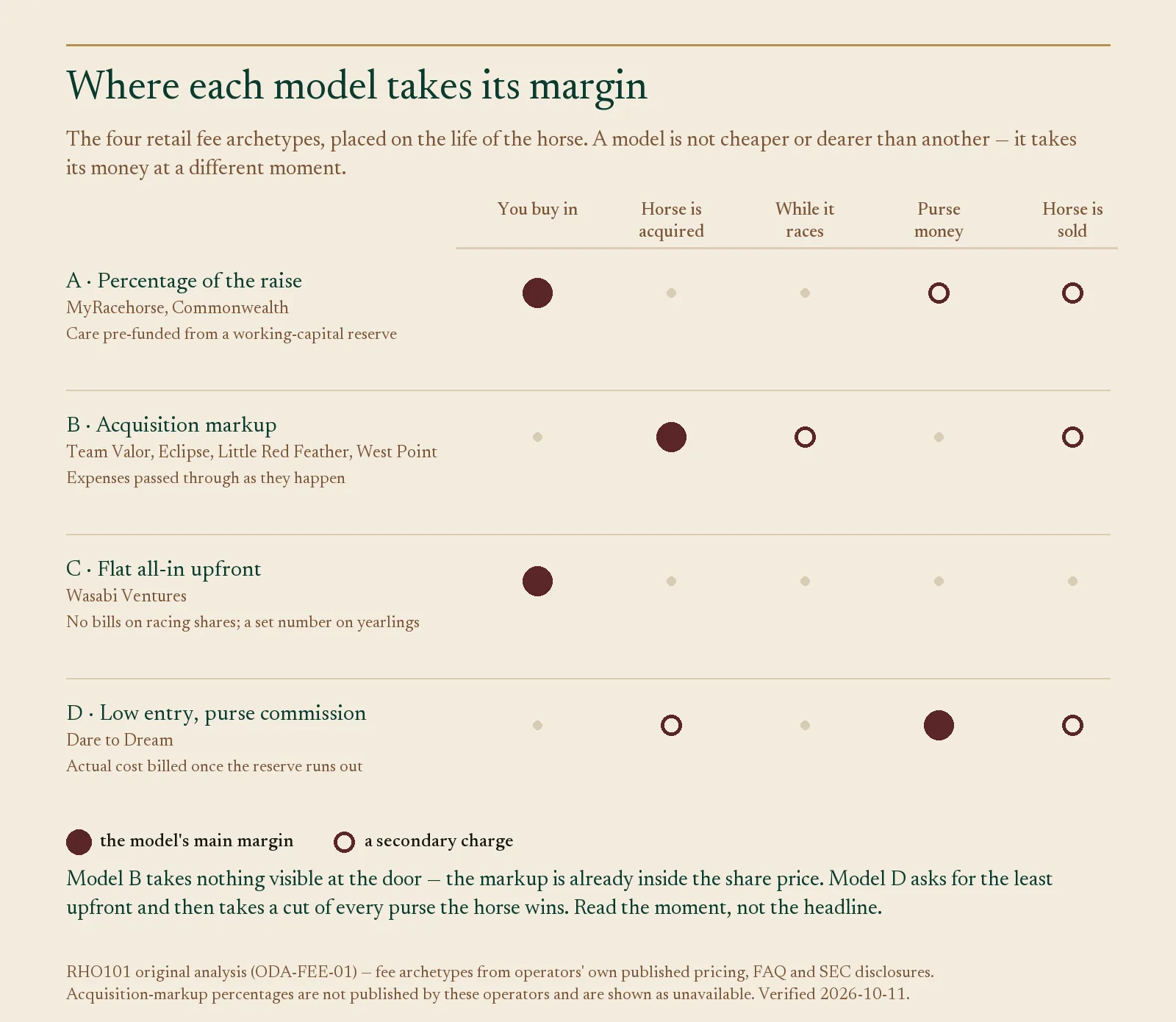
Model A: a percentage of the raise, with care paid for in advance
MyRacehorse and Commonwealth take their fees as a percentage of the money they raise from you, and hold back part of that raise to pre-pay the horse’s care. Both register their offerings with the SEC, so the fee stack is written down in a filing rather than described on a sales page — which makes these two the only operators in the retail market you can compare numerically and honestly.
Commonwealth’s own use-of-proceeds page states that the reserve “cover[s] all of the ongoing costs associated with, managing, training and caring for the horse for 24 months.” That is the defining feature of the model: you are not billed during those two years because you already paid, inside your share price. The reserve is not a gift, and when it runs out the economics change.
24 months
of care pre-funded inside a Commonwealth share price, held back from the raise rather than billed to you later.
We keep the numeric side of this model on two dedicated pages rather than duplicating it here: what MyRacehorse charges, line by line from the SEC filings, and the two operators compared side by side. If you want percentages, read those. If you want to know which machine you are in, stay here.
Model B: the markup is already inside the share price
Traditional syndicates such as Team Valor, Eclipse, Little Red Feather and West Point buy a horse, add a markup, and sell you a share at the marked-up figure — then bill the actual costs of racing as they fall due. Team Valor’s Getting Started page is unusually blunt about both halves: asked whether it charges a management fee, the answer is “No. We used to, but we dropped it.” Asked how it makes money, it says it “marks up a horse prior to syndication.”
That is the whole trick of the “no management fee” headline. The fee did not disappear; it moved into the purchase price, where you cannot see it as a line item. Team Valor also takes “10 percent of profits upon conclusion of the investment” and “a 5 percent sales commission when a horse is sold.”
A markup you cannot see is not the same as a fee you are not paying.
Within this model the billing rhythm varies more than the margin does, and that is the part that catches new owners out:
- Team Valor “bills actuals in arrears bi-monthly,” with US training running “about $64,000 annually” for a whole horse.
- Eclipse does charge a management fee, and publishes it: “Monthly Management fee: $600 + Related expenses,” per its legal and pricing page.
- Little Red Feather charges no monthly management fee and no markup on expenses, and collects running costs through quarterly capital calls.
- West Point has charged no monthly management fee since 2012, and covers expenses from the syndication price before moving to quarterly capital calls.
None of these four publishes its acquisition markup as a percentage. That absence is the single most important thing to know about Model B, and it is why the table above has a column for what is not published.
Model C: flat upfront, with one caveat worth reading
Wasabi Ventures charges a one-time fee and then, on its racing shares, nothing further. Its About page promises “NO bills or other payments to be made after the initial one-time payment” on a racing share, alongside a “$25 fee to become part of the WV Stables Member Club.” Racing shares run from 0.25% to 4.99%, with a minimum contribution “between $40 and $125.”
The caveat is that “no ongoing bills” is true of the racing shares and not of everything Wasabi sells. Buy into a yearling and you get “four quarterly bills prorated by percent owned that begin 90 days after purchase”; buy into a weanling and it is six. The bills stop after that fixed run, which is still a long way from an open-ended capital call — but it is not the zero that the headline implies, and it is the kind of detail that only appears if you read past the first product.
Model D: low entry, and a cut of every purse
Dare to Dream asks for little at the door and takes its margin from the horse’s winnings. Its FAQ states the mechanism in one line: “Manager commissions are 5% of gross purse $ earned.” Gross, not net — the commission is calculated before the costs of winning the race come out.
The rest of the structure follows from that. There is no separate ongoing management fee. Initial capital covers the horse, acquisition costs and an estimated three to nine months of training; after the reserve is exhausted you are billed your share of actual cost. The FAQ puts that at $3,400 a month for a whole horse:
- Training and boarding — $2,650
- Medical, including vet and vitamins — $500
- Blacksmith — $150
- Office — $100
A 4% interest typically costs between $1,000 and $5,000 to buy, and runs about $136 a month once billing starts.
Dare to Dream says it does not mark up expenses, and its own FAQ is clear that management is paid through the markup on the horse, the purse percentage, and commissions on profitable sales. Three mechanisms, none of them a monthly fee.
What the fee model tells you about the entry price
Entry price in retail racehorse ownership falls into three distinct bands, not the two that the micro-share-versus-traditional framing suggests. The usual telling has a cheap tier and an expensive tier with nothing in between. There is something in between, and it is a whole fee model.
Three entry rungs, not two
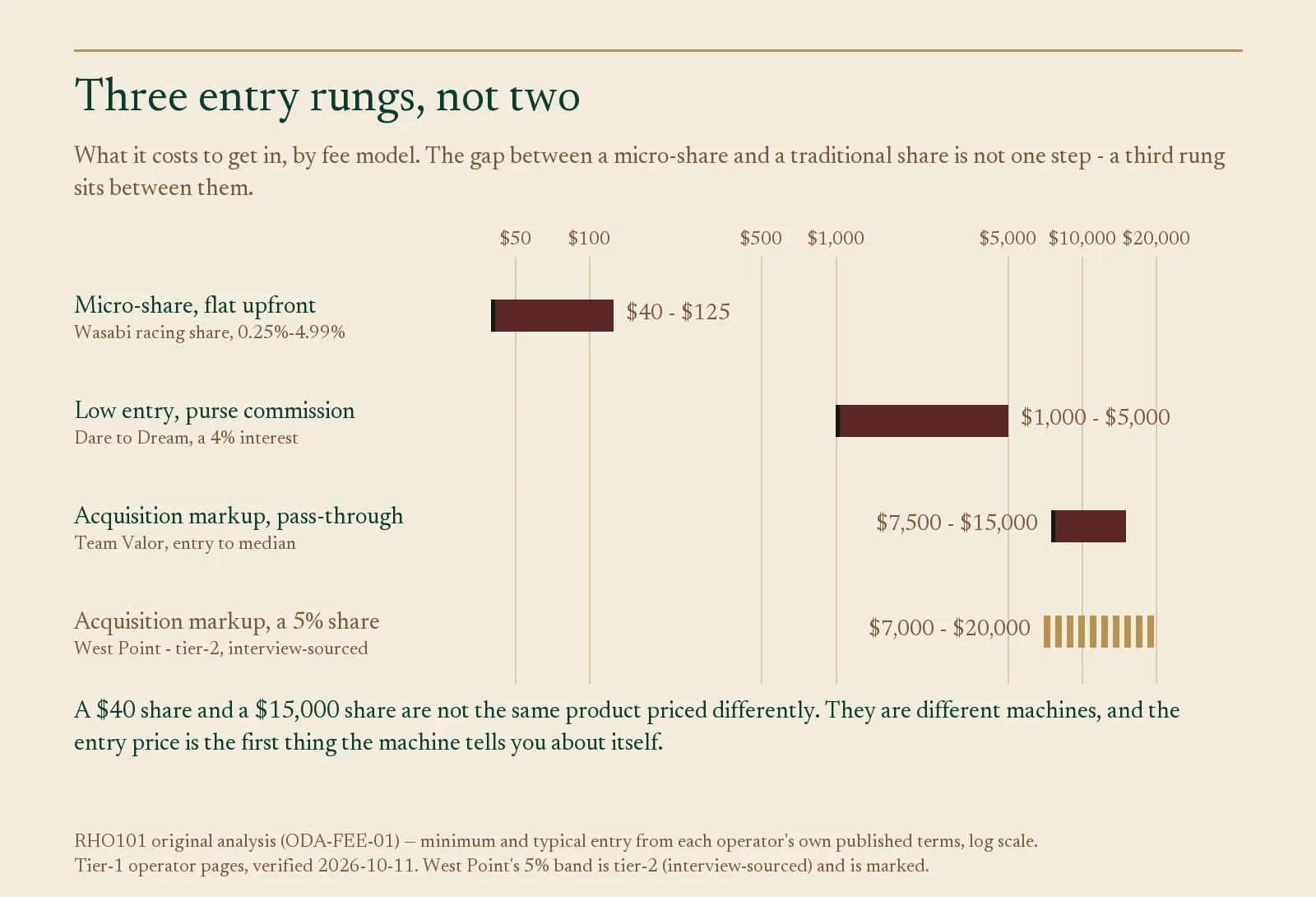
RHO101 original analysis. The three rungs are derived by taking each operator’s own published minimum or typical entry and grouping them by fee archetype rather than by brand. The micro rung is Wasabi’s $40–$125 racing share. The middle rung is Dare to Dream’s $1,000–$5,000 for a 4% interest, which exists because a purse commission lets the operator price the door cheaply. The top rung is Team Valor’s $7,500 entry and $15,000 median, which exists because a markup model needs a meaningful slice to be worth syndicating. West Point’s $7,000–$20,000 band for a 5% share points the same way but is interview-sourced rather than published, so it is marked separately and excluded from the rung boundaries.
Method and limits. Each figure is the operator’s own published minimum or typical entry, read from its own site and checked on 11 October 2026; nothing is inferred and nothing is averaged across operators. Three honest edges apply. These are minimums and medians rather than what a given horse will actually cost you. One operator stands for each of the three rungs, so the bands describe the archetype, not the whole market. And an entry price says nothing about total cost of ownership — the $40 share and the $7,500 share bill very differently afterwards, which is the point of the first table rather than this chart.
Why a seven-operator percentage table would be dishonest
A single percentage column covering every operator on this page cannot be built from public sources, and any page showing you one has filled the gaps with guesses. Team Valor, Little Red Feather and West Point all confirm that a markup exists and none of them publishes what it is. That is not an oversight we can research around; it is a disclosure choice, and the honest response is to leave the cell empty.
Two further limits are worth stating plainly:
- Numeric comparison works only between MyRacehorse and Commonwealth, because only those two file the full fee stack with the SEC.
- We do not rank a cheapest operator or model a net return, because either would require assuming the markup percentages nobody has published.
A ranking built on an assumption is worth less than an empty cell that tells you what to go and ask.
What you can do with this is ask a better question. Not “what are your fees” — every operator has an answer ready for that. Ask instead: at what moment do you take your margin, and what does my bill look like in month thirteen? The four models give four genuinely different answers, and the one that suits you depends on whether you would rather pay in advance or pay as you go.
Questions owners ask about syndicate fee structures
How do horse racing syndicates charge fees?
Racing syndicates charge through one of four mechanisms: a percentage of the offering proceeds, a markup built into the share price, a flat one-time fee, or a commission on purse earnings. Most operators also take a commission when the horse is sold. Which mechanism an operator uses determines when you pay far more than how much you pay.
What is the difference between a markup and a management fee?
A management fee is a visible recurring charge, such as Eclipse’s $600 a month. A markup is a one-time amount added to the horse’s purchase price before shares are offered, so it is paid once, invisibly, inside the share price. An operator with no management fee and a markup has not made ownership free; it has moved the charge somewhere you cannot itemise.
Why can’t I compare MyRacehorse to West Point on one percentage?
You cannot compare them on one percentage because MyRacehorse discloses its full fee stack in SEC filings while West Point does not publish its acquisition markup at all. The two also bundle costs differently — one pre-funds care from a reserve, the other bills through capital calls — so even with both percentages in hand the figures would not measure the same thing.
What does a $50 share imply about the fee model?
A share priced near $50 almost always means the operator takes its margin from the raise or from a flat upfront fee, because only those models work at that scale. It also implies the horse’s near-term care is pre-funded rather than billed to you. Expect the fee to be a stated percentage of what you paid, and expect a charge on the way out when the horse is sold.
What to read next
- Horse racing syndicates with “no management fee”: what they actually charge instead — the claim audit, operator by operator.
- MyRacehorse vs Commonwealth fees — the only honest numeric comparison in the retail market.
- What’s actually in a syndicate or partnership agreement — where these fee terms are written down.
- What a Thoroughbred actually costs to keep, by month — the bills the pass-through models send you.
About the Author

Calvin Johnson is a Thoroughbred racehorse owner, day trader, and independent racing analyst with more than a decade of firsthand ownership experience. He has participated in nearly every common structure in horse racing — fractional platform shares, traditional syndicates, LLC partnerships, claiming ventures, and outright ownership — across more than two dozen horses. Calvin writes about racehorse ownership the same way he approaches markets: by studying risk, incentives, fees, and whether the people controlling the deal are aligned with the investors behind it.
- Calvin Johnsonhttps://racehorseownership101.com/author/calvin-johnson/

- Calvin Johnsonhttps://racehorseownership101.com/author/calvin-johnson/

- Calvin Johnsonhttps://racehorseownership101.com/author/calvin-johnson/

- Calvin Johnsonhttps://racehorseownership101.com/author/calvin-johnson/