When a racehorse syndicate advertises a commitment to accredited aftercare, that sentence is either a contract term or a marketing statement, and the two are not worth the same money to you. The Thoroughbred Aftercare Alliance is real and independently checkable: its published directory lists roughly 86 accredited organizations across about 175 facilities, and the TAA has granted $40.74 million to accredited groups since it was founded in 2012, including $4.7 million in 2025. What the directory cannot tell you is whether the syndicate you are buying into actually owes your horse a place in one of them. That answer sits in a single clause of the agreement you sign, and finding it takes about ten minutes.
The short version
- TAA accreditation describes an aftercare organization. It says nothing on its own about what happens to your horse.
- An aftercare commitment binds only when the agreement you sign carries four things: a verb, a standard, a deadline, and a funding source.
- Every check below is one a buyer can run alone, before money moves, using the syndicate’s own documents and a public directory.
What “accredited aftercare” actually means when a racehorse syndicate says it
TAA accreditation is a rating of an aftercare organization, not a guarantee attached to any individual horse. The Thoroughbred Aftercare Alliance, founded in 2012, is the sport’s accrediting body for aftercare: it assesses non-profit aftercare organizations against a Code of Standards covering five areas — operations, education, horse health care management, facility standards and services, and adoption policies and protocols — and, as BloodHorse reported when 49 organizations were accredited for 2025, inspections are conducted at every facility housing thoroughbreds, with re-inspections required as a condition of staying accredited. Accreditation runs in terms and has to be renewed; the TAA’s directory of accredited organizations is refreshed each January. All of that describes the receiving end of retirement. None of it describes the sending end.
Racing’s best-kept open secret: you don’t have to just watch.
Ownership groups let regular people own a share of a real racehorse. The free guide explains how it works, in ten minutes.
So a syndicate that says it works with accredited aftercare has named a category of organization that genuinely exists and is genuinely audited. It has not yet told you what it owes you. Those are separate facts, and syndicate marketing tends to present them as one.
- What accreditation does: audits an aftercare organization’s operations, education, horse health care, facilities and adoption protocols, and inspects every facility holding thoroughbreds.
- What it does not do: attach to a horse, oblige a syndicate to use an accredited organization, or oblige any organization to accept a particular horse.
My own habit when reading syndicate material is to treat the aftercare paragraph as the most carefully written writing on the page, because it usually is. It carries real institutional names, it is warm, and it answers the question a prospective owner is most uncomfortable asking. Then I go looking for the same commitment in the document that actually governs the deal, and the temperature drops.
Marketing page versus operating agreement: where the aftercare promise actually lives
A syndicate’s aftercare promise can appear in four places — the website, the pitch deck, the offering or prospectus material, and the syndicate or operating agreement — and only the last of those creates an obligation you hold. The first three describe the deal. The agreement is the deal. If the aftercare language lives only in the description, you are relying on the manager’s continued goodwill, which may be excellent and is still not a term.
This is the same discipline our guide to reading a syndicate prospectus applies to fees and to control, pointed at the end of the horse’s career instead of the start. It is also the reason the request that follows is so ordinary: ask for the signature-ready agreement, not the summary of it.
Marketing claim, contract clause, and what you can verify
| What the marketing says | What the agreement needs to say for it to bind | What you can verify before signing |
|---|---|---|
| “We are committed to accredited aftercare” | A duty on the manager to place the horse with an organization holding current accreditation | Ask for the section number; read the verb in it |
| “We partner with TAA-accredited organizations” | The organization named, or the accreditation standard named as the test | Look the organization up on the TAA directory |
| “Our horses never go to auction” | A prohibition with a stated consequence, not a description of past practice | Ask what happens if it is breached, and who may act |
| “Retirement is fully funded” | A named reserve, per-share contribution, or other funding source | Ask where the reserve sits and who controls it |
| “Aftercare is handled by the managing partner” | A duty owed to owners, plus confirmation of placement owed back to them | Ask what proof owners receive, and by when |
Nothing in that middle column is exotic. It is the ordinary furniture of a commercial agreement: an obligated party, a defined outcome, a test, a deadline, a source of funds. Aftercare language is worth reading closely precisely because it is so often written without any of them.
The five clause types that decide whether the promise binds
An enforceable aftercare commitment is assembled from five separate pieces, and a syndicate agreement can carry three of them and still leave you with nothing. Read for all five, in this order.
- The trigger. What event starts the obligation? “Retirement” is a word the manager may define. A clause that fires on the horse ceasing to race, or on a vote of the members, is a clause you can point at.
- The placement obligation. The verb and its object. “Shall transfer the horse to” is an obligation. “Will seek to identify a suitable home for” is an activity.
- The standard. Either a named organization or a named test — current TAA accreditation is the only widely used test in this sport, which is what makes it useful in a contract. “Appropriate,” “reputable,” and “qualified” are all decided by whoever is holding the horse.
- The funding clause. Retirement costs money after the horse stops earning any. Look for the source — a reserve, a per-share contribution, a share of sale proceeds — and look separately for whether owners can be assessed for shortfalls.
- The proof and the remedy. What are owners owed once the horse is placed, and within how long? An obligation nobody has to report on is difficult to notice being broken.
Our walkthrough of what is actually in a racehorse syndicate or partnership agreement covers the general anatomy of these documents; this is the retirement corner of the same instrument, which tends to be the least negotiated part of it.
Weak aftercare language beside language that binds
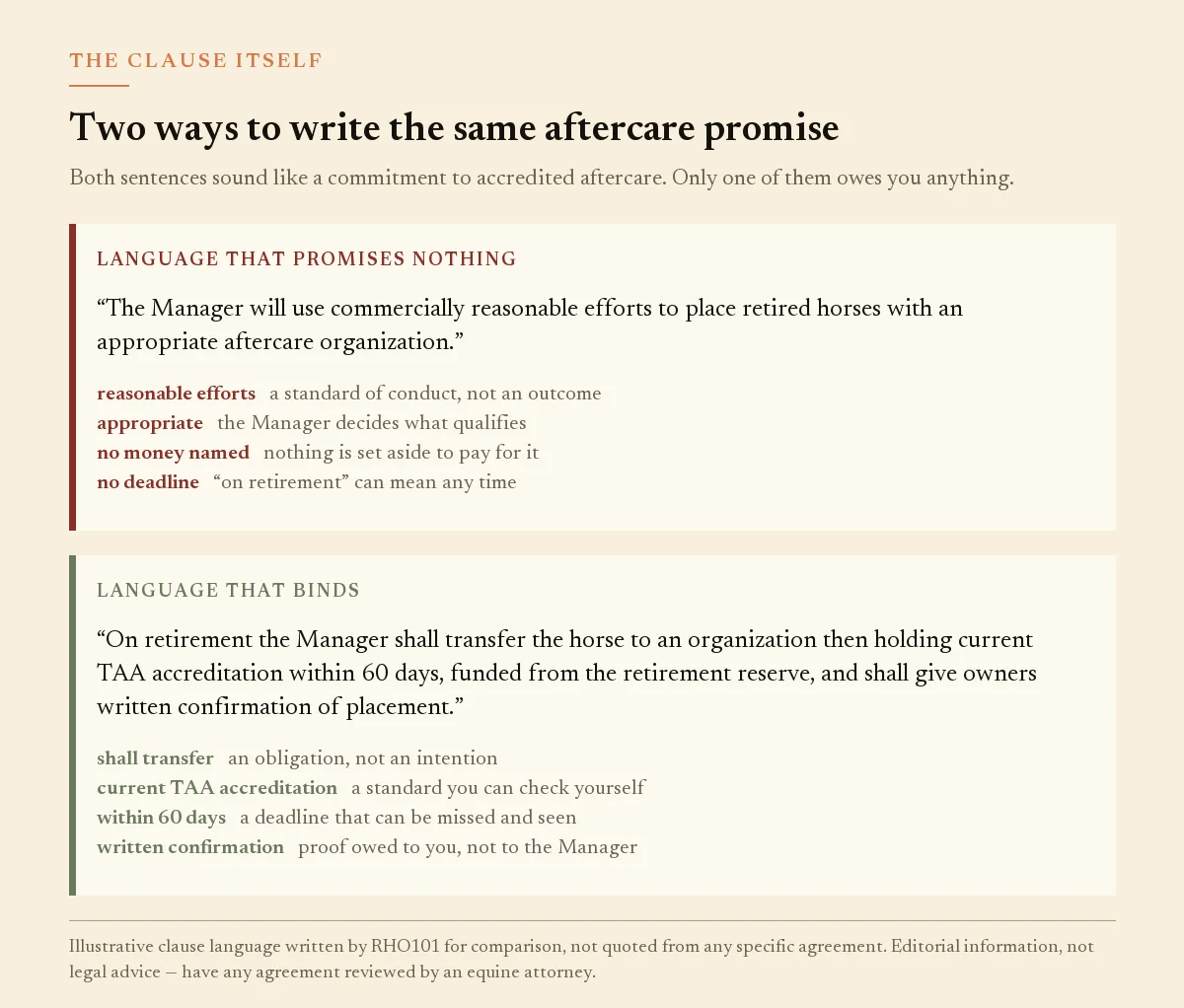
“Commercially reasonable efforts” is a real legal standard, chosen deliberately, and it commits the manager to a way of behaving rather than to a particular result. Plenty of well-run syndicates use it in good faith and place every horse they retire. The reason to read for it is simply to know which of those two sentences you are being sold, because they promise different things and cost the same.
How to verify a syndicate’s aftercare claim yourself
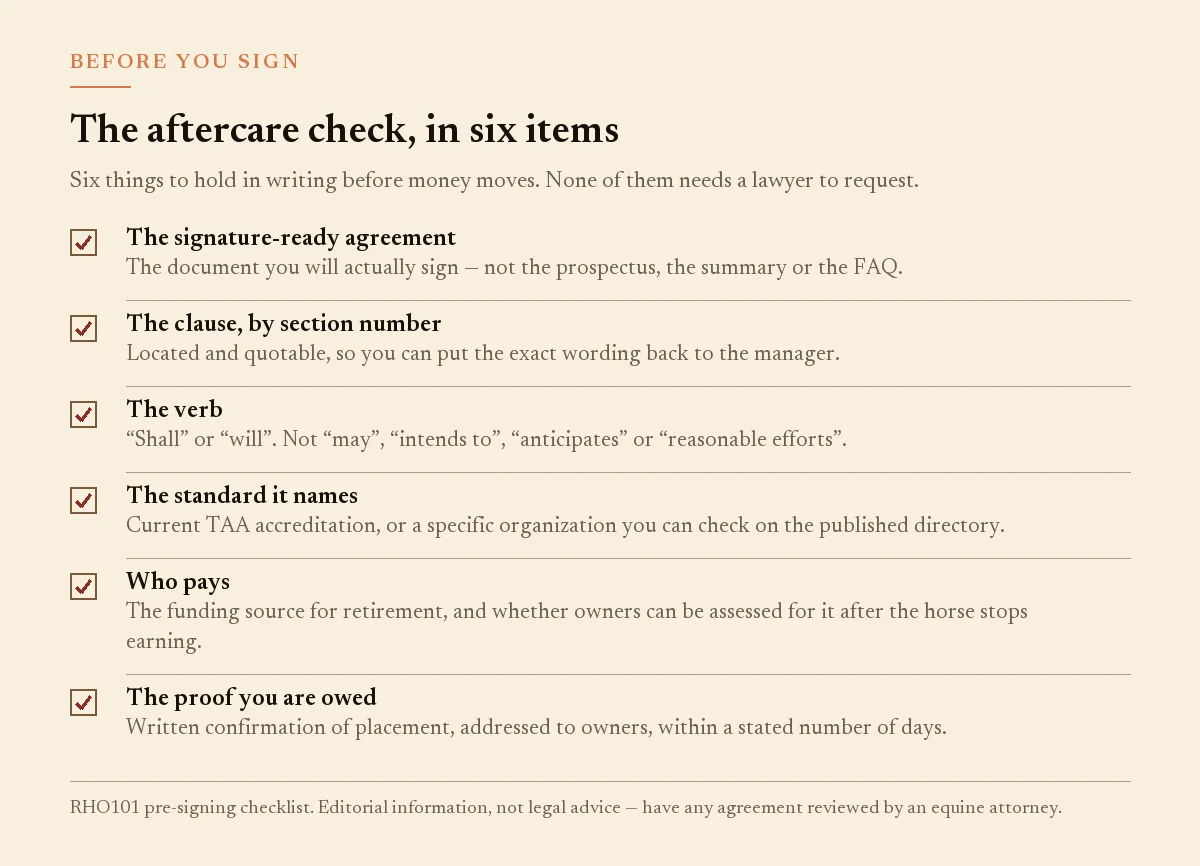
The whole verification runs in four checks, none of which requires an attorney, a subscription, or a phone call you would be embarrassed to make. Each check either produces a document you can hold or tells you the promise lives in marketing.
From pitch deck to TAA directory: the four checks

Two of those steps deserve a note. Asking for the signature-ready agreement before you commit is a normal request, and a manager’s response to it tells you something whatever the document says; our checklist for vetting a syndicate manager treats that response as evidence in its own right. And the directory check is worth doing on the day, rather than trusting a press release: accreditation is a term that expires, the TAA refreshes its published list each January, and organizations have to reapply to keep it. An organization that was accredited when the brochure was printed is not necessarily accredited now.
If you want the background on what the accreditation itself involves before you use it as a test, our guide to what the Thoroughbred Aftercare Alliance is and what accreditation means covers the standards and the money.
What to ask the syndicate manager before you sign
Six questions get you to the bottom of a syndicate’s aftercare position, and none of them is adversarial. A manager who has thought about retirement will have answers ready; one who has not will tell you that too.
- Which section of the agreement covers what happens when the horse stops racing?
- Does that section name an aftercare organization, name a standard, or leave the choice open?
- Where does the money for retirement come from, and is any of it set aside now?
- Can owners be billed for retirement costs after the horse stops earning?
- What do owners receive in writing once a horse has been placed, and how soon?
- How many horses has this operation retired so far, and where did they go?
The last one is the least legal and the most revealing. A syndicate with a track record can answer it in a sentence. A syndicate that has never retired a horse is not disqualified by that — everyone starts somewhere — but the promise is then entirely a matter of what the document says, because there is no practice to point at.
The aftercare check, in six items
What happens at retirement when the clause is weak
A minority owner in a syndicate holds an economic interest and very little operational control, and retirement is where that gap is felt most sharply. The decisions that matter at the end of a horse’s career — whether it is sold, claimed away, retired, or moved on — are usually the manager’s to make, and the agreement is what decides how much say anyone else has.
Consider an owner holding a two-percent share in a claiming partnership. The horse runs honestly for three seasons and then stops being competitive. There is no retirement reserve, because nobody built one, and the aftercare paragraph on the website was never carried into the operating agreement. The manager is not acting in bad faith; he simply has a horse that costs money, twenty-eight co-owners who each own a fraction of the problem, and no clause telling him what to do. The horse goes into a claiming race at the bottom of the ladder, which is a legitimate racing decision and also, in practice, one of the ways a horse leaves a partnership’s books.
The aftercare question is not really “does this syndicate care about horses.” It is “did anyone write down what happens when caring costs money.”
Retirement is a genuine expense, and it starts on the day the earnings stop; our breakdown of what it costs to retire a racehorse walks the boarding, sanctuary, and adoption numbers. A syndicate that has funded that in advance has made a choice with real money attached, and it is fair to ask to see it.
Five retirement questions and the clause that decides each
| The question at retirement | What usually decides it |
|---|---|
| Who chooses the aftercare organization | The manager, unless the agreement names one or gives owners a vote |
| Whether the horse is sold or claimed away instead of retired | The disposition and transfer clauses, and the manager’s racing authority |
| Who pays for retirement | The funding clause; where there is none, whoever volunteers |
| Whether you can be billed after the horse stops earning | The assessment or capital-call clause |
| What you can enforce if the promise is broken | Whatever the agreement made an obligation — a marketing page is not one |
Questions owners ask about racehorse syndicates and aftercare
Does TAA accreditation mean my horse is covered?
No. TAA accreditation is awarded to an aftercare organization that has met the Code of Standards and passed facility inspection; it says that the organization is capable and audited. It creates no obligation on your syndicate to send your horse there, and no obligation on the organization to accept a particular horse. The accreditation is the standard you can point a contract at, and the contract is what makes it yours.
Who pays for aftercare in a syndicate?
Whoever the agreement says, and where the agreement is silent, the question opens at the worst possible moment. Some syndicates fund retirement from a reserve built out of share sales or purse earnings; some fund it from the sale of the horse; some rely on the manager absorbing it; some have not decided. The TAA itself distributes grants to accredited organizations — $4.7 million in 2025 — but those grants support the organizations, not individual owners’ obligations.
Can I ask for an aftercare clause to be added before I sign?
You can ask. In a small partnership being assembled around a specific horse, terms are sometimes still open, and a retirement clause is an unglamorous request that a serious manager will take seriously. In a large syndicate selling standardized micro-shares, the document is fixed and the honest answer is that your choice is to buy it or not. Either way, ask before the money moves, and have an equine attorney read anything you are negotiating.
What if the named aftercare organization loses its accreditation?
This is the argument for writing the standard into the clause rather than the name. A clause pointing at “an organization then holding current TAA accreditation” survives any single organization’s lapse, because the test travels with the horse. A clause naming one charity is only as durable as that charity’s next re-accreditation, and the TAA’s list is refreshed every January.
The honest answer
Sincerity and enforceability are different properties, and syndicate aftercare language can carry one without the other. The industry built a credible accrediting body and funded it; what it has not built is a habit of carrying that credibility into the documents individual buyers sign. That gap is yours to close, one question at a time, before you wire anything. If you are still deciding whether shares are the right route at all, our independent answer on whether buying shares in a racehorse is worth it is the place to start, and our owner’s guide to the aftercare system covers where these horses actually go. Ask for the section number. If the manager can give it to you from memory, that is usually the whole answer.
— Race Horse Ownership 101
About the Author

Calvin Johnson is a Thoroughbred racehorse owner, day trader, and independent racing analyst with more than a decade of firsthand ownership experience. He has participated in nearly every common structure in horse racing — fractional platform shares, traditional syndicates, LLC partnerships, claiming ventures, and outright ownership — across more than two dozen horses. Calvin writes about racehorse ownership the same way he approaches markets: by studying risk, incentives, fees, and whether the people controlling the deal are aligned with the investors behind it.
- Calvin Johnsonhttps://racehorseownership101.com/author/calvin-johnson/

- Calvin Johnsonhttps://racehorseownership101.com/author/calvin-johnson/

- Calvin Johnsonhttps://racehorseownership101.com/author/calvin-johnson/

- Calvin Johnsonhttps://racehorseownership101.com/author/calvin-johnson/