Horse Racing Glossary for Investors If you’re putting money into racehorses—whether through a microshare, a traditional partnership, or full ownership—you’ll run into a language all its own. Auction catalogs, partnership agreements, and Daily Racing Form past performances pack in terms that can make your head spin. Reddit threads and ownership forums are full of abbreviations and insider talk that leave newcomers scratching their heads. Social media chatter about “Beyers,” “claim backs,” and “K-1s” can feel like a foreign language. This…
·
Calvin Johnson
Horse Racing Glossary for Investors
If you’re putting money into racehorses—whether through a microshare, a traditional partnership, or full ownership—you’ll run into a language all its own. Auction catalogs, partnership agreements, and Daily Racing Form past performances pack in terms that can make your head spin. Reddit threads and ownership forums are full of abbreviations and insider talk that leave newcomers scratching their heads. Social media chatter about “Beyers,” “claim backs,” and “K-1s” can feel like a foreign language. This glossary cuts through the jargon so you can follow the conversation, read the fine print, and make smarter investment decisions. We’ve grouped terms by theme: ownership, legal, financial, sales, pedigree, training, vet, racing, entries, performance metrics, track conditions, team roles, purses, betting, and retirement. Whether you’re sizing up your first syndicate or negotiating a co-ownership deal, these terms will show up. Bookmark this. You’ll need it.
Racing’s best-kept open secret: you don’t have to just watch.
Ownership groups let regular people own a share of a real racehorse. The free guide explains how it works, in ten minutes.
Ownership & Partnership Terms
Ownership & Partnership Terms
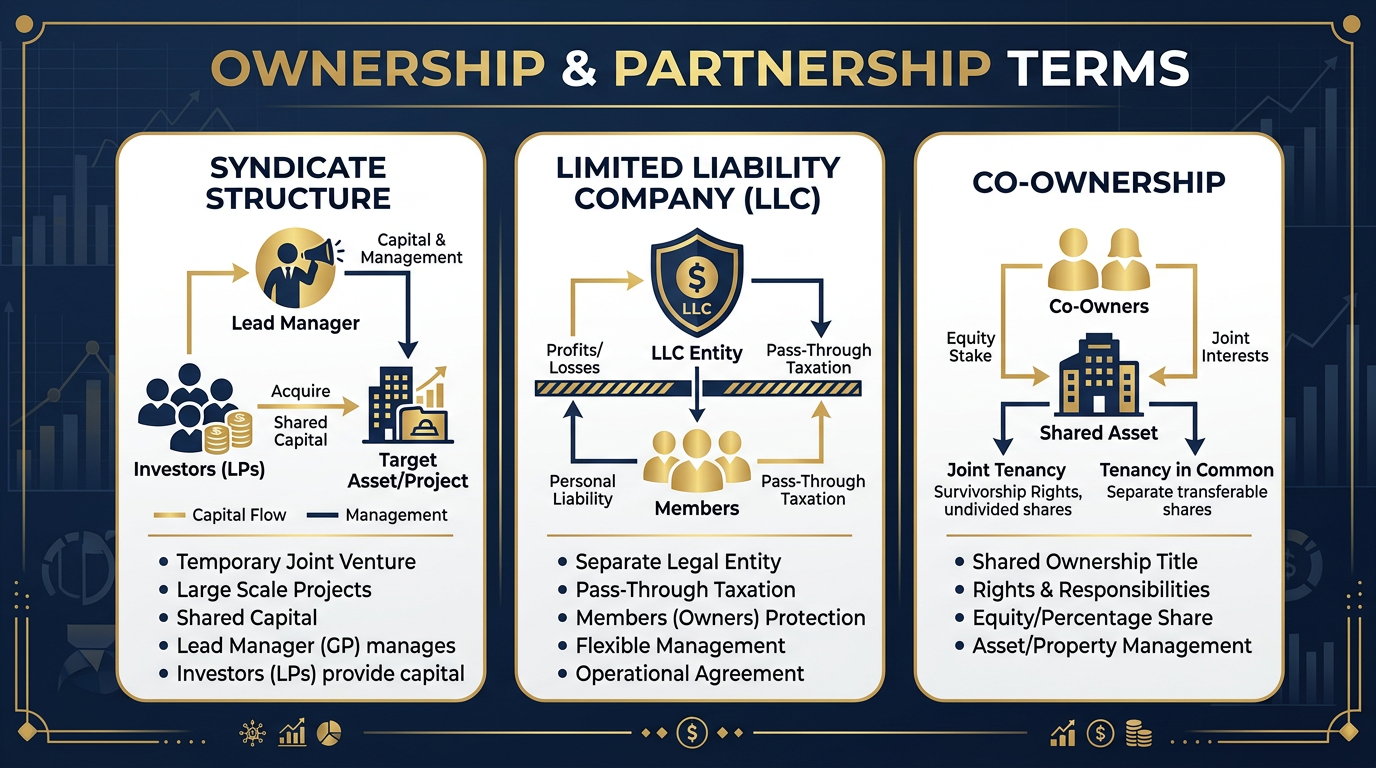
Syndicate – A group of investors who pool capital to own one or more horses, typically managed by a designated manager who handles day-to-day decisions. Share sizes vary—some syndicates cap individual members at 1–10%, others let you take larger pieces. Members share purse earnings proportionally after racing authority and administrative fees are deducted. On forums you’ll see people asking “Which syndicates actually pay out?”—transparency varies, so read the operating agreement. Co-ownership describes an agreement between two or more individuals without a formal LLC; it offers less liability protection than an LLC structure and can get messy when one partner wants out. Managing partner or syndicate manager has control over training, vet care, racing decisions, and communications—their decisions are binding on members. Pick yours carefully. Fractional ownership and microshare refer to small stakes (sometimes as low as $100) with no ongoing costs; platforms like MyRacehorse operate this model. You get a piece of the action without the monthly bills, though you’re also along for the ride on management decisions. Racing club is similar to a syndicate but often with lower commitment and fewer decision rights—good for dipping a toe. Stallion share or breeding share gives you the right to breed a mare to a stallion for one season, distinct from racehorse ownership. Silks are the colors and design registered to an owner; they identify your horse on the track. Watching your colors cross the wire first never gets old. One thing investors learn fast: how you structure ownership affects liability, tax treatment, and decision-making. An LLC gives you a corporate shield; a handshake co-ownership does not. Microshares let you test the waters with minimal downside but limited upside. Traditional syndicates put more capital at risk and more control in the manager’s hands. There’s no one-size-fits-all—pick the structure that matches your goals and risk tolerance.
Legal, Compliance & Securities Terms
Legal, Compliance & Securities Terms
The SEC has treated pooled horse ownership with profit expectations as securities since the 1970s. A security is broadly an investment in a common enterprise with profits expected from others’ efforts—racing partnerships fit that definition. You’re not just buying a horse; you’re buying into a venture run by someone else. Registration or exemption is required; offerings must be registered or qualify for an exemption (e.g., Regulation A, Regulation D). Skip this and you’re in risky territory. Unregistered securities can lead to civil and criminal liability for issuers; investors may get full rescission—return of all funds regardless of horse value. That sounds like a safety net until you realize the issuer might be broke. Regulation A allows smaller companies to offer securities with streamlined disclosure; MyRacehorse uses it for their microshare offerings. Broker-dealer refers to a firm registered under the Securities Exchange Act to facilitate offerings; not every “advisor” selling horse shares is one. Conditions of Sale govern auction purchases—reserves, codes of conduct, and prohibited practices like “luck money” (side payments over $500 to buyers that can skew results). Co-ownership agreement spells out fractional interests and obligations. Operating agreement (for LLCs) defines member rights, manager duties, and how disputes are resolved. Always have a lawyer review before you sign. A few hundred bucks now can save you thousands later. On Reddit you’ll see threads asking “Is this syndicate legit?”—often the answer hinges on whether the offering is properly registered or exempt. Unregistered schemes can blow up; investors may get rescission but the operator may have no assets left. Do your due diligence. Check SEC filings. Ask for the legal opinion. If someone won’t provide it, walk away. The racing industry has seen its share of Ponzi-style schemes disguised as horse partnerships. Know the difference.
Financial & Tax Vocabulary
Financial & Tax Vocabulary
Schedule C – Where sole proprietors report racehorse income and expenses. Schedule K-1 – The form partners receive showing their share of partnership income, losses, deductions, and credits; it flows through to your personal return. Expect it in March or April; don’t file until you have it. MACRS (Modified Accelerated Cost Recovery System) – The IRS depreciation system for racehorses: 3-year property for horses over 2 when placed in service; 7-year for yearlings. You’ll see this in partnership memos. Bonus depreciation and Section 179 can accelerate deductions in year one—big for new owners—but tax law changes, so stay current. Basis – Your cost for tax purposes; purchase price plus certain expenses, minus depreciation taken. Track it. Ordinary income vs. capital gains – Purse money is ordinary income; horse sales can be capital gain if held long enough (e.g., 24+ months for Section 1231 livestock treatment). Hobby loss rules – If the IRS deems your activity a hobby, loss deductions are limited. Run it like a business: records, expectations, effort. Passive activity – Losses may be limited if you don’t materially participate. At-risk rules cap losses to what you have at risk. Form 4797 – Used for sales of business property; gains there can be ordinary. Carried interest – Sometimes used in partnership structures for managers. Get a CPA who knows equine work. Horse tax is its own beast. One nuance: breeders and racetrack owners often have different tax profiles than racehorse owners. Breeder awards can be taxable income; depreciation schedules depend on when the horse was placed in service. Some partnerships front-load deductions in year one; that can create a mismatch if the horse doesn’t perform. Track your basis religiously. If you sell at a gain, you’ll need it. If you sell at a loss, the IRS will want to see the paperwork. Equine CPAs aren’t everywhere—plan ahead.
Sales, Auctions & Bloodstock Terms
Sales, Auctions & Bloodstock Terms
Bloodstock – The collective term for racehorses as assets. You’ll see “bloodstock agent” in bios—they’re the pros who scout and buy for clients. Consignor – The seller (or agent) offering a horse at auction. Could be a breeder, owner, or pinhooker. Reserve – The minimum price below which the consignor won’t sell; if the bid doesn’t reach it, the horse is bought back. Reserves aren’t disclosed; you’re guessing. Buyback – When the consignor purchases the horse back because the reserve wasn’t met. High buyback rates can signal overpriced reserves. Commission – The fee paid to the sales company (e.g., 5% of final bid at Fasig-Tipton, with a minimum). Budget for it. Entry fee – Cost to enter a horse in a sale (e.g., $500 per horse, often non-refundable). Catalogue – The listing of horses in a sale with pedigrees and details. Keeneland and Fasig-Tipton catalogues are dense—pedigree nerds love them. Under-tack show – A timed workout before 2-year-old sales so buyers can evaluate speed. Fast times move the needle; slow times can kill interest. Breeze-up – A sale where 2-year-olds work (breeze) before auction; popular in Europe and growing here. Horses of racing age – Horses already in or ready for competition vs. yearlings or broodmares. Weanling – A foal after weaning; yearling – A 1-year-old. Hip number – The catalogue number assigned to each lot. “Hip 47” means that horse. Out – Failed to sell (no bid meeting reserve). RNA (Reserve Not Attained) – Same idea. Bidder registration – Required to bid; credit approval can take 48 hours, so don’t show up at Keeneland in September without it. Sales seasons have their own rhythms. Yearling sales dominate the fall; 2-year-olds in training sales heat up in spring. Fasig-Tipton, Keeneland, and OBS run the big North American auctions. Overseas, Tattersalls and Goffs handle European bloodstock. Prices swing with the economy, stallion success, and fashion. When a sire gets hot, his yearlings can double in value in a year. When he falters, the bottom can fall out. Pinhookers buy weanlings or yearlings, develop them, and resell as 2-year-olds—high risk, high reward. If you’re buying at auction, get a trusted agent or advisor. Catalogues are thick; pitfalls are everywhere.
Pedigree, Breeding & Genetics Terms
Pedigree, Breeding & Genetics Terms
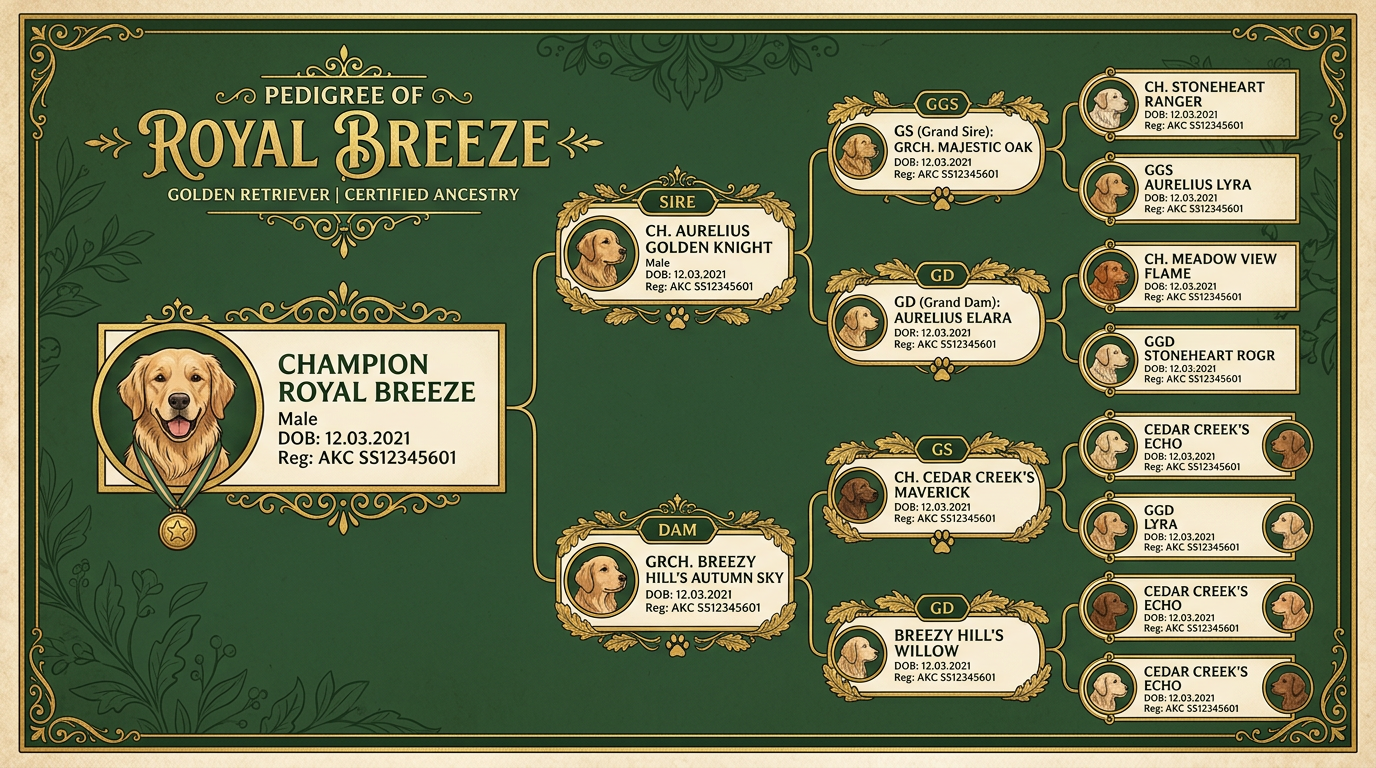
Sire – The father; dam – The mother. You’ll see “by Tapit out of Unbridled’s Song” in catalogues. Stallion – A male used for breeding; broodmare – A female used for breeding. Progeny – Offspring of a stallion; produce – Offspring of a dam. Dam sire or broodmare sire – The maternal grandfather. Pedigree geeks care a lot about him. Second dam, third dam – Maternal grandmother, great-grandmother (tail-female line). The female line matters for stamina and temperament. By [sire] – Sired by; out of [dam] – Foaled by. Half-sibling – Same dam, different sire; full sibling – Same sire and dam. Full siblings to stakes winners get attention. Black type – Bold type in pedigrees indicating stakes wins or placings; it signals class. More black type usually means higher value. Inbreeding – An ancestor appearing multiple times in a pedigree. Some crosses “nick” well; others don’t. Nicking – Pedigree patterns that historically produce good runners. Stallion reports often highlight nicks. Stakes winner – Won a stakes race; graded stakes – Grade 1, 2, or 3. Producer – A dam whose offspring have succeeded. Runner – A horse that has raced. Pedigree – The ancestry chart, usually four to five generations; sire’s side on top, dam’s on bottom. Spend time with it before you bid. Pedigree doesn’t guarantee performance—horses with modest bloodlines win big races all the time—but it influences price and expectations. Black-type sells. A first foal from a stakes-winning mare will command a premium. A stallion’s first crop (freshman sire) is a gamble; his second and third crops tell you more. Broodmare sires matter: Unbridled’s Song, Storm Cat, and A.P. Indy pop up in successful pedigrees. The “tail-female” line (dam, second dam, third dam) is especially watched for stamina and soundness. If you’re new to pedigrees, start with a few prominent sire lines and trace them. The patterns become familiar fast.
Training, Conditioning & Stable Terms
Training, Conditioning & Stable Terms
Breeze – A timed, fast workout (not all-out); typically 2–6 furlongs with the rider sitting quietly. The horse moves “under its own power.” Gallop – Faster than a jog, slower than a breeze; the main daily conditioning work. Horses gallop a mile or more to build stamina. Jog – Slow trot for warm-up and recovery. Handily (H) – Workout where the rider actively encourages speed vs. a regular breeze (B). Handily works show more intent. Bullet – Fastest workout at a given distance that day. “Bullet work” gets people excited. Blowout – Short, sharp burst (1–2 furlongs) a few days before a race to sharpen speed without tiring the horse. Work – Any timed exercise. Breezing – Running at a controlled fast pace; trainers often breeze once weekly when preparing for a race. Exercise rider – The person on the horse during morning training (not the jockey). Different skill set. Set down – Urging the horse to run. Off the bridle – Horse not responding to rider’s hands; can mean tiring or not trying. Stable – The barn or group of horses under one trainer. String – A trainer’s group of horses. “He’s got a big string at Saratoga.” Stall – Individual enclosure. Feed tub, water bucket – You’ll see these in stall tours. Condition book – The racing secretary’s schedule of upcoming races and conditions. Trainers plan around it. If your trainer says “we’re waiting for a race in the condition book,” that’s why. Training cycles typically run 60–90 days from a layoff to race-ready. Horses coming off a break will jog, then gallop, then breeze. A bullet work close to race day can signal readiness—or a trainer showing off. Blowouts are short and sharp; the goal is to sharpen without fatiguing. Morning works are public at most tracks; you can show up at dawn and watch. It’s one of the perks of ownership. Seeing your horse breeze in :47 for a half-mile hits different when you understand what you’re watching.
Veterinary, Health & Insurance Terms
Veterinary, Health & Insurance Terms
Mortality insurance – Covers death from accident, illness, or humane destruction; pays up to insured value. Most investors require it. Loss of use (LOU) – Pays a percentage (often 50–75%) if the horse becomes permanently unable to perform its declared use; typically requires vet confirmation. Note: LOU is rarely available for racehorses in training—it’s more for sport horses. Major medical – Covers vet fees for diagnostics, treatment, and surgery; usually has limits and deductibles. Colic surgery can run $10–20K; major medical helps. Colic – Abdominal pain; can require emergency surgery. One of the top causes of mortality. Bowed tendon – Injury to the superficial digital flexor tendon. Common, often career-limiting. Suspensory – Ligament supporting the fetlock; strains are common and serious. Laminitis – Inflammation of the hoof structures; can be career-ending or fatal. Coggins – Test for equine infectious anemia; required for transport and sale. No Coggins, no sale. Sound – Free of lameness; unsound – Has a condition affecting performance. “Vetted clean” means no major issues. Vetted out – Failed a vet exam (e.g., at sale). Buyer walks. X-rays, ultrasound, MRI, CT – Imaging used for diagnosis. Pre-purchase exams usually include X-rays. Clean – No significant findings on exam or imaging. Serviceable – Capable of performing but not necessarily perfect. Exclusions – Conditions not covered by insurance. Read the policy. Exclusions are where surprises hide. Pre-existing conditions are almost always excluded. Some policies exclude certain surgical procedures or cap payouts for colic. Mortality premiums depend on insured value, age, and use. A $500K racehorse costs more to insure than a $50K claimer. Loss-of-use is rare for racehorses because the standard is “permanently unable to perform”—and many injured racehorses can still breed or do light work. Major medical has annual limits; one colic surgery can blow through a year’s coverage. If you’re in a partnership, confirm who holds the policy and what it covers. Disputes over insurance payouts are ugly. Avoid them by reading the fine print before you need it.
Race Types, Classes & Conditions
Race Types, Classes & Conditions
Maiden – A horse that has never won. Everyone starts here. Maiden special weight (MSW) – For maidens, no claiming price; higher-quality horses. If your horse wins first out in MSW, you’ve got something. Maiden claiming (MCL) – Maiden race where horses can be claimed at a set price. Lower rung. Claiming race – Every horse is available for purchase at a stated price; claims are filed before the race; the original owner keeps purse money regardless. You can lose your horse mid-race. Allowance – Conditions restrict eligibility (e.g., non-winners of two, non-winners of a race other than maiden or claiming); no claiming. Stepping stone to stakes. Starter allowance – For horses that have run in claiming races but can’t be claimed in this race. Good spot for proven claimers. Stakes – Prestigious races; Grade 1, Grade 2, Grade 3 – Levels of quality (G1 is highest). Kentucky Derby is G1. Listed stakes – Below graded but still black-type. Handicap – Weights assigned by officials to equalize chances. Better horses carry more. Optional claiming – Horse can run for a claiming price or under allowance conditions. Flexible. Restricted – Limited to state-breds, fillies only, etc. State-bred races often have fatter purses. Condition book – Lists upcoming races and their conditions. Claiming races now make up over half of U.S. races; they’re the workhorses of the game. Know where your horse fits. Claiming prices range from a few thousand to $100K or more. A $25K claimer at Belmont is a different animal than a $25K claimer at a smaller track. Conditions can be arcane: “non-winners of two races other than maiden, claiming, or starter” means the horse hasn’t won two allowance-quality races. Stakes horses often progress: maiden → allowance → listed stakes → graded stakes. Some never make it past allowance company—and that’s okay. Earning money at any level beats burning cash in overmatched spots. Trainers and racing secretaries speak in conditions; learn the language.
Entries, Declarations & Scratch Terms
Entry – Nominating a horse to a race; submitted to the racing secretary by owner, trainer, or agent. Declaration – Naming the horse as a starter; usually taken a few days before the race. Miss the declaration and you’re out. Scratch – Removing a horse before the race. Scratched horses can’t be bet on; win/place/show bets are refunded; exotics (exacta, trifecta) are adjusted. “Scratched at the gate” means a last-minute pull. Scratch rules vary by jurisdiction and bet type—check your track. Forfeit – Money owed for entry fees, stakes payments, or other obligations; owners are jointly liable. Stakes horses often have multiple forfeits before they ever run. Also-eligible (AE) – Horse didn’t make the main field but can draw in if there are scratches. Hope for scratches. Preferred list – Horses given priority when oversubscribed. Past performance and class matter. Weight – Assigned weight the horse carries; impost – Same thing. Declaration scratch – Trainer or owner withdraws before declarations close. Steward scratch – Officials remove a horse for rule violations or other grounds. Coupling – Two or more horses from the same owner/trainer run as a single betting interest. One entry, one ticket. Field – The horses in a race. Oversubscribed – More horses entered than spots available. Good races fill up. Your trainer’s job is to get your horse in. Stakes races often close weeks in advance with dozens of nominations; only a fraction make the final field. Also-eligibles sweat it out until scratches create openings. Declaration day is tense—you’re either in or you’re scrambling for a backup race. Scratch rules for exotic wagers vary: some tracks refund, some substitute the favorite, some “all” the scratched horse. If you bet and your horse scratches, check the rules before you assume you’re getting money back. For owners, a scratch can be strategic (trainer doesn’t like the post or the weather) or forced (vet finds something). Either way, it’s part of the game.
Form, Speed Figures & Performance Metrics
Form, Speed Figures & Performance Metrics
Beyer Speed Figure – Andrew Beyer’s system (published in Daily Racing Form since 1992) that normalizes speed across tracks and distances. Stakes horses often run in the 100s; 120+ is exceptional. About 2.5 points equals a length in sprints; 2 points in routes. Doesn’t account for pace or weight, but it’s the lingua franca. BRIS (Brisnet) and TimeformUS offer competing figures; TimeformUS factors pace. Timeform (European) uses a different scale; subtract 12–14 to approximate Beyer. Raw speed – Unadjusted time. Raw times vary by track and day. Track variant – Adjustment for how fast the track played that day. A “fast” track can play differently than “good.” Par – Expected or average figure for a given class level. Maiden special weight par might be 75; allowance 85; stakes 100+. Form – A horse’s recent race record (e.g., 1-2-3-4 means first, second, third, fourth in last four). Past performances (PPs) – The charts showing race history, speed figures, and more. Learn to read them. Class – Quality level; horses move up or down in class. “Class relief” means dropping to easier company. Bounce – A poor performance after a peak effort; some handicappers believe in the pattern. Improvement – Horse running better than prior form suggests. First-time starters have no form. Speed rating – Generic term for any numeric performance measure. Beyers dominate the conversation in the U.S. Handicappers and owners use them to compare horses across tracks and days. A 95 Beyer at Saratoga is comparable to a 95 at Del Mar—that’s the point. First-time starters have no figures; you’re judging on works, pedigree, and trainer. Some trainers are known for first-out wins; others need a race or two. “Improving” horses show ascending Beyers; “bouncing” horses drop sharply after a big effort. Class and distance matter: a 90 in a 6-furlong sprint doesn’t equal a 90 in a 1¼-mile route. Pace figures (from Brisnet, TimeformUS) add another layer for sophisticated players. For investors, the key is understanding that speed figures drive opinions—and opinions drive odds, claims, and sales prices.
Track Surfaces, Distances & Course Terms
Track Surfaces, Distances & Course Terms
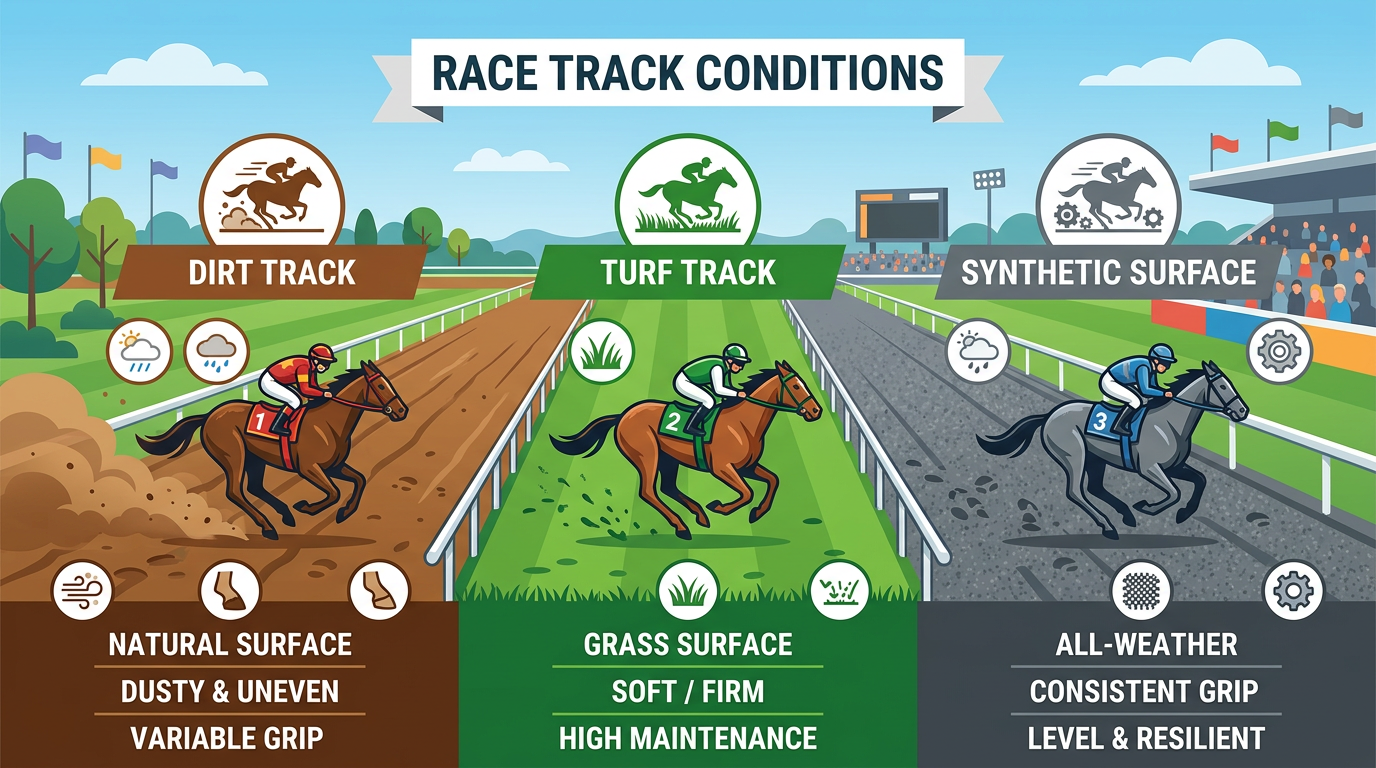
Furlong – 1/8 mile, 220 yards; standard unit in U.S. racing. An 8-furlong track is 1 mile. Six furlongs is 3/4 mile. Dirt – Most common in North America; conditions include fast (fst), good (gd), muddy (my), sloppy (sly). Dirt specialists exist. Turf – Grass; conditions include firm (fm), good (gd), yielding (yl), soft (sf). European-breds often prefer it. Synthetic – Man-made surfaces (e.g., Polytrack); fewer injuries, different pace profiles. Keeneland had it; some tracks still do. Sprint – Generally 6 furlongs or less; route – Longer, often 1 mile or more. Sprinters vs. routers is a real thing. Off the track – Turf race moved to dirt due to weather. Big deal for turf-only horses. Chute – Extension of the track for certain distance starts. Stretch – The straightaway to the finish. Backstretch – The far side of the oval. Clubhouse turn, far turn – The bends. Inside – Closer to the rail; outside – Wider. Wide – Horse raced away from the rail; can mean extra ground. “Wide trip” often means a loss of lengths. Track condition – Fast, good, muddy, etc.; affects how the surface plays. Cuppy – Track surface with uneven footing. Tight – Firm, fast. Sloppy – Wet, splashy. Surface and distance dramatically affect outcomes. Some horses only fire on dirt; others need turf. Know your horse. Turf specialists often struggle on dirt; dirt specialists can flounder on grass. Synthetics play differently—speed can carry less, closers can thrive. Distance matters as much as surface. A brilliant 6-furlong horse may wilt at a mile. Stretch-outs and cutbacks are common trainer maneuvers. “Firing” means the horse is handling the track; “not handling” means he’s struggling. Track bias—when the track favors inside or outside, speed or closers—changes day to day and affects results. Serious investors track surface and distance profiles. A horse with five wins on fast dirt and one clunker on turf isn’t necessarily a bad horse; he might just be a dirt horse.
Jockey, Trainer & Team Role Terminology
Jockey, Trainer & Team Role Terminology
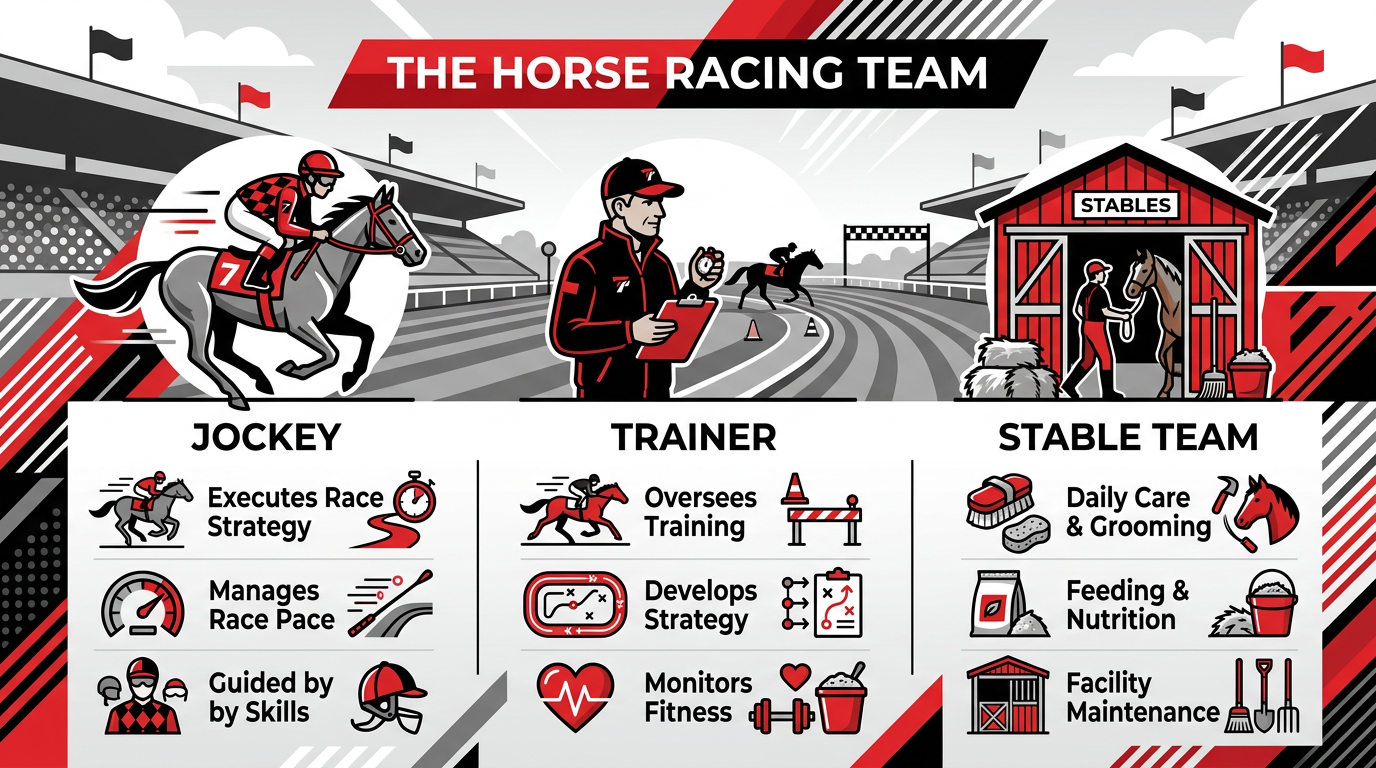
Jockey – The rider in a race. They get 5–10% of the purse. Apprentice or bug – A jockey with fewer wins; gets a weight allowance (often 5–10 lbs). The “bug” is the asterisk next to their name. Jockey agent – Represents a jockey, secures mounts, negotiates deals, arranges travel; typically earns 25% of jockey income. Agents work 24/7 during meets. Trainer – Conditions the horse, enters races, hires staff; earns 10% of purse (standard). Your most important hire. Exercise rider – Rides in morning works and gallops. Different from the jockey. Groom – Cares for the horse daily. The backbone of the barn. Hotwalker – Walks horses to cool them down after works. Racing secretary – Manages the condition book, stall allocation, stakes solicitations, and racing office operations. They write the races. Assistant trainer – Works under the trainer. Big stables have several. Owner – Holds the registration; makes final decisions (unless delegated). Managing partner – Runs a syndicate. Vet – Treats the horse; track vet – Official vet with authority during races. Farrier – Trims and shoes. Agent – Can represent owner or buyer in purchases. Stipend – Fee for jockey mount; separate from percentage of purse. The team matters as much as the horse. A great trainer with a lousy jockey agent can leave you without mounts. Top jockeys are in demand; getting a Hall of Famer on your horse isn’t guaranteed. Agents juggle multiple riders and prioritize based on relationships and potential. New owners sometimes wonder why their horse has a “B” jockey—it’s often a matter of timing and connections. Trainers build relationships with agents over years. Assistant trainers handle day-to-day barn operations; the head trainer sets strategy and deals with owners. Racing secretaries write the condition book and manage stall allocation—getting stalls at premier tracks (Saratoga, Del Mar) is competitive. The industry runs on relationships. Invest in yours.
Purse Structure, Bonuses & Earnings Terms
Purse Structure, Bonuses & Earnings Terms
Purse – Total prize money for a race (for scale at the top, see all-time earnings leaders); typically 60% to winner, decreasing shares to lower finishers. Fourth and fifth usually get small cuts. Stake – Entry fee paid into the purse (e.g., Breeders’ Cup). Nomination fees add up. Gross purse – Total before distribution. Net purse – After deductions. Owner’s share – Roughly 80% of the purse (before trainer/jockey cuts). You don’t keep it all. Trainer’s share – Usually 10% of owner’s portion. Jockey share – About 5–10% of owner’s portion. Breeder award – Bonus paid to the breeder of a state-bred winner; varies by state (e.g., NY: 40% of first for NY-sired, 20% for non-NY-sired, with caps). Breeder awards can be huge—$20K or more per win in NY. Owner award – Bonus to owner of state-bred winners. Stallion award – Bonus to stallion owner when his offspring win. Purse supplement – Extra money added (from slots, sponsor, etc.). Slots have transformed purses in many states. Black-type – Stakes wins in the pedigree; they boost value. Earnings – Lifetime or seasonal purse money; used in race conditions. Stakes-placed – Finished second or third in a stakes. Kentucky Derby purse is $5 million; the winner takes over $3 million. Breeder incentives can add tens of thousands per win in some states. Plan your breeding and racing strategy around them. Purse distribution varies by track and race type. A typical breakdown: 60% winner, 20% second, 10% third, 6% fourth, 4% fifth. Some races pay through eighth place. Stakes often have nomination, eligibility, and entry fees that add to the gross purse. Slots and gaming have transformed purses in Pennsylvania, New York, Kentucky, and elsewhere—tracks with slots often offer double or triple the purse of comparable non-slots tracks. Owner and breeder awards in state-bred programs can effectively double your return on a win. If you’re breeding or buying state-breds, know the incentive structure. It’s real money.
Betting & Odds Terms Investors Should Understand
Betting & Odds Terms Investors Should Understand
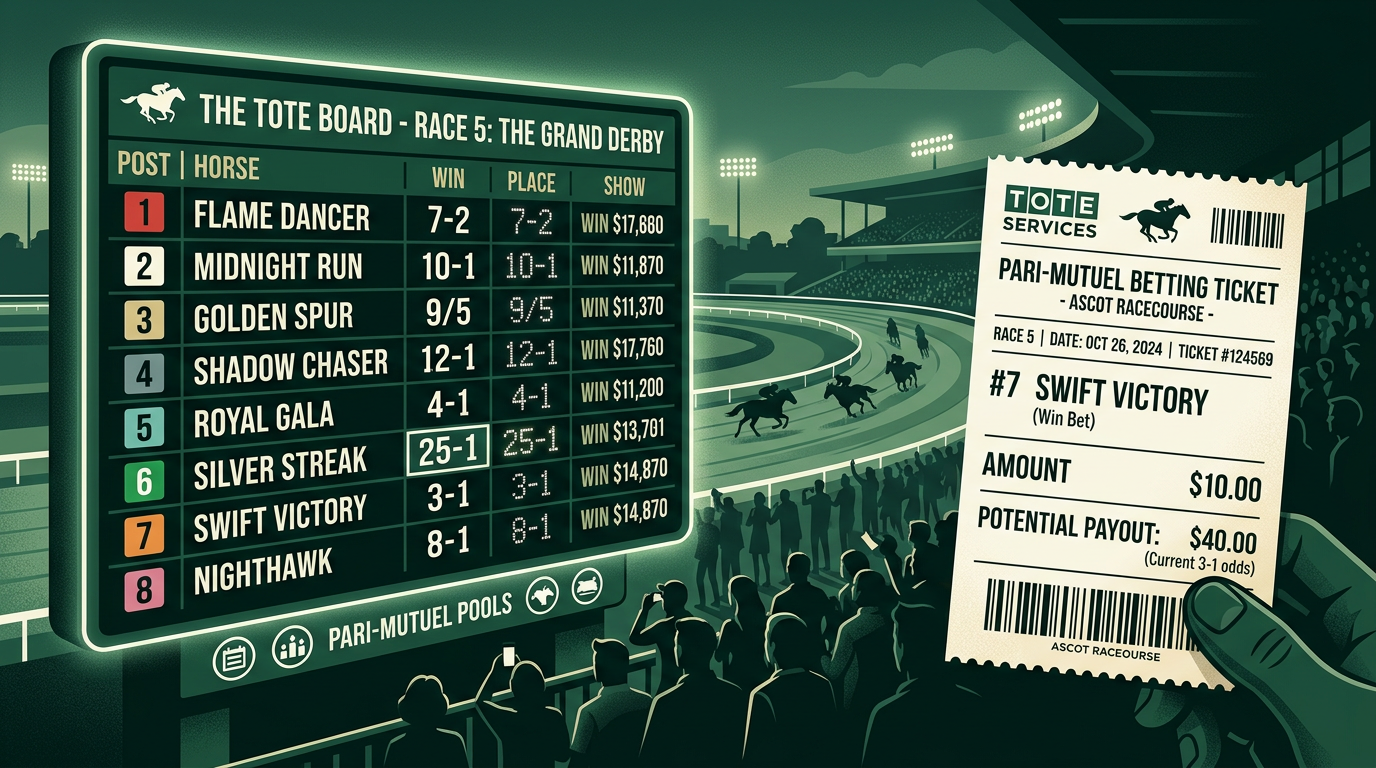
Pari-mutuel – Pool betting; all wagers of a type go into a pool; takeout (typically 15–25%) is removed; the rest is split among winners. Odds aren’t fixed—they change until post time. Your payout depends on the pool. Takeout – The track’s cut. It’s why betting is a losing proposition long-term; takeout eats into returns. Morning line – Estimated odds before betting opens; doesn’t affect final odds. Handicappers set it. Mutuel pool – The total wagered on a bet type. Win – Horse must finish first. Place – First or second. Show – First, second, or third. Exacta – First two finishers in order. Trifecta – First three in order. Superfecta – First four. Daily double – Win both races. Pick 3, 4, 5, 6 – Pick winners of consecutive races. Bridge jumper – Bettor who places a huge show bet on a heavy favorite. When the favorite runs out, show payouts can explode. Chalk – Heavy favorite. Longshot – High odds. Overlay – Horse whose odds are higher than his true chance suggests. Underlay – Opposite. Handle – Total amount wagered. Investors don’t need to bet, but understanding the economics helps—handle drives purses, which drive your returns. Tracks need bettors. You need purses. Takeout rates vary by bet type—exotics often have higher takeout than win/place/show, which is one reason serious handicappers gravitate toward straight bets. Pari-mutuel odds reflect the wisdom (and inefficiencies) of the crowd. Heavy favorites get bet down; longshots can drift. Bridge jumpers—betting huge sums to show on heavy favorites—create odd payouts when the favorite runs out: a $2.10 show payout can become $20 if the favorite finishes fourth. Handle has been under pressure from competition (sports betting, online gaming) and generational shifts. Tracks that attract handle thrive; those that don’t see purse cuts. As an investor, you’re indirectly in the betting business.
Retirement, Aftercare & Resale Terms
Retirement, Aftercare & Resale Terms
Off the track – Retired from racing. OTT or OTTB – Off-the-track Thoroughbred. Great horses for second careers. Aftercare – Programs that rehab, retrain, and rehome retired racehorses. The industry has stepped up; aftercare is no longer optional. Thoroughbred Aftercare Alliance (TAA) – Accredits aftercare organizations. Look for TAA accreditation when donating or placing a horse. New Vocations, CANTER – Major adoption programs. They’ve placed thousands. Sold as retired from racing – Jockey Club form that marks the horse’s certificate inactive for racing; prevents re-entry. Do this if you’re serious about retirement. Resale – Selling a retired horse for a second career. Some horses bring good money as sport horses. Buyback – In claiming, when the original owner reclaims the horse at the claiming price (allowed in some jurisdictions within a window). Claim back – Similar. Adoption contract – Bars return to racing or auction; aftercare programs use these. Lifetime return policy – Some programs take horses back if adopters can’t keep them. Rehoming – Finding a new home. Second career – Riding, driving, or other use after racing. Eventing, show jumping, and trail riding are common. Producer – Broodmare; retiring to breeding is another path. Plan for retirement before you buy; it’s part of responsible ownership. The best investors think about the back end from day one. The Thoroughbred Aftercare Alliance (TAA) has raised the bar for accredited programs—they audit care standards, adoption policies, and financials. When you donate or place a horse, look for TAA accreditation. Adoption contracts typically include “no racing” and “no auction” clauses to prevent horses from cycling back into at-risk situations. Some programs offer lifetime return policies: if the adopter can’t keep the horse, the program takes it back. Resale for second careers can recoup some value—event horses, jumpers, and trail mounts from OTTBs are in demand. A stakes-placed mare might have more value as a producer than as a riding horse. Weigh the options. Retirement isn’t optional; it’s a cost of ownership. Factor it in from the start.
You don’t need to memorize every term overnight—but having this reference when you’re reviewing a partnership agreement, an auction catalogue, or a vet report will save you confusion (and possibly money). The racing world speaks its own language. Reddit threads, ownership forums, and sales catalogs assume you know the basics. Now you do. Bookmark it. Share it with your partners. And the next time someone says “we’re running for a stake in the condition book,” you’ll know exactly what they mean.
Calvin Johnson is a Thoroughbred racehorse owner, day trader, and independent racing analyst with more than a decade of firsthand ownership experience. He has participated in nearly every common structure in horse racing — fractional platform shares, traditional syndicates, LLC partnerships, claiming ventures, and outright ownership — across more than two dozen horses. Calvin writes about racehorse ownership the same way he approaches markets: by studying risk, incentives, fees, and whether the people controlling the deal are aligned with the investors behind it.
Calvin Johnson is a Thoroughbred racehorse owner, day trader, and independent racing analyst with more than a decade of firsthand ownership experience. He has participated in nearly every common structure in horse racing — fractional platform shares, traditional syndicates, LLC partnerships, claiming ventures, and outright ownership — across more than two dozen horses. Calvin writes about racehorse ownership the same way he approaches markets: by studying risk, incentives, fees, and whether the people controlling the deal are aligned with the investors behind it.