Race Horse Ownership 101  ·  Chapter One of Four  ·  Start here

The Starting Gate

An honest primer on thoroughbred ownership for the people thinking about getting in.

15 min read  ·  Chapter One of 4  ·  Updated May 2026

A thoroughbred racehorse in training in the United States costs somewhere between $30,000 and $80,000 a year to keep, depending on the trainer, the track, and the horse’s habits. The purchase price of the horse is on top of that. So is the cost of the horse’s career-ending injury, which has a roughly one-in-three probability of arriving in the first three years of its racing life.

These are the numbers people in racing rarely lead with. The brochures lead with the Triple Crown. The trade press leads with stakes wins. The tipsters lead with this weekend’s longshot. And the smart, curious person who’s been quietly Googling “how to own a racehorse” for the past six months is left to figure out the actual economics from a patchwork of dated forum posts and operator pitches.

This site exists because there’s almost no honest writing for that person. This chapter is the place to start.

By the end of it, you’ll understand what thoroughbred ownership actually is, the four practical ways to get into it, what each one costs and feels like, and which one most new owners now choose — and why. None of what follows is a sales pitch. We’re a publication, not a syndicate. The goal is to make you a more informed person before you put your name on anything.

What thoroughbred ownership actually is

Thoroughbred ownership is the legal title to a racehorse — or a fractional share of one — registered with The Jockey Club and licensed through the state racing commission in whatever jurisdiction the horse is racing. That registration is what allows the horse to enter races. The licensing is what allows you, as the owner, to be in the paddock, to watch from the owner’s section, to collect prize money, and to make the decisions that affect the horse’s career.

That’s the technical definition. It’s also the part most operators stop at, because the technical definition makes ownership sound like a paperwork transaction. It isn’t.

In practice, owning a thoroughbred is closer to owning a small, complicated business that has one full-time professional athlete on staff. You don’t manage the athlete’s training schedule yourself — your trainer does. You don’t make the day-to-day decisions about feed, shoeing, or veterinary care — your trainer does. What you do is decide which races to enter, which trainer to keep working with, when and how to insure the horse, what to do when the horse gets hurt, and what happens at the end of the horse’s racing career.

You also get the experience. Standing at the paddock before a race. Watching morning works at a training track at 6 a.m. Receiving the call when your horse breaks her maiden. Walking into the winner’s circle if she wins a stakes race. The horse running in your silks, or in your syndicate’s. The relationships that form, over years, with trainers and jockeys and bloodstock agents and other owners. These are the things people stay in the sport for. The economics are rarely the reason.

A useful frame: ownership is an experience purchase with operating costs, occasionally subsidized by prize money, with significant tax considerations for owners who structure it correctly.

Treat any operator who pitches it as an investment with skepticism. Treat any one who pitches it as an experience with curiosity.

The four ways into thoroughbred ownership

There are, broadly, four practical paths into US thoroughbred ownership. Each has different cost profiles, different control levels, different time commitments, and different risk exposures. Understanding the four is the most important thing a prospective owner can do before any other decision.

Sole ownership

Sole ownership is what most people picture when they imagine owning a racehorse. You buy the horse outright, you pay all the bills, you make all the decisions, you collect all the prize money. The horse is registered to you alone. The silks are your silks. The relationship with the trainer is direct.

The economics are the brutal part. A competitive thoroughbred in the United States typically costs between $50,000 and $300,000 to purchase — sometimes less for a claimer, sometimes considerably more for a yearling at the marquee sales. Once purchased, the horse costs roughly $35,000 to $50,000 per year to keep in training at a mid-tier US barn, and meaningfully more at a top barn or a higher-cost region like Southern California. Add veterinary expenses (typically $3,000 to $8,000 a year for a healthy horse, much more for one with issues), insurance (4-6% of the horse’s valuation annually), entry fees, transport, and the occasional surgical bill, and the all-in cost of sole ownership of a single racehorse runs somewhere between $50,000 and $90,000 per year, every year, regardless of whether the horse earns a dollar.

Sole ownership is appropriate for owners who want maximum control, have substantial discretionary capital, and are prepared to absorb a total loss on a single animal. It is also, statistically, how the smallest number of new owners enter the sport — and for good reason.

Partnerships

A partnership is the structural cousin of sole ownership, sized for two to ten people. Two friends, three business partners, a family group — anyone who wants to share the cost of an outright horse purchase splits the purchase, the bills, and the prize money in agreed-upon proportions.

Partnerships are typically structured as either general partnerships (simpler, more legal exposure) or limited liability companies (more paperwork, cleaner liability). The partners often make decisions collectively or designate one member as the managing partner with authority to act on behalf of the group.

The economics scale linearly: a four-way partnership in a $100,000 horse means each partner is in for a $25,000 share of the purchase and roughly a $10,000 to $15,000 share of the annual operating cost. The risk also splits — if the horse breaks down, the loss is shared across the partners.

Partnerships work well for owners who have a trusted small circle of people willing to commit to a multi-year horse venture, and who want more involvement in decision-making than a syndicate typically offers. They work less well when one partner wants out mid-campaign and the others don’t, or when there’s disagreement on a major decision like a sale or a retirement. The exit dynamics of partnerships are the part most new partnerships underestimate.

Syndicates

A syndicate is a partnership structure scaled up: instead of two to ten people sharing a horse, a syndicate divides a single horse into ten, twenty, fifty, or in some cases a hundred fractional shares. Each share entitles the owner to a proportional split of the prize money and a corresponding obligation for the bills. The horse is managed by a syndicate manager — a professional who handles the trainer relationship, the accounting, the communications with members, and the decisions members don’t want to handle themselves.

Syndicate shares typically run from $5,000 for a small percentage of a modestly priced claimer up to $40,000 or more for a 5-10% share of an elite-level horse. The monthly contribution per share generally runs from $200 to $1,000, depending on the horse’s expense profile and the size of the share.

In a well-run syndicate, the member writes one check to buy in, makes a monthly payment to cover their share of the operating cost, and otherwise receives regular updates from the manager — training reports, race entries, video of morning works, race-day notifications, and quarterly accounting statements showing exactly where the money has gone and what’s coming in. The owner gets paddock access, owner’s badges, the horse running in the syndicate’s silks, and the sport-of-kings experience — without needing to handle the operational complexity themselves.

The structural appeal of syndication is twofold. First, the financial exposure is dramatically lower than sole ownership: the same dollars that would buy you a 100% stake in one $100,000 horse could buy you 10% stakes in five different syndicate horses, spreading the risk of injury or underperformance across multiple animals. Second, the time commitment is minimal — you’re not managing a small business, you’re participating in one that’s being run by a professional.

The honest caveats: a syndicate is only as good as the manager running it. Markups on the purchase price, hidden fees, vague exit policies, and uneven aftercare commitments are real risks in the industry. Vetting the syndicate manager matters more than vetting the horse. (We wrote a free guide on exactly how to do that vetting; it’s linked at the end of this chapter.)

Racing clubs and micro-shares

The fourth path is the newest and the most accessible. Racing clubs sell extremely small fractional interests — sometimes 1% or less, sometimes less than $1,000 for the buy-in. The club is typically managed similarly to a syndicate, but the share sizes are small enough that the offering is accessible to almost any interested party.

The trade-off for the low cost is reduced participation. In many racing clubs, members have limited or no voting rights, the prize money distributions are very small per member, and the paddock access varies depending on the club and the track. Some clubs operate with the rigor of a true partnership; others operate more like a high-end fan club with race-day perks.

Racing clubs are an excellent way for someone to dip a toe into the experience of ownership without making a meaningful financial commitment. They are less suited to someone who wants the substantive ownership experience — being involved in real decisions, having a financial stake that matters, being treated as a partner rather than a subscriber. For some people, the racing club is the destination. For others, it’s the on-ramp to a syndicate or partnership.

What it costs, in real numbers

The most useful thing a prospective owner can do is build a realistic mental model of the annual cost of ownership before they look at a single horse. The numbers below are typical for US Thoroughbred racing as of early 2026. They will vary by trainer, by track, by horse, and by region — but the orders of magnitude hold.

The recurring costs

Training day-rate. The trainer’s fee for keeping the horse in the barn and managing its daily work. Typically $75 to $120 per day at most US tracks, with the higher end at top barns and major circuits. At a $95/day rate, training alone costs roughly $34,000 per year per horse.

Veterinary care. Routine veterinary care, dental, vaccinations, and minor treatments typically run $3,000 to $8,000 per year for a healthy horse. A serious injury or surgical procedure can add $5,000 to $30,000 or more in a single event.

Farrier. Shoeing every four to six weeks at approximately $150-250 per visit. Roughly $1,500 to $2,500 per year.

Insurance. Mortality insurance — the equine equivalent of life insurance — typically costs 4-6% of the horse’s valuation per year. Medical/major-medical insurance, optional but recommended, adds another 1-3%.

Transport. Shipping the horse between tracks, training centers, or sales venues. Varies dramatically. Budget $2,000 to $8,000 per year for a horse with a typical campaign.

Entry fees and jockey mounts. Each race entry has a fee, typically modest ($50-200), and jockey mount fees of $50-100 plus a percentage of any earnings. Annual cost varies by how often the horse runs.

Total annual operating cost. For a healthy, regularly-running horse at a mid-tier US barn: roughly $45,000 to $60,000 per year, all in. At a top barn or in higher-cost regions: $60,000 to $90,000 or more.

What this means in practice for each ownership structure

For a sole owner, the full annual operating cost falls on a single person. A horse that runs ten times in a year and earns $30,000 in prize money is still operating at a substantial annual deficit.

For a partnership of four equal members, each partner’s share of the operating cost is roughly $11,000-15,000 per year.

For a syndicate member holding a 5% share, the monthly contribution might be $200-400, with occasional additional bills for major expenses, putting the annual all-in cost in the $3,000-6,000 range.

For a racing club member holding a 1% interest in a $30,000 buy-in, the monthly contribution might be $50-100.

These are the comparative economics that most first-time owners don’t see laid out plainly. Operators tend to quote either the buy-in number (sole ownership’s $100,000+ purchase) or the per-share number (syndicate’s $5,000-$25,000 share), but rarely the annualized total cost of ownership across each structure. The structural differences are large, and they matter.

The language you’ll hear before you sign anything

Racing has more specialized vocabulary than almost any other sport. The terms below are the ones you’ll encounter in any conversation about ownership, and understanding them before you walk into your first meeting with a trainer or syndicate manager will save you time and credibility.

The Jockey Club
The registry for all thoroughbred horses in North America. Every racehorse must be registered with The Jockey Club before it can run.
Maiden
A horse that has never won a race. “Breaking the maiden” means winning a race for the first time. Maiden races are the entry point for almost every racing career.
Claiming race
A race in which every entered horse is for sale at a stated price, and any licensed owner can claim (buy) the horse before the race. Claiming races are the workhorse format of US racing — the structure that allows horses to find the right competitive level.
Allowance race
A race for horses that aren’t for claim, with eligibility conditions like “non-winners of two races.” A step up from maiden and claiming company.
Stakes race
The highest tier of US racing. Includes Grade 1, Grade 2, Grade 3, and listed stakes. The races people remember.
Furlong
One-eighth of a mile. Races are measured in furlongs (a six-furlong race is three-quarters of a mile).
Workout / Breeze
A timed training run, typically over a short distance, used to measure a horse’s fitness and readiness to race. Bullet works are the fastest of the day.
Day-rate
The daily fee a trainer charges for keeping a horse in their barn. The single largest recurring expense in ownership.
Bloodstock agent
A professional who advises owners on horse purchases, particularly at sales. Typically paid a commission of 5% on purchases.
Syndicate manager
The professional who runs a syndicate — handles the trainer relationship, accounts, member communications, and partnership decisions.
HISA
The Horseracing Integrity and Safety Authority, the federal regulatory body overseeing US Thoroughbred racing as of 2022. Sets the rules on medication, safety, and anti-doping.
Aftercare
The arrangements made for a horse’s life after its racing career ends. The good operators have aftercare plans documented in writing before the horse is purchased.
Silks
The colored jacket and cap worn by the jockey, registered to the owner or partnership and unique to them. The visual signature of ownership.

There is much more vocabulary in racing, and most of it is covered in the site’s blog. But these terms are the ones you’ll encounter first. If a prospective trainer, agent, or syndicate manager uses a term you don’t recognize, ask them to define it. Their willingness to do so without condescension is itself a useful signal about whether you want to work with them.

Why most new owners now come in through syndication

If you compare the four structures honestly, side by side, a clear pattern emerges for first-time owners.

Sole ownership offers maximum control and the deepest experience, but requires both substantial capital ($150,000+ all-in for the first year) and a willingness to absorb concentrated risk in a single animal. For an owner who can afford it and who wants the full responsibility, it’s the deepest version of ownership. For most first-time owners, the financial exposure is larger than they want for an experience they’re still evaluating.

Partnerships are an elegant structure for two to ten people who trust each other deeply and want shared decision-making authority. But the exit dynamics, the disagreement risk, and the requirement to find the right group of partners make partnerships harder to enter than they appear. Most new owners don’t have a pre-existing small group of people ready to commit to a multi-year horse venture.

Racing clubs offer the lowest cost and the easiest entry, but the participation level — voting rights, decision-making involvement, prize money distributions — is typically light. For an owner who wants the experience without the substantive ownership stake, racing clubs are an excellent first step. For an owner who wants the substantive stake, they’re often a way station rather than a destination.

Syndicates, when run well, occupy a useful middle position. The financial exposure is meaningfully lower than sole ownership — typically one-fifth to one-twentieth of the cost. The operational complexity is handled by a professional manager. The risk is spread across the manager’s broader operation (a well-run syndicate manager typically has multiple horses in their program, which means a member with shares in multiple syndicates is naturally diversified). The owner still gets paddock access, race-day experience, regular updates, and the horse running in the syndicate’s silks. And the exit dynamics, in a well-structured syndicate, are documented and predictable.

For these reasons, the majority of new thoroughbred owners in the US now enter the sport through some form of syndication or partnership rather than sole ownership.

This wasn’t always the case — fifty years ago, ownership was almost exclusively the province of wealthy individuals owning outright. The growth of the syndicate model is what has made the sport accessible to a much wider group of people. It’s the reason the headline of this site says ownership is closer than the brochures suggest.

This isn’t an argument that syndication is right for every prospective owner. It isn’t. The four structures exist because they each serve different goals, different capital levels, and different temperaments. But for the smart, curious person reading this chapter who isn’t a billionaire and isn’t already deep in a partnership with a pre-existing group — syndication is the structure that most likely fits the goal of getting into the sport, having a meaningful ownership experience, and not absorbing a catastrophic financial loss on a single animal.

The next chapter walks through exactly how to evaluate a syndicate before signing anything.

What to do before you decide anything

A few practical steps that experienced owners almost universally recommend to first-timers, regardless of which structure they ultimately choose.

Spend time around the sport before you spend money in it. Visit a training track at dawn. Walk through the backside on a race day if a friend can get you a pass. Watch the morning works at a major meet. The version of racing visible to fans on television is a sliver of the actual sport. Owners who have spent time around the barn before buying in tend to make better first decisions than those who haven’t.

Read the prospectus carefully. If you’re considering a syndicate or a partnership, the offering documents tell you almost everything you need to know about how the operator will treat you as a member. Vague language about fees, exit terms, and aftercare is the most reliable single signal that the operator is not the one you want.

Talk to current and former members. Any operator worth working with will introduce you to people they’ve previously sold shares to — including some whose horses are no longer in the program. The conversations with those former members will tell you more than any pitch.

Get the numbers in writing. A good operator can hand you a clean, detailed projection of what your 12-month all-in cost will be, based on similar horses they’ve previously managed. An operator who won’t provide that — or whose numbers seem suspiciously low — is one to step away from.

Trust your instincts. The racing industry is small and word travels. If a partnership feels wrong, ask three people in the sport whose judgment you trust before signing. The right operator will not make you feel rushed.

Where to go from here

You now have the full landscape of US thoroughbred ownership in front of you. Sole ownership, partnerships, syndicates, racing clubs. The real numbers. The vocabulary. The structural reasons most new owners now come in through syndication.

The next step depends on where you are.

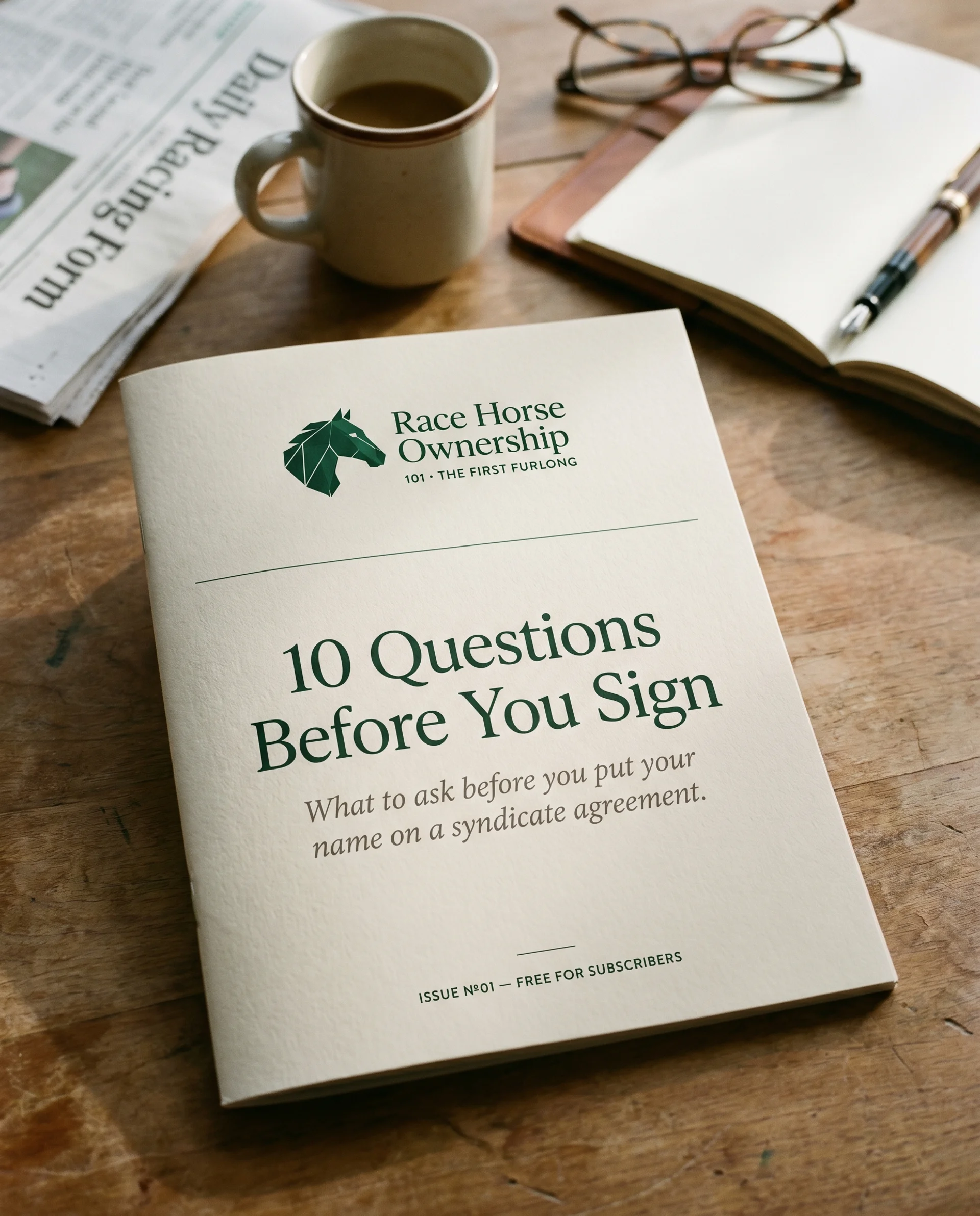
If you’ve decided that syndication is likely the right structure for you, the most useful thing you can do next is learn how to evaluate the syndicate manager you’re considering working with. The site’s free guide — “10 Questions Before You Sign” — is the document we wish we’d had when we were in your position. It’s the ten questions that separate the operators worth working with from the ones who aren’t.

If you want to continue the guided journey through ownership, Chapter Two — The First Furlong covers what happens from the moment you sign the agreement to your horse’s first morning at the gallops. The questions to ask, the costs to expect, and the small details that separate a partnership you’ll enjoy from one you’ll regret.

If you’re still in the research phase and want to keep up with the work, the site sends one Sunday letter a week — new writing, occasional notes on sales worth watching, and the partnerships and people we’re paying attention to. Free for as long as you find it useful. Subscribe here.

Welcome to the starting gate. The next chapters get more practical from here.

— Race Horse Ownership 101

Keep Reading

One letter every Sunday.

New writing from inside the sport, every Sunday morning. Free for as long as you find it useful.

Free. Unsubscribe anytime.

The 10 Questions Before You Sign printed guide on a wooden desk in morning light

The Free Guide

10 questions to ask
before you sign anything.

The questions that separate the partnerships you’ll enjoy from the ones you’ll regret. Written from inside the sport — what to ask, what a good answer sounds like, and what to do if you don’t get one.

  • The clauses every good syndicate puts in writing
  • The hidden markups in purchase price that prospectuses rarely show
  • The questions experienced owners ask trainers before signing
  • Why the exit policy matters more than the buy-in
  • What “all-in monthly fees” should and shouldn’t include

Plus the weekly letter, every Sunday. Unsubscribe anytime.

Continue the Journey

  1. Chapter One The Starting Gate Read it →
  2. Chapter Two The First Furlong Read it →
  3. Chapter Three Down the Backstretch Read it →
  4. Chapter Four Last in the series The Final Turn Read it →

Continue to the next chapter →