The short version
- What you paid for a racehorse and what it is worth are two different numbers, and they rarely meet.
- Four things move worth: pedigree, race record, physical conformation, and market timing — plus the name on the program, which has its own rules; see how racehorses get their names. Race record is the one that actually pays your bills.
- Auction headlines report the average, not the typical horse. At Keeneland’s 2025 September sale the average yearling brought $175,807, but the median was $80,000 — and one colt sold for $3.3 million.
- Breeding residual is a real driver for a tiny handful of horses and a fantasy for almost everyone else.
- If an operator quotes you a “valuation,” ask what number it is, who set it, and what the horse would actually fetch tomorrow.
I once stood at a shed row and watched a $40,000 yearling and a $400,000 yearling walk past me twenty minutes apart. Same barn, same morning, same Kentucky dirt under their feet. If you had asked me which one was the better racehorse, I could not have told you — and neither could the people who paid those prices. That gap, between what a horse costs and what it is actually worth, is where most new owners get hurt.
“How much is a racehorse worth” sounds like it should have a number for an answer. It doesn’t. It has four or five numbers, and the one an operator shows you is almost never the one that matters to your bank account. This is a buyer’s guide to all of them — written from the owner’s side of the table, not the seller’s.

What “worth” actually means for a racehorse
The word “worth” hides at least four different figures, and confusing them is the single most common mistake I see prospective owners make. Before you evaluate any horse, separate these in your head:
The Sport of Kings has a side entrance. Here’s the key.
Regular people own racehorses — together, in partnerships — and stand in the paddock like they were born there. The free guide shows you the way in.
- Purchase price — what someone paid at a sale or in a private deal. It is a historical fact, not a current value. The moment the gavel falls, it stops being worth.
- Market value — what the horse would realistically sell for today, given its record and condition. This moves constantly, usually downward, and a single bad workout can erase it.
- Earning value — the purse money the horse can plausibly win. For the overwhelming majority of owners, this is the only “worth” that ever shows up as cash.
- Breeding residual — what the horse might be worth as a stallion or broodmare after racing. Real for a few, irrelevant for nearly everyone.
An operator selling you a share will happily blur all four into one optimistic story. Independence means pulling them back apart. When I evaluate a horse, I assume earning value is the only one I will ever touch, and I treat everything else as a lottery ticket I did not pay extra for.
What is the resale value of a racehorse?
Resale value is not the purchase price and it is not racing earnings. Purchase price is what you paid; earnings are what the horse banks in purses while you own it. Resale is what someone else will pay you to take the horse off your hands — and for most runners that path is a claiming race, a private sale, or a retirement placement, not a breeding windfall.
A horse entered for a tag has a posted exit price by design. A private sale depends on current form and who is shopping. Retirement and aftercare are usually about finding a good home rather than recovering capital. Breeding residual can be real for a tiny handful of horses and a mirage for almost everyone else — so treat resale as market value today, not the story that sold you the share.
The four things that actually drive worth
Strip away the marketing and a racehorse’s worth comes down to four inputs. They are not equally reliable, and the order in which a seller emphasizes them tells you a lot about what they are not saying.
What moves a racehorse’s value
| Driver | What it is | How reliable | Who emphasizes it |
|---|---|---|---|
| Pedigree | The sire and dam’s record and the demand for their bloodline | Sets the ceiling, guarantees nothing — most well-bred horses never win a stakes race | Sellers, before the horse has run |
| Race record | Actual results: wins, places, class of competition, earnings | The only hard evidence; the market trusts it above all else | Buyers, and anyone being honest |
| Physical / conformation | Soundness, build, how the horse moves and vets out | Can add or destroy value overnight; one injury resets the math | Vets and shrewd buyers |
| Market timing | Where the horse sits in the sale calendar and the broader economy | Real but uncontrollable; a hot sale lifts everything, a cold one buries it | Nobody, until it works against you |
Notice the pattern. The drivers a seller leans on hardest — pedigree, potential, the look of the horse — are the ones that come before any racing has happened. The driver that actually determines your return, the race record, can only be measured after you have already spent the money. That asymmetry is structural, and it is why a buyer-first publication exists.

What headline auction prices don’t tell you
Every September, the racing press fills with seven-figure sale headlines, and every September a few thousand prospective owners quietly conclude they cannot afford this game. Both halves of that reaction are based on a misreading. The headline number is the average, dragged upward by a handful of extraordinary horses, and the average is not the horse you would buy. Before you treat a catalog page as a price tag, learn how to read a thoroughbred sale catalog.
The 2025 Keeneland September Yearling Sale is the clearest example I can give you. It set a worldwide record: 3,070 horses sold for $531.5 million, with an average price of $175,807. That average is the number that made the headlines. But the median — the price of the horse sitting exactly in the middle of the sale — was $80,000. More than half the horses sold for less than that, while 56 yearlings crossed seven figures and one Gun Runner colt brought $3.3 million. As Blood-Horse’s sale coverage shows season after season, the top of the market and the middle of the market are barely the same sport.
Where racehorse prices actually land
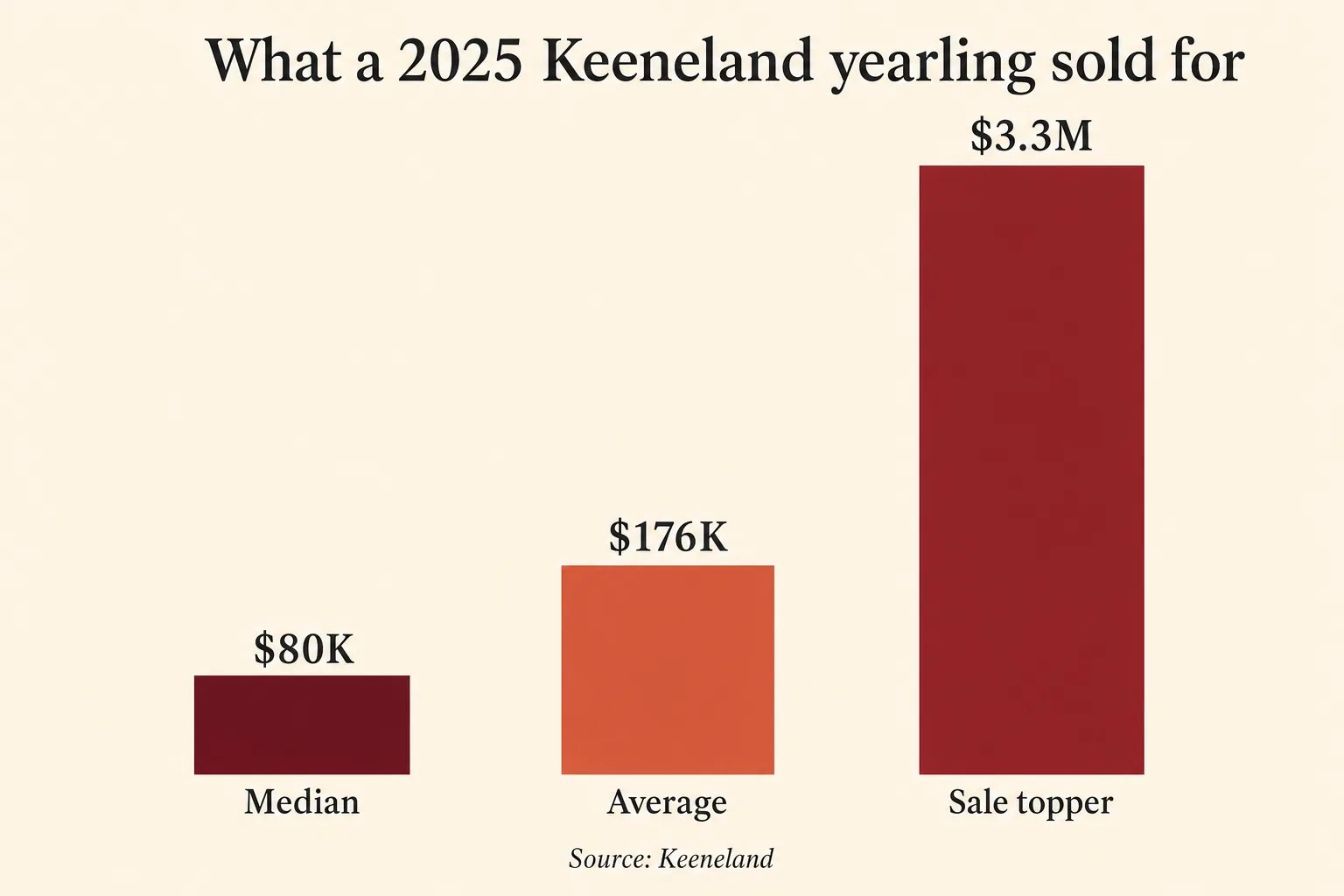
The chart makes the buyer’s lesson obvious. If you anchor your sense of “worth” to the $3.3 million colt or even to the $175,807 average, you will badly misjudge what a typical, perfectly raceable yearling costs — and you will be an easy mark for anyone quoting you a price “below market.” The honest reference point is the median, and the median says a real racehorse changes hands for a fraction of what the headlines imply.
There is a darker version of the same lesson. In 2006 a colt nicknamed The Green Monkey sold for $16 million, then the highest auction price ever paid for a thoroughbred. He started three times, never won a race, and retired to an unremarkable stud career. His purchase price and his worth never once occupied the same universe. The most expensive horse in the room is not the best horse in the room; he is just the most expensive.
The most expensive horse in the room is not the best horse in the room. He is just the most expensive.
Worth by tier: claimer, allowance, stakes, breeding prospect
Racehorses sort themselves into tiers, and worth means something different in each one. A claimer is valued like a used asset with a posted price; a stakes horse is valued on a record that the whole industry can see; a breeding prospect is valued on a future that may never arrive. Knowing which tier you are actually shopping in keeps you from paying stakes-horse prices for claimer economics.
How worth works at each level
| Tier | Typical worth basis | How it is set | Liquidity | Honest reality |
|---|---|---|---|---|
| Claimer | The posted claiming price (often a few thousand up to roughly $50,000) | Literally tagged in the condition book; anyone can buy at that price on race day | High — there is a live, public market every time the horse runs | The most transparent worth in racing, and usually the most modest |
| Allowance | Earning potential against mid-level competition | Negotiated privately on the strength of the race record | Moderate — buyers exist but the price is opaque | The working middle class; rarely a windfall, occasionally a steady earner |
| Stakes | Proven class plus residual upside | Set by the open market and by what breeders will pay | Low but high-value — few buyers, large sums | Where the headline numbers live, and where almost no first-time owner starts |
| Breeding prospect | Projected stud or broodmare income | Speculative, based on pedigree and a racing record | Very low and slow — value can take years to confirm or evaporate | Real for a few horses a year; a marketing line for the rest |
The claiming tier deserves a moment, because it is the one place in racing where worth is refreshingly honest. When a horse runs in a claiming race, its price is printed in the condition book, and any licensed owner can drop a claim and buy it for exactly that figure — sound or not, win or lose. There is no negotiation and no story. If you want to know what a racehorse is “really” worth, the claiming box is the closest thing the sport has to a stock ticker.

The breeding-residual mirage
Somewhere in almost every ownership pitch is a sentence about the horse’s value “at stud” or “as a broodmare.” It is the most seductive number in the conversation and the one you should trust least. Breeding residual is real — but it is real for a vanishingly small share of horses, and the headline cases are warnings as often as they are promises.
Consider Fusaichi Pegasus, the 2000 Kentucky Derby winner. After his racing career, Coolmore bought him for stud duty at a price reported between $60 million and $70 million — a record at the time. He entered his first breeding season at an extraordinary $150,000 per mare. Then his foals failed to live up to the pedigree, and his stud fee fell, year after year, until it sat at a tiny fraction of where it began. The breeding residual that justified a $70 million valuation simply did not materialize. If a horse that won the Derby and cost more than most professional sports franchises could disappoint at stud, the breeding upside on a syndicate share in an unraced two-year-old is not a number you should be banking on.
My rule, and the one I would give any new owner: model your purchase as if the breeding residual is zero. If the horse earns its keep on the track, wonderful. If it also turns into a breeding asset, treat that as a windfall you never paid for — never as the foundation of the deal.
Syndicate shares and paper value
When you buy into a syndicate or partnership, you are handed a different kind of “worth” — a percentage of a valuation that someone else set. A 2% share of a horse “valued at $500,000” sounds like it is worth $10,000. On paper, it is. The problem is that paper value and realizable value are not the same thing, and the gap between them is where partnership disappointment lives.
Two honest questions cut through it. First, who set the valuation, and do they earn a fee on it? A number an operator assigns to their own horse is a marketing input, not an appraisal. Second, what is your exit? Unlike a stock, there is rarely a buyer waiting for a fractional share of a midlevel racehorse. If you cannot sell your 2% next month for anything close to its stated paper value, then that value is a story, not an asset. A buyer-protection lens treats every quoted share value as a claim to be checked, not a fact to be accepted.
How to sanity-check a quoted valuation
You do not need to be a bloodstock agent to pressure-test a number. You need to ask the questions an interested seller would rather you skipped. Before you accept any racehorse valuation, walk through this checklist:
- Which number is this? Purchase price, market value, earning projection, or breeding residual — make the seller name it. Vague “value” is a red flag.
- Who set it, and how do they get paid? An independent sale result is evidence. A figure the operator assigned to their own horse is advertising.
- What would it sell for tomorrow? If the honest answer is “much less,” the quoted worth is aspirational.
- Is the comparison the median or the average? Insist on the typical horse, not the sale topper.
- Does the math survive a zero breeding residual? If the deal only works because of stud income, it does not really work.
- What does the race record actually say? Earnings and class are the only worth you can take to the bank.
If you want the companion numbers on what a horse costs to buy and keep — as opposed to what it is worth — start with our breakdown of what a racehorse actually costs and our guide to how to buy a racehorse. And if the seven-figure headlines are still in your head, our look at the highest-grossing racehorses of all time is a useful reminder of how rare the top of the market really is.
Frequently asked questions
How much is a Kentucky Derby horse worth?
A Derby starter’s worth depends entirely on what happens next, not on the race itself. A win can push a colt’s value into the tens of millions on breeding potential alone, as the Fusaichi Pegasus sale showed. But most Derby horses are worth far less than that ceiling, and a Derby runner who never wins again can see its market value fall sharply within a single season. The race buys prestige; the record buys worth.
What is a winning racehorse worth?
A win raises a horse’s worth in two ways: the purse it banks and the class it proves. For a claimer or allowance horse, that might mean a few thousand to a few tens of thousands of dollars in added market value. For a stakes horse, a single Grade 1 victory can multiply its worth many times over by opening the door to breeding demand. The size of the bump tracks the quality of the company the horse beats, not the win alone.
What is a retired racehorse worth?
For most retired racehorses, market worth is modest and the real value is in responsible aftercare rather than resale. A successful stallion or broodmare can carry significant breeding value, but those are the exceptions. The majority of retirees move into second careers or aftercare programs, where what matters is finding the horse a good home — not extracting a price.
How much is a racehorse to buy versus what it is worth?
They are different questions with different answers. Purchase cost is what you pay to get in; worth is what the horse could return or resell for afterward. You can buy a sound, raceable horse for a five-figure sum at a regional sale or out of a claiming race, while a sale topper costs millions — and neither price predicts what the horse is ultimately worth. Decide which number you are really being quoted before you write a check.
The honest bottom line is the one operators have no incentive to tell you: a racehorse is worth what it can earn and what someone will actually pay for it today — not the headline that sold you on the dream. Anchor to the median, model the breeding upside at zero, and ask who set every number you are handed. Do that, and you will value a racehorse the way an owner should: clearly, and from the buyer’s side of the table.
About the Author
Calvin Johnson is a Thoroughbred racehorse owner and day trader who has spent the last decade inside the world of horse racing ownership — not as a promoter, but as an owner, investor, and skeptic who has learned the hard way which questions matter.
Calvin brings a market-based lens to the racing business, analyzing ownership deals through risk, incentives, fees, transparency, and alignment. He has owned interests in more than two dozen racehorses across fractional platforms, syndicates, LLC partnerships, private deals, claiming ventures, and sole ownership.
His blog provides an investigative, independent voice for current and aspiring owners who want to understand what is really behind the pitch deck. Calvin’s goal is to help readers enjoy the sport without ignoring the numbers, the contracts, or the red flags.