Most racehorse owners don’t make money, and the ones who do rarely make it the way the winner’s-circle photographs suggest — which is why it helps to understand why people still buy racehorses before you judge the economics. Headline racehorse earnings figures are gross purse splits, not owner profit: when a horse wins a $50,000 purse, the owner doesn’t collect $50,000. The winner’s share is roughly 60 percent of the purse, and from that the trainer is paid about 10 percent and the jockey another 10 percent — so a $50,000 win leaves the owner with around $24,000, before a single training bill is settled. Across a full season the arithmetic is humbling: the Thoroughbred Owners and Breeders Association estimates that fewer than 8 to 10 percent of racehorses earn enough to cover their annual costs. Purse money is real, and a minority of owners genuinely profit. But knowing how a purse is actually divided — and why the published averages mislead — is what separates a clear-eyed decision from an expensive education.
The short version
- A purse isn’t winner-take-all: first place earns roughly 60 percent, and the field splits the rest down to fifth.
- The owner keeps about 80 percent of whatever the horse earns, after the customary 10 percent each to trainer and jockey.
- Fewer than one racehorse in ten earns enough to cover its own upkeep. The headline “leading owner” totals are gross, pre-cut, and propped up by a handful of stars.
How do horse owners make money?
Horse owners make money three main ways — and purse money is only one of them. Purse splits: a race’s prize is shared down the field (winner roughly 60 percent), and after the customary 10 percent each to trainer and jockey the owner keeps about 80 percent of what the horse earns; fewer than one racehorse in ten earns enough to cover annual upkeep. Breeding upside: a well-bred filly who races respectably can be worth more as a broodmare prospect than she ever earned on the track, and a colt who picks up black-type can be sold or syndicated for stud. Claiming-sale paths: you can claim a horse cheaply, win a few races, and move it up or sell it on — or accept a claim on your own horse and still keep that race’s purse. Resale at a two-year-old or breeding-stock sale is its own market again. For a real share of the owners who come out ahead, the return came from the sale, not the win.
The Sport of Kings has a side entrance. Here’s the key.
Regular people own racehorses — together, in partnerships — and stand in the paddock like they were born there. The free guide shows you the way in.
How a purse actually splits (the part nobody quotes you)
A purse is the total prize money a race pays out, and it is almost never won outright. Most American tracks pay down to the top five finishers on a sliding scale, with the exact percentages set by each state’s racing commission and printed in the track’s condition book. The shape is close to a standard from track to track, but not identical. At the New York Racing Association, a typical split runs about 55 percent to the winner, 20 to second, 12 to third, 6 to fourth and 4 to fifth, with the small remainder divided among the rest. Florida tracks lean more top-heavy — closer to 60/20/13/5 — so the winner’s slice is larger and the tail thinner. The practical lesson for an owner: finishing third in a rich race can pay more than winning a cheap one, and most of any purse rewards the horses that hit the board.
A typical purse split, by finishing position
| Finish | Typical share of the purse | On a $50,000 purse |
|---|---|---|
| 1st | ~60% | $30,000 |
| 2nd | ~20% | $10,000 |
| 3rd | ~12% | $6,000 |
| 4th | ~6% | $3,000 |
| 5th | ~2% | $1,000 |
What the owner keeps after the trainer and jockey are paid
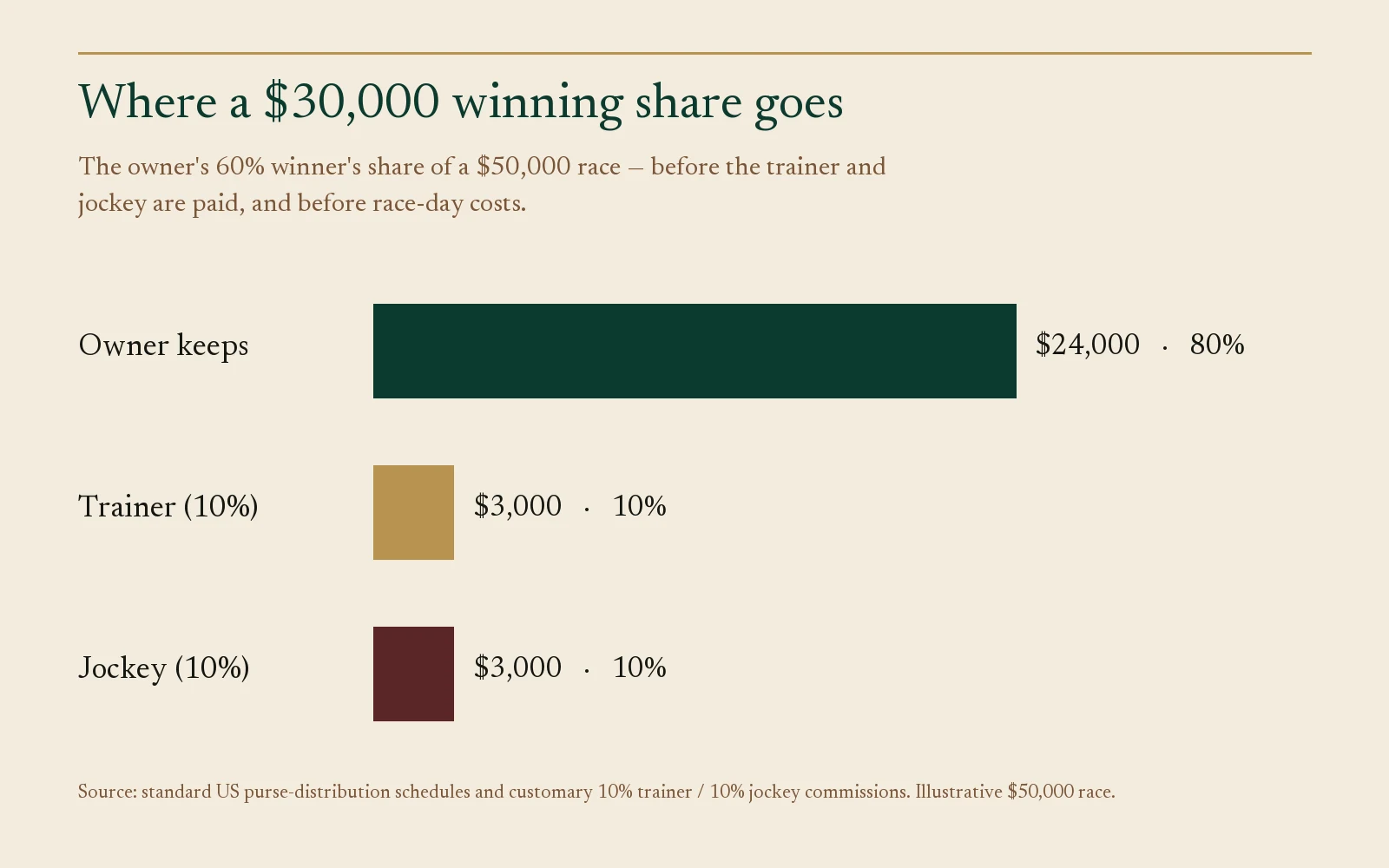
Winning the purse share is not the same as banking it. By long-standing custom, the trainer receives about 10 percent of the horse’s earnings and the jockey another 10 percent (the rider also collects a small flat mount fee on losing rides). So the owner nets roughly 80 percent of whatever share the horse earns. Take that $50,000 race again: a win pays a $30,000 first-place share; the trainer’s 10 percent ($3,000) and the jockey’s 10 percent ($3,000) come out first, and the owner is left with about $24,000. That figure is still gross — it lands before the month’s training day-rate, vet, farrier, shipping and entry fees, which is where most of it goes straight back out. If you want the other side of that ledger, here is what a racehorse actually costs to own.
Where a winning share actually goes
The money that isn’t purse money: breeding, resale, and claiming

Purses are the obvious revenue, but they aren’t the only way a horse returns money — and for many owners they aren’t the main one. A well-bred filly who races respectably can be worth more as a broodmare prospect than she ever earned on the track; a colt or filly who picks up black-type can be sold or syndicated for stud. Claiming races offer a different lever: you can lose a horse to a claim, but you can also claim one cheaply, win a few races, and move it up or sell it on. Resale at a two-year-old or breeding-stock sale is its own market again. None of these are guaranteed, and each carries its own costs and risks — but an honest picture of “what owners make” has to count them alongside purse money, because for a real share of the owners who come out ahead, the return came from the sale, not the win.
Consider an owner who buys a yearling, races it to a couple of modest wins over two seasons, and then sells it as a sound, lightly-raced four-year-old. The purse cheques may have covered only a fraction of the bills, while the resale closed most of the gap. That pattern is common, and it is invisible in any earnings table — which is exactly why earnings tables are a poor guide to how ownership money really works.
Why “leading owner” earnings figures mislead
Open any year-end summary and you’ll see eye-watering owner-earnings totals. They are real numbers, and they are also nearly useless to a prospective owner, for two reasons. First, they’re gross — pre-trainer, pre-jockey, and pre-every-bill — so they describe revenue, not profit. Second, they’re dominated by a tiny number of elite stables. According to The Jockey Club’s Fact Book, roughly 45,000 horses started in North America in a recent year, competing for about $1.3 billion in purses — an average of around $30,000 per starter. But that average is an illusion of the middle: a small population of stakes horses earns the bulk of the money, dragging the mean far above what a typical horse brings home. The median horse earns a good deal less than the average, and a large share of starters earn little or nothing. The highest-grossing racehorses of all time aren’t the experience; they’re the lottery ticket that makes the averages lie.
Fewer than 8–10% of racehorses earn enough to cover their annual costs.
Thoroughbred Owners and Breeders Association
What it actually takes to net positive
Turning a profit isn’t impossible — owners do it every year — but it usually takes some combination of the following, and rarely luck alone:
- Buying well. The purchase price is the single biggest number you control, and overpaying at the sale is the most common way an owner starts underwater.
- Keeping costs honest. A clear monthly budget, and a trainer who places the horse where it can actually win, beats chasing prestige races it can’t hit the board in.
- Racing for the right purses. Where you run decides what you earn; the same horse is profitable in one condition book and a money-loser in another.
- Counting the exit. Breeding, resale, or a well-timed claim is where much of the real return lives — plan for it rather than stumbling into it.
- Spreading the risk. Partnerships and syndicates cap any single horse’s downside, which is why many first-timers start with buying a fractional share rather than a whole horse.
Most owners go in knowing the odds and deciding the experience is worth the cost. That’s a perfectly rational choice — as long as it’s made with the real numbers in front of you, not the winner’s-circle version. If you’re weighing the decision, our free guide, the 10 Questions Before You Sign, walks through the financial questions worth asking first.
A few honest questions owners ask
Do racehorse owners actually make a profit?
Most don’t. Industry estimates put the share of horses that earn enough to cover their annual costs at under 10 percent. A minority of owners do profit — usually through some mix of buying well, racing smart, and resale or breeding — but ownership is best entered as a considered expense, not an investment with an expected return.
How is a horse’s purse money split between owner, trainer, and jockey?
The owner keeps roughly 80 percent of the horse’s earnings. The trainer customarily takes about 10 percent and the jockey about 10 percent (plus a small mount fee on losing rides). Those percentages are convention rather than law, and can vary slightly by stable and contract.
What does the winner of a race actually take home?
The winner earns the first-place share of the purse — usually about 55 to 60 percent of the total, not the whole purse. On a $50,000 purse that’s roughly $30,000, and after the trainer and jockey are paid the owner is left with about $24,000 gross.
— Race Horse Ownership 101
About the Author

Calvin Johnson is a Thoroughbred racehorse owner, day trader, and independent racing analyst with more than a decade of firsthand ownership experience. He has participated in nearly every common structure in horse racing — fractional platform shares, traditional syndicates, LLC partnerships, claiming ventures, and outright ownership — across more than two dozen horses. Calvin writes about racehorse ownership the same way he approaches markets: by studying risk, incentives, fees, and whether the people controlling the deal are aligned with the investors behind it.
- Calvin Johnsonhttps://racehorseownership101.com/author/calvin-johnson/

- Calvin Johnsonhttps://racehorseownership101.com/author/calvin-johnson/

- Calvin Johnsonhttps://racehorseownership101.com/author/calvin-johnson/

- Calvin Johnsonhttps://racehorseownership101.com/author/calvin-johnson/