Every honest accounting of racehorse ownership starts with the same uncomfortable number. In 2025, American owners put roughly $740 million more into keeping horses in training than the entire sport paid back in purses. Seventy-eight percent of the horses that started a race earned less than it cost to train them. Then, weeks after those figures were tallied, buyers spent a record $531.5 million on yearlings at a single auction in Kentucky.
Both things are true at once. The economics are brutal, and demand has never been stronger. If you are thinking about buying in, that contradiction is the first thing worth understanding, because it tells you what you are actually paying for. It is not what the marketing implies.
The short answer
Most people who buy racehorses do not make money, and most of them know it going in. They buy anyway because the product is not a financial return. It is an experience: the anticipation before a race, a horse you can visit and call partly yours, a cold morning at the barn, and a real but small shot at a life-changing result. The upside is a lottery ticket stapled to the experience, not the reason to buy.
The Sport of Kings has a side entrance. Here’s the key.
Regular people own racehorses — together, in partnerships — and stand in the paddock like they were born there. The free guide shows you the way in.
That framing matters because the industry rarely states it plainly. Sales companies and syndicators sell the dream of the big score, because the dream sells better than the base rate. We take the opposite position: know what you are buying before you write the check. If you would be satisfied spending the money on the experience alone, with any purse or resale money treated as a surprise rather than a plan, ownership can be worth it. If you need it to pay, the numbers say you will probably be disappointed.
The math everyone knows but nobody markets
The loss is not a secret. It is documented, stable, and roughly the same size every year. What the marketing does is leave it out.
The $740 million gap
The clearest recent accounting comes from the Thoroughbred Daily News, whose June 2026 “State of the Industry: The Owner” report laid out the money flow for 2025. North American purses totaled about $1.38 billion. Before an owner sees a cent, roughly 30% of that goes to the costs of racing itself, leaving around $966 million to be split among the owners of 42,674 starters.
Now set that against what those horses cost to keep. At a conservative $40,000 a year each — day rate, vet, farrier, shoeing, the incidentals that never stop — training that population runs about $1.71 billion. Purses return $966 million. The difference, roughly $740 million, is money owners collectively put in every year and never get back. That is the gap the sport is built on.
$740 million
What U.S. owners collectively put in beyond what purses pay back — every year.
The 2025 owner economics, in one table
| The 2025 money flow (U.S.) | Amount |
|---|---|
| North American purses paid | ~$1.38 billion |
| Less ~30% to racing’s own costs | −~$414 million |
| Distributed to owners | ~$966 million |
| Cost to keep 42,674 starters in training (~$40k each) | ~$1.71 billion |
| Net annual shortfall to owners | ~$740 million |
78% of starters, and a century of unchanged economics
The averages hide how lopsided the distribution is. Of those 42,674 starters, 78% earned less than the $40,000 it cost to train them for the year. A small number of stakes horses and their connections take home the bulk of the purse money, and everyone else is subsidizing the show. This is not a recent failure or a market in decline. The structure has looked roughly like this for as long as the modern sport has kept records. Owning has never, at the population level, been a way to make money. It has always been a way to spend it in pursuit of something else.
So why do record yearling prices keep climbing?
Keeneland 2025: demand is not dying
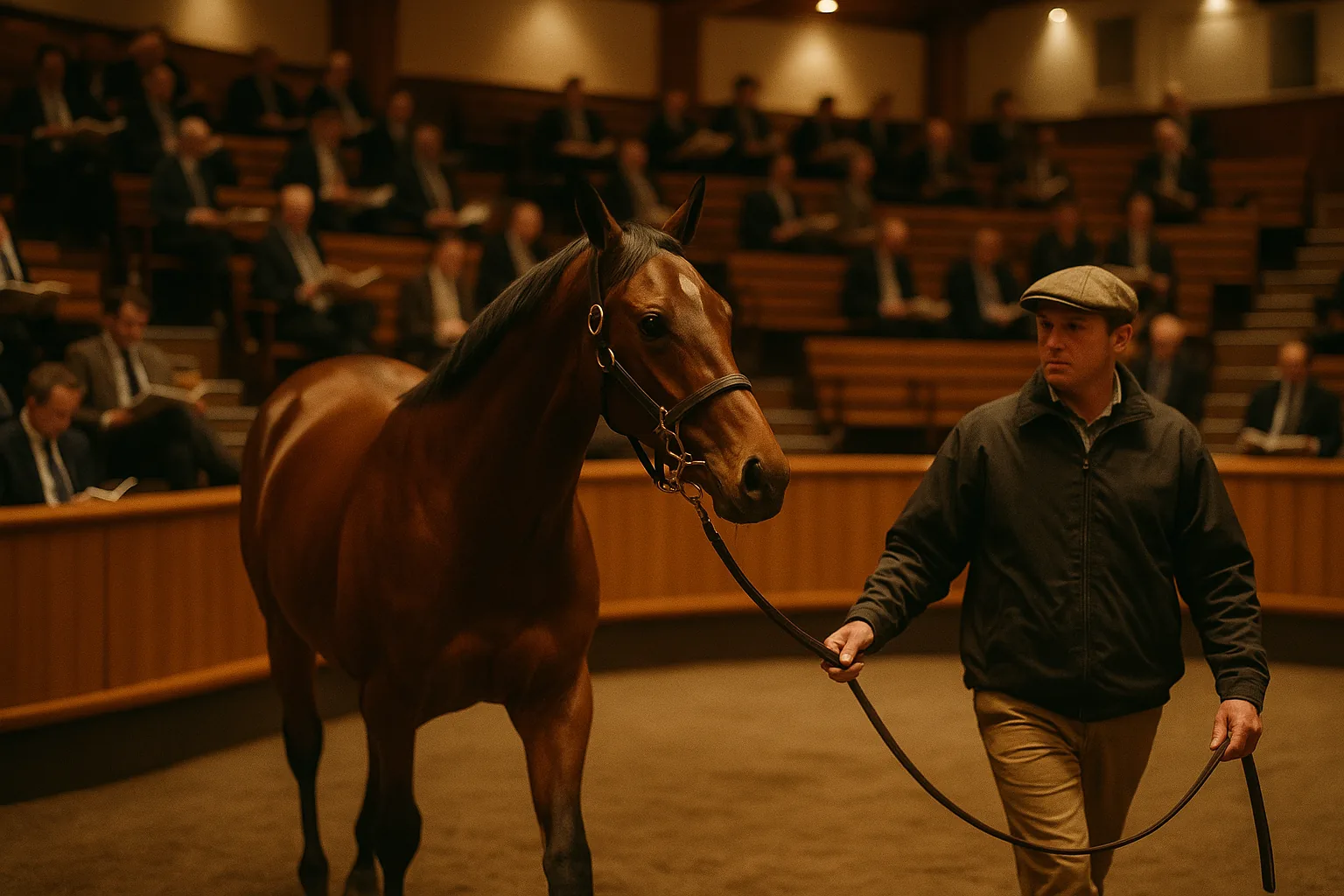
If the math is this unforgiving, you would expect demand to be collapsing. It is doing the opposite. In September 2025, the Keeneland September Yearling Sale grossed a record $531.5 million, the highest total ever realized at a Thoroughbred auction anywhere in the world, up nearly 24% on the prior year. Fifty-six yearlings sold for seven figures, a colt by Gun Runner topping the sale at $3.3 million.
Record loss data and record sales prices in the same year are not a contradiction. They are the same fact seen from two sides. Buyers are not misreading the returns. They are paying, knowingly, for something the purse ledger does not measure. The people spending seven figures on a yearling are, on average, the people best positioned to know exactly how the economics work. They keep bidding anyway.
What you’re actually paying for
Strip out the fantasy of the big check and a real product remains. It is worth naming its parts, because this is the thing you are actually buying, and it is easier to judge whether it is worth buying racehorse shares for your budget once you see it itemized rather than sold.
What the money actually buys
| What you’re paying for | What it actually is |
|---|---|
| Anticipation | Weeks of a race to look forward to, and a stake in an outcome you cannot control |
| Access | Backstretch mornings, the paddock, the owner’s box — rooms most fans never enter |
| Belonging | A trainer who takes your call, a syndicate group text, a place inside the sport |
| The rooting interest | A horse that is partly yours to cheer, by name, in public |
| The upside lottery | A small, real chance at a stakes score, a black-type filly, or a resale surprise |
Consider a first-time owner who buys a 5% share in a two-year-old filly for a few thousand dollars. She may never win a graded stakes. But her owner gets the text when she breezes a good work, drives out to watch her train on a cold morning, stands in the paddock before her first start, and spends the ninety seconds of the race shouting a name that is, in a small and real way, his. If she never earns back the training bill, which is the likeliest outcome, he has still bought a season of that. Whether it was worth the money is a question only he can answer. But it is the right question. “Will she pay me back” is the wrong one.
The lottery-ticket upside, with honest odds
That last line in the table is where owners get into trouble, so it deserves an honest read. The upside is real. Horses do win stakes. A well-bred filly who runs well can be worth far more at stud than she cost. The occasional resale doubles someone’s money. But the odds of it happening to you are close to the odds implied by that $740 million gap. Treat the upside as a lottery ticket that comes free with the experience, pleasant if it hits, never the reason you bought. Owners who invert that, who buy the ticket and tolerate the experience while waiting to get paid, are the ones who leave bitter.
Investment framing versus experiential reality
The gap between how ownership is sold and what it delivers is wide enough to set side by side. The left column is the pitch you will hear. The right column is what the numbers actually support.
The pitch versus the honest reality
| The marketing claim | The honest reality |
|---|---|
| “Racehorses are an investment” | For most owners it is an expense, not an investment; ~78% of starters earn less than their training bill |
| “Get in early on the next champion” | Champions exist; your statistical odds of owning one are very small |
| “Purses are at record levels” | True, and owners still put in ~$740 million more than purses return |
| “It pays for itself through breeding and resale” | It does for a few; for most, breeding and resale are upside, not a plan |
| “It’s a smart way to diversify” | It is a consumption experience with a lottery attached, and is better budgeted as one |
How to decide if the experience is worth your budget
Start by separating the two purchases you are actually making, the experience and the lottery ticket, and price only the first.
Run the real annual carry, not the purchase price. Buying in is the small number; keeping a horse in training is the one that recurs. Our component breakdown of what a racehorse costs to own and the month-by-month version give you a figure to test against your own budget. Then look at the other side of the ledger honestly: our breakdown of how owners actually make money shows where purse money goes and why so little of it reaches most owners.
If the recurring cost is money you can spend on an experience without needing it back, ownership can be one of the more rewarding things you do with discretionary money. If it is not, the honest move is a smaller door: a fractional or micro-share buys much of the same experience for a fraction of the exposure. The worst outcome is the one the base rate predicts, which is writing a large check expecting a return and discovering a year later that you bought an experience you were not prepared to pay full price for.
None of this is an argument against owning. It is an argument for owning with your eyes open. The people who are happiest in this sport are the ones who decided, before they bought, that the experience alone was worth the money, and who were pleasantly surprised by anything beyond it. The $740 million gap is not a warning to stay out. It is a price tag. Read it before you buy.
Frequently asked questions
Do racehorse owners ever make money?
Some do. A small minority — the connections of stakes horses, successful breeders, and the occasional well-timed resale — come out ahead. But at the population level, owners collectively put roughly $740 million more into training each year than purses return, and about 78% of starters earn less than their training costs. Making money is the exception, not the expectation.
If most owners lose money, why is the sport setting sales records?
Because buyers are paying for the experience and the small chance of a big result, not for reliable returns. Keeneland’s September sale set an all-time record of $531.5 million in 2025 even as the loss data held steady. Demand reflects the value of the experience, not the profitability of the average horse.
What is the cheapest honest way to try ownership?
A fractional share or micro-share syndicate. You get most of the experience — a named horse, race-day access, the rooting interest — for a small share of the cost and risk. It is the sensible first door for anyone who wants to find out whether the experience is worth it before committing to a whole horse.
Is buying a racehorse a good investment?
For most people, no, and it is more useful to stop calling it an investment. Budget it as a consumption experience with a lottery ticket attached. If it pays, treat that as a windfall. If you need it to pay, the numbers are against you.
About the Author

Calvin Johnson is a Thoroughbred racehorse owner, day trader, and independent racing analyst with more than a decade of firsthand ownership experience. He has participated in nearly every common structure in horse racing — fractional platform shares, traditional syndicates, LLC partnerships, claiming ventures, and outright ownership — across more than two dozen horses. Calvin writes about racehorse ownership the same way he approaches markets: by studying risk, incentives, fees, and whether the people controlling the deal are aligned with the investors behind it.
- Calvin Johnsonhttps://racehorseownership101.com/author/calvin-johnson/

- Calvin Johnsonhttps://racehorseownership101.com/author/calvin-johnson/

- Calvin Johnsonhttps://racehorseownership101.com/author/calvin-johnson/
- Calvin Johnsonhttps://racehorseownership101.com/author/calvin-johnson/