The Claiming Crown is the championship day for claiming horses, and in 2026 it runs on Saturday, November 14 at Churchill Downs: nine races, $1,200,000 in guaranteed purses, and not one of them written as a claiming race. Making a horse eligible costs $250 per race if the request is filed by Friday, October 23, and $1,250 if you leave it until entry day on November 7. What that money buys is the right to be considered for a place in the field. It does not buy the place.
My habit with any date-driven target is to read the conditions before the marketing, and the Claiming Crown conditions repay it. The official site gives you the date and the romance. What it does not put in front of a first-time claiming owner is the part that decides whether November 14 is a plan or a daydream: eligibility is a property of the horse’s past starts, not of the horse you have just bought, and an eligible horse can still be shut out of the race its owner paid for.
The short answer
The Claiming Crown is a single card of racing for horses that have run in claiming races, founded in 1999 by the National Horsemen’s Benevolent and Protective Association and the Thoroughbred Owners and Breeders Association. The 2026 renewal is at Churchill Downs on Saturday, November 14: nine races carrying $1,200,000 in guaranteed purses, with Kentucky Thoroughbred Development Fund money listed on top of each. Despite the name, none of the nine is a claiming race. All are written under starter allowance conditions, which means a horse’s past claiming starts are what make it eligible and no horse can be claimed out of the race that afternoon. Eligibility is requested per horse, per race, for a non-refundable $250 by Friday, October 23, 2026. After that the fee rises to $1,250, and it closes at entry on Saturday, November 7.
Imagine your colors on the horse at the front.
Not a bet. Not a ticket. Yours. Thousands of everyday fans own a piece of a racehorse. The free guide is how they started.
Nine races, $1,200,000 guaranteed, and not one of them is a claiming race.
A championship for claiming horses is not a claiming race
No horse can be claimed out of a Claiming Crown race: all nine 2026 events are written as starter allowances, so the tag that made a horse eligible is not hanging on it that afternoon. A claiming race puts a price on every runner and lets any licensed owner buy it before the gate opens. A starter allowance borrows the eligibility test from that world and drops the sale. The condition reads “for horses which have started for a claiming price of $8,000 or less,” and it is a look backwards at the form. It is not an offer on the horse.
The distinction is worth stating flatly, because the worry that attaches most naturally to the Claiming Crown is that shipping a good claimer to Churchill in November means risking it on the biggest stage of its year. It does not. Whether you should run a horse for a tag at all is a real decision with its own logic, and losing a horse out of a claiming race is a real risk on an ordinary Tuesday. Championship day carries none of it.
What actually makes a horse eligible
A horse becomes eligible for a Claiming Crown race by having started for that race’s claiming price or lower — over 2025–26 for seven of the nine races, and over the horse’s entire lifetime for the two $8,000 events.
The eligibility path at a glance
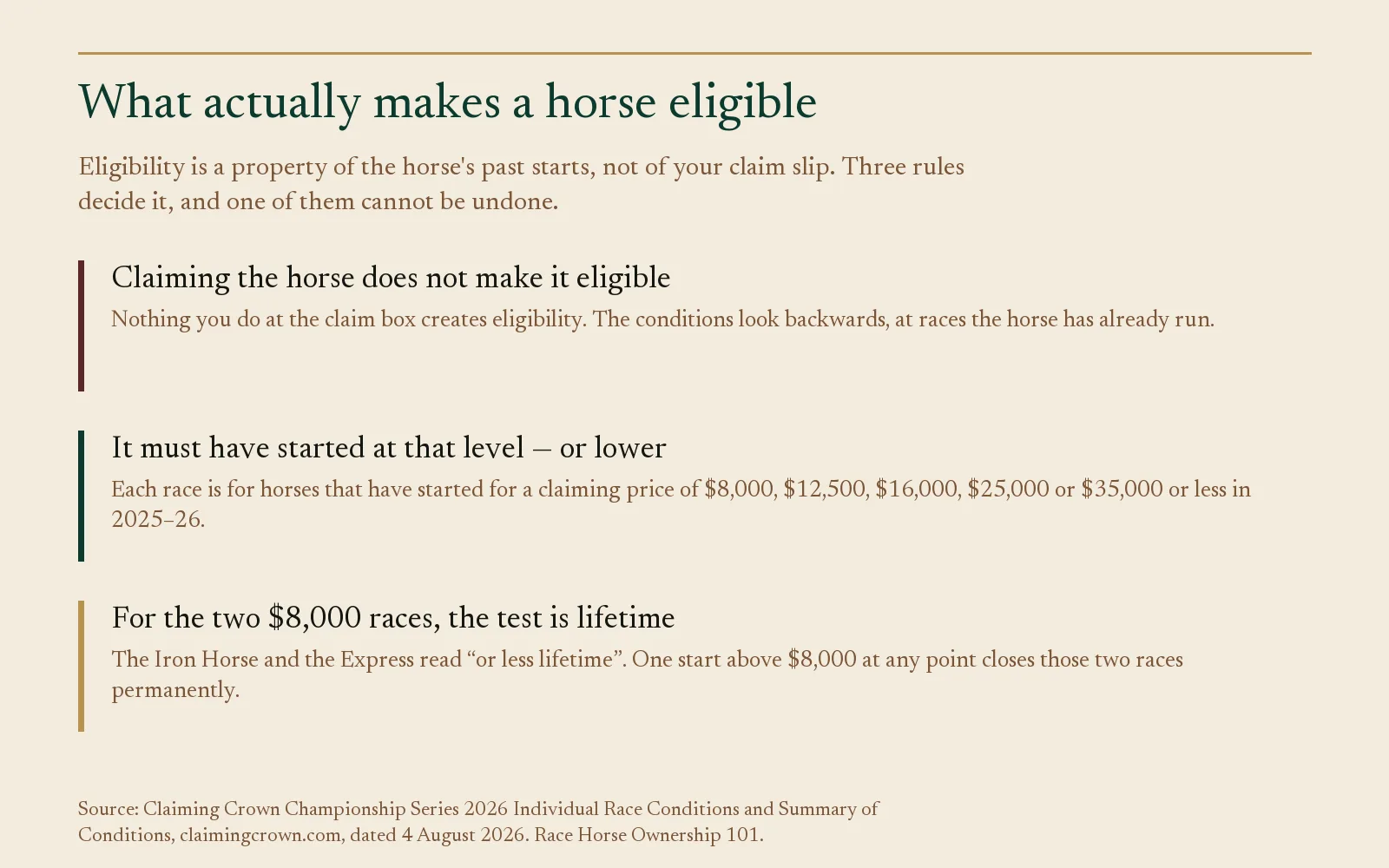
The expensive misreading is to think the claim creates the eligibility. It does not. Nothing that happens at the claim box qualifies a horse for anything; the conditions look backwards at races the horse has already run. The general condition requires a start for a claiming price in 2025–26 at a recognized North American pari-mutuel track, and each individual race then requires a start at its own level or below.
Consider an owner who buys a well-bred three-year-old at auction, runs it twice in maiden special weight company and once in an allowance race, then reads about the Jewel’s $200,000 purse. That horse cannot be made eligible for any of the nine races at any price. Not one of its starts was for a claiming price, and the conditions contain no mechanism for buying past that.
Eligibility is inherited from a horse’s past starts. There is no price at which it can be bought.
The test also runs one way. Each race is for horses that have started at its level or lower, so a modest claimer can be aimed at a race above its own tag while a horse that has only run for higher tags cannot come down into one. And for the two $8,000 races — the Kent Stirling Memorial Iron Horse and the Ready’s Rocket Express — the condition reads “or less lifetime.” One start above $8,000 at any point in a career closes those two races permanently. Nothing a horse does afterward reopens them.
The nine 2026 Claiming Crown races and their claiming windows
| Race | Claiming window | Age / sex | Distance | Surface | Guaranteed purse |
|---|---|---|---|---|---|
| The Kent Stirling Memorial Iron Horse | $8,000 or less lifetime | 3 & up | 1 1/16 miles | Dirt | $100,000 plus $10,000 KTDF |
| The Ready’s Rocket Express | $8,000 or less lifetime | 3 & up | 6 furlongs | Dirt | $100,000 plus $10,000 KTDF |
| The Glass Slipper | $12,500 or less in 2025–26 | 3 & up, fillies and mares | 1 mile | Dirt | $100,000 plus $10,000 KTDF |
| The Empress | $16,000 or less in 2025–26 | 3 & up, fillies and mares | 6 furlongs | Dirt | $100,000 plus $10,000 KTDF |
| The Rapid Transit | $16,000 or less in 2025–26 | 3 & up | 7 furlongs | Dirt | $125,000 plus $15,000 KTDF |
| The Tom Metzen Memorial Canterbury | $25,000 or less in 2025–26 | 3 & up | 5 1/2 furlongs | Turf | $150,000 plus $20,000 KTDF |
| The Tiara | $25,000 or less in 2025–26 | 3 & up, fillies and mares | 1 1/16 miles | Turf | $150,000 plus $20,000 KTDF |
| The Emerald | $25,000 or less in 2025–26 | 3 & up | 1 1/16 miles | Turf | $175,000 plus $20,000 KTDF |
| The Jewel | $35,000 or less in 2025–26 | 3 & up | 1 1/8 miles | Dirt | $200,000 plus $25,000 KTDF |
Three of the nine are turf races, and each of those conditions carries the line that management reserves the right to transfer the race to the main track. If the plan is to ship a turf specialist several states to Louisville for a $150,000 turf sprint, that sentence is part of the cost of the trip.
What it costs to get a horse there
Claiming Crown eligibility costs $250 per horse, per race, by October 23, 2026, and $1,250 after that — and the fee is the smallest line in the budget.
The fee dates at a glance
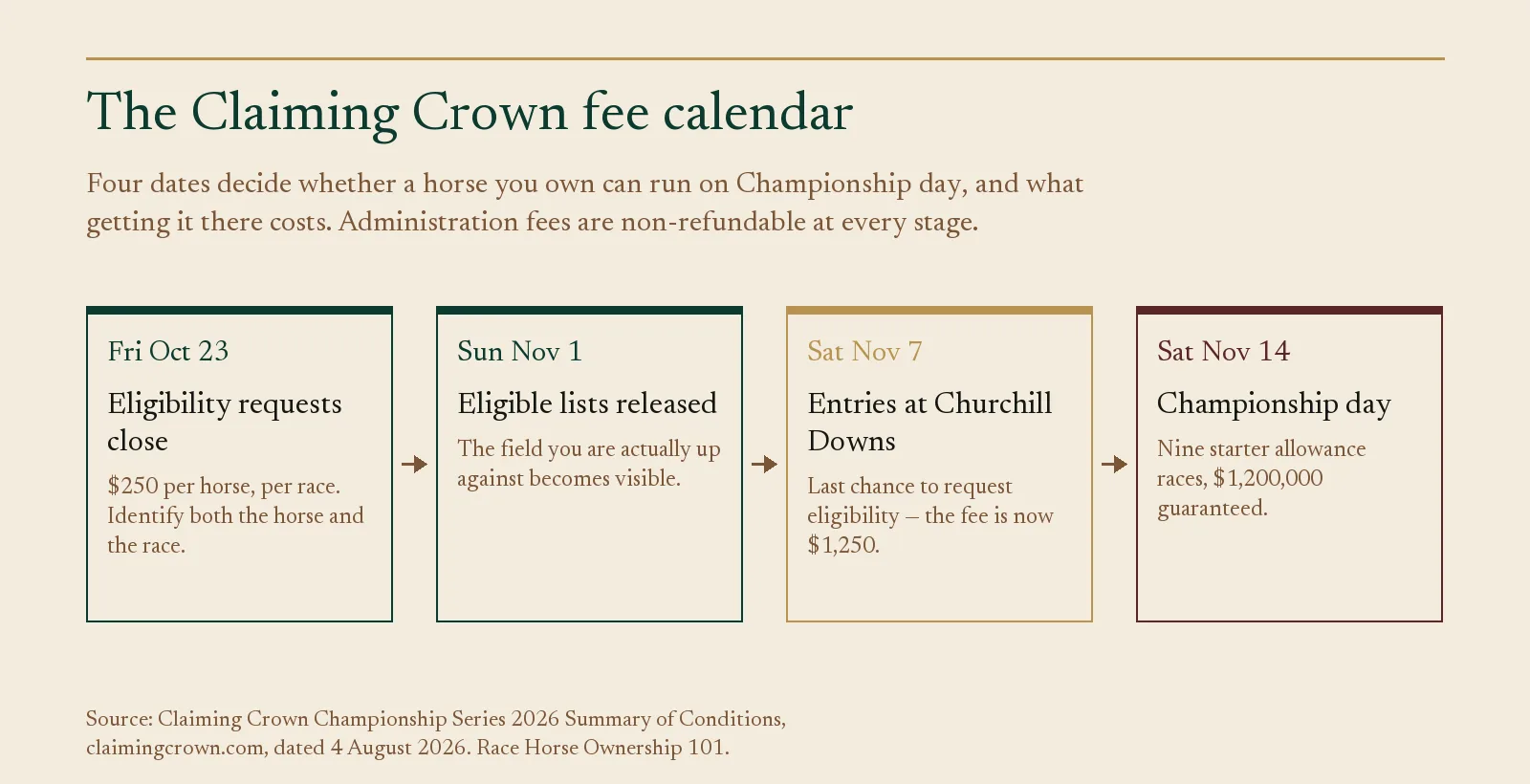
The administration fee is charged per race rather than per horse, and it is non-refundable. An owner hedging one horse across two suitable races pays $500 before anything is decided. Missing October 23 and supplementing at entry costs $1,250 for exactly the same thing, which is a $1,000 penalty on a calendar the owner controlled. Between those dates, on November 1, the lists of eligible horses are released — the first honest look at the company a horse is actually in.
Everything after the fee is yours to estimate, and the official documents will not do it for you:
- Shipping to Louisville and home again, from wherever the horse is based
- Stabling at the meet, and the trainer’s time on the road
- The jockey’s mount fee, plus the trainer’s and jockey’s percentages if the horse hits the board
- Several weeks of training bills spent pointing at a date rather than at the next winnable race
That last item is the cost nobody quotes, and for most owners it is the largest one. A horse aimed at November 14 is a horse not entered somewhere in October where it might have won. The purse it did not run for is as real as the shipping bill, and it never appears on an invoice.
One more line deserves reading properly. Each race lists a guaranteed purse plus a KTDF figure — Kentucky Thoroughbred Development Fund money, which supplements purses for Kentucky-breds. For an owner shipping in a horse bred elsewhere, the guaranteed number is the one that applies.
Paying the fee does not get you into the race
Every 2026 Claiming Crown condition ends with the same clause: preference is given to stakes winners in 2025–26, then by highest earnings in 2025–26.
“Preference given to stakes winners in 2025-26, then by highest earnings in 2025-26.” — the closing line of all nine 2026 race conditions
That one line is the part an owner should read before writing any check. These races draw well and can fill past their limit. When more eligible horses want in than the race can take, the racing office does not run a lottery and does not reward whoever filed first. It seats the stakes winners, then works down the earnings list.
Read that from the position of the owner most likely to be excited by the Claiming Crown in the first place: someone with a useful $16,000 claimer and no black type. By the plain terms of the condition, that owner is at the back of the queue. The $250 is spent either way, because the administration fee is non-refundable whether or not the horse draws in.
The Showcase at Colonial Downs is the one guaranteed way in
There is a hedge, and for this year it has already closed. Claiming Crown Showcase Day was run at Colonial Downs in New Kent, Virginia on Saturday, August 22, 2026. The top two finishers in each Showcase qualifier earn automatic entry into the corresponding race at Churchill, and Showcase winners have been offered a $2,000 travel stipend from the Virginia HBPA to come back for Championship day. An owner who wants a Claiming Crown start rather than a Claiming Crown hope aims at the August qualifier first — which makes it a decision for next spring, not for this October.
Purse math in owner terms
The Jewel’s $200,000 guaranteed purse pays its winning owner somewhere around $115,000 to $123,000 before the barn’s percentages, because the conditions pay 1% to every owner finishing sixth through last and split what remains 62/20/10/5/3.
Purse distribution at a glance
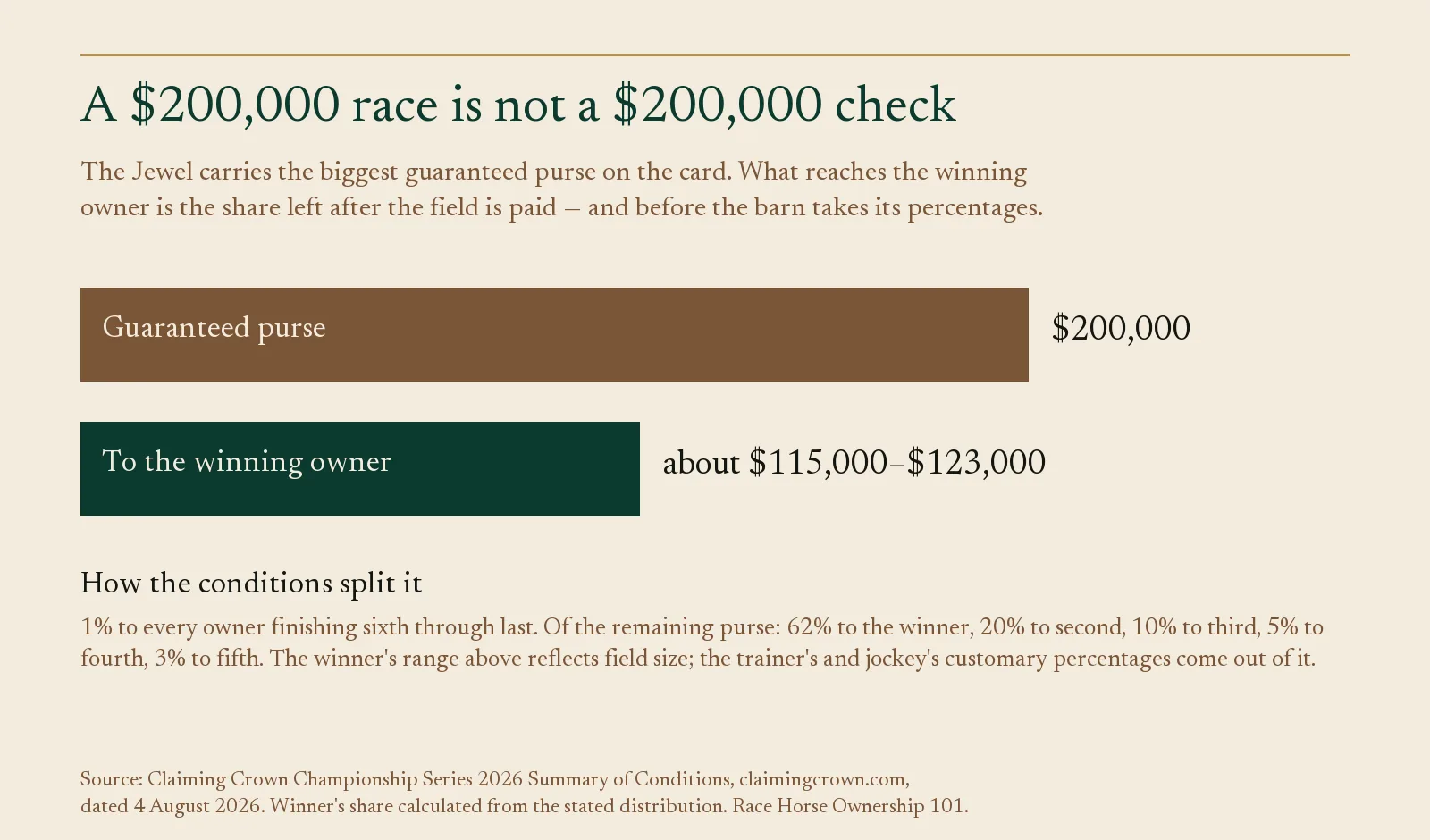
Every Claiming Crown purse is distributed the same way. One percent goes to the owners of horses finishing sixth through last, which is the money that makes shipping a longshot rational. The remainder is split 62% to the winner, 20% to second, 10% to third, 5% to fourth and 3% to fifth.
Two things follow from that:
- The winner’s share moves with field size. The more horses finish out of the money, the more of the purse is paid out before the 62% is calculated.
- The guaranteed figure is a gross number, not a deposit. The trainer’s and jockey’s customary percentages come out of the owner’s share, and so does the cost of the trip.
None of this makes the day a bad target. It makes it a target with an honest number attached. A win in the Jewel is a six-figure result for a horse that has run for a $35,000 tag, and that gap is the entire argument for the card.
Should you claim a horse to run in the Claiming Crown?
No. Claim a horse because the tag, the trainer and the budget make sense on their own, and treat the Claiming Crown as a bonus that a horse you already own may turn out to fit.
The honest answer: eligibility cannot be bought, only inherited from a horse’s past starts. The fee is non-refundable and secures nothing. And preference favors the horses whose owners needed the Claiming Crown least.
Set against that, the case for the day is real. Nine races restricted to horses that have run for a tag, purses from $100,000 to $200,000, and a field of genuine peers instead of the allowance horses that have been beating them all year. For a claiming owner, there is not much else on the American calendar that offers it.
So the sequence runs one way only. Claim the horse because the claim is right — the right level, the right trainer, a budget that survives a bad month. If you are still working out what that looks like, start with how the claiming process actually works, and with the case for buying a ready-to-run juvenile at OBS March instead. Then, in October, look at what the horse has genuinely done in 2025 and 2026, find the race whose window it already fits, and decide whether $250 is buying a realistic shot or a lottery ticket.
A championship day is a fine thing to be eligible for. It is a poor reason to buy a horse.
Common questions about the Claiming Crown
Is the Claiming Crown a claiming race?
No. The 2026 Summary of Conditions states that the Claiming Crown Championship Series consists of nine races run under starter allowance conditions. A horse’s past claiming starts are what make it eligible; the race itself carries no claiming price.
Can my horse be claimed on Championship day?
No. Because the races are starter allowances rather than claiming races, no horse in a Claiming Crown event is in for a tag that afternoon. You run the horse and you keep it, whatever the result.
How much does it cost to make a horse eligible?
$250 per horse, per race, if the eligibility request reaches Churchill Downs by midnight EST on Friday, October 23, 2026. After that date a late request costs $1,250 and must be made at or before entry on Saturday, November 7, 2026. Administration fees are non-refundable in both cases.
I just claimed a horse. Is it eligible?
Only if the horse’s own record already satisfies the condition. The 2026 conditions require a start for a claiming price in 2025–26, and a start at the specific race’s claiming level or lower. The claim you just made is itself a start for that tag, so it can count — but a horse whose starts have all been above the window, or that has never run for a claiming price at all, cannot be made eligible by being bought.
What is Claiming Crown Showcase Day?
Showcase Day is the qualifying card, held at Colonial Downs in New Kent, Virginia — Saturday, August 22 in 2026. The top two finishers in each Showcase qualifier earn automatic entry into the corresponding race at Churchill Downs, which is the one reliable way to convert eligibility into a guaranteed start rather than a place in the preference order.
Do I need to be a TOBA or HBPA member to enter?
The published 2026 conditions do not set out any membership requirement. They ask that the owner of record or an authorized agent identify the horse and the intended race, submit the administration fee, and be determined eligible with Churchill Downs at the time of entry. If membership matters for a particular circumstance, ask the racing office directly rather than assuming either way — the forms and current documents are published at claimingcrown.com.
What to read next
- Claiming races, explained for owners — the mechanism the whole Claiming Crown is built on top of
- How do you claim a horse? — the process, step by step
- Why would an owner put a good horse in a claiming race? — the logic behind running for a tag
- Do you have to sell your horse in a claiming race? — what you are actually agreeing to
Dates, fees and race conditions in this article come from the Claiming Crown Championship Series 2026 Summary of Conditions and Individual Race Conditions published at claimingcrown.com on August 4, 2026. The event is run by the National HBPA and TOBA. Conditions are rewritten each year and dates can move — confirm against the official documents before filing an eligibility request.
About the Author

Calvin Johnson is a Thoroughbred racehorse owner, day trader, and independent racing analyst with more than a decade of firsthand ownership experience. He has participated in nearly every common structure in horse racing — fractional platform shares, traditional syndicates, LLC partnerships, claiming ventures, and outright ownership — across more than two dozen horses. Calvin writes about racehorse ownership the same way he approaches markets: by studying risk, incentives, fees, and whether the people controlling the deal are aligned with the investors behind it.
- Calvin Johnsonhttps://racehorseownership101.com/author/calvin-johnson/

- Calvin Johnsonhttps://racehorseownership101.com/author/calvin-johnson/

- Calvin Johnsonhttps://racehorseownership101.com/author/calvin-johnson/

- Calvin Johnsonhttps://racehorseownership101.com/author/calvin-johnson/