There is no national rule for who in a racing partnership has to hold a state owner license. New York licenses every partner on a horse with 35 or fewer owners. Pennsylvania, Indiana, Virginia, Maryland and Texas draw the line at a 5 percent interest. Kentucky, Florida and Illinois do not publish a threshold on their licensing pages at all. Which group your partnership falls into depends on where the horse races, not on what your agreement says, and the managing partner’s license does not cover the rest of you.
The short version
- New York: on a horse with 35 or fewer owners, every owner must be licensed. Above 35, everyone at 3 percent or more.
- Pennsylvania, Indiana, Virginia, Maryland and Texas: owners at 5 percent or more. Indiana adds that a smaller owner with backside access needs a license too.
- Kentucky, Florida and Illinois: no percentage published on the licensing page. Ask the commission.
- Your partnership agreement and HISA’s designated owner do not decide any of this.
The short answer: every partner, 5 percent, or 3 percent
Who in a racing partnership needs a state owner license splits three ways across the commissions we sourced: every partner (New York, up to 35 owners), everyone at 5 percent or more (Pennsylvania, Indiana, Virginia, Maryland, Texas), or a threshold the commission does not publish (Kentucky, Florida, Illinois). Each racing commission writes its own rule, and the rule that applies is the one in the state where the horse is entered.
The billionaires would prefer you didn’t know this.
You can own a racehorse with a group of people just like you — and the insiders wrote down how. Free guide, ten minutes.
Before I sign a partnership agreement, I read the commission’s threshold first. The assumption I see most often is that the managing partner holds “the license” and everyone else is a passive investor riding along on it. In some states that is close to true for a small holder. In New York it is wrong for every partner in a group of 35 or fewer, and finding that out at entry time costs you a race.
Your partnership agreement does not decide who is licensed
A partnership agreement sets out who owns what and who decides what, but the list of people who must hold a state license comes from the racing commission’s rules, and the two lists can differ. The agreement governs shares, cash calls, purse splits and exits, and we go through those clauses in what’s actually in a racehorse syndicate or partnership agreement. Nothing in that contract can exempt a partner from a commission’s licensing rule, and a well-drafted agreement will say who is responsible for making sure every partner who needs a license gets one. If yours is silent on it, that is a question to put to the manager before you sign.
And HISA’s designated owner is a different role again
HISA’s designated owner is the one person who represents a jointly owned horse in the federal database, and that role has nothing to do with which partners hold a state license. A partnership can have one designated owner with HISA and six licensed owners with the New York commission at the same time. We explain the designated-owner role, and why only one partner hears from the regulator, in HISA registration for owners. Keep the two apart: the state license lets you participate at the track, and the HISA role decides who receives the federal paperwork. Who must hold an owner license is also not the authorized-agent card — what 21 commissions charge for that license is a different page.
Who has to be licensed in a racing partnership, state by state
The partnership licensing rule falls into one of three groups in the states we sourced, and no single source we found sets the groups side by side. Commission rules are written one state at a time, in different places: a regulation in one state, a fee page in another, an FAQ in a third.
RHO101 original analysis: each row below comes from the state commission’s own regulation, fee page or FAQ. Where a commission does not publish a threshold on its licensing page, we say so rather than fill the gap. This is part of the same research as our owner-license fee comparison, which covers the 13 of 32 US racing states that publish a readable fee.
Partnership owner-license threshold by state (commission-sourced)
| State | Who in the partnership must hold an owner license | Group | Source |
|---|---|---|---|
| New York | All owners on a horse with 35 or fewer owners; above 35 owners, each person with 3% or more | Every partner (3% above 35) | NYS Gaming Commission; 9 NYCRR 4026.3 |
| Pennsylvania | Each owner with 5% or more | 5% | 7 Pa. Code §303.6 |
| Indiana | Owners with 5% or more must be disclosed; an owner under 5% need not be licensed unless they have backside access | 5% | 71 IAC 5.5-2-2 |
| Virginia | Each owner with 5% or more; one person pays the entity fee | 5% | Virginia Racing Commission FAQ; 11VAC10-60-10 |
| Maryland | Anyone who owns 5% or more | 5% | Maryland Racing Commission fees page |
| Texas | Each director, officer or partner, or any owner with 5% or more | 5% | 16 TAC §311.101 |
| California | The application lists all persons with a financial interest; a percentage threshold is not published | Not published | CHRB-4 application |
| Kentucky | Threshold not published on the licensing page | Not published | 810 KAR 3:020 |
| Florida | Threshold not published on the licensing page | Not published | Florida Gaming Control Commission |
| Illinois | Threshold not published on the licensing page | Not published | Illinois Racing Board |
The three partnership licensing rules compared (graphic)
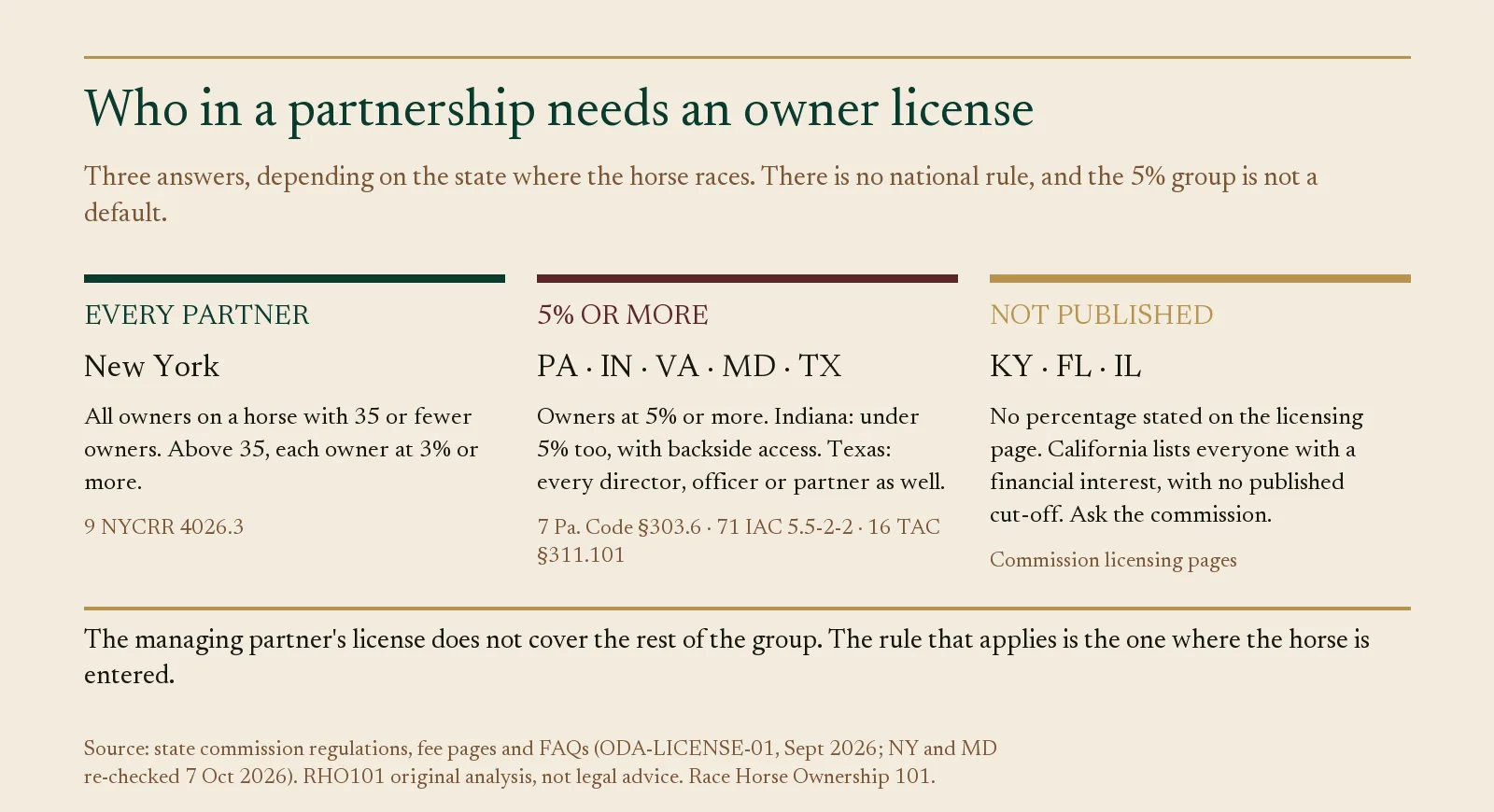
One point of method. The table covers the states whose commission text answers the question directly, plus the four where we looked and found no published percentage. It does not cover every racing state, and it would be wrong to read the 5 percent group as a default that applies wherever a state is not listed. There is no default.
New York: every partner, until the horse has more than 35 owners
New York requires every owner of a horse with 35 or fewer owners to be licensed before the horse can be entered, and only above 35 owners does a 3 percent threshold apply. The commission’s wording is blunt: no horse with 35 or fewer owners will be accepted for entry unless all owners are licensed. New York is my home circuit, so it is the rule I check first, and its every-partner rule is the strictest of the states we sourced.
New York worked example: who needs a license at three partnership sizes
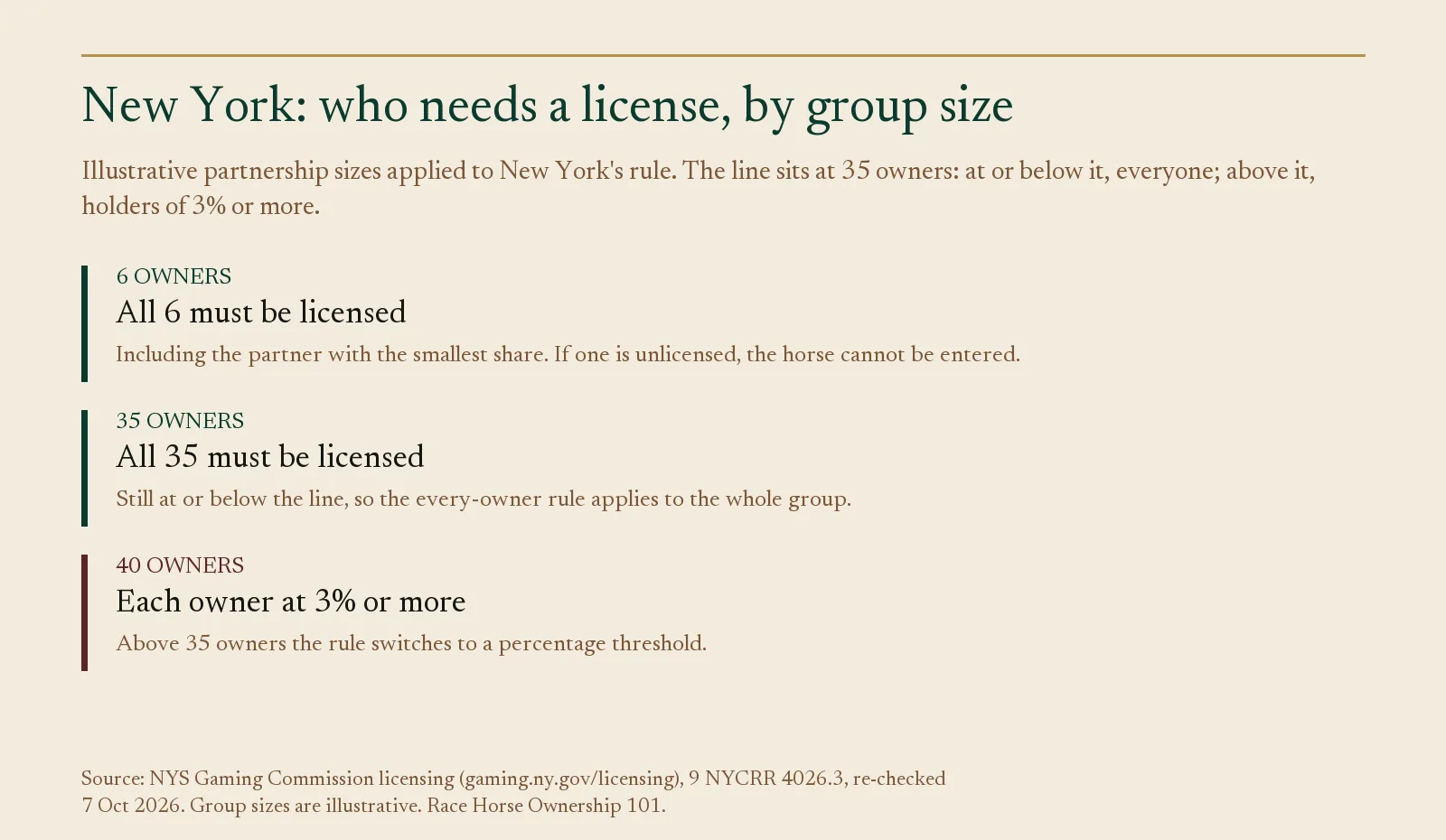
Consider a six-person partnership that buys a claimer to race at Belmont and Saratoga. Under New York’s rule all six owners need a license, including the friend who put in the smallest share and has no intention of going near the barn. If one of the six has not been licensed by the time the trainer wants to enter, the horse waits. Now picture a larger group of 40 owners. The rule flips to a percentage, and only the owners at 3 percent or more are required to hold a license. The cut-off sits at 35 owners, so a group of 35 and a group of 36 face different rules.
In New York, the friend with the smallest share needs a license too. The horse waits until they have one.
New York also requires a first-time applicant to submit state and federal fingerprints, at $90, and every owner either files workers’ compensation coverage or a CE-200 exemption. For a small group that is a short list of paperwork multiplied by every partner, which is the cost New York partnership buyers tend to overlook.
The 5 percent states: Pennsylvania, Indiana, Virginia, Maryland and Texas
Five of the states we sourced license partnership owners at 5 percent or more, but the details differ enough that “5 percent” alone does not settle what you owe. A 5 percent rule means a partner holding 4 percent usually is not required to carry a license of their own. It does not mean the partnership itself escapes licensing, and each state words the rule a little differently.
- Pennsylvania requires each owner at 5 percent or more to be licensed under 7 Pa. Code §303.6, and its fee schedule lists a separate $60 partnership license.
- Indiana requires owners at 5 percent or more to be disclosed, and an owner under 5 percent need not be licensed, unless that owner has access to the backside. If you plan to visit the barn area, assume you will need a license whatever your share.
- Virginia licenses owners at 5 percent or more, with one person paying the entity fee, according to the Virginia Racing Commission’s FAQ. Virginia’s whole participant permit schedule is $0.
- Maryland states that anyone who owns 5 percent or more must have an owner’s license, and its fees page lists a $100 Jockey Fund payment on each owner license.
- Texas casts the widest net of the five: each director, officer or partner of the entity, or anyone with 5 percent or more, under 16 TAC §311.101.
Texas is the trap in this group. A small holder in a Texas partnership who is also named as a partner, rather than holding a share through an LLC, may fall inside the rule on the “partner” wording alone, whatever their percentage. If you are below 5 percent anywhere in this group, the useful question for the manager is how your interest is held, not only how large it is.
States that do not publish a threshold: Kentucky, Florida and Illinois
Kentucky, Florida and Illinois do not state a partnership percentage threshold on their licensing pages, so we have not assigned them one. California’s owner application lists every person with a financial interest in the horse but does not publish a percentage cut-off either. That is not evidence that small partners are exempt in those states. It means the answer is in the regulations, in the commission office, or with the partnership manager, and you should get it in writing before you rely on it.
A partnership buying a Kentucky-based horse is exactly the kind of group in which a small investor reasonably wonders whether they need a license, and the commission’s licensing page won’t answer that question for you.
What a silent partner should still do before signing
A silent partner should find out, before signing, which state the horse will race in, what that state’s rule is, and who in the group is responsible for getting every required partner licensed. None of those three answers is in a typical marketing deck, and only the third is usually in the agreement.
- Ask where the horse will be entered. The rule follows the race, so a horse shipping between New York and Pennsylvania can put a small partner under two different rules in one season.
- Ask the manager for the license list: which partners the manager believes must be licensed, and on what rule. A manager who cannot answer is telling you something, and we cover what else to ask in how to vet a syndicate or partnership manager.
- Read the prospectus or offering document for licensing language. Some groups handle licensing centrally and some leave it to each partner; how to read a syndicate prospectus shows where that usually sits.
- If you are near a threshold, ask how your interest is held. A 4 percent share in an LLC and a 4 percent interest as a named partner can be treated differently.
- Budget for your own license, fingerprints and any workers’ compensation filing if the rule catches you. These are per person, not per partnership.
Partnership licensing questions
Does every partner in a racehorse have to be licensed?
It depends on the racing state. In New York, yes, on a horse with 35 or fewer owners. In Pennsylvania, Indiana, Virginia, Maryland and Texas, owners at 5 percent or more must be licensed. Kentucky, Florida and Illinois do not publish a threshold on their licensing pages.
What is the 5 percent owner license rule?
It is a state-level rule, not a national one: in Pennsylvania, Indiana, Virginia, Maryland and Texas, a partnership owner holding 5 percent or more must hold an owner license. Indiana and Texas add conditions, for backside access and for named partners and officers respectively.
If I own 2 percent of a racehorse, do I need a license?
In New York you do if the horse has 35 or fewer owners, because every owner must be licensed. In the 5 percent states you generally do not, unless another condition applies, such as backside access in Indiana or being a named partner in Texas. Elsewhere, ask the commission.
Is a HISA designated owner the same as a licensed owner?
No. HISA’s designated owner is the one person who represents a jointly owned horse in the federal database. State owner licenses are issued by each racing commission under its own partnership rule, and several partners may need one.
What if my state does not publish a threshold?
Ask the racing commission directly and get the answer in writing, then ask the partnership manager how the group handles it. Do not assume the 5 percent rule applies; it is not a default.
What to read next
The licensing question sits alongside the contract, so read it with what’s in a syndicate or partnership agreement. For the people running the group, see how to vet a syndicate manager, and for the offering document, how to read a syndicate prospectus. Get the licensing answer in writing before you sign, because once the horse is entered it is too late to fix.
About the Author

Calvin Johnson is a Thoroughbred racehorse owner, day trader, and independent racing analyst with more than a decade of firsthand ownership experience. He has participated in nearly every common structure in horse racing — fractional platform shares, traditional syndicates, LLC partnerships, claiming ventures, and outright ownership — across more than two dozen horses. Calvin writes about racehorse ownership the same way he approaches markets: by studying risk, incentives, fees, and whether the people controlling the deal are aligned with the investors behind it.
- Calvin Johnsonhttps://racehorseownership101.com/author/calvin-johnson/
- Calvin Johnsonhttps://racehorseownership101.com/author/calvin-johnson/
- Calvin Johnsonhttps://racehorseownership101.com/author/calvin-johnson/

- Calvin Johnsonhttps://racehorseownership101.com/author/calvin-johnson/