MyRacehorse’s organizational and experiential fee is up to 12.50% of the gross cash proceeds of a series offering, taken out of the money investors put in at the point of purchase rather than billed to them afterwards. It sits beside a separate management and due-diligence fee of up to 15.00% of offering proceeds. In the post-qualification amendment that My Racehorse CA LLC filed with the SEC on December 8, 2025, every one of the nine series disclosed charges the full 12.50% — the ceiling is the rate, not a starting point. The two fees together account for 27.50% of a raise before a dollar goes toward the horse, and a 1.00% brokerage fee brings the total deducted to 28.50%.
What the offering circular authorizes
The organizational and experiential fee is disclosed in MyRacehorse’s Regulation A+ offering circular, not in its marketing. The filing I worked from is post-qualification amendment No. 5 to Form 1-A (File No. 024-12611), filed by My Racehorse CA LLC, the entity that issues the series offerings. Its wording on this fee is one sentence: the fee “covers several organizational and experiential aspects of the business up to 12.50% of the gross cash proceeds.”
Racing’s best-kept open secret: you don’t have to just watch.
Ownership groups let regular people own a share of a real racehorse. The free guide explains how it works, in ten minutes.
Two details in that sentence do the work. The fee is a percentage of proceeds — the money raised from investors — not of the horse’s purchase price. And it is expressed as a ceiling. The filing notes the fee may be discounted for certain series, or capped for investors who buy into several offerings or take a large position.
The organizational and experiential fee at a glance
| Question | What the filing says |
|---|---|
| Rate | Up to 12.50% |
| Charged on | Gross cash proceeds of the series offering |
| When it is taken | From offering proceeds, at purchase — not billed later |
| Separate from | The management & due-diligence fee of up to 15.00% of offering proceeds |
| Can it vary | Yes — may be discounted by series, or capped for large or repeat investors |
| Source | Form 1-A post-qualification amendment No. 5, File No. 024-12611 (filed December 8, 2025) |
What “organizational and experiential” actually covers
The circular never defines “organizational and experiential” as a single term, which is why the phrase is hard to price in your head. It does describe the fee in two parts, and those parts are worth reading closely because they are doing different jobs: one is the cost of creating the offering, the other is the cost of the experience of being an owner in it.
The two parts the filing names
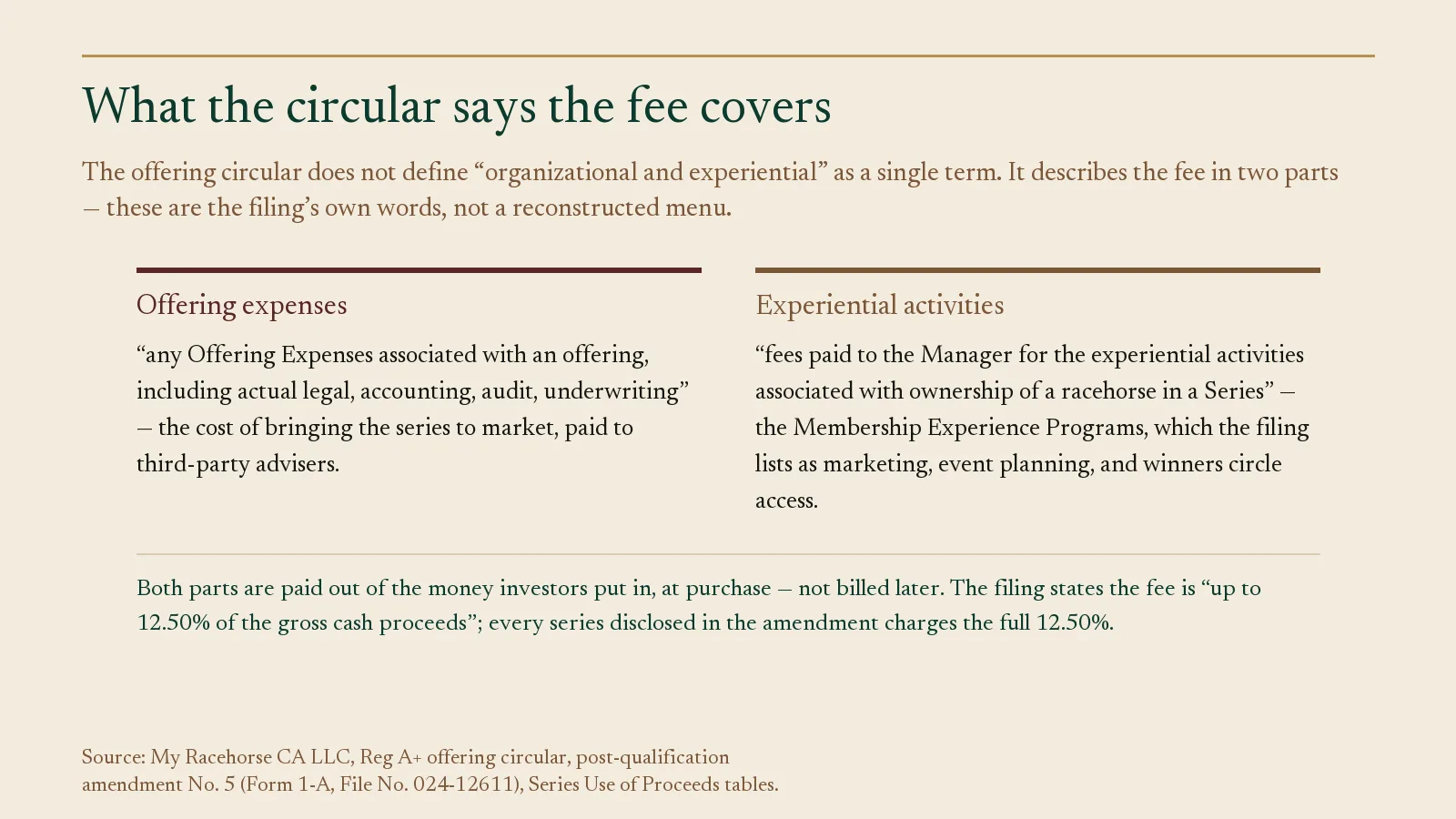
That second half is the one to sit with. A share of this fee pays for marketing, event planning and winners circle access — the things that make fractional ownership feel like ownership. Whether that is worth 12.50% of a raise is a judgement each buyer makes. The filing’s own language is the only honest basis for making it; anything more specific about what the money buys would be a guess, and this is not a line to guess at.
The “up to” never comes down
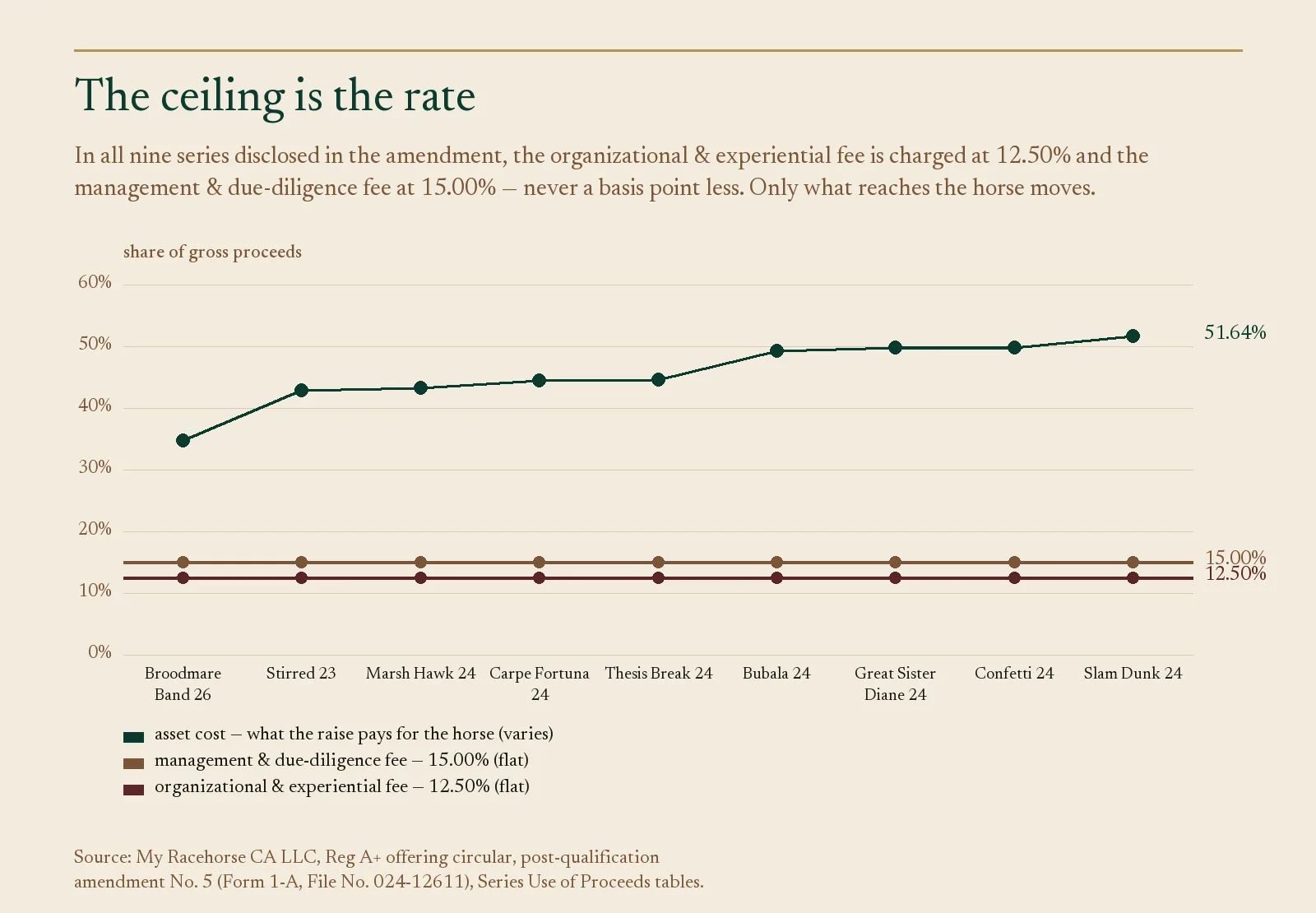
Across all nine series disclosed in amendment No. 5, the organizational and experiential fee is charged at exactly 12.50% and the management and due-diligence fee at exactly 15.00%. Not one series in that filing carries a discount. This is RHO101 original analysis, read off the per-series Use of Proceeds tables in the amendment itself: the ceiling and the charged rate are the same number.
The contrast inside the same tables is what makes the point. The share of each raise that goes to asset cost — the actual price of the horse — moves across a wide band, from 34.69% to 51.64%. The two fee lines never move at all. What varies between one MyRacehorse offering and the next is how much of your money reaches the animal, not how much the manager takes.
Fees hold flat while what reaches the horse moves
Where the money went in one series
Series Carpe Fortuna 24 raised $433,500.00, and its Use of Proceeds table accounts for every dollar. It is the clearest worked example in the filing: the five line items sum exactly to the gross, so nothing is hidden in rounding.
Series Carpe Fortuna 24: the full use of proceeds
| Line item | Amount | Share of gross |
|---|---|---|
| Asset cost (the horse) | $192,780.00 | 44.47% |
| Operating expense reserve | $117,172.50 | 27.03% |
| Management & due-diligence fee | $65,025.00 | 15.00% |
| Organizational & experiential fee | $54,187.50 | 12.50% |
| Brokerage fee | $4,335.00 | 1.00% |
| Total gross proceeds | $433,500.00 | 100.00% |
Read it as two groups. Fees take $123,547.50, or 28.50% of the raise. The remaining 71.50% — the purchase price plus the reserve that pays the horse’s training and veterinary bills — is money that goes to the animal and its upkeep. That reserve is not margin, and treating the whole 28.50% as “lost” would be as misleading as ignoring it. The useful question is narrower: of the money that does not reach the horse, the organizational and experiential fee is the larger half of what most buyers never knew was there.
Why owners miss this line
Owners miss the organizational and experiential fee because it never arrives as a bill. A fee deducted from offering proceeds is settled before the series starts running; there is no invoice, no monthly line, nothing to query. A buyer who assumes that no bills means no fees is right about their mailbox and wrong about their entry price.
That pattern is not unique to MyRacehorse — it is the whole reason we keep auditing syndicates that advertise no management fee. A fee taken off the top of a raise is invisible in a way a monthly charge never is. The fix is the same every time: read the Use of Proceeds table, not the homepage.
A fee you never receive a bill for is still a fee. It is simply one you paid on the way in.
This piece deliberately covers one line. The rest of the stack — the bloodstock fee, the management performance bonus on stakes earnings, the final gross proceeds fee at sale — is laid out in our breakdown of what MyRacehorse charges in fees. If you want the same disclosures set against another operator’s, the MyRacehorse and Commonwealth comparison does that job; this page does not rank operators, and a single fee line is not a verdict on either.
The honest edges of this analysis
Every figure in this piece comes from one document: post-qualification amendment No. 5 to My Racehorse CA LLC’s Form 1-A, filed December 8, 2025. The percentages and dollar amounts are quoted from its narrative text and its per-series Use of Proceeds tables; the 28.50% and 71.50% groupings are my arithmetic on those tables, and the line items sum exactly to the stated gross. Four limits are worth stating plainly.
- It is one amendment, not the current one. My Racehorse CA LLC has filed nine further Form 1-A post-qualification amendments since, the most recent on October 5, 2026. Series offered today may carry different numbers. Check the issuer’s EDGAR filing history and read the circular covering the series you are actually buying.
- Nine series is the sample. “Every series charges the full 12.50%” is true of the nine disclosed in this amendment. It is not a claim about every series MyRacehorse has ever offered.
- The discount language is real. The filing permits per-series discounts and caps for large or repeat investors. None of the nine shows one, but an individual investor’s effective rate can differ.
- One figure in the tables does not reconcile. Carpe Fortuna 24’s operating expense reserve is printed at 26.50%, but its own dollar amount works out to 27.03%, and the printed percentage column sums to 99.47% rather than 100%. The dollar amounts reconcile exactly, so I have used those and shown the derived share.
Questions owners ask
Is the 12.5% on top of the 15%?
Yes. The organizational and experiential fee and the management and due-diligence fee are separate line items in the same Use of Proceeds table, and both are deducted from the offering proceeds. In each of the nine series disclosed in amendment No. 5 they appear together at 12.50% and 15.00%, for a combined 27.50% of gross proceeds.
Is it deducted from my share price or billed later?
Deducted. The fee is paid out of the money raised in the offering, at purchase. An investor never receives a separate bill for it, which is precisely why it is easy to miss — it is priced into what you paid to join the series rather than charged to you afterwards.
Does the fee buy anything an owner can point to?
Partly. The circular splits the fee into offering expenses — legal, accounting, audit and underwriting costs of bringing the series to market — and fees to the manager for the experiential side, which the filing identifies as the Membership Experience Programs covering marketing, event planning and winners circle access. Beyond those words the filing offers no itemisation, and neither will we.
About the Author

Calvin Johnson is a Thoroughbred racehorse owner, day trader, and independent racing analyst with more than a decade of firsthand ownership experience. He has participated in nearly every common structure in horse racing — fractional platform shares, traditional syndicates, LLC partnerships, claiming ventures, and outright ownership — across more than two dozen horses. Calvin writes about racehorse ownership the same way he approaches markets: by studying risk, incentives, fees, and whether the people controlling the deal are aligned with the investors behind it.
- Calvin Johnsonhttps://racehorseownership101.com/author/calvin-johnson/

- Calvin Johnsonhttps://racehorseownership101.com/author/calvin-johnson/

- Calvin Johnsonhttps://racehorseownership101.com/author/calvin-johnson/

- Calvin Johnsonhttps://racehorseownership101.com/author/calvin-johnson/
