
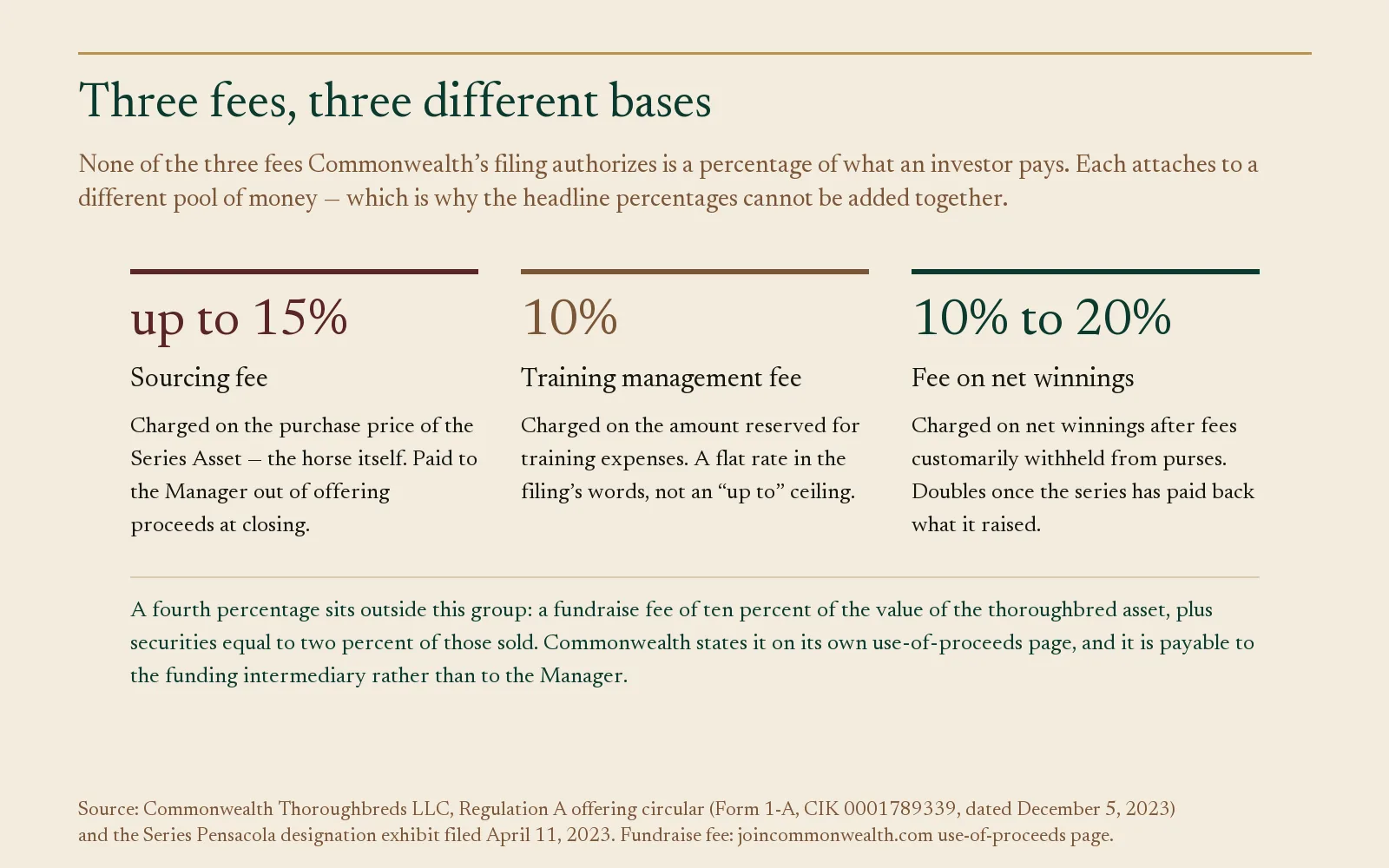
Commonwealth Thoroughbreds’ SEC filing authorizes three fees: a sourcing fee of up to 15% of a horse’s purchase price, a training management fee of 10% of the money reserved for training, and a fee of 10% of net winnings that rises to 20% once cumulative distributions to unit holders equal what the series raised. Not one of the three is a percentage of what you pay for your share, so they cannot be added into a single headline number. Shares are priced at $50.00 per unit, with a minimum subscription of one unit. Those figures come from Commonwealth’s Regulation A offering circular. They do not appear on the page Commonwealth publishes to explain where your money goes.
The three fees Commonwealth’s filing authorizes
Commonwealth Thoroughbreds LLC raises money under Regulation A, which means its terms live in a Form 1-A offering circular filed with the SEC rather than in a prospectus you receive by email. The document I worked from is the offering circular dated December 5, 2023, filed under CIK 0001789339. Its fee language is short, and each of the three fees is defined by the base it attaches to rather than by a round number a buyer can carry in their head.
The Sport of Kings has a side entrance. Here’s the key.
Regular people own racehorses — together, in partnerships — and stand in the paddock like they were born there. The free guide shows you the way in.
The same three fees appear, in nearly identical wording, in the series designation exhibit for Series Pensacola filed in April 2023 — a useful check, because it means the structure held across eight months and across the move from one series to a later circular. Commonwealth files under Regulation A, not Regulation Crowdfunding; the distinction matters only if you go looking on EDGAR, where searching the wrong form family returns nothing.
Commonwealth’s disclosed fee stack, line by line
| Fee | Rate | Charged on | When it is taken |
|---|---|---|---|
| Sourcing fee | Up to 15% | The purchase price of the Series Asset | From offering proceeds, at closing |
| Training management fee | 10% | The reserves for training expenses | From the reserve, not billed to investors |
| Fee on net winnings | 10%, rising to 20% | Net winnings after fees customarily withheld from purses | As the horse earns; the rate steps up at the payback line |
| Fundraise fee | 10%, plus securities equal to 2% of those sold | The value of the thoroughbred asset | Payable to the funding intermediary, not the Manager |
| Price per unit | $50.00 | All series; minimum subscription one unit | At purchase |
15% is charged on the horse, not on what you paid
Commonwealth’s sourcing fee is charged on the animal: “up to 15% of the purchase price of the Series Asset.” The Series Pensacola exhibit adds that it is paid to the Manager “from the offering proceeds at closing.” That base is the detail worth slowing down for. A buyer who reads 15% and pictures 15% of their $50 share has the wrong picture: the fee is calculated on what the horse cost, then drawn out of the pooled money raised from every investor in the series.
This is also why a 15% that sounds steep next to another operator’s 12.5% is not a comparison at all until you convert the bases. I have watched owners talk themselves into and out of deals on headline percentages that were measuring different things. The percentage is the second question. The first is: a percentage of what?
Three percentages, three different pools of money
The 10% training-management fee is charged on the reserve
Commonwealth’s training management fee is “a training management fee equal to 10% of the amount of the reserves for training expenses” — a charge on the money set aside to keep the horse in training, not an invoice that arrives monthly. The Series Pensacola exhibit states the same 10% against a slightly wider base, naming the training reserve “and the working capital contingency stated in the Offering Circular.”
Two things follow. The first is that this fee, unlike the sourcing fee, carries no “up to” in the filing’s wording — it reads as a flat rate. The second is that a buyer never sees it leave their account, because it is taken from a reserve that was funded out of the raise. Commonwealth’s own page says of the training and reserve money that “any unused funds will be returned to investors” and that “Commonwealth never has access to these funds,” which is a meaningful protection and a separate question from what the manager is paid for administering them.
A fee drawn from a reserve you funded at purchase is still a fee. You simply paid it before the horse ever ran.
The fee on net winnings doubles at the payback line
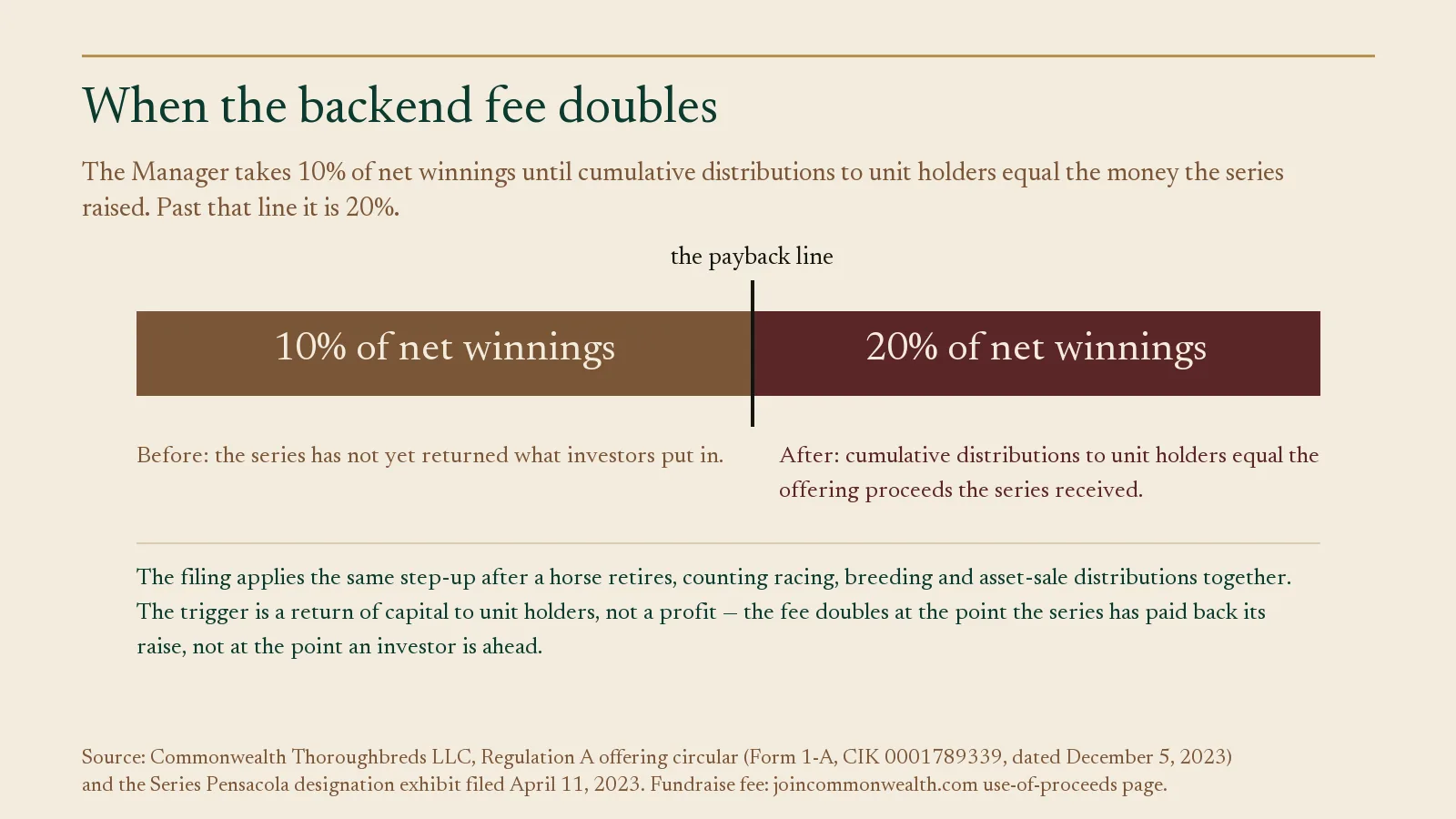
Commonwealth’s Manager takes “a fee equal to 10% of net winnings after fees customarily withheld” from purses, and that rate doubles to 20% once cumulative distributions to unit holders equal the offering proceeds the series received. The trigger is a return of capital, not a profit. The rate steps up at the moment the series has handed back what it raised — not at the moment an individual investor is ahead on their own position.
The Series Pensacola exhibit applies the same step-up after a horse retires, with breeding distributions counted alongside racing and asset-sale distributions toward the same threshold. For most series this fee never reaches 20%, because most racehorses never return their purchase price. That is the honest reading, and it cuts in Commonwealth’s favor as much as against it: a backend rate you are unlikely to trigger is a smaller real cost than a front-loaded one you pay on day one.
Where the 10% becomes 20%
The rates are in the SEC filing, not on the page that explains your money
Commonwealth’s use-of-proceeds page names eleven line items a share is divided into, and attaches a rate to none of the manager’s fees. The list is genuinely useful for understanding the shape of an offering — Asset Purchase Price, Working Capital Reserve, Race Training Expenses, Racehorse Management Fees, a Fundraise Fee and six more — and it states the reserve horizon plainly: “Working capital reserves include 24 months of projected training expenses.” What it never gives is a percentage for the sourcing fee, a percentage for the management fee, or any mention of the manager’s share of winnings. “Racehorse Management Fees” appears as a label with no rate attached.
RHO101 original analysis: I read Commonwealth’s use-of-proceeds page and its December 2023 offering circular side by side this week and mapped which of the figures a buyer needs appears in which document. The three percentages that determine what the manager is paid are in the SEC filing and absent from the marketing page; the 24-month reserve horizon that frames the whole offering is on the marketing page. Neither document is wrong. They are simply answering different halves of the same question, and a buyer who reads only the friendlier one will not find the rates.
The same questions, asked of both documents
| What a buyer wants to know | Commonwealth’s use-of-proceeds page | The Regulation A offering circular |
|---|---|---|
| The sourcing fee rate | Not stated | “up to 15% of the purchase price of the Series Asset” |
| The management fee rate | “Racehorse Management Fees” named, no rate given | “10% of the amount of the reserves for training expenses” |
| The manager’s share of winnings | Not stated | 10% of net winnings, rising to 20% at the payback line |
| The price of a unit | Not stated | “The price per Unit is $50.00 for all Series” |
| The reserve horizon | “24 months of projected training expenses” | Not located in the sections I read |
| The fundraise fee | 10% of the asset’s value, plus securities equal to 2% of those sold | Not located in the sections I read |
How this differs in structure from MyRacehorse
Commonwealth and MyRacehorse charge on different bases: Commonwealth’s headline fees attach to the horse’s purchase price and the training reserve, MyRacehorse’s to the proceeds of the offering itself. That is the structural difference worth holding onto, and it makes the two fee stacks genuinely hard to rank. This page does not try — if you want the disclosures set against each other, our MyRacehorse and Commonwealth comparison does that job, and the MyRacehorse fee breakdown walks that operator’s filing the way this page walks Commonwealth’s. Both sit under our running audit of syndicates that advertise no management fee, which is where this pattern keeps surfacing: the fee you are not billed for is the one you have to go looking for.
The honest edges of this analysis
Every figure above was read this week from two Commonwealth SEC filings and one Commonwealth web page, and quoted rather than paraphrased wherever a rate is involved. Four limits are worth stating plainly before you rely on any of it.
- The circular is dated December 5, 2023, and is marked preliminary. Its cover reads “SUBJECT TO COMPLETION” — these are the terms as proposed in that document, and it is the most recent Form 1-A filing on the issuer’s EDGAR docket. Check the issuer’s filing history and read the circular for the series you are actually buying.
- I did not read the circular end to end. It runs to roughly 287,000 characters and I read the first third — the cover, series tables, glossary, offering summary and part of the risk factors. Where this piece says a figure was “not located,” that means not located in those sections, not that it is absent from the document.
- These are authorized rates, not confirmed charged rates. The sourcing fee is written as a ceiling (“up to 15%”). I could not reach the per-series Use of Proceeds tables that would show what each series was actually charged, so nothing here claims the ceiling is the rate.
- The two filings differ slightly on one base. The December 2023 circular puts the 10% management fee on “the reserves for training expenses”; the April 2023 Series Pensacola exhibit puts it on the training reserve and the working capital contingency together. The rate matches; the base is worded differently.
Questions owners ask
Is the 15% taken out of my share price?
Not directly. The sourcing fee is calculated as up to 15% of the horse’s purchase price, then paid to the Manager out of the offering proceeds at closing — the pooled money raised from everyone in the series. Your $50 unit is a slice of that pool, so you fund a proportional share of the fee without ever being billed for it separately. The percentage and the thing it is charged on are two different numbers, and conflating them is the most common mistake I see in fractional ownership.
Does Commonwealth send monthly training bills?
No. Training is funded from a working capital reserve raised up front, which Commonwealth’s use-of-proceeds page describes as covering 24 months of projected training expenses. The manager’s 10% training management fee is drawn from that reserve rather than invoiced. Commonwealth states that unused reserve funds are returned to investors and that it never has access to them, so the absence of a monthly bill is real — it is not the same as the absence of a fee.
When does the 10% on winnings become 20%?
When the series has paid back its raise. The filing sets the step-up at the point cumulative distributions to unit holders equal the offering proceeds the series received, counting racing and asset-sale distributions — and, after retirement, breeding distributions as well. Because most racehorses never return their purchase price, most series will never cross that line, which makes the 20% rate less consequential in practice than the fees charged at closing.
About the Author

Calvin Johnson is a Thoroughbred racehorse owner, day trader, and independent racing analyst with more than a decade of firsthand ownership experience. He has participated in nearly every common structure in horse racing — fractional platform shares, traditional syndicates, LLC partnerships, claiming ventures, and outright ownership — across more than two dozen horses. Calvin writes about racehorse ownership the same way he approaches markets: by studying risk, incentives, fees, and whether the people controlling the deal are aligned with the investors behind it.
- Calvin Johnsonhttps://racehorseownership101.com/author/calvin-johnson/

- Calvin Johnsonhttps://racehorseownership101.com/author/calvin-johnson/

- Calvin Johnsonhttps://racehorseownership101.com/author/calvin-johnson/
- Calvin Johnsonhttps://racehorseownership101.com/author/calvin-johnson/
