
The Breeders’ Cup Challenge Series is a slate of 95 qualifying races in 14 countries whose winner earns an automatic berth — a guaranteed starting position — in the corresponding Breeders’ Cup World Championships race, and Breeders’ Cup has put up a record $6.5 million in free entry fees across the 2026 series. What a berth does not do is make the campaign free. The horse still has to have been nominated ($400 for a foal nomination filed on time, $1,500 once the late window opens), and the extra starts, shipping and race-day bills needed to reach a Challenge race land on top of the $50,000 to $90,000 a year it already costs to keep one thoroughbred in training in the United States. The Challenge Series changes which race you point at. It does not change what the year costs.
The honest answer, in three lines
- A Challenge win buys the berth and the entry fee. It does not buy the season it took to earn them.
- The nomination clock and the pre-entry clock are two different clocks, and they govern two different horses.
- Breeders’ Cup does not publish its per-race pre-entry and entry amounts on any public page. A partnership budgeting for a berth has to ask for that number.
What the Breeders’ Cup Challenge Series actually is
The Breeders’ Cup Challenge Series is a global qualifying program in its 20th year: win one of the 95 designated races on the 2026 schedule and your horse holds a guaranteed starting position in the matching Breeders’ Cup race. The races run across 14 countries on five continents — Argentina, Canada, Chile, England, France, Ireland, Japan, Peru, Saudi Arabia, South Africa, South Korea, the United Arab Emirates, the United States and Uruguay. Breeders’ Cup markets it as “Win and You’re In,” and the shorthand is accurate as far as it goes: the winner is in, without going through the usual scramble for a spot in a field that fills on merit and preference. For 2026 the organisation has allocated a record $6.5 million in free entry fees across the series, and horses finishing first, second or third in designated races earn a tiered bonus bankroll usable toward pre-entry and entry fees, with more than $525,000 in free entry fees available to program participants.
The billionaires would prefer you didn’t know this.
You can own a racehorse with a group of people just like you — and the insiders wrote down how. Free guide, ten minutes.
That is the industry’s account of the program, and none of it is misleading. The part nobody publishes is the owner’s side of the ledger: what it costs to put a horse in a position to win one of those 95 races, and whether the money the berth saves is large or small against the money the attempt spends. That is the calculation this piece runs.
What a “Win and You’re In” berth actually buys
A Challenge Series win buys two things: a guaranteed starting position in the corresponding Breeders’ Cup race, and the entry fee that would otherwise fall due to take it. Everything else about the horse’s year is unchanged.
The distinction matters because the berth is the cheap part of the exercise. Breeders’ Cup is paying the fee at the end of the road; the owner is paying for the road. A horse that wins a Challenge race in September has already been kept in training all year, shipped to wherever the qualifier was run, and started often enough for a trainer to know it belonged in that race. None of that is covered.
What the berth does not carry:
- Eligibility. A Challenge win does not nominate an un-nominated horse. Nomination is a separate transaction with its own deadlines, covered below.
- Pre-entry. The published figure is free entry fees. Pre-entry is a distinct step with its own earlier deadline, and the public announcements do not describe it as waived.
- The campaign. Training, veterinary work, farrier, shipping and race-day costs bill exactly as they would if the horse had never gone near a Challenge race.
There is also a gap worth naming plainly. Breeders’ Cup publishes the deadlines for pre-entry and entry, but its public eligibility and fees page does not list the per-race amounts; those sit in the Pre-Entry Guide issued to horsemen. So the headline number — millions in free entry fees — is public, while the figure it is freeing you from is not. An owner cannot size the benefit from the public record alone, which is a strange place for the sport’s most-promoted qualifying program to leave a prospective partner.
What it costs to make a horse eligible in the first place
Breeders’ Cup eligibility starts at $400 per foal if the nomination is filed on time and rises to $1,500 in the late window — a small number in the context of a racing stable, and one of the easiest expensive mistakes in the sport to make by inattention.
Two separate clocks govern this, and conflating them is the easiest mistake to make about Breeders’ Cup eligibility. The nomination clock applies to a foal — a horse in its first months of life, years before anyone knows whether it can run. The pre-entry and entry clock applies to the horse you are campaigning right now. Missing the first is a problem you cannot fix cheaply in year four; missing the second is a problem you cannot fix at all.
Two Breeders’ Cup deadline clocks, side by side
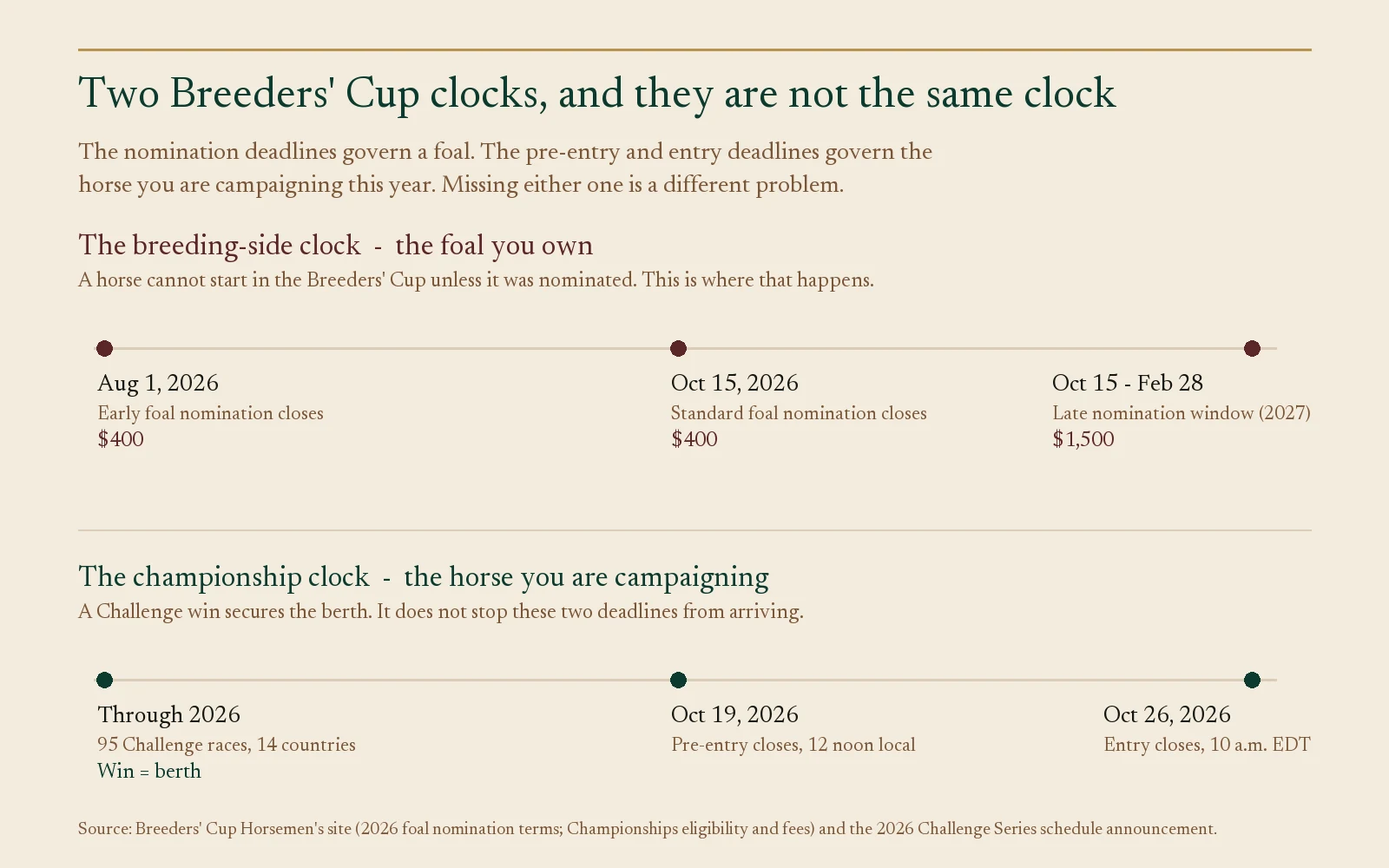
If you are buying rather than breeding, the practical move is to confirm nomination status before money changes hands. A horse by a nominated stallion whose foal fee was paid on time is eligible on the cheapest terms available; a horse that slipped into the late window cost someone $1,500 instead of $400, and a horse never nominated at all is a different conversation entirely. The Breeders’ Cup horsemen’s nomination pages are the authority on where a given horse stands.
One change is worth knowing if you are breeding at the lower end of the market. BloodHorse reported that beginning with the 2027 foal crop, foals sired by North American nominated stallions standing for an advertised fee of $5,000 or less will be assigned a $200 nomination fee — half the current $400. That is a real reduction aimed squarely at the commercial breeder who is not operating at stallion-book prices.
What the Breeders’ Cup nomination and entry stack costs
| Item | Deadline | Cost | What it does |
|---|---|---|---|
| Early foal nomination | Aug 1, 2026 | $400 | Nominates a 2026 weanling entered in a fall or winter stock sale |
| Standard foal nomination | Oct 15, 2026 | $400 | Nominates a 2026 foal on standard terms |
| Late foal nomination | Oct 15, 2026 – Feb 28, 2027 | $1,500 | The same eligibility, at 3.75 times the on-time price |
| Stallion nomination | Annual | Advertised stud fee, minimum $1,000 | Paid by the stallion’s owner; keeps the sire’s foals on standard terms |
| Championships pre-entry | Oct 19, 2026, 12 noon local | Not published publicly | Declares the horse for a Championships race |
| Championships entry | Oct 26, 2026, 10 a.m. EDT | Not published publicly | Passes the box at the Breeders’ Cup Racing Office, Keeneland |
The costs a berth does not cover
A horse aimed at a Challenge race costs the same $50,000 to $90,000 a year to keep as any other thoroughbred in full US training, and the qualifying attempt adds starts and shipping on top of that baseline rather than replacing any part of it.
Our sourced breakdown of what a racehorse costs to own for a year puts the working band at $50,000 to $90,000, with the trainer’s day rate running from about $40 a day at a small track to $125 at the top of the New York and Southern California meets. On the month, the line-item view of what a thoroughbred costs to keep lands at roughly $2,000 to $5,000. Those are the numbers a Challenge campaign is built on top of, not instead of.
The day rate is the largest single line in a campaign budget, and it does not pause between qualifying attempts. A horse pointed at a Challenge race in October is being paid for in March.
What the qualifying path genuinely adds is three things. Extra starts, because a horse rarely wins a graded qualifier off a light schedule and each prep carries its own race-day expenses. Shipping, because the 95 Challenge races are spread across 14 countries and the right one is often not at your horse’s home meet — and shipping is the line with the least honest public data behind it, with West Point Thoroughbreds’ published figure of roughly $2,000 a year one of the few clean benchmarks anywhere in the sport. And stakes fees, which our annual breakdown describes as optional exposure running from a few thousand dollars for a mid-tier stakes to $50,000 or more for a Breeders’ Cup-class target.
A worked example: three extra starts chasing points
Three extra starts on a qualifying path adds somewhere between roughly $10,500 and $44,800 to a year, depending almost entirely on the circuit and how ambitious the stakes targets are.
Consider an owner with a lightly raced four-year-old that has won an allowance race and looks better than its record. The trainer’s view is that the horse wants a mile on turf and could be competitive in a Challenge qualifier in the autumn. Getting there means three more starts than the horse would otherwise have made: a prep, a graded attempt that does not go to plan, and the qualifier itself. The horse stays in the race barn through all of it rather than going to the farm.
The table below models that decision from published cost ranges rather than from any single owner’s bill. The lean column runs the smaller-circuit end of every range; the expensive column runs the New York and Southern California end with genuinely ambitious stakes targets. Real campaigns land between them.
What three extra Challenge starts add to a year of carry
| Line | Basis | Lean campaign | Expensive campaign |
|---|---|---|---|
| Three more months in a race barn | $50–$120 per day, per Thoroughbred OwnerView | ~$4,500 | ~$10,800 |
| Non-training stack, three months | $1,000–$3,000 per month — vet, vanning, farrier, race-day — per BloodHorse’s OwnerView accounting panel | ~$3,000 | ~$9,000 |
| Stakes nomination and entry fees | A few thousand for a mid-tier stakes; $50,000+ for a Breeders’ Cup-class target | ~$3,000 | ~$25,000 |
| What the chase adds | ~$10,500 | ~$44,800 |
Set that against what winning actually returns. Purse money reaches an owner net of two commissions, and the headline number is never the number that arrives: as our breakdown of what racehorse owners actually make lays out, the winner’s share is roughly 60 percent of the purse, and the trainer’s 10 percent and the jockey’s 10 percent come out of that — so a $50,000 race won leaves the owner with about $24,000 before a single training bill is settled. On the lean end of the model above, one won prep roughly pays for the chase. On the expensive end, it does not come close.
What Breeders’ Cup pays back, and what it doesn’t
Breeders’ Cup pays a starter travel award of $10,000 for North American starters and $40,000 for international starters, which is real money and materially smaller than the year of training that produced the starter.
The travel award against a year of training
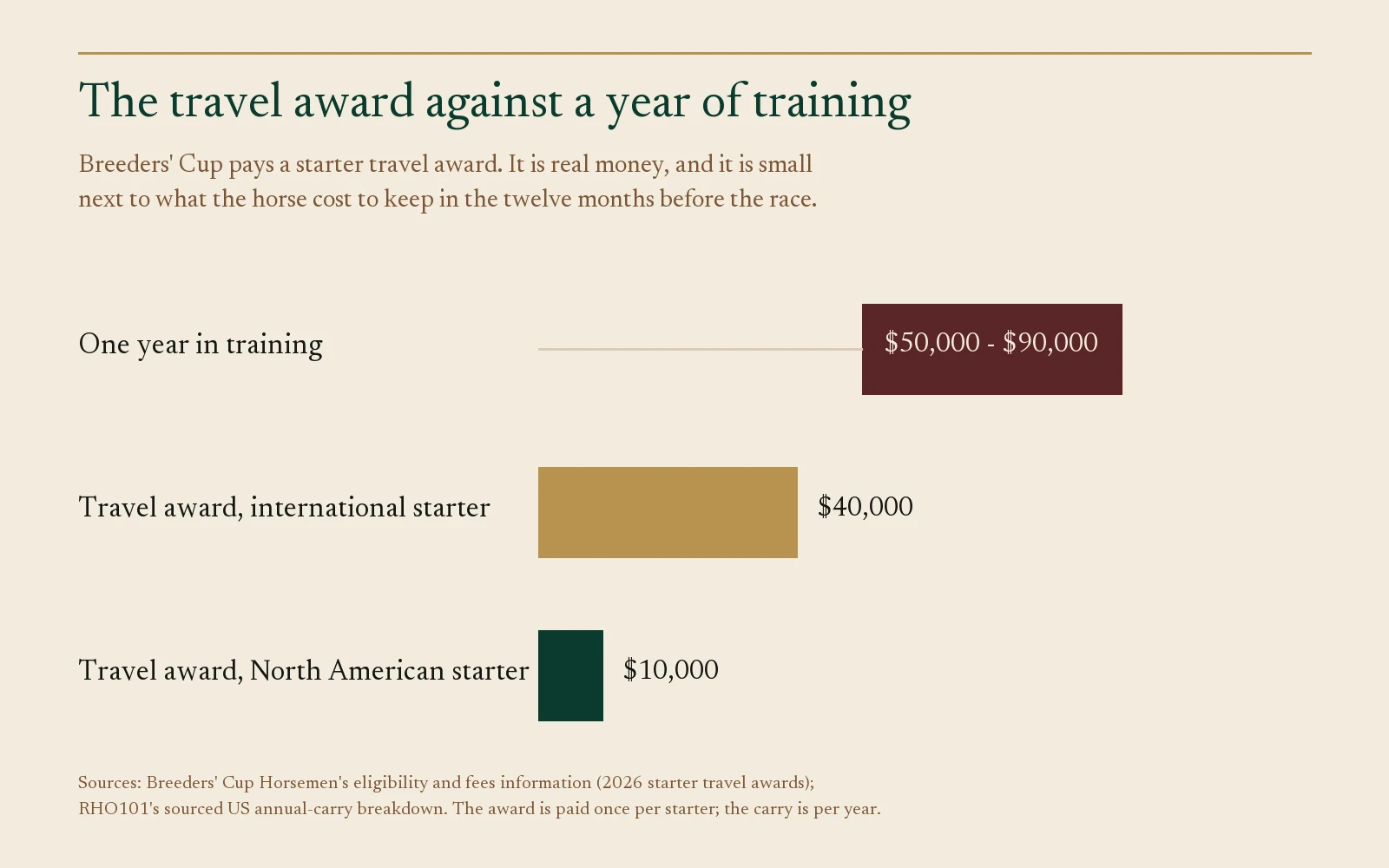
We are not making the case that these programs are stingy. The travel award, the free entry fees and the tiered bonus bankroll are genuine subsidies, and $40,000 toward an international shipping bill changes what is possible for a European or Japanese owner. The case we are making is narrower: none of it is scaled to the cost of the campaign, so an owner who treats a berth as a break-even event has mis-sized the problem by an order of magnitude. The support is a discount on the last transaction, not a contribution to the season.
What to tell your partners before you chase points
A partnership should agree the extra spend before the trainer suggests a qualifier, because once a horse looks live the conversation stops being financial and starts being emotional.
Look at your own partnership agreement. It will set out a training budget and a mechanism for capital calls. Whether it says anything about campaign ambition is the open question, and in a great many agreements the answer is nothing at all — which is the gap a Challenge chase falls into. A trainer proposing three additional starts is proposing a five-figure decision, and in most partnerships nobody has decided in advance who gets to make it.
The questions worth settling in writing, before the horse is good:
- Is the horse nominated to the Breeders’ Cup, and if not, what would it cost to make it eligible now?
- What is the ceiling on stakes nomination and entry fees for the year, as a number rather than a principle?
- Who authorises an out-of-state or overseas start, and at what shipping cost?
- If the chase requires a capital call, what happens to a partner who declines it?
- What result ends the attempt — a finishing position, a date, or a spend?
The honest bottom line. The fifth question is the one partnerships skip and the one that costs them. An attempt with no stated stopping condition does not stop; it runs until the money or the horse gives out, and both of those are worse endings than a number agreed in March.
When the Challenge path is rational, and when it isn’t
Chasing a Challenge berth is rational when the horse would be running in graded company anyway, and irrational when the qualifying attempt is what puts it there.
That test does most of the work. If a trainer already had the horse pointed at a graded stakes on turf in September, running that race as a Challenge qualifier costs nothing extra and carries a free option on a berth. The berth is a bonus attached to a decision made on the horse’s merits. Take the option every time.
The other case is the expensive one. A horse that needs three additional starts, a shipping campaign and a stakes budget to reach a race it would not otherwise have contested is being asked to earn its way into a field on the owner’s money rather than on its form. Sometimes that works, and the horses it works for are memorable. It is still a poor default, and it becomes a worse one in a partnership where the people writing the cheques are not the person watching the works.
The narrower version of the question — is this horse good enough — is the one to keep asking, because the Challenge Series does not change the answer. It only changes what a yes is worth.
Questions owners ask about the Challenge Series
Does winning a Challenge race guarantee my horse a Breeders’ Cup start?
Winning a Challenge Series race earns an automatic berth — a guaranteed starting position in the corresponding Breeders’ Cup World Championships race — provided the horse is nominated and is pre-entered and entered by the deadlines. For 2026 those deadlines are 12 noon local time on October 19 for pre-entry and 10 a.m. EDT on October 26 for entry. The berth removes the uncertainty about getting into the field; it does not remove the paperwork.
How much does it cost to nominate a horse to the Breeders’ Cup?
A foal nomination costs $400 filed by the standard deadline of October 15, 2026, or by the early deadline of August 1, 2026 for weanlings entered in a fall or winter stock sale. Nominations made in the late window from October 15, 2026 through February 28, 2027 cost $1,500. Separately, a stallion’s owner pays an annual nomination fee equal to the advertised stud fee, with a minimum of $1,000, which is what keeps that sire’s foals on standard terms.
What are the Breeders’ Cup pre-entry and entry fees?
Breeders’ Cup does not publish per-race pre-entry and entry amounts on its public eligibility and fees page; those figures are issued to horsemen in the Pre-Entry Guide. If you are budgeting a campaign or evaluating a partnership’s projections, ask your trainer or the Breeders’ Cup racing office for the current schedule rather than working from an estimate. Any figure you find quoted secondhand should be treated as unverified until it comes from that document.
Is a Breeders’ Cup berth worth chasing for a small partnership?
For most small partnerships, chasing a berth is worth it only when the horse was already campaigning at that level. The qualifying attempt itself adds roughly $10,500 to $44,800 to a year on our modelling of published cost ranges, while the direct support — free entry fees and a starter travel award of $10,000 domestically or $40,000 internationally — is sized to the final transaction rather than the season. Where the horse belongs in graded company on form, the option is close to free and worth taking.
The Challenge Series is a well-built program that does what it says. The mistake is reading a free entry fee as a free campaign, and the cost of that mistake is a year of day rates nobody budgeted for.
About the Author

Calvin Johnson is a Thoroughbred racehorse owner, day trader, and independent racing analyst with more than a decade of firsthand ownership experience. He has participated in nearly every common structure in horse racing — fractional platform shares, traditional syndicates, LLC partnerships, claiming ventures, and outright ownership — across more than two dozen horses. Calvin writes about racehorse ownership the same way he approaches markets: by studying risk, incentives, fees, and whether the people controlling the deal are aligned with the investors behind it.
- Calvin Johnsonhttps://racehorseownership101.com/author/calvin-johnson/

- Calvin Johnsonhttps://racehorseownership101.com/author/calvin-johnson/

- Calvin Johnsonhttps://racehorseownership101.com/author/calvin-johnson/

- Calvin Johnsonhttps://racehorseownership101.com/author/calvin-johnson/