Last updated: November 18, 2026
Whether a state-bred horse is worth paying more for comes down to one question the sale catalogue never answers: does that state’s program pay the owner, or somebody else? Kentucky’s most-quoted state-bred figure, $20,000,227.81 for the 2025 race year, is breeders’ money. Owners in Kentucky are paid from a second fund that publishes no annual total at all. Indiana repealed owner awards in 2010 and offers 374 restricted races in their place for 2026. Illinois floors designated open races at a minimum +40% of the purse; Ohio pays a flat $10,500 / $3,000 / $1,500; neither figure converts into the other. A premium is arithmetic when the published mechanism pays you, in races your horse can reach, in a unit you can price. Otherwise it is a contribution to somebody else’s award.
The short version
- A state-bred premium is only owner money where the state’s own fund or statute says owners are paid. In several states the published figure goes to the breeder, and in several more no owner figure is published at all.
- Kentucky is the trap case. KBIF paid $20,000,227.81 for the 2025 race year and pays breeders; KTDF is the owners’ fund, and it publishes no annual total.
- Indiana repealed owner awards in 2010. What an Indiana-bred buys an owner now is a restricted-race calendar — 374 races scheduled for 2026 — not an award.
- Illinois, Ohio, Iowa and New York all publish owner figures, in four different units. There is no honest exchange rate between a percentage floor, a flat dollar and a capped award.
- Three questions settle it: does the program pay owners, in which races, and in what unit. A premium that cannot answer all three is being paid for eligibility, not for money.
The short answer: who gets paid decides whether the premium is rational
A state-bred horse is worth paying more for when the state publishes an owner figure you can price, and is not when it publishes a breeder figure, a figure for races your horse will never enter, or no figure at all. Those are the three failure modes, and each one is visible on a commission or fund page before you bid. Kentucky’s KBIF pays breeders; Idaho pays the breeder 10% of the first-place purse; Kansas authorises supplements and publishes no owner percentage. New York pays owners 20% of the purse share for NY-sired horses, but only in open races with a $30,000 claiming floor, and nothing at all to owners in its restricted ones. The designation is the same word in every catalogue. The money behind it is not the same product.
The Sport of Kings has a side entrance. Here’s the key.
Regular people own racehorses — together, in partnerships — and stand in the paddock like they were born there. The free guide shows you the way in.
The agreed part is not in dispute, and I will put it plainly before I complicate it: most US racing states run a breeders’ or development fund that adds money to races for horses bred in that state, and in most of those states some of that money reaches owners. The commissions say so on their own pages, and a seller quoting it is quoting something real. What no commission publishes is the shape of the money in the state next door, which is where a buyer’s assumption quietly forms.
My own habit costs about ten minutes: before I let a state-bred designation move a price, I open the fund’s own page and find the sentence naming who receives the award — not the association’s summary, not the consignor’s note in the catalogue. If you are still working out which ownership structure you want at all, our guide to every ownership path puts a purchase premium back in the context of the whole transaction.
Kentucky is two funds, and only one of them is yours
Kentucky runs two separate state-bred programs, and the one that pays owners is not the one with the famous number. The Kentucky Thoroughbred Development Fund (KTDF), established under KRS 230.400, is a purse supplement: the fund adds money to races at Kentucky tracks, and the owner collects it as part of the purse. The Kentucky Breeders’ Incentive Fund (KBIF) is a different program with a different beneficiary. Its 2025 race-year awards came to $20,000,227.81, announced by the racing commission on 13 February 2026, and every dollar of it went to breeders.
That $20 million is the figure a buyer is most likely to have heard, and it is the figure least likely to reach them. A yearling bought at a premium because Kentucky pays well is a yearling bought on KBIF’s reputation and KTDF’s terms. KTDF’s terms are thinner than they sound: the split across finishing positions is proposed by the track rather than fixed by the fund, the Kentucky Thoroughbred Association’s 60/20/10/5/3/2 is a worked example rather than a mandate, and the fund publishes no annual total, so there is no pot size to reason from. And the Kentucky Thoroughbred Association’s own FAQ states there is no restricted Kentucky-bred racing, so the third source of state-bred value does not exist in Kentucky at all.
The two Kentucky funds are routinely spoken of as one program. They have different beneficiaries, different statutes and different published totals, and only one of them has your name on it.
The three questions a premium has to answer
Three questions decide whether a state-bred premium is a calculation or a guess: does the program pay the owner, in which races does it pay, and in what unit is it paid. All three are answerable from public pages before you bid.
Three questions before you pay a state-bred premium
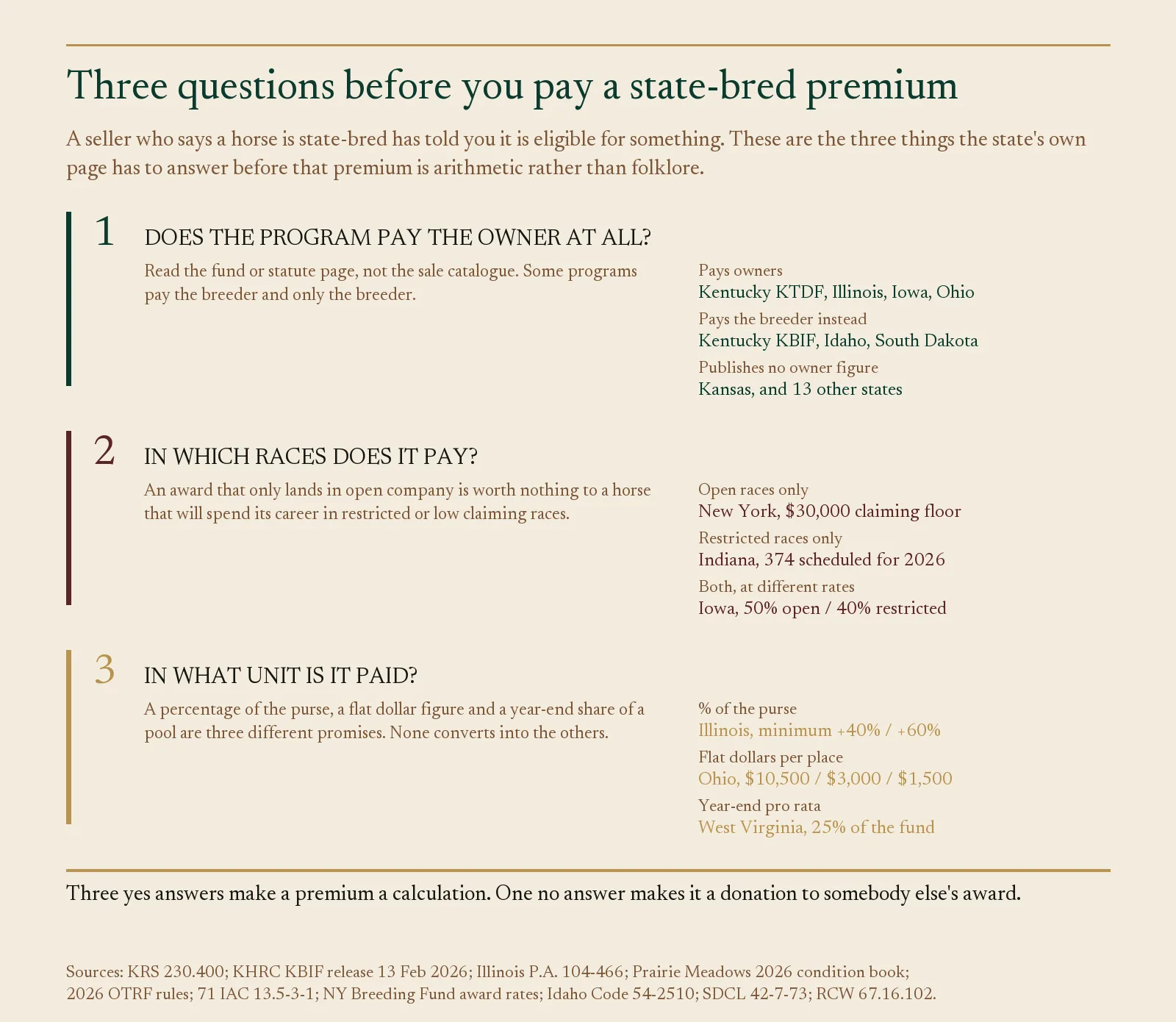
That rule is RHO101 original analysis, drawn from our own survey of state-bred incentive programs across the 32 US racing states, sourced on 26 October 2026 from each state’s commission, fund or statute pages. The method is deliberately dull: every cell traces to one state’s own document, no figure is carried from one state to another, and where a state’s own sources disagree the disagreement is recorded rather than resolved. Its honest edge is that 14 of the 32 states run a program without publishing an owner figure — which is why this is a decision rule and not a national ranking.
When there is no owner award at all
Indiana is the cleanest example of a state-bred designation that pays the owner nothing directly: 71 IAC 13.5-3-1 repealed Indiana’s owner awards in 2010. Sixteen years later the designation is still sold, and it still carries real value — but the value is a calendar rather than a cheque. Indiana scheduled 374 restricted races for 2026, 144 for Indiana-sired horses and 230 for Indiana-breds, with elevated overnight purses. That is worth something to a horse that can win them and nothing to one that cannot.
Four places the published figure is not the owner’s
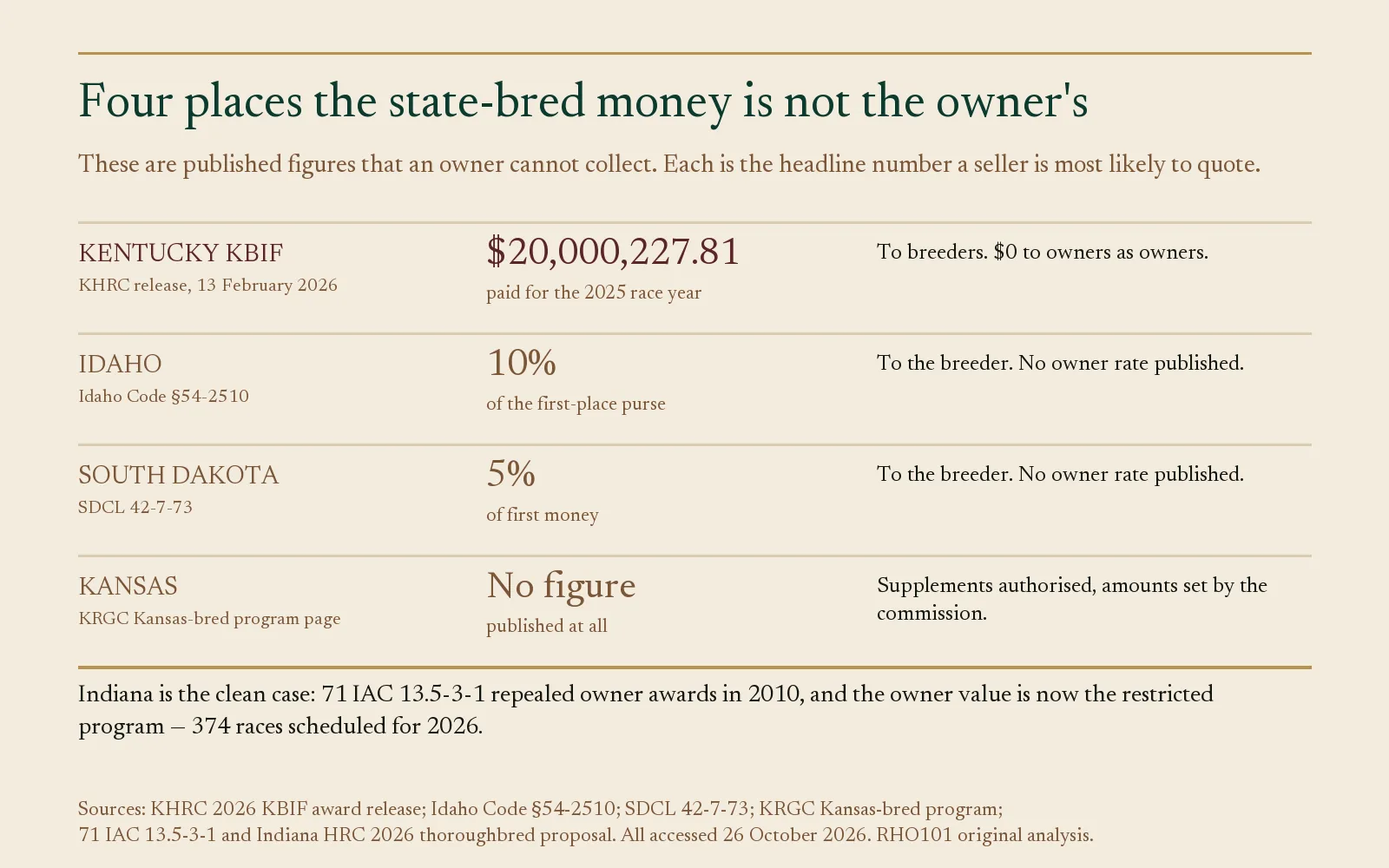
Consider an owner who pays twenty per cent over the open-market price for an Idaho-bred filly on the strength of a line about the state paying ten per cent. Idaho Code §54-2510 does pay ten per cent of the first-place purse — to the breeder. South Dakota’s SDCL 42-7-73 pays the breeder five per cent of first money on the same pattern. Kansas authorises purse supplements and leaves the amounts to the commission without publishing a percentage. In each case the premium bought a real program, correctly described, that does not pay the person who paid the premium.
The published numbers are not the same kind of number
Even among the states that do pay owners, the published figures cannot be ranked against one another, because they are not measured in the same thing. A percentage floor on a purse, a flat dollar amount per finishing position, a rate that changes with race type and a capped award are four different promises, and the premium one of them justifies is not the premium another justifies.
The unit you are buying, state by state
| State | What the published owner figure is | What it is not |
|---|---|---|
| Illinois | A minimum percentage floor on designated open races: +40% for Illinois-foaled and +60% for Illinois conceived-and-foaled, 1st–3rd (P.A. 104-466, effective 16 June 2026). | Not a fixed sum. The money scales with the purse, so a cheap race adds little. |
| Ohio | Flat dollars by finishing position: $10,500 / $3,000 / $1,500 in accredited non-claiming races, $15,000 per race (2026 OTRF rules). | Not a percentage. A rich purse does not enlarge it, and a modest one does not shrink it. |
| Iowa | A supplement 1st–4th at 50% in open races and 40% in restricted ones (Prairie Meadows 2026 condition book), stated as subject to adjustment. | Not fixed for the season. The condition book reserves the right to move it. |
| New York | 20% of the purse share for NY-sired horses 1st–3rd, capped at $20,000; 10% if not NY-sired, same cap. Open races only, $30,000 claiming floor. | Not available in restricted races, where owners receive nothing, nor below the claiming floor. |
Those four are an illustration, not the map. The owner side of all 17 states that publish a figure, each with its own program year attached, sits in our state-by-state table of what each state pays the owner — a reference, not a league table.
What a purchase premium can and cannot buy
A state-bred premium buys one of three things, and knowing which one is the whole of the decision: access to restricted races, a supplement or award in open company, or a year-end share of a pool. Each has a different risk attached, and only the second pays anything like the way a buyer imagines it will.
Three things a state-bred premium can buy, and what each is worth
| What the premium buys | Where it shows up | What it is honestly worth |
|---|---|---|
| Restricted-race access | Races only state-breds may enter. Indiana scheduled 374 for 2026; New York ran 548 at NYRA in 2024 against more than $41.1M of restricted purses in 2025. | Worth the softer company, and nothing more. Kentucky runs no restricted races at all, so a KY-bred premium buys none of this. |
| An open-race supplement or award | Illinois’ +40% / +60% floor, Ohio’s $15,000 per accredited non-claiming race, New York’s 20% capped at $20,000. | The only one that pays like a cheque — but only on a result, and New York’s version stops below a $30,000 claiming floor. |
| A year-end share of a pool | West Virginia pays owners 25% of the fund pro rata, capped at 35% of that horse’s accredited earnings and counting only the first $100,000 of a purse. Washington divides 1% of in-state parimutuel receipts; its 2025 pool was $368,301.44 at an allocation factor of 20.62%. | Unknowable when you bid. The figure is not set until the meet is counted. |
Put against a purchase price, the asymmetry is the point. An open-race award is the only one of the three a buyer can price before bidding, and even then only conditional on winning or placing. Restricted access is a probability, not a payment. A pool share is a number that does not exist yet. A premium justified by the second is defensible; a premium justified by the first or third is a bet on a bet, and the seller is not the one carrying it.
What this does not say
This piece does not name a best state to buy a state-bred in, because 14 of the 32 US racing states publish no owner figure at all and the 17 that do publish it in units that have no exchange rate. The limits are part of the analysis, and I would rather state them than let a reader over-read it.
- There is no best state here, and there is no honest way to produce one. Percentages, flat dollars, pool shares and point values do not average, and 14 of the 32 racing states publish no owner figure at all.
- Every figure above is stamped to the program year its state published. Illinois, Ohio, Iowa, Minnesota, Maryland, Florida, California and Kentucky all carry 2026 effective dates, and any of them can restate.
- Partial states are named, not glossed. Pennsylvania, Louisiana, New Jersey, Virginia, Nebraska, Arizona, Arkansas, Colorado, Idaho, Kansas, Montana, Nevada, Oregon and South Dakota each run a program without a published owner figure, and a missing cell has not been filled by inference.
- Nothing here says buy a Pennsylvania-bred, or an Illinois-bred, or any other designation. This is a method for pricing a premium somebody has already quoted you.
- Eligibility is separate from paperwork. A horse can be a state-bred on the page and ineligible in fact, because several states set the deadline before the foal is born — Pennsylvania requires the dam in state from 1 December of the conception year, and Virginia from 1 September of the conception year through foaling for foals of 2024 onward. We are working on that subject separately.
Questions buyers ask about state-bred premiums
Five questions come up every time a state-bred premium is quoted at a sale, and each one is answered below from the relevant state’s own published figures rather than from the catalogue page.
Is a state-bred horse worth paying more for?
A state-bred horse is worth paying more for when the state publishes an owner figure, in races the horse can realistically enter, in a unit you can put against the price. Illinois, Ohio and Iowa publish owner money that meets that test. Kentucky’s headline $20,000,227.81 does not, because it is breeders’ money. Indiana publishes no owner award at all. The designation alone is not the answer; the state behind it is.
Who actually gets paid — the owner, the breeder or the stallion owner?
All three, in proportions each state sets for itself, and some states pay only the breeder. The clearest illustration is New York, which publishes the division: of $16,191,136 in 2025 awards, breeders took $12.0M, stallion owners $2.0M and owners $2.1M. An owner is one claimant on a fund, rarely the largest, and in Idaho and South Dakota not a claimant at all — both publish a breeder rate and no owner rate.
Does Kentucky pay owners or breeders?
Both, through two separate funds that should never be added together. KTDF supplements purses and so pays owners; KBIF pays breeders, and KBIF is the fund behind the $20,000,227.81 announced for the 2025 race year. KTDF publishes no annual total, which means a Kentucky owner premium cannot be sized from public figures the way a breeder’s can.
What happened to Indiana’s owner awards?
Indiana repealed them. 71 IAC 13.5-3-1 removed owner awards in 2010, and the state’s 2026 thoroughbred budget carries an open-races award line of $360,000 with no published percentage attached. What an Indiana-bred buys an owner today is the restricted program: 374 races scheduled for 2026, with elevated overnight purses and a three-pound allowance in open company.
Can you compare Illinois, Iowa and Ohio owner money directly?
No, and any source that ranks them is inventing an exchange rate. Illinois publishes a minimum percentage floor on the purse, Ohio publishes flat dollars per finishing position, and Iowa publishes a percentage that differs between open and restricted races and is marked subject to adjustment. The three can be compared on what they are — the unit, the race types, the conditions — but not on which is largest.
What to read next
If you want the numbers rather than the method, what each state actually pays the owner is the full 17-state table this piece draws on. If the premium came up at a sale rather than in a pedigree, the sale bonus schemes are a different pot of money with their own arithmetic. And if you are building a first-year budget rather than pricing a purchase, owner license fees by state covers the one commission cost every owner pays wherever the horse was foaled.
Every state figure on this page was read from that state’s own commission, fund or statute page on 26 October 2026 and carries the program year as the state published it. Race Horse Ownership 101 takes no money from breeders’ associations, syndicates, sale companies or racing commissions, and nothing here is a recommendation to buy in any state. It is a method for checking whether a premium somebody has quoted you is money or a story.
— Race Horse Ownership 101
About the Author

Calvin Johnson is a Thoroughbred racehorse owner, day trader, and independent racing analyst with more than a decade of firsthand ownership experience. He has participated in nearly every common structure in horse racing — fractional platform shares, traditional syndicates, LLC partnerships, claiming ventures, and outright ownership — across more than two dozen horses. Calvin writes about racehorse ownership the same way he approaches markets: by studying risk, incentives, fees, and whether the people controlling the deal are aligned with the investors behind it.
- Calvin Johnsonhttps://racehorseownership101.com/author/calvin-johnson/
- Calvin Johnsonhttps://racehorseownership101.com/author/calvin-johnson/
- Calvin Johnsonhttps://racehorseownership101.com/author/calvin-johnson/

- Calvin Johnsonhttps://racehorseownership101.com/author/calvin-johnson/