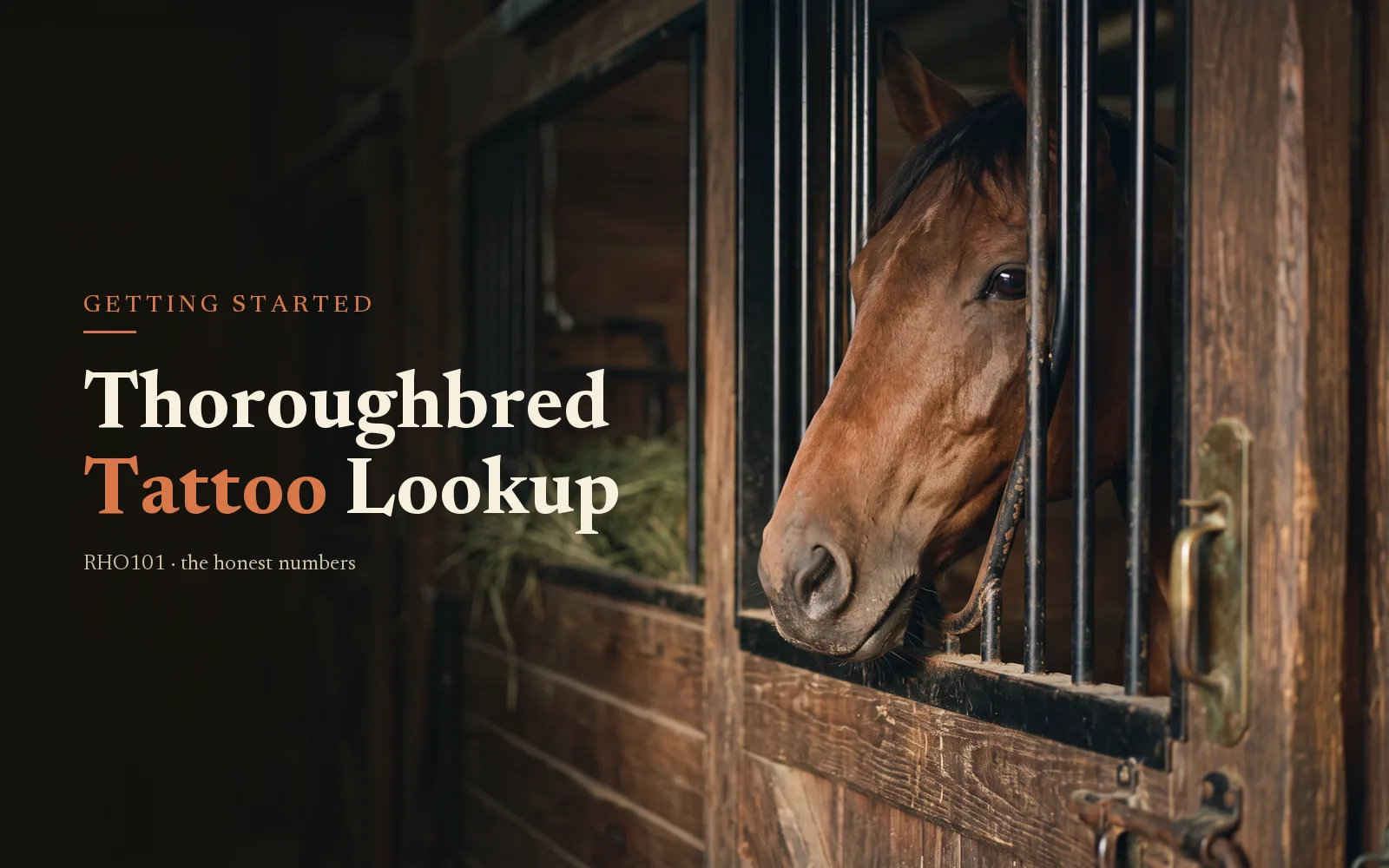
A Thoroughbred lip tattoo is a letter followed by a run of digits, inked inside the horse’s upper lip, and a Thoroughbred tattoo lookup through The Jockey Club is free. The letter stands for the year the horse was foaled; the digits identify the individual animal in the registry’s records. The part most guides leave out is what happens on a young horse: one foaled in 2017 or later may carry no lip tattoo at all, because The Jockey Club has required a microchip for registration since that foal crop. So the useful instruction is not “read the tattoo.” It is: identify the horse by whatever mark it actually carries, before a claim, a private purchase or an aftercare handover is final. A mark you cannot read is an ordinary outcome with a free remedy. A mark that contradicts the paperwork is a different problem, and it is the one worth stopping for.
The honest answer
- The lookup is free. The Jockey Club Registry runs a tattoo lookup for legible marks and a staffed research service for partial ones, both at no charge.
- An unreadable tattoo is normal. Ink laid into lip tissue years ago blurs and spreads, which is precisely why the free research service exists.
- No tattoo is not the same as no record. Foals of 2017 and later were registered with a microchip, so on a younger horse the identifier is under the skin, not inside the lip.
What a Thoroughbred lip tattoo actually is
A Thoroughbred lip tattoo is an identifier, not a decoration: a letter and a set of numbers applied inside the upper lip so that the horse racing under a name can be matched to the horse registered under that name. It exists because racing needed to be certain, at the gate, that the animal in the stall was the animal on the entry. Everything else it gets used for — an owner checking a claim, a buyer checking a private sale, an adopter tracing a race record — is a secondary use of a mark the sport created for its own integrity.
The Sport of Kings has a side entrance. Here’s the key.
Regular people own racehorses — together, in partnerships — and stand in the paddock like they were born there. The free guide shows you the way in.
That origin also tells you what the mark can and cannot do. It identifies which registered horse is standing in front of you. It says nothing about whether the horse is sound, whether the seller owns it outright, or whether the race record you were quoted belongs to the same animal. Identity is the first question in a purchase, not the whole of it — and it is the only one on the list with a free answer.
The three moments identifying the horse is your job
There are three moments in ownership when nobody else verifies the horse’s identity for you: claiming, a private purchase, and taking an off-track Thoroughbred home. I do not write a check on a horse I cannot identify, and the reason is not suspicion of anyone in particular. It is that in each of those three moments, the only person whose money is at risk is the one asking the question.
Claiming is the sharpest case, because the claim is committed before the race is run — you are buying on a slip you filed in advance, and the paddock is the last unhurried look you get. A private purchase off the farm removes the auction company, the repository and every other third party from between you and the seller’s account of the horse; the identifier on the animal and the name on the papers are what agree, or do not, before the money moves. And an off-track Thoroughbred usually arrives with a story attached, sometimes several handlers deep. The mark is what turns that story into a record.
The three moments an owner carries the identity check
n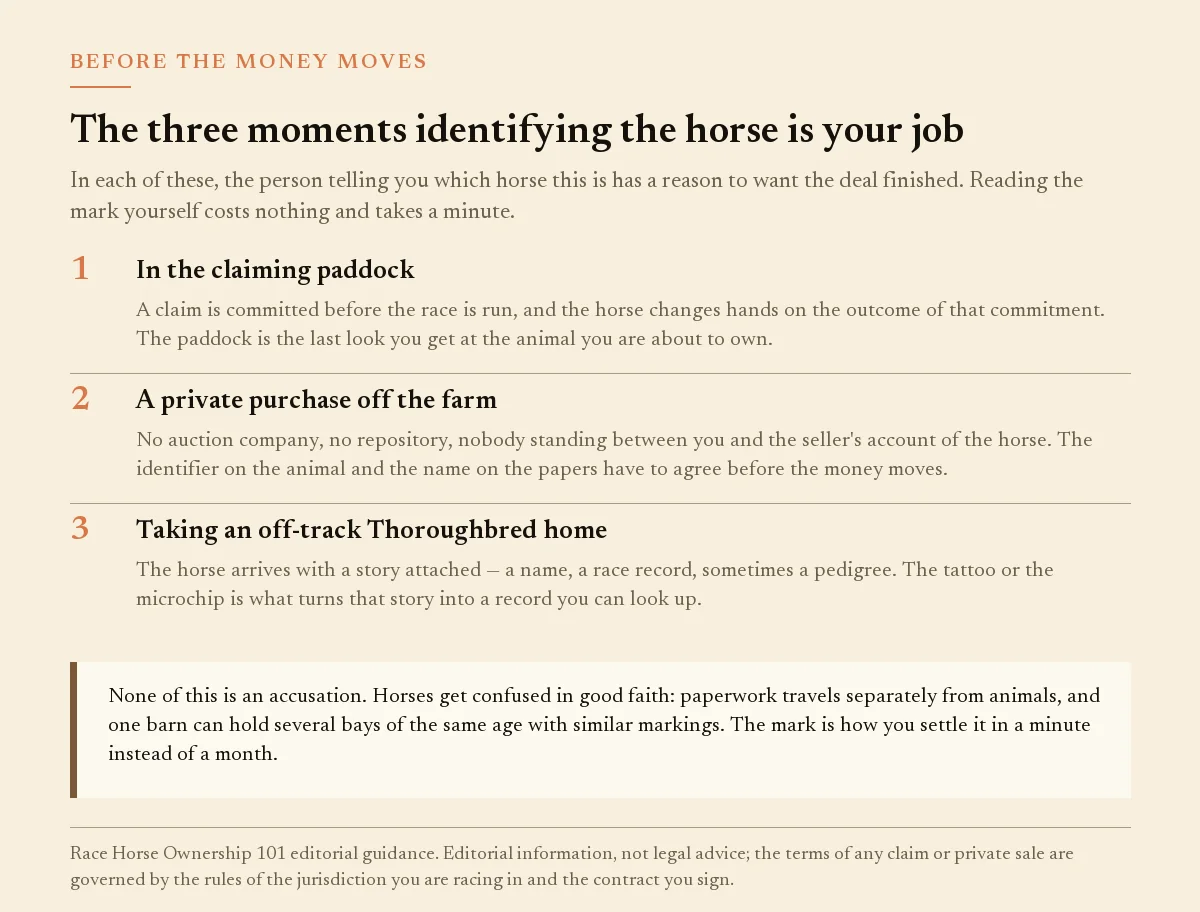
None of this assumes bad faith. Horses get confused innocently, and the identity check is how a genuine mix-up gets caught in a minute rather than surfacing a month later, after the horse is yours and the bill of sale is signed.
Lip tattoo, digital tattoo, microchip: which mark this horse carries
Which identifier a Thoroughbred carries depends mostly on when it was foaled, and the dividing line an owner needs is 2017. The Jockey Club announced in 2016 that microchips would be required for registration beginning with foals of 2017. Before that crop, the lip tattoo was the identifier a person could read without equipment. Since it, the identifier that matters most is a chip under the skin that no amount of squinting will reveal.
2017 — the foal crop from which The Jockey Club required a microchip for registration. A horse younger than that may have nothing in its lip at all.
The ink era also has a successor of its own. Lip tattooing at the racetrack has given way to a digital identification process run by the Thoroughbred Racing Protective Bureau, in which a technician validates the horse’s identity electronically rather than marking it — the Retired Racehorse Project’s guide to registering racehorses covers the transition from an aftercare reader’s point of view. For a buyer, the operational consequence of all of this is one sentence long: on a young horse, expect to find nothing in the lip, and plan to scan instead.
Three marks a horse can carry, and where each one is looked up
| The mark | Which horses carry it | How you read it | Where it is looked up |
|---|---|---|---|
| Lip tattoo | Thoroughbreds from the decades when ink was the racetrack standard | Roll back the upper lip and read the letter and digits by eye | The Jockey Club Registry — free tattoo lookup, plus free research for a partial mark |
| Microchip | Thoroughbreds registered from the 2017 foal crop onward | Nothing is visible; a handheld scanner reads the chip number | The Jockey Club record tied to that chip number |
| Freeze brand | Other breeds and programs — not part of the Thoroughbred lip-tattoo system | White hair in a pattern on the neck or shoulder | Whichever registry issued it, which is not The Jockey Club |
How to read the mark inside the lip
Reading a lip tattoo means rolling the horse’s upper lip back and transcribing what is there — a letter, then digits — exactly as it appears. That is the entire procedure, and it is worth saying plainly because the SERP makes it sound more technical than it is. The letter stands for the horse’s year of foaling. The digits identify the individual animal in the registry’s records. You are transcribing, not decoding.
The two halves of the mark
n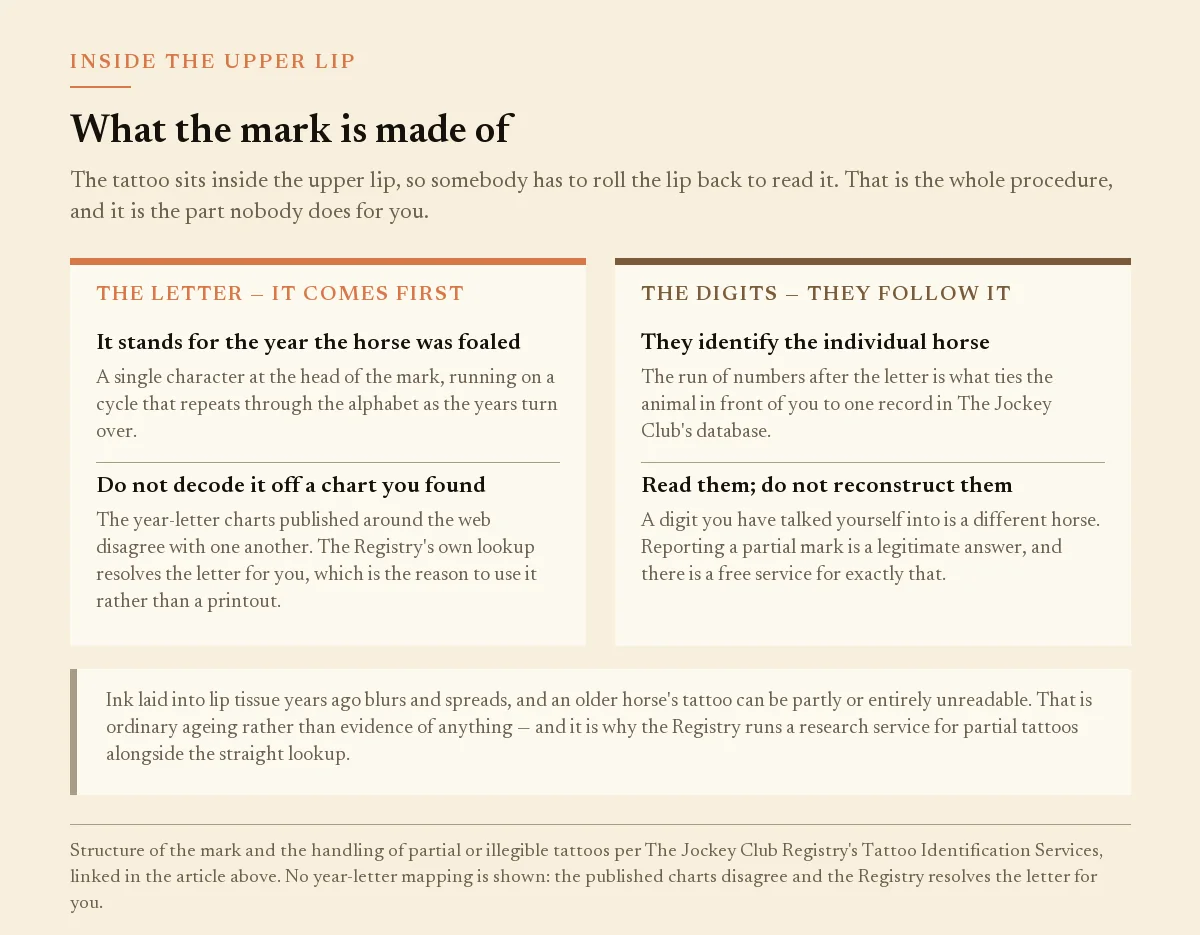
This publication does not print a year-letter chart, and the reason is the same reason we would not print an out-of-date fee schedule: the charts circulating on hobby sites and clinic pages disagree with one another, and we could not confirm a version against a Jockey Club primary source. Since the registry’s own lookup resolves the letter for you as part of returning the horse, a printed chart adds a chance to be wrong without adding anything you need. Transcribe the letter; let the Registry tell you what year it means.
The other half of reading a tattoo is knowing when to stop. Old ink blurs and spreads through lip tissue, so on an older horse a mark can be partly or entirely unreadable — ageing, not evidence of anything. A digit you have talked yourself into is a different horse. “I can read the letter and the first two numbers” is a legitimate answer, and there is a free service built for exactly that sentence.
How the free Jockey Club tattoo lookup works
The Jockey Club Registry provides tattoo identification free of charge, in two forms. If the mark is legible, you enter it exactly as it appears in the Tattoo Lookup and basic information on any matching registered Thoroughbred comes back. If the mark is partial or illegible, the Registry’s Tattoo Identification Services put the question to staff, who research the horse’s identity at no charge using colour, markings and photographs held in the database. A free Interactive Registration account opens the online research tools, and Registration Services takes the question by telephone on (800) 444-8521.
What to do with what you can actually read
n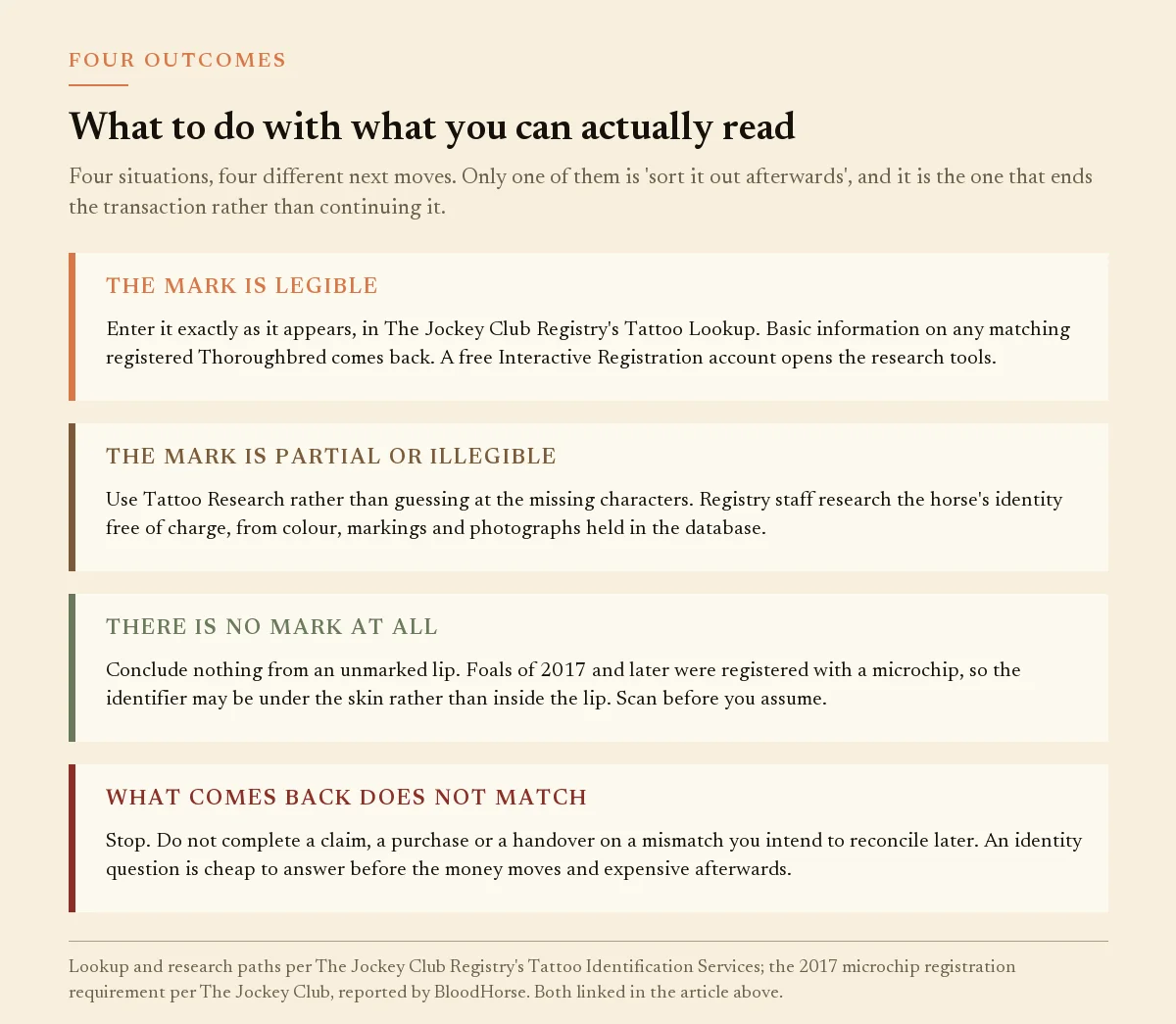
One detail there is worth an owner’s attention: the registry built a staffed path specifically for marks nobody can read, which tells you unreadable tattoos are common enough to be institutional business rather than a red flag in themselves. The check is routine. Treat it as routine, and do it every time.
What a mismatch means, and why you stop
A mismatch — the mark returning a horse that is not the horse you were offered — is the one outcome that ends the transaction rather than continuing it. Not because it proves dishonesty; most will resolve into an administrative muddle. It ends the transaction because the cost of resolving an identity question falls entirely on whichever side of the money it lands on, and until you sign, that side is not you.
A mismatch is not a paperwork problem to sort out afterwards. Afterwards is when it becomes yours.
Consider a buyer looking at a well-presented gelding on a farm, with a race record quoted, a name given and a price agreed. The lip returns a mark that maps to a different registered horse. An explanation will be offered, and it may well be the true one: two similar horses in one barn, papers that travelled with the wrong animal, a yard name that was never the registered name. All ordinary. None of them the buyer’s to untangle at their own expense after the money has moved. Pause the purchase and let the seller reconcile the record; if that takes weeks, the buyer has lost nothing but time on a horse that was never confirmed to be the horse.
The asymmetry is what makes this an editorial position rather than a hygiene tip. A seller, a consignor or a trainer with a horse to move is not incentivised to slow a deal down over an identifier, and I have never seen an operator’s marketing material advise a buyer to walk away from one. That is not a scandal. It is simply a job nobody in the transaction is paid to do, which is why it belongs on the buyer’s own due-diligence list, alongside the vetting and the contract.
Marks that are not a Thoroughbred lip tattoo
Not every mark on a horse is a Thoroughbred lip tattoo, and looking a number up in the wrong registry returns either nothing or, worse, a confident answer about the wrong animal. A freeze brand — white hair applied in a pattern, usually on the neck or shoulder — belongs to other breed and management programs and is traced through whichever body issued it. Standardbreds are recorded by their own governing body rather than by The Jockey Club, which is why a Standardbred resource can rank on a Thoroughbred tattoo search and send a reader somewhere that cannot help them. The guard is to confirm what you are holding before you search: if you are unsure the horse is a Thoroughbred at all, that uncertainty is itself the finding, and a larger one than any tattoo will settle.
This is not how you register or name a horse
Identifying a horse someone else raised and registering one of your own are different jobs with different paperwork, and they get blurred together constantly. A lookup asks the registry a question about an existing record. Registration creates the record, and naming a horse runs on its own set of Jockey Club rules with its own approvals and refusals. Owner licensing and the sport’s regulatory registrations are a third thing again. If the question in your head is “how do I get my horse into the system,” this article is the wrong one; we will cover that ground separately.
Common questions about Thoroughbred tattoos
Do all racehorses have a lip tattoo?
No. Lip tattooing was the racetrack identification standard for decades, so most older Thoroughbreds carry one, but The Jockey Club has required a microchip for registration since the 2017 foal crop and racetrack identification has since moved to a digital process. On a horse foaled in recent years, finding nothing in the lip is the expected result rather than a warning sign. The correct next step is to scan for a chip, not to conclude the horse is unregistered.
Can I look up a Thoroughbred tattoo for free?
Yes. The Jockey Club Registry’s tattoo lookup is free, and a free Interactive Registration account opens its online research tools. Enter a legible tattoo exactly as it appears and basic information on any matching registered Thoroughbred is returned. Partial and illegible marks are also researched free by Registry staff. No paid intermediary is needed for an identity check, and any service charging you for one is selling access to something the registry already gives away.
What if I can only read part of the tattoo?
Report exactly what you can read and let the Registry do the rest. The Jockey Club’s Tattoo Identification Services handle partial and illegible marks through a research path staffed by Registration Services, who work from colour, markings and photographs held in the database; the telephone number is (800) 444-8521. Do not fill in the characters you cannot see. A guessed digit produces a confident answer about a different horse, which is worse than no answer at all.
Is a freeze brand the same as a lip tattoo?
No. A freeze brand is a pattern of white hair applied to the neck or shoulder and used by other breed and management programs; a Thoroughbred lip tattoo is ink inside the upper lip, tied to The Jockey Club’s records. They are different systems, issued by different bodies, and looked up in different places. If the mark you are looking at is on the outside of the horse rather than inside its lip, The Jockey Club’s tattoo lookup is not the tool for it.
Where this leaves you
The identity check is the cheapest piece of due diligence in racehorse ownership and the one most often skipped, because it feels like an insult to ask and it produces nothing when it passes. It costs a minute in the paddock or on the farm, and nothing at the registry. Every other item on a buyer’s list — the vetting, the contract, the trainer conversation, the mechanics of the claim itself — is more expensive than this one and depends on it being true. Roll the lip. If there is nothing there, scan. Then look it up before the money moves.
— Race Horse Ownership 101
About the Author

Calvin Johnson is a Thoroughbred racehorse owner, day trader, and independent racing analyst with more than a decade of firsthand ownership experience. He has participated in nearly every common structure in horse racing — fractional platform shares, traditional syndicates, LLC partnerships, claiming ventures, and outright ownership — across more than two dozen horses. Calvin writes about racehorse ownership the same way he approaches markets: by studying risk, incentives, fees, and whether the people controlling the deal are aligned with the investors behind it.
- Calvin Johnsonhttps://racehorseownership101.com/author/calvin-johnson/
- Calvin Johnsonhttps://racehorseownership101.com/author/calvin-johnson/

- Calvin Johnsonhttps://racehorseownership101.com/author/calvin-johnson/

- Calvin Johnsonhttps://racehorseownership101.com/author/calvin-johnson/