A $50,000 budget reached 1,021 of the 2,856 yearlings sold through the ring at Keeneland September 2026 — 35.75 percent of the sale — and 973 of those 1,021, or 95.3 percent, sold in Books 4, 5A and 5B. Books 1 and 2 together sold seven yearlings under $50,000 across their four sessions. The sale-wide average was $187,933; the median hammer was $85,000. Those two figures describe the same auction and send a first-time buyer in opposite directions, which is why the budget question is better answered with a count of hips than with an average.
The short version
- 1,021 of the 2,856 yearlings sold in 2026 made less than $50,000 — 35.75 percent of everything that sold through the ring.
- 973 of those 1,021 (95.3 percent) were in Books 4, 5A and 5B. Book 1 sold none under $50,000; Book 2 sold seven.
- The $20,000–$100,000 band held 1,102 yearlings, 38.59 percent of the sale, and 722 of those sat in Books 4 and 5A.
- Book medians ran from $600,000 in Book 1 to $15,000 in Book 5B, against a sale-wide average of $187,933.
The short answer: 1,021 yearlings sold under $50,000
At the 2026 Keeneland September Yearling Sale, run over twelve sessions from September 14 to 26, 2,856 yearlings sold through the ring for $536,737,900 from a catalogue of 4,642. Of those, 1,021 sold for less than $50,000, which is 35.75 percent of everything that changed hands at the hammer. The sale is divided into books, blocks of sessions catalogued from the most commercial pages down to the least, and a $50,000 budget was concentrated almost entirely in the last three: 973 of the 1,021, or 95.3 percent, sold in Books 4, 5A and 5B. Books 1 and 2, the first four sessions, sold seven yearlings under $50,000 between them. A $50,000 budget at Keeneland September is a real budget. It is a Book 4 and Book 5 budget.
The billionaires would prefer you didn’t know this.
You can own a racehorse with a group of people just like you — and the insiders wrote down how. Free guide, ten minutes.
I set a number before I go, and then I find out which pages of the catalogue that number is allowed to touch. The order matters. Set the budget from the sale-wide average and you have built a Book 1 plan on a Book 5 wallet, because the average is carried by a small number of very expensive horses: 70 yearlings made $1 million or more in 2026, topped by a $3.7 million Into Mischief colt. Count the hips first, then pick the book.
What sold below each price point at Keeneland September 2026
| Price point | Yearlings sold below it | Share of the 2,856 sold |
|---|---|---|
| Under $20,000 | 487 | 17.05% |
| Under $50,000 | 1,021 | 35.75% |
| Under $100,000 | 1,492 | 52.24% |
| Under $250,000 | 2,167 | 75.88% |
| Under $500,000 | 2,589 | 90.65% |
| $20,000 to $100,000 (inclusive) | 1,102 | 38.59% |
More than half the sale — 1,492 of 2,856 — went for under $100,000. That is the most useful line in the table for anyone who has only seen a wrap-up headline, because the 2026 headline was a record gross of $558.3 million and an average of $187,933. Neither figure tells you that the median yearling made $85,000, and the gross is not even the right number to compare year on year: $536,737,900 went through the ring, and Keeneland’s own wrap-up adds $21,575,500 of post-sale deals on top to reach $558,313,400.
Where the $50,000 yearlings actually sat
The $50,000 yearlings at Keeneland September 2026 sat in the back half of the catalogue: 973 of the 1,021 that sold under $50,000, or 95.3 percent, were in Books 4, 5A and 5B. Keeneland groups its twelve sessions into six books — sessions 1 and 2 are Book 1, 3 and 4 Book 2, 5 and 6 Book 3, 7 and 8 Book 4, 9 and 10 Book 5A, 11 and 12 Book 5B — and publishes the mapping in its hip grouping document before the sale. Which session suits which buyer is a separate question, and one we answer in our guide to the Keeneland September sale and which session is actually yours. This is the narrower question of where the hammer prices landed.
Yearlings sold under $50,000 by book, Keeneland September 2026
| Book | Sessions | Sold under $50,000 | Median for the book |
|---|---|---|---|
| Book 1 | 1–2 | 0 | $600,000 |
| Book 2 | 3–4 | 7 | $300,000 |
| Book 3 | 5–6 | 41 | $175,000 |
| Book 4 | 7–8 | 148 | $85,000 |
| Book 5A | 9–10 | 352 | $40,000 |
| Book 5B | 11–12 | 473 | $15,000 |
Book 1 sold nothing under $50,000 in 2026, and Book 2 sold seven. The practical reading is that a buyer at this budget who spends the opening weekend at the sale is watching, not bidding — a reasonable thing to do deliberately, and an expensive way to spend four days by accident. The yearlings in reach were in the last six sessions, where Book 5B alone accounted for 473 of them.
The $20,000 to $100,000 band most first-time owners are in
The $20,000 to $100,000 band held 1,102 yearlings in 2026, 38.59 percent of everything sold, and 722 of them — just under two thirds — sat in Books 4 and 5A. That band matters more than the $50,000 line for anyone buying into a partnership rather than alone, because a shared hammer price puts a more expensive yearling inside the same personal outlay: a $75,000 hip split four ways is $18,750 each before costs. The by-book split was:
- Book 1: 2 yearlings
- Book 2: 36
- Book 3: 139
- Book 4: 311
- Book 5A: 411
- Book 5B: 203
Books 4 and 5A are where that band concentrates, and they are also where the book median crosses it: $85,000 in Book 4, $40,000 in Book 5A. A buyer working to $20,000–$100,000 is bidding around the middle of those two books rather than reaching for the top of them.
Why the sale-wide average is the wrong number to budget from
The 2026 sale-wide average of $187,933 was 2.21 times the median of $85,000, and it sat above the median of four of the six books. The industry states that average every year and states it correctly; our point is narrower and comes after it. An average is a fair description of what the sale grossed per horse. It is a poor description of what a horse cost, because a handful of seven-figure yearlings pull it clear of the typical hammer. The same gap held in 2025, with a median of $80,000, and in 2024, with a median of $70,000 — so this is the shape of the sale rather than a quirk of one year.
What the typical yearling made, book by book
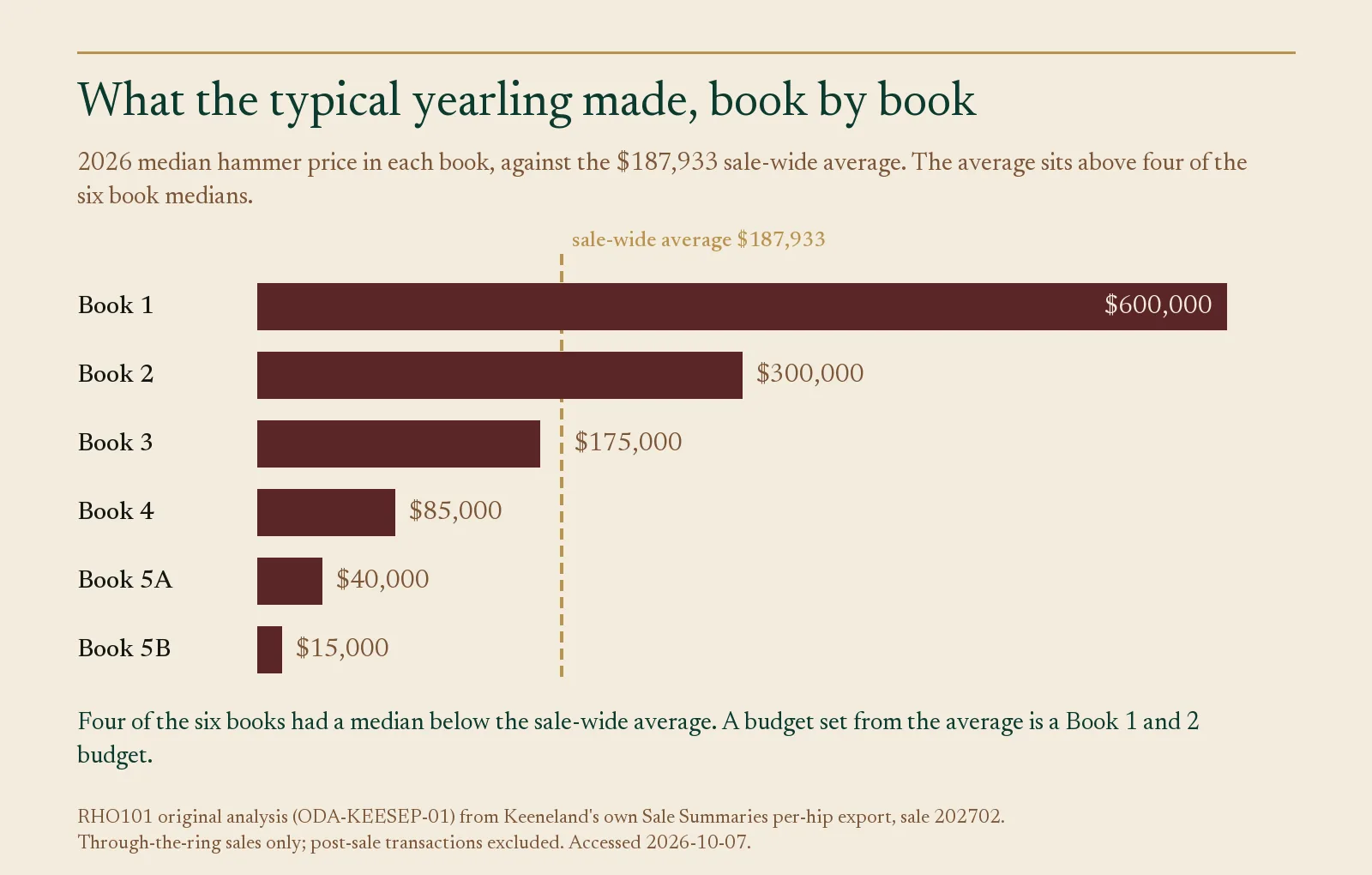
Read the chart as a budgeting instrument rather than a league table. If your number sits below the dashed line, the average was never describing your end of the sale. What a horse is worth once you own it is a different calculation again, and we work through it in what a racehorse is actually worth. For the pages themselves — what a hip’s catalogue entry is telling you and what it is not — start with how to read a sale catalogue.
The share selling under $50,000 is shrinking
The share of Keeneland September yearlings selling under $50,000 fell from 41.17 percent in 2024 to 37.43 percent in 2025 to 35.75 percent in 2026, while the median hammer rose from $70,000 to $80,000 to $85,000. In counts: 1,126 of 2,735 in 2024, 1,087 of 2,904 in 2025, 1,021 of 2,856 in 2026. The bottom of the sale is getting more expensive at the same time as the top.
The under-$50,000 share, 2024 to 2026
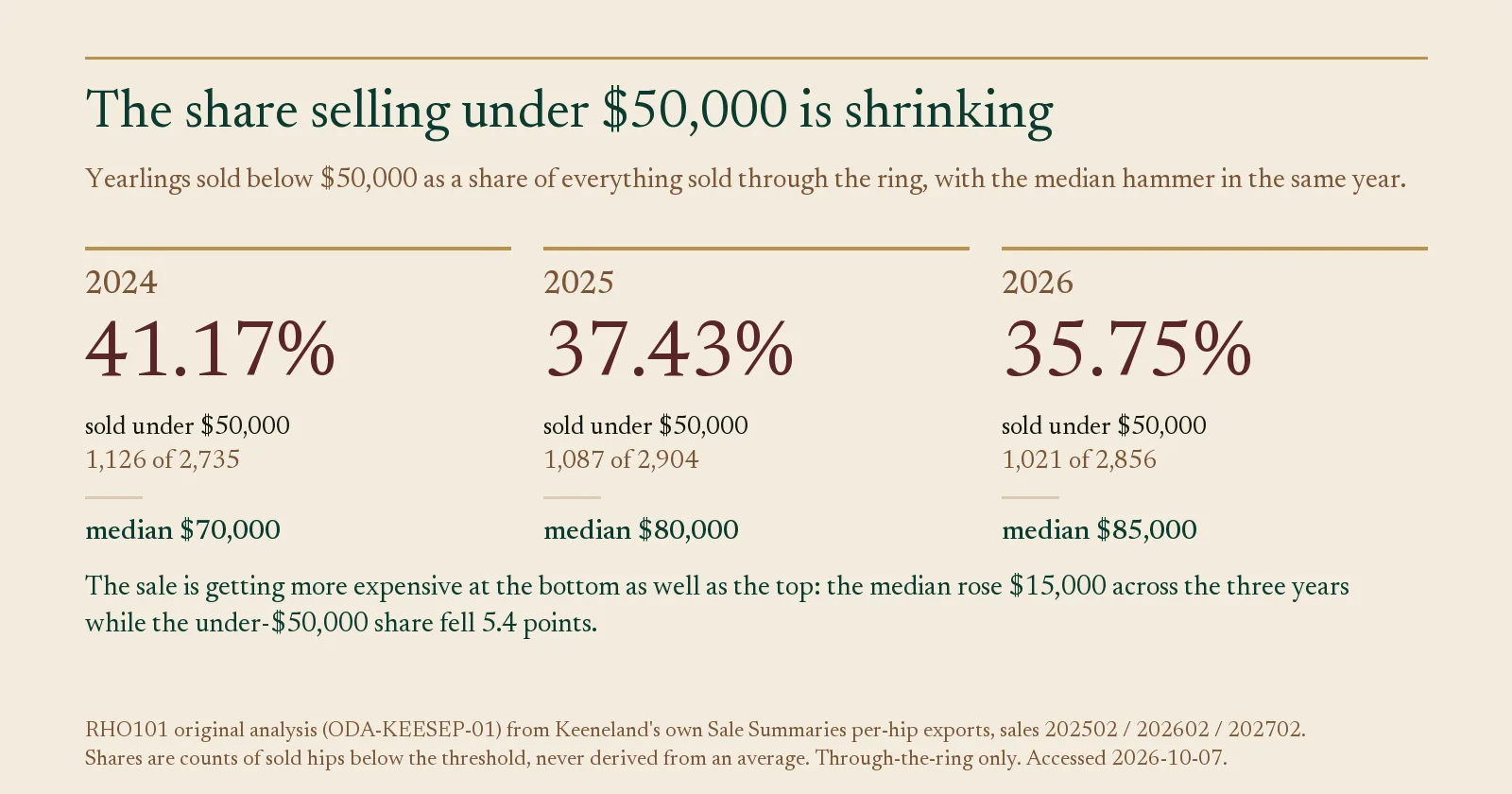
Three years is a short series and we are not forecasting a fourth. What it does say is that a $50,000 budget has been buying a slightly thinner slice of this sale each year, so a figure quoted from a 2024 article is already about five percentage points out of date. If you are weighing the auction against the other routes in, that drift belongs in the decision, and we set the routes side by side in our guide to how to buy a racehorse.
What these numbers do not say
Every band and median on this page comes from Keeneland’s own per-hip Sale Summaries export for sales 202702, 202602 and 202502, reconciled against Keeneland’s published wrap-up for each year. Every band is a count of hips at their hammer price, never a figure derived from an average. The 2026 sold count, gross, average and median match Keeneland’s release exactly; the 2025 file differs from its release by eight hips, a post-sale restatement, and we use the through-the-ring figure. The limits worth stating:
- Post-sales are excluded. 178 yearlings sold privately after the ring in 2026, at a different negotiating posture. They sit in Keeneland’s $558.3 million headline, not in any band or median here.
- Thresholds are strict unless labelled. “Under $50,000” means below $50,000. Including hips that sold at exactly $50,000 gives 1,102.
- Two counts land on 1,102 by coincidence. Hips sold at $50,000 or less, and hips sold between $20,000 and $100,000 inclusive, are different sets that happen to share a total.
- Nothing here says who bought. The file carries buyer names but not buyer type, so we cannot tell you how much of Book 5B went to pinhookers rather than to end users.
- Nothing here speaks to quality. There is no conformation or veterinary dimension in the file. A cheap hip is a cheap hip, not a bargain.
- Three years only. Keeneland publishes earlier years as sale-wide figures; we did not pull per-hip files before 2024, so the series starts there.
One more boundary. This is a record of what hammered, not a shopping list. Knowing that 473 yearlings in Book 5B sold under $50,000 tells you the budget is live. It does not tell you that any of them should have been bought.
Questions about a $50,000 budget at Keeneland September
What can you buy at Keeneland September for $50,000?
In 2026, a $50,000 budget reached 1,021 of the 2,856 yearlings that sold through the ring, 35.75 percent of the sale. Almost all of them were in the later books: 973 of the 1,021 sold in Books 4, 5A and 5B, across sessions 7 to 12.
How many yearlings sold under $50,000 in 2026?
1,021 sold for less than $50,000. If you also count the hips that sold at exactly $50,000, the figure is 1,102. Both are counts of yearlings sold through the ring; post-sale transactions are excluded from each.
Which Keeneland September books still have $50,000 yearlings?
Books 4, 5A and 5B, which run across sessions 7 to 12. In 2026 they sold 148, 352 and 473 yearlings under $50,000 respectively. Book 3 sold 41, Book 2 sold seven, and Book 1 sold none.
What is the $20,000 to $100,000 band at Keeneland September?
It is the range most first-time buyers and small partnerships actually operate in. In 2026 it held 1,102 yearlings, 38.59 percent of everything sold, and 722 of those were in Books 4 and 5A alone.
Why is the sale-wide average the wrong number to budget from?
Because 70 yearlings made $1 million or more in 2026 and pulled the average to $187,933 while the median hammer was $85,000, a ratio of 2.21 to one. The average sat above the median of four of the six books, so budgeting from it points you at pages your money cannot reach.
What to read next
If the next question is which days to attend rather than what things cost, read the Keeneland September sale explained for buyers. Before you bid on anything, how to read a sale catalogue covers what the page in front of you is claiming. And if the auction is only one of the routes you are weighing, how to buy a racehorse sets the paths side by side. Set the number first, then find the book it belongs to.
About the Author

Calvin Johnson is a Thoroughbred racehorse owner, day trader, and independent racing analyst with more than a decade of firsthand ownership experience. He has participated in nearly every common structure in horse racing — fractional platform shares, traditional syndicates, LLC partnerships, claiming ventures, and outright ownership — across more than two dozen horses. Calvin writes about racehorse ownership the same way he approaches markets: by studying risk, incentives, fees, and whether the people controlling the deal are aligned with the investors behind it.
- Calvin Johnsonhttps://racehorseownership101.com/author/calvin-johnson/

- Calvin Johnsonhttps://racehorseownership101.com/author/calvin-johnson/

- Calvin Johnsonhttps://racehorseownership101.com/author/calvin-johnson/
- Calvin Johnsonhttps://racehorseownership101.com/author/calvin-johnson/