
An authorized agent in horse racing holds a separate racing-commission license — not the owner’s license, and not a power of attorney on its own — and 21 of the 32 US racing states print a dollar figure for it. The published range runs from $0 in Virginia to $200 for Arizona’s full Group 5 agent, with New York at $5 and twenty of the twenty-two published lines sitting at or under $65. Most commissions print the dollar without stating what term it buys; Pennsylvania is the exception, selling the card at $35 for one year, $70 for two and $100 for three. Six states that publish an owner fee — Kentucky, Florida, Kansas, Colorado, Montana and Iowa — print no named agent line at all. That means unpublished, not free.
The short version
- An authorized agent license is its own credential. Holding an owner license does not license the person acting for you.
- 21 racing states publish an agent dollar. Virginia prints $0, New York $5, Arizona $200 for a full agent. Same job, very different bill.
- Across the 20 states that print both numbers, the agent card is cheaper than the owner card in 10, identical in 9, and more expensive in exactly one — Arizona.
- Arizona splits the role in two: Group 5 for a full agent at $200, Group 2 for a partial agent at $50. The commission does not pick one for you, and neither will I.
- Six states print nothing. Do not read an owner fee across into an agent cell, and do not assume the role is free because the schedule is silent.
The short answer: a separate card, in the states that sell one
An authorized agent license is a commission credential letting a named person act for an owner at the track — signing entries, signing claim slips, dealing with the racing office — and in the states that license the role, the owner’s own card does not extend to that person. This is the part most partnership paperwork skips. A signed power of attorney tells your partners and your trainer that someone speaks for you. It tells the racing secretary nothing, because the racing secretary answers to a commission that licenses occupations, and “agent” is one of them.
The billionaires would prefer you didn’t know this.
You can own a racehorse with a group of people just like you — and the insiders wrote down how. Free guide, ten minutes.
The practical version: if you are buying into a horse two time zones away, somebody actually at that track will end up acting in your name. Before I look at what an owner license costs in a state, I want to know who that person is and whether the commission wants them licensed too. The fee is usually small. The surprise is not.
This is not the owner-license table
The owner license and the authorized agent license are two different lines on the same fee schedule, and 29 of the 32 US racing states publish a readable owner-license dollar against 21 that publish an agent one. If what you need is the owner number — what it costs you, personally, to be licensed as an owner in a given state — that is a different page: our state-by-state breakdown of racehorse owner license fees carries that table, including the multi-year terms that make a straight annual comparison misleading.
Six states publish an owner figure and print no named agent line at all, and Delaware itemizes none on its 2025 application. That gap is what this page exists to mark, because an owner fee is never evidence of an agent fee. Kentucky charges $150 a year for an owner license under 810 KAR 3:020 and prints nothing for an agent; that silence is a question for the Kentucky Horse Racing Commission, not a number I can supply.
This is not "who in the partnership has to be licensed"
Whether every partner in a racing partnership needs an owner license is a separate question from whether your agent needs an agent license, and the two get conflated constantly. The partnership question is about thresholds: New York licenses every partner on a horse with 35 or fewer owners, while Pennsylvania, Indiana, Virginia, Maryland, Texas, New Mexico, West Virginia and Delaware use a 5% rule. We cover that split in who in a racing partnership actually needs an owner license.
The agent question is about function, not percentage. Whether your agent owns 0% or 40% of the horse is beside the point; what matters is that they will act in your name in front of the commission, and 21 states put that person on the schedule under their own heading.
What 21 racing commissions charge for an authorized agent
| State | Authorized-agent fee, as printed | Term or note, where the commission states one | Source |
|---|---|---|---|
| Virginia | $0 | Every participant permit on the schedule is $0 | 11VAC10-60-15, read 25 October 2026 |
| New York | $5 | Thoroughbred only | NYS Gaming Commission licensing, read 25 October 2026 |
| Minnesota | $5 | — | Minn. R. 7877.0120; cited 15 October 2026 |
| New Mexico | $10 | NMAC figure; listed as Group E on the 2024 application | 16.47.1.8 NMAC; cited 15 October 2026 |
| West Virginia | $20 | — | WVRC application / Table 178-1A; cited 15 October 2026 |
| California | $25 | — | CHRB occupational license fees; cited 15 October 2026 |
| Illinois | $25 | — | IRB / 11 Ill. Adm. Code 502.30; cited 15 October 2026 |
| Louisiana | $25 | — | LSRC licenses and forms; cited 15 October 2026 |
| North Dakota | $25 | $15 if filed early | NDRC licensing / NDAC 69.5-01-05-02; cited 15 October 2026 |
| Washington | $31 | — | WHRC / WAC 260-36-085; cited 15 October 2026 |
| Indiana | $35 | — | IHRC license fees; cited 15 October 2026 |
| Pennsylvania | $35 | 1 year; $70 for 2 years, $100 for 3 | PA SHRC fee schedule eff. 1 May 2024; cited 15 October 2026 |
| Wyoming | $35 | Type I | Wyo. Code R. 038-7; cited 15 October 2026 |
| Nevada | $36 | — | NGCB horse racing fee schedule; cited 15 October 2026 |
| Arkansas | $38 | — | 2025 ARC rule book; cited 15 October 2026 |
| Arizona | $50 | Group 2 — authorized agent, partial | Ariz. Admin. Code R19-2-202, read 25 October 2026 |
| New Jersey | $50 | Form III | NJRC licensing FAQ; cited 15 October 2026 |
| Ohio | $50 | — | OAC 3769-2-24; cited 15 October 2026 |
| Idaho | $50 | — | Idaho State Police license fees; cited 15 October 2026 |
| Oregon | $65 | Tier 3, per year — the same tier as an Owner | ORC application Rev 05/2026; cited 15 October 2026 |
| Nebraska | $90 | Term not published on the fee list | NRGC 2026 racing license fees PDF; cited 15 October 2026 |
| Arizona | $200 | Group 5 — authorized agent, full | Ariz. Admin. Code R19-2-202, read 25 October 2026 |
No commission publishes this comparison, because none has any reason to tell you what its neighbors charge. The table is assembled from the commissions’ own fee schedules, statutes and application forms, one cell at a time, with nothing carried across between states. Where a commission prints no figure, the cell is absent rather than estimated.
The spread: Virginia $0, New York $5, Arizona $200
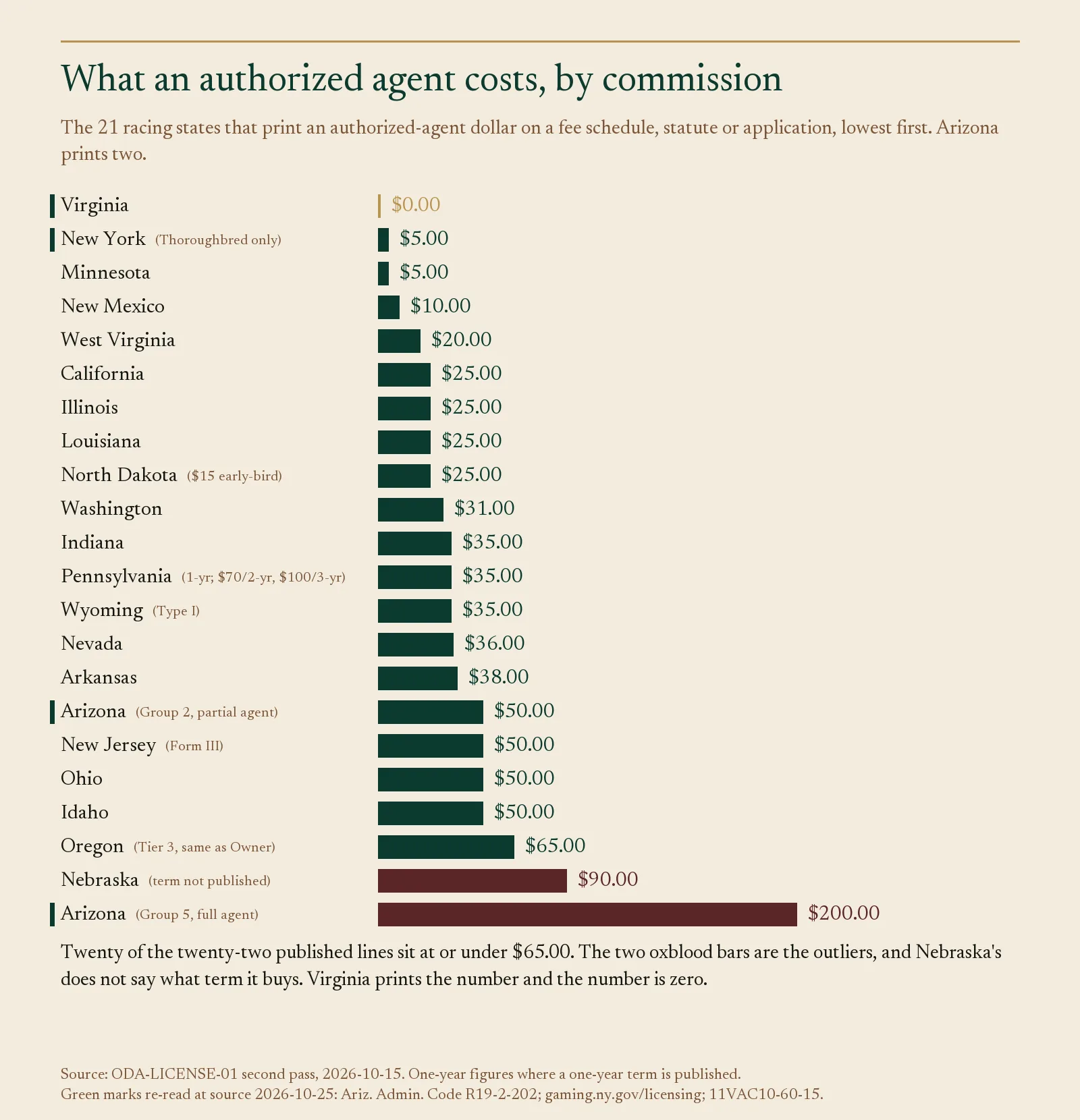
The authorized-agent fee runs from $0 in Virginia to $200 for Arizona’s full agent, a fortyfold spread among the states that charge anything at all, and there is no regional logic to it. New York charges $5 for the card. Arizona charges $200 for the full version of the same function. Minnesota charges $5. Nebraska charges $90, and neither schedule explains itself.
Two things in that chart are worth slowing down for. Virginia’s $0 is a published figure, not a missing one — the entire Virginia participant permit schedule is zero, so the state licenses the role and charges nothing. And Nebraska’s $90 sits high without the commission saying what term it buys. A $90 annual card and a $90 three-year card are different products, and the fee list does not say which.
The same job — signing your entries while you are three states away — is billed at nothing in Virginia, $5 in New York, and $200 in Arizona. Budget from the state you are racing in, never from the one you read about.
The agent card is almost never more than the owner card
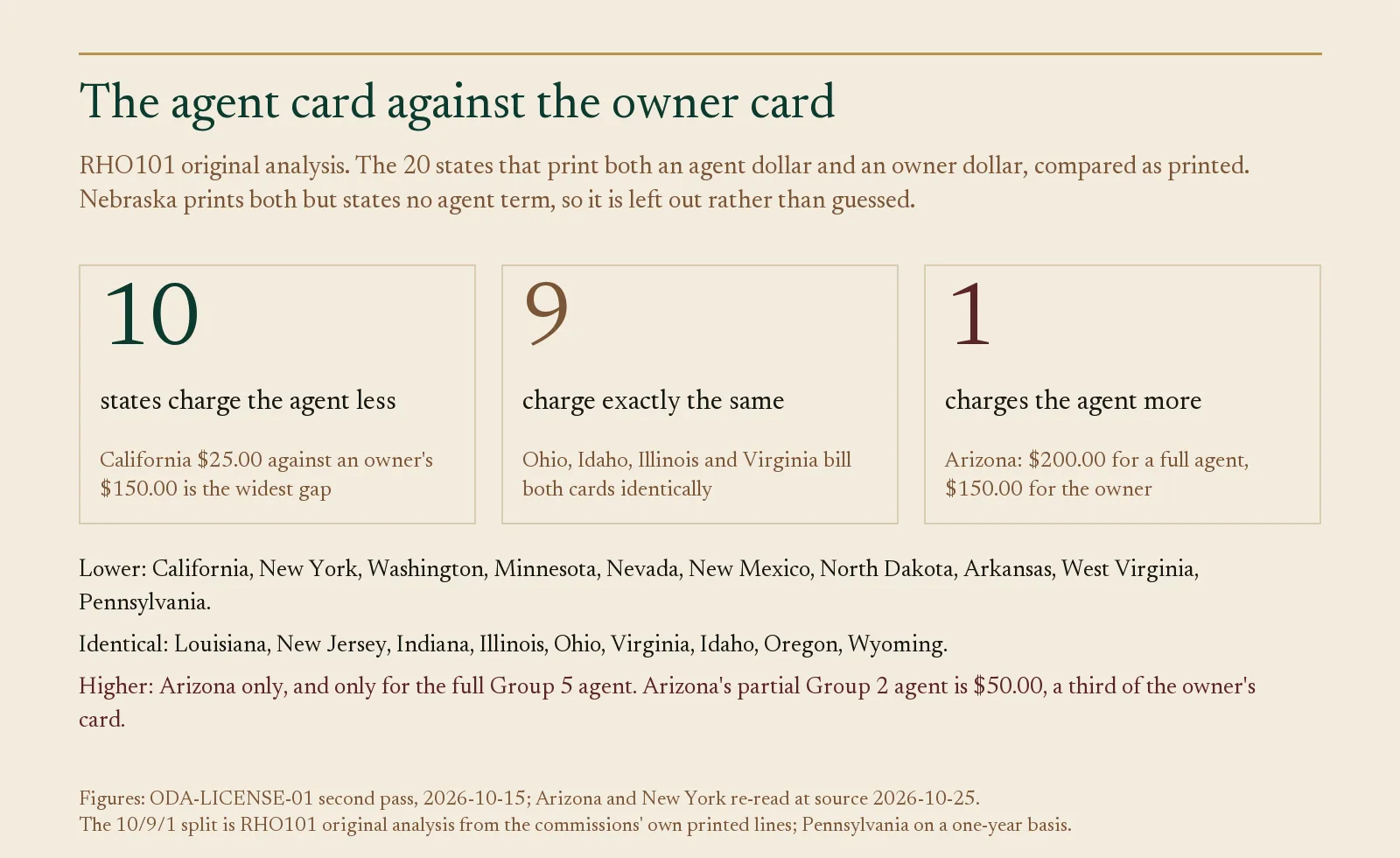
Across the 20 states that print both an agent fee and an owner fee, the agent card costs less in 10 states, exactly the same in 9, and more in exactly one: Arizona. That is the finding this page exists for, and it runs against the instinct most new owners bring to the question. Agents are usually assumed to be the expensive professionals in the arrangement. On the commissions’ own schedules they are usually the cheap line.
How we built this, and what it does not cover
The agent figures come from our ODA-LICENSE-01 licensing dataset, built by reading each commission’s own fee schedule, statute, regulation or application form and recording what it printed. The universe is the 32 US states with 2026 Equibase Thoroughbred dates and an ARCI-listed racing commission. Every cell traces to a commission source; a cell with no published figure is marked unavailable, never filled from a neighboring state or from the same state’s owner line. Arizona, New York and Virginia were re-read at source on 25 October 2026; the rest carry the dataset’s 15 October 2026 citation, and the table says which is which.
The edges matter as much as the figures. The comparison is between numbers as printed: most commissions state no term for the agent card, so this is not a strict annualized ranking. Pennsylvania is reduced to a one-year basis because it publishes all three terms; Nebraska is excluded for the opposite reason. None of it includes fingerprinting, which every sourced state requires for a first license and which is usually a vendor’s charge rather than the commission’s.
Arizona’s Group 5 and Group 2 are two different jobs
Arizona is the only state that prices an authorized agent twice: $200 for a full agent under Group 5 and $50 for a partial agent under Group 2, against $150 for an owner under Group 4. The regulation lists both without defining which arrangement belongs in which group in a way an outside reader can apply confidently, and I am not going to resolve that for you by picking the cheaper one.
- Group 5, $200. The full authorized agent, grouped with jockeys, veterinarians, farriers and owner-trainers.
- Group 2, $50. The partial authorized agent, grouped with jockey agents and vendor employees.
- Group 4, $150. Owners and trainers — the reference point, and the only owner line Arizona publishes.
The gap between those two figures is $150, larger than most states’ entire owner fee. If you are licensing an agent in Arizona, ask the Arizona Department of Gaming which group your arrangement falls into, before you file rather than after. That is a fourfold difference riding on a classification you cannot safely make yourself.
Six racing states print no authorized-agent line at all
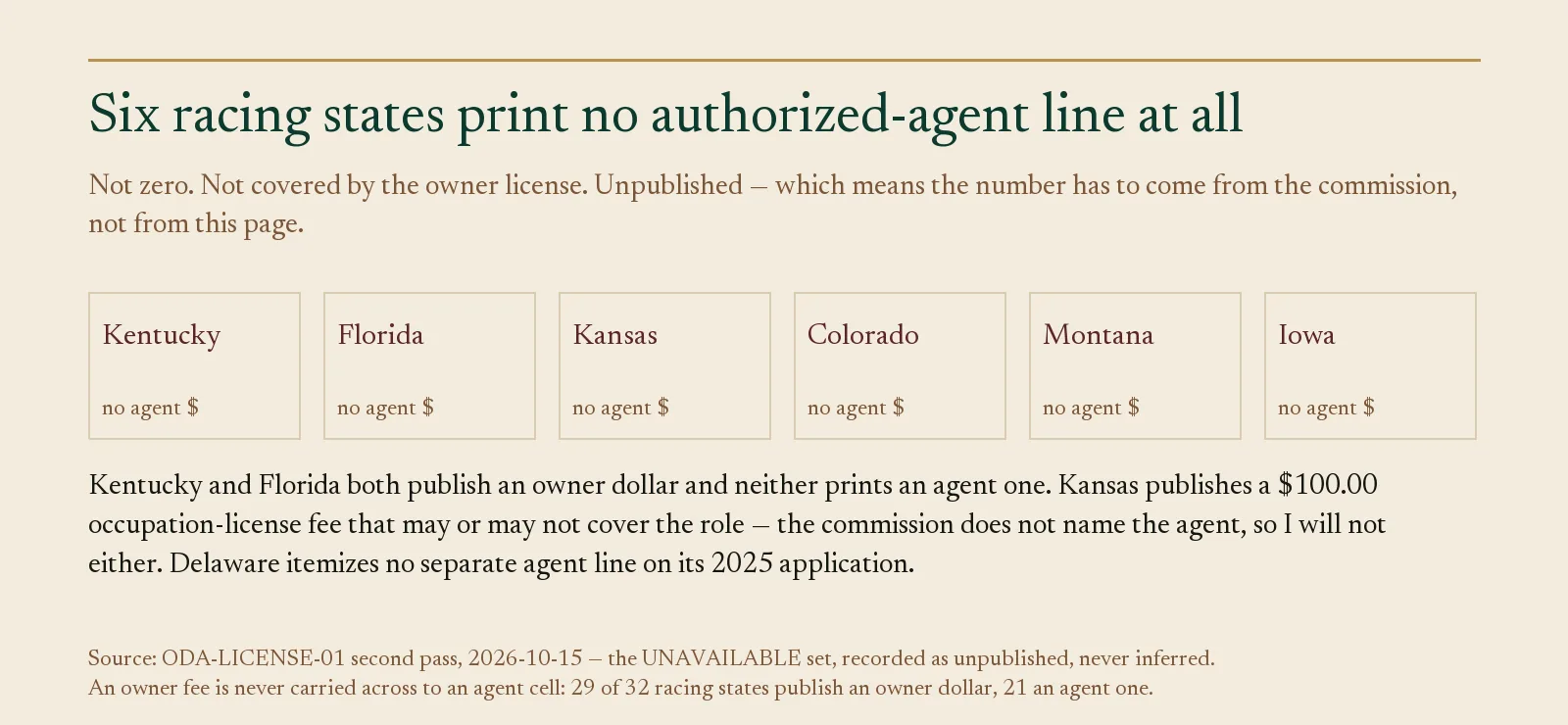
Kentucky, Florida, Kansas, Colorado, Montana and Iowa publish an owner-license dollar but print no named authorized-agent fee, and the correct reading of that is unpublished rather than free. Kentucky and Florida are on that list, so the size of a circuit tells you nothing about the legibility of its fee schedule.
Kansas earns its own note. The commission publishes a $100 occupation-license fee that an agent may well fall under, but it does not name the agent on that line, and a fee that might cover the role is not a fee published for it. Delaware is a near miss the other way: it licenses the role but itemizes no separate agent figure on its 2025 application. In all seven, the number comes from one call to the licensing office.
Questions owners actually ask about this
Does a racing authorized agent need a license?
In the states that license the occupation, yes — the agent holds their own commission card, separate from the owner’s. 21 states publish a fee for it, the clearest evidence a state treats it as a licensed role. Where a state publishes none, ask the commission rather than assuming the owner license carries over.
How much does an authorized agent license cost?
Between $0 and $200 among the 21 states that publish a figure. Virginia charges nothing, New York and Minnesota charge $5, Arizona charges $200 for a full Group 5 agent. Twenty of the twenty-two published lines sit at or under $65: a small number with two conspicuous exceptions.
Is the agent fee the same as the owner fee?
Sometimes exactly, usually less, and in one state more. Across the 20 states printing both figures, 9 bill the two cards identically — Ohio, Idaho, Illinois, Louisiana, New Jersey, Indiana, Virginia, Oregon and Wyoming. 10 charge the agent less, with California’s $25 agent card against a $150 owner card the widest gap. Arizona is the only state where the agent line exceeds the owner line.
Can one agent cover every partner in a partnership?
That depends on the commission and on your partnership agreement, and it belongs in front of the racing office before entries rather than after. The license authorizes a person to act; who they may act for is a matter of the filing you make. It is a separate question from which partners must hold an owner license, which turns on thresholds that differ by state.
What if my state does not publish an agent fee?
Call the commission’s licensing office and ask for the occupation name and the fee in writing. Kentucky, Florida, Kansas, Colorado, Montana and Iowa all fall into this group, and so does Delaware on its 2025 application. An unpublished fee is not a waived fee, and reading a neighboring state’s figure across is the single easiest way to budget this wrong.
What to read next
Three RHO101 pages pair with this one: the ownership route, the owner dollar, and the partnership thresholds. Our independent guide to buying a racehorse lays out every ownership path and what each asks of you. The owner license fees by state table is this page’s companion, and who in a partnership needs licensing covers the thresholds that set how many owner cards your group buys.
About the Author

Calvin Johnson is a Thoroughbred racehorse owner, day trader, and independent racing analyst with more than a decade of firsthand ownership experience. He has participated in nearly every common structure in horse racing — fractional platform shares, traditional syndicates, LLC partnerships, claiming ventures, and outright ownership — across more than two dozen horses. Calvin writes about racehorse ownership the same way he approaches markets: by studying risk, incentives, fees, and whether the people controlling the deal are aligned with the investors behind it.
- Calvin Johnsonhttps://racehorseownership101.com/author/calvin-johnson/

- Calvin Johnsonhttps://racehorseownership101.com/author/calvin-johnson/

- Calvin Johnsonhttps://racehorseownership101.com/author/calvin-johnson/
- Calvin Johnsonhttps://racehorseownership101.com/author/calvin-johnson/
