Last updated: November 17, 2026
17 of the 32 US racing states publish a figure for what a state-bred designation pays the horse’s owner. The other 15 do not, and that is the first thing anyone paying a state-bred premium at a sale should know. The 17 published figures are also not in the same units, so they cannot be ranked against one another: Illinois floors designated open races at a minimum +40% of the purse for Illinois-foaled horses and +60% for Illinois conceived-and-foaled; Ohio pays flat dollars, $10,500 / $3,000 / $1,500 in accredited non-claiming races; Iowa’s Prairie Meadows book pays a 50% supplement in open races and 40% in restricted ones; New York pays 20% to NY-sired horses in open races only and nothing to owners in its restricted ones. Fourteen more states run a program but publish no owner number at all.
The short version
- 17 of the 32 US racing states publish an owner purse-supplement or owner-award figure on a commission, fund or statute page: California, New York, Kentucky, Florida, Indiana, Illinois, Ohio, Washington, Maryland, Texas, West Virginia, Iowa, Minnesota, New Mexico, North Dakota, Oklahoma and Wyoming.
- Those figures are percentages, flat dollars, pro-rata fund shares and point values. There is no honest way to average them or to name a best state from them.
- Fourteen states — Pennsylvania, Louisiana, New Jersey, Virginia, Nebraska, Arizona, Arkansas, Colorado, Idaho, Kansas, Montana, Nevada, Oregon and South Dakota — run a program without publishing an owner figure. Delaware’s program is not a thoroughbred state-bred fund.
- In some states the restricted races are the whole of the owner value. Indiana repealed owner awards in 2010 and scheduled 374 restricted races for 2026.
- Kentucky is two funds. KTDF supplements owners’ purses; KBIF pays breeders, and it paid $20,000,227.81 for the 2025 race year.
The short answer: what a state-bred designation pays the owner
A state-bred designation pays the owner through one of three mechanisms, and which one you get depends entirely on the state. The first is a purse supplement: the state’s breeders’ or development fund adds money to the advertised purse of an open race, and the owner collects it as part of the winner’s or placegetter’s share. The second is an owner award paid separately from the purse, usually as a percentage of the purse share and usually capped. The third is access to restricted races — races only state-breds may enter, carrying purse money an ineligible horse cannot reach at all. Kentucky’s program is purse supplement only. New York pays an award in open races and nothing in restricted ones. Indiana pays no owner award and offers restricted races instead. Those are three different products sold under the same phrase.
Imagine your colors on the horse at the front.
Not a bet. Not a ticket. Yours. Thousands of everyday fans own a piece of a racehorse. The free guide is how they started.
The industry position on these programs is not controversial, and I will state it plainly before I complicate it: nearly every US racing state operates a breeders’ or development fund that puts additional money into races for horses bred in that state, and in most of those states some of that money reaches owners. That much is agreed, and the commissions say so themselves. What no commission publishes is its neighbors’ terms. Each fund page describes one state, in that state’s own units, under that state’s own program year, so the designation sounds like a single thing you can shop for and is not.
I read the fund page before deciding whether a premium is money or folklore. A seller telling you a horse is state-bred has told you the horse is eligible for something; he has not told you what that something pays, whether it pays you or the breeder, or whether it pays in a race your horse can realistically win. The published figures answer those three questions differently in every one of the 17 states that publish anything. If you are still deciding how you will own a horse at all, start with our guide to every ownership path, which puts a purchase premium in the context of the whole transaction.
What the designation pays, state by state
The table below is the owner side of all 17 states that publish a figure, with the program year as the state published it. Read it as a reference rather than a league table. Every cell traces to that state’s own commission, fund or statute page, accessed 26 October 2026. No figure has been carried from one state to another, and where a state’s own documents disagree, the disagreement is shown rather than resolved.
Owner purse supplements and owner awards in the 17 states that publish a figure
| State | What the owner gets, as published | Restricted-race program |
|---|---|---|
| California | Statute BPC 19614.4: 20% of the winner’s share if the horse was conceived by a registered California stallion, 10% if not. The CTBA’s undated FAQ instead describes at least 20% for 1st–5th in open allowance and overnight stakes. The statute and the FAQ do not agree. | At least one Cal-bred race per day; at least 10% of stakes (BPC 19568). |
| New York | NY-sired 20% of the purse share for 1st–3rd, capped at $20,000; non-NY-sired 10%, same cap. Open races only, with a $30,000 claiming floor. No owner awards at all in restricted races. Owners took $2.1M of the fund’s $16,191,136 in 2025 awards. | 548 restricted races at NYRA in 2024; more than $41.1M in restricted purses in 2025. |
| Kentucky | KTDF is a purse supplement only, split across finishing positions as the track proposes — the KTA’s worked example is 60/20/10/5/3/2, an example rather than a mandate. The annual KTDF total is not published. KBIF, the other fund, pays breeders and not owners. | None. Kentucky runs no restricted Kentucky-bred races. |
| Florida | A Florida Owners’ Award on a first-place finish in claiming, allowance, maiden special weight and stakes races with a purse of $40,000 or less unless otherwise agreed, and no award above 50% of the gross purse. No statewide percentage is published. The 2026 Florida Sire Stakes pays the owner $20,000 and the breeder $5,000 at Gulfstream and Tampa. | About $7.5M in Florida-bred purses, roughly $5.5M of it restricted overnights at Gulfstream. Race count not published. |
| Indiana | Owner awards were repealed in 2010 (71 IAC 13.5-3-1). The 2026 budget carries a $360,000 line for awards in open races with no published percentage. Breeder awards continue at 20% of the gross purse, winner only. | 374 races scheduled for 2026 (144 sired, 230 bred); 399 ran in 2025. Elevated overnights of $100,000–$250,000. |
| Illinois | Designated open races are floored at a minimum of +40% of the purse for Illinois-foaled horses and +60% for Illinois conceived-and-foaled, 1st–3rd (P.A. 104-466, effective 16 June 2026). In 2025 the board paid $4.36M to owners across 148 open races, plus $482,000 for place and show. | At least two restricted races a day and a minimum of six a week; $2.96M to restricted winners across 108 races in 2025. |
| Ohio | Flat dollars rather than percentages. Under the 2026 OTRF rules an accredited non-claiming race pays $10,500 / $3,000 / $1,500, $15,000 in total. Open maiden special weight and listed allowance pay $7,000 / $2,000 / $1,000, and claiming bands run from $2,800 down to $700. | At least one Ohio-funded overnight every race day, with restricted add-ons of $3,000–$9,000. The 2026 overnight and supplement allotment is $5,736,000. |
| Washington | 1% of in-state parimutuel receipts during the live meet, divided pro rata among owners of Washington-breds finishing 1st–4th (RCW 67.16.102, amended 2025). The 2025 pool generated $368,301.44 at an allocation factor of 20.62%. There is no fixed percentage of your own purse. | At least one Washington-bred-only race on every Class A, B and C race day. Purse total not published. |
| Maryland | As of 1 January 2026, a 15% owner bonus on the purse share for Maryland-breds finishing 1st–3rd in open overnight races, plus a 15% developer bonus. The 2026 out-of-state pools hold $700,000 for owner and developer bonuses together. | Nearly $698,000 in Maryland-bred stakes and premiums in 2024. The 2026 restricted overnight schedule is not published. |
| Texas | A purse supplement for accredited Texas-breds finishing 1st–3rd in any Texas race except restricted stakes. For accredited Texas-breds running in races that are not Texas-bred-restricted, the owner bonus is funded by 25% of the program’s money after administration. Of the awards remaining from 80% of breakage, 40% goes to owners, 40% to breeders and 20% to stallion owners. | At least two Texas-bred races every day, one of them a maiden. Overnight totals not published. |
| West Virginia | 25% of the development fund goes to owners, paid year-end pro rata rather than race by race, capped at 35% of that horse’s accredited earnings and calculated on the first $100,000 of purse only (W. Va. Code §19-23-13B). | At least one restricted race a day, or three a day at the older-fund tracks. Audited annual total not published. |
| Iowa | The Prairie Meadows 2026 condition book pays a thoroughbred supplement of 50% in open races and 40% in restricted races, 1st–4th, subject to adjustment. The breeder of the winner takes 12% of the purse won. | At least one Iowa-foaled race per day. |
| Minnesota | Approved 19 February 2026: $5,000 for a restricted maiden special weight or allowance, $5,000 for an open one, 12% of other open overnights, $10,000 for the Myers and Genter stakes, $5,000 for other Minnesota-bred stakes and 10% of open stakes. Estimated total $522,000. | Restricted maiden and allowance races carry the $5,000 supplement. |
| New Mexico | Open overnight races pay a 20% increase on the original purse for 1st–3rd, split 63/24/13. Separately, 35% of the incentive fund goes to owners of horses finishing 1st–3rd. The 2024–25 award sheet paid owners $1,539,663.53. | New Mexico-bred overnights and stakes, with unclaimed-ticket and breakage money enhancing restricted overnights. |
| North Dakota | 60% of each scheduled award goes to the owner, rising to as much as 100% where the dam or sire is not registered, split 50/30/20 by finishing position. Published 2026 allocations are $225,000 in state and $25,000 out of state, with a $2,000 minimum purse. | At least one restricted race a day. |
| Oklahoma | Half the breeding development fund goes out as purse supplements to owners of winning accredited Oklahoma-breds, split 50/30/20. Owners finishing 1st–3rd in open races may be eligible, with no percentage published. The commission says as much as $7 million has been paid in a single year, without naming the year. | An average of at least two Oklahoma-bred races a day. |
| Wyoming | Of the fund remaining after the top slices, 40% goes to owners on a point system; the 2025 owner award was $460.37 per point. The 2025 headline total of $10,040,175.26 is mostly Historic Horse Racing money rather than live-racing purse. | Not published as a separate restricted schedule. |
That table is RHO101 original analysis, and it is worth saying how it was built. I started from the 32 states that have both 2026 thoroughbred race dates and a racing commission in the ARCI’s jurisdiction list, then went to each state’s own fund, commission or statute page and recorded what it says about money reaching the owner. Seventeen publish an owner percentage, an owner dollar, or a clear finding that owner awards do not exist; those 17 are the table. Fourteen more publish a program without publishing an owner figure, and they are named below rather than guessed at. A missing number is written as not published, never inferred from a neighbor, and no percentage is averaged. The honest edges are real: award percentages reset with the program year, Kentucky’s KTDF annual total is not published at all, and several states’ own documents contradict each other, which I have shown where it happens.
Why you cannot crown a largest state-bred bonus
No honest ranking of state-bred owner bonuses exists, because the four biggest published figures are measured in four different things. Illinois publishes a percentage uplift on the purse. Ohio publishes a dollar amount per finishing position. Iowa publishes a percentage that differs depending on whether the race is open or restricted. Washington publishes a share of a parimutuel pool divided pro rata at the end of the meet, which means the owner cannot know the figure until the money is counted. Put those four side by side and the comparison collapses.
The reason this gets handled badly almost everywhere is understandable: a percentage looks like it should be comparable with another percentage. It is not, when one is a floor on a purse uplift and the other is a cap on an award. Illinois adds at least 40% to the advertised purse of a designated race, raising what the winner collects. New York pays 20% of the purse share as a separate award, capped at $20,000, in open company only. Two horses running for $40,000 purses in those two states are paid under different arithmetic, and the New York horse is paid nothing at all if the race was restricted.
Four states, four different units
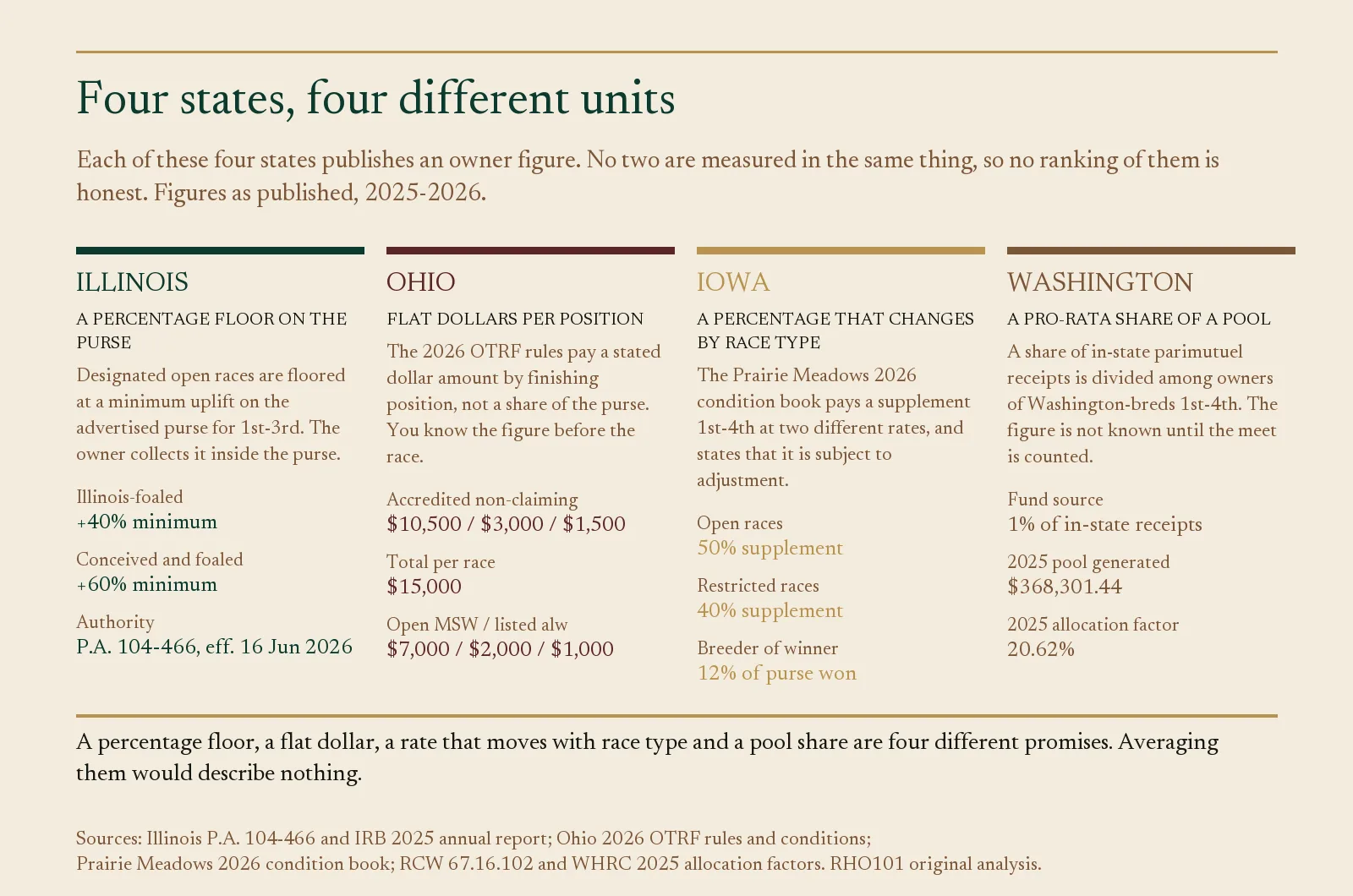
So the question "which state pays the most?" has no answer, while "what would this state pay my horse, in the races my horse can actually win?" always does. That second question needs three inputs: the state’s published mechanism, the class of race your horse is realistically entered in, and whether the mechanism covers open races, restricted races or both. A Washington-bred finishing fourth collects a pro-rata slice of a $368,301 pool; an Ohio-bred winning an accredited non-claiming race collects $10,500. Neither figure tells you anything about the other.
A percentage and a flat dollar are not two readings of the same number. They are two different promises, and only one of them tells you what you will be paid before the race is run.
Restricted races are owner money too, and sometimes the only money
Restricted races are the most under-counted part of a state-bred program’s owner value, and in Indiana they are the entire owner value. Indiana repealed its owner awards in 2010 and kept its restricted program, scheduling 374 restricted races for 2026 against 399 run in 2025, with elevated overnights between $100,000 and $250,000. An Indiana-bred owner collects nothing labeled an owner award. What the designation buys is a calendar of races that ineligible horses may not enter, which is a different kind of asset and, for a modest horse, often a more valuable one.
New York runs the mirror image. Its owner award is real, published and capped, and it applies in open races only; in the restricted races the state spends more than $41.1 million on, owners receive no award whatsoever. The purse is the payment. Read as a single number, New York’s 20% looks like one of the stronger offers in the country. Read against where a state-bred actually runs most of its races, the picture changes.
- Restricted access with no award: Indiana. 374 scheduled restricted races for 2026, no owner award since 2010.
- Award in open company only: New York. 20% NY-sired, 10% non-NY-sired, capped at $20,000, nothing in restricted races.
- Both, at different rates: Iowa. 50% supplement in open races, 40% in restricted ones, at Prairie Meadows in 2026.
- Neither, because there are no restricted races: Kentucky. KTDF supplements purses; the state runs no restricted Kentucky-bred races.
Those four lines are the argument against shopping for a designation by its headline rate. A sale-ring premium is paid once, in cash, on the day; what it buys is a position in one state’s particular arrangement of open races, restricted races and award caps. Sale-scheme bonuses attached to individual auctions work the same way, and we worked them through in our buyer’s math guide to yearling sale bonus schemes. Those are a separate pot of money with separate eligibility, and a horse can qualify for one, both or neither.
Kentucky is two funds, and only one of them pays owners
Kentucky runs two separate programs that are constantly treated as one, and the distinction decides who gets paid. The Kentucky Thoroughbred Development Fund supplements purses in races at Kentucky tracks, which means the money reaches the owner through the purse. The Kentucky Breeders’ Incentive Fund pays breeders, and it is the larger and more visible of the two: it paid $20,000,227.81 for the 2025 race year, announced by the racing commission in February 2026. None of that $20 million goes to owners as owners.
Where Kentucky’s two funds send the money
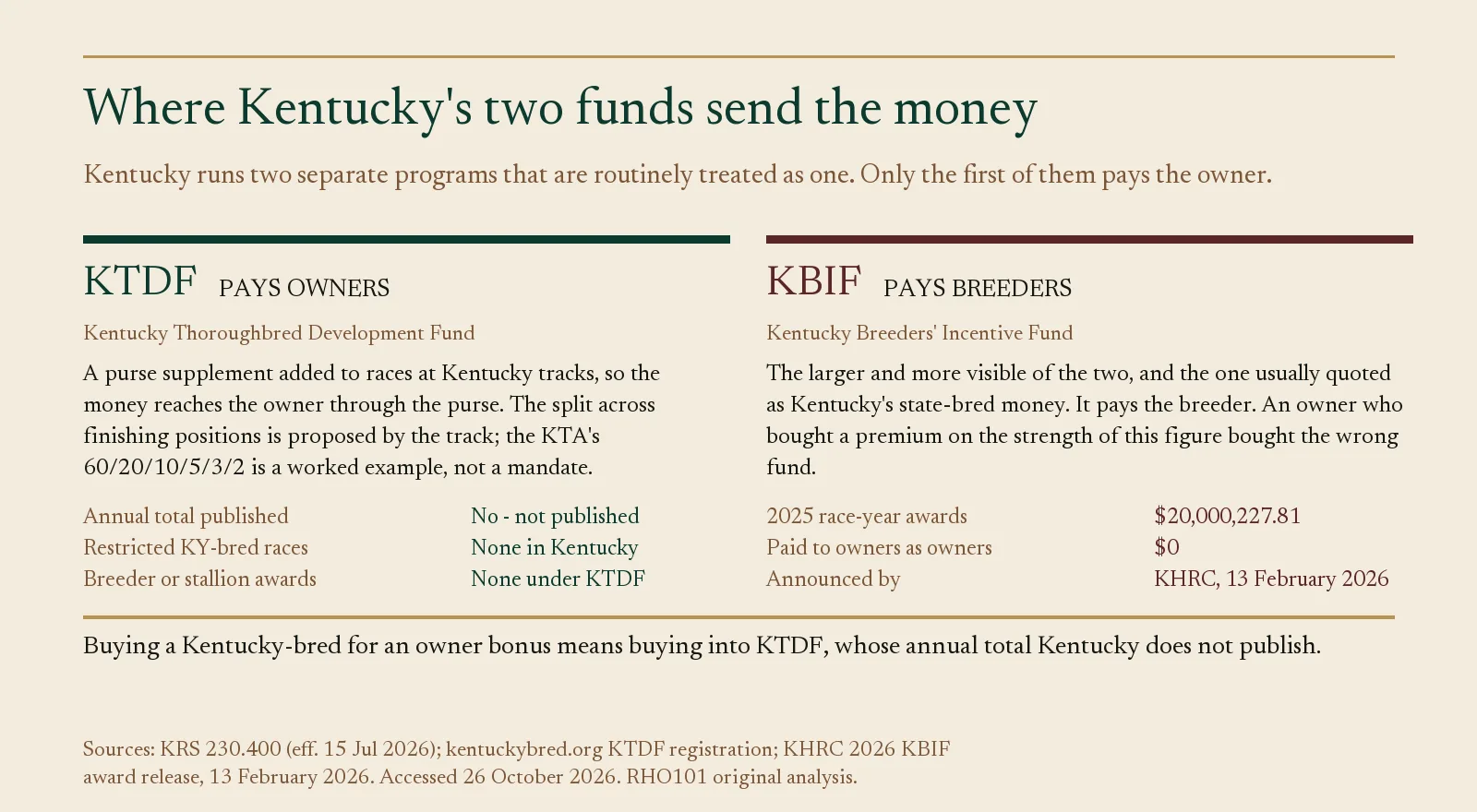
Buying a Kentucky-bred for the owner bonus means buying into KTDF, not KBIF, and KTDF does not publish an annual total. The eligibility rule is unusually simple by national standards: under KRS 230.400, a Kentucky-bred is a horse sired by a Kentucky stallion and foaled in Kentucky, with no mare-residency dates to miss. The registration fees, effective 1 January 2026, run $95 for a foal registered by 31 December, $140 as a yearling and $700 at racing age before the close of entries. Whether a specific premium is worth paying is a question of owner economics rather than eligibility, and it turns on which fund is paying and in what race — a question with enough in it to deserve its own treatment.
Kentucky is also the reason I distrust any summary that reports one number per state. A single-figure table would have shown Kentucky at roughly $20 million, which is the largest figure in this piece and the one most likely to be quoted at a sale. The $20 million is real. It is simply not owner money, and an owner who bought a premium on the strength of it bought the wrong fund.
Wyoming’s $10 million is Historic Horse Racing, not live purses
Wyoming’s 2025 breeders’ award total was $10,040,175.26, and $9.97 million of it came from Historic Horse Racing terminals rather than live racing. The live-racing contribution was about $24,000, with roughly $34,000 from simulcast and $15,000 from advance-deposit wagering. The Wyoming Gaming Commission publishes the breakdown, and the 2024 figure was $8.53 million on the same basis.
That is an eight-figure fund attached to one of the smallest live-racing programs in the country. Owners take 40% of what remains after the fund’s top slices, distributed on a point system that paid $460.37 per point in 2025. The money is genuine and it does reach owners. It is simply not generated by the racing, which matters the moment anyone reasons from that headline to a conclusion about Wyoming’s racing economy.
How many states publish an owner figure at all
Just over half the US racing states publish an owner figure: 17 of 32. Fourteen run a program and publish no owner number, and one — Delaware — runs a certified-thoroughbred program that is not a statutory state-bred fund at all, since the Delaware statute covering that ground applies to harness racing. The 14 are not failures of searching. In most of them the commission publishes a breeder percentage and says nothing about owners, which is itself the finding.
The 17 states that publish an owner figure, and the 14 that do not
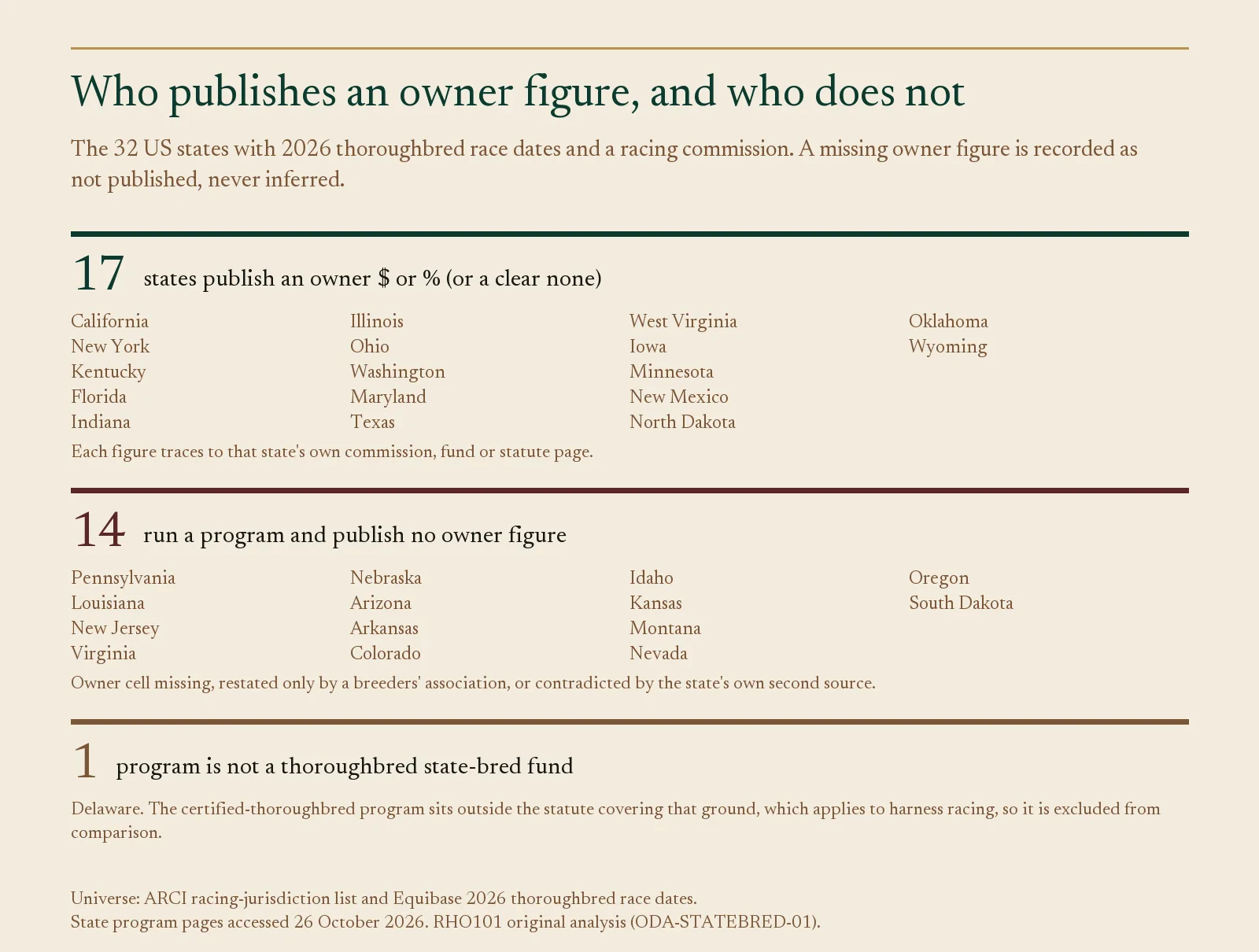
Several of the 14 are worth naming, because a reader may have been quoted a figure from one of them. Pennsylvania’s statute splits the remaining fund 50/50 between owner bonuses and restricted purses without setting a rate; the familiar 40/30/25 figures for Parx, Presque Isle and Penn National come from the breeders’ association’s stallion directory, marked subject to change, not from the statute. New Jersey’s 10% of purse for 1st–4th plus a 40% bonus for 1st–3rd, capped at $15,000 a race, comes from the breeders’ association with no program year attached. Virginia’s administrative code caps purse supplements at $25,000 a race in state and $5,000 out of state, while the thoroughbred association describes a 50% bonus at Colonial Downs and a Mid-Atlantic cap of $10,000 — two official-looking sources, two different ceilings. Arizona’s statute pays 10% of first money to the breeder, and the 15–25% figure owners hear comes from the breeders’ association without a year. Those are all real programs. None has a current owner rate you could put in a table honestly.
What these numbers do not say
This table cannot tell you the best state to buy a state-bred in, and I want to be specific about why rather than leaving it as a caveat. Four limits apply.
- It is not national. Fourteen of 32 states are missing an owner figure. A table of 17 is a table of 17, and calling it a national comparison would misrepresent 44% of the racing map.
- The percentages have expiry dates. Every rate here is stamped with the program year the state published it under — Illinois from a public act effective 16 June 2026, Maryland as of 1 January 2026, Minnesota approved 19 February 2026, Ohio from the 2026 rules. Program years reset. A rate read in 2026 is not a rate you can rely on in 2028.
- Nothing here is averaged. There is no mean owner bonus, no median, no carried figure. Averaging a percentage floor, a flat dollar and a pro-rata pool share would produce a number that describes nothing.
- Several states contradict themselves. California’s statute and the CTBA FAQ disagree. Maryland’s 2024 commission report uses different breeder rates from the 2026 schedule. Both readings are recorded rather than reconciled, because picking a winner between two official sources would be inventing a fact.
What the table does do is tell you what to ask and whom to ask. If a horse is being sold to you at a premium for its state-bred status, the question is not whether the state has a program. It is which mechanism pays, at what published rate, in which class of race, under which program year, and whether the money lands on the owner or the breeder. In 17 states you can check that in an afternoon. In 14 you cannot, and in those 14 a premium justified by an owner bonus is a premium justified by a number nobody has published.
Questions owners ask about state-bred awards
Is a state-bred horse worth paying more for?
It depends on which state and on who the program pays. Illinois, Iowa and Ohio publish substantial owner money, Indiana publishes none and offers restricted races instead, and Kentucky’s $20 million headline is breeders’ money. A premium paid on a designation whose owner figure the state has never published is a premium paid on an assumption. The arithmetic of the purchase price against the published mechanism is a separate exercise from eligibility, and it is the one that decides the answer.
Do these programs pay the owner or the breeder?
Both, in different proportions, and some pay only the breeder. Kentucky’s KBIF pays breeders exclusively. Idaho pays the breeder 10% of the first-place purse and publishes no owner rate. South Dakota pays the breeder 5% of first money. Arizona’s statute pays 10% of first money to the breeder. Where a state publishes a split, owners are usually one of three or four claimants: Texas divides the residual awards 40% owners, 40% breeders and 20% stallion owners, and Wyoming does the same.
Can the award be lost on paperwork?
Yes, and in several states the deadline falls before the horse is born. Pennsylvania requires the dam to have been in the state since 1 December of the conception year. Virginia requires dam domicile from 1 September of the conception year through foaling for foals of 2024 onward. New Mexico requires conception in state to an accredited stallion. California charges $750 for a late registration after 1 January of the two-year-old year. Registration traps are a subject in their own right, and a horse that misses one is simply not eligible, whatever the sale catalogue said.
How many states publish an owner figure?
Seventeen of the 32 US racing states that have 2026 thoroughbred race dates and a racing commission. Fourteen run a program without publishing an owner number, and Delaware’s certified-thoroughbred program is not a statutory state-bred fund. That ratio is the single most useful fact in this piece: slightly over half the racing map lets an owner check the figure before buying.
Is the state-bred award related to my owner license?
No. The owner license is a cost you pay the commission for permission to race; the state-bred award is money the state’s fund pays out on a result. They are issued under separate programs with separate paperwork. We cover the first in what owner licenses cost across 29 commissions, which is a separate budget line from anything on this page.
What to read next
If the state-bred question came up while you were working out how to buy at all, the hub piece is every ownership path explained. If it came up at a yearling sale, the bonus schemes attached to the sale itself are a different pot of money and are worked through in our sale bonus math guide. And if you are budgeting the first year rather than the purchase, owner license fees by state covers the one licensing cost every owner pays regardless of where the horse was foaled.
This table gets refreshed each first quarter, after the program years reset: Illinois, Maryland, Minnesota, Ohio, Iowa, Florida, California and Kentucky all carry 2026 effective dates, so every one of them can restate. Race Horse Ownership 101 takes no money from syndicates, breeders’ associations or racing commissions, and nothing here is a recommendation to buy in any state. It is a reading of what 17 commissions and funds have put in public.
About the Author

Calvin Johnson is a Thoroughbred racehorse owner, day trader, and independent racing analyst with more than a decade of firsthand ownership experience. He has participated in nearly every common structure in horse racing — fractional platform shares, traditional syndicates, LLC partnerships, claiming ventures, and outright ownership — across more than two dozen horses. Calvin writes about racehorse ownership the same way he approaches markets: by studying risk, incentives, fees, and whether the people controlling the deal are aligned with the investors behind it.
- Calvin Johnsonhttps://racehorseownership101.com/author/calvin-johnson/
- Calvin Johnsonhttps://racehorseownership101.com/author/calvin-johnson/
- Calvin Johnsonhttps://racehorseownership101.com/author/calvin-johnson/

- Calvin Johnsonhttps://racehorseownership101.com/author/calvin-johnson/