Last updated: November 19, 2026
A state-bred award is won or lost on dates that fall before the foal is born. Pennsylvania wants the dam in the state from 1 December of the year she was covered. Virginia, for foals of 2024 onward, wants her domiciled there from 1 September of the conception year through foaling. New Mexico will not accept a foal that was merely born in the state — it has to have been conceived there. Miss one of those and no fee fixes it afterwards, because the horse was never eligible. Miss a filing deadline instead and the repair is priced: New Mexico charges $60 for a weanling and $2,000 for a three-year-old, and California charges $750 for anything registered after 1 January of the two-year-old year.
The short version
- Two kinds of trap. A residency or conception rule is permanent — if the mare was in the wrong state at the wrong time, the foal can never be registered. A missed filing date is only expensive.
- The permanent ones bite earliest: Pennsylvania 1 December of the conception year, Virginia 1 September of the conception year for foals of 2024 onward, New Mexico conception in state plus a 30-consecutive-day stay from 15 February 2025.
- Late fees climb steeply and unevenly. New Mexico runs $60 to $2,000 across four age bands; West Virginia runs $150 to $500 for the same span.
- Two states publish numbers that contradict each other. New York’s own FAQ still shows a $50 weanling fee after the board set $100 for 2026, and California’s statute says Cal-sired horses get no owner awards while the CTBA’s FAQ carves out a maiden bonus.
The short answer: the award is a clock, not a sticker
A state-bred designation is not a label attached to a horse at birth. It is the output of a sequence of dated conditions, most of which are about where the mare physically stood in the months before and after she was covered, and the rest of which are filing deadlines with escalating fees. A state-bred foal is registered with the state’s breeders’ fund or racing commission, not with The Jockey Club, and each state writes its own clock. Pennsylvania requires the dam to have been in the state since 1 December of the conception year. Virginia requires her domiciled there from 1 September of the conception year through foaling, for foals of 2024 onward. New Mexico requires conception in state to an accredited stallion. A horse that fails one of those conditions is not a late registration. It is not eligible at all, and no fee will make it so.
Imagine your colors on the horse at the front.
Not a bet. Not a ticket. Yours. Thousands of everyday fans own a piece of a racehorse. The free guide is how they started.
This matters more at a sale than in a breeding shed, because the buyer usually carries the risk. A catalogue page can show a designation the horse has already forfeited, or show nothing where one is still available if somebody files in time. So when I look at a hip with a state-bred angle in its appeal, the designation is a line I check rather than a line I read. I want to see the registration itself, and the date it was filed.
The five traps worth knowing before you buy
Five states publish rules that are strict enough, early enough or expensive enough to decide whether a state-bred award exists at all. The table below is RHO101 original analysis: we read each state’s own fund, commission or statutory page and recorded the deadline, the fee and the specific thing that is forfeited, so the three sit in one place for the first time. Every cell traces to that state’s own documents, accessed 26 October 2026. Nothing has been carried from one state to another, and where a state’s own sources disagree, both readings are shown rather than reconciled.
Registration traps in five states: the clock, the fee and what is forfeited
| State | The clock | The fee | What is forfeited |
|---|---|---|---|
| Pennsylvania | The dam must have been in Pennsylvania since 1 December of the year she was covered, unless the foal qualifies by the public-sale or breed-back route. | Weanling registration $100 for members, $300 for non-members. Late registration after 31 December of the yearling year costs $500. | PA-bred status, and with it the restricted-race program and any owner bonus paid on it. |
| Virginia | For foals of 2024 onward, the dam must be domiciled in Virginia from 1 September of the conception year through foaling (11VAC10-130-10, effective 1 January 2024). | Not published on the fund’s registration page as sourced — the page returned an error. | Virginia-bred eligibility, and the purse supplements the Virginia fund pays through it. |
| New Mexico | The foal must be conceived in New Mexico to an accredited stallion. From 15 February 2025 the mare must also complete a 30-consecutive-day stay. | Weanling $60, yearling $150, two-year-old $1,000, three and over $2,000. Foaling out of state costs $500 for foals of 2025 onward. | New Mexico-bred status, which carries a 20% increase on open overnight purses and a 35% owner share of the incentive fund. |
| New York | A resident dam must stay 120 days from her last cover until foaling. A non-resident dam needs 90 continuous days and a breed-back to a registered New York stallion. | Priced by how late you are: foals of 2026 $100, 2025 $300, 2024 $500, 2023 or earlier $1,000. The weanling fee itself is disputed (see below). | New York-bred status — 20% of the purse share for NY-sired horses, capped at $20,000, in open races only. |
| California | Registration is free to members and $200 to non-members up to 30 September of the yearling year, then $0 or $250 until 1 January of the two-year-old year. | After 1 January of the two-year-old year the fee is $750, for members and non-members alike. | Cal-bred status. Note that Cal-sired is a separate designation that the statute pays no owner awards on at all. |
The clock starts in the year the mare is covered
The earliest state-bred deadlines fall roughly eleven months before the foal exists, and they are about geography rather than paperwork. Pennsylvania, Virginia and Ohio all measure something in the year the mare was covered, and New Mexico goes further by requiring the covering itself to happen in state. A breeder who ships a mare to a stallion in another state and brings her home to foal has satisfied none of those conditions, however carefully the foal is registered afterwards.
The second window is the foaling year, and it is also permanent. New York asks a resident dam to stay 120 days from her last cover until she foals. Illinois asks for 30 consecutive days including the foaling itself. Minnesota and North Dakota set plain calendar dates, 15 March and 1 February of the foaling year. These are counted in days a mare physically stood somewhere, which is why they cannot be repaired by writing a cheque later.
Where each deadline falls, from cover to two-year-old year
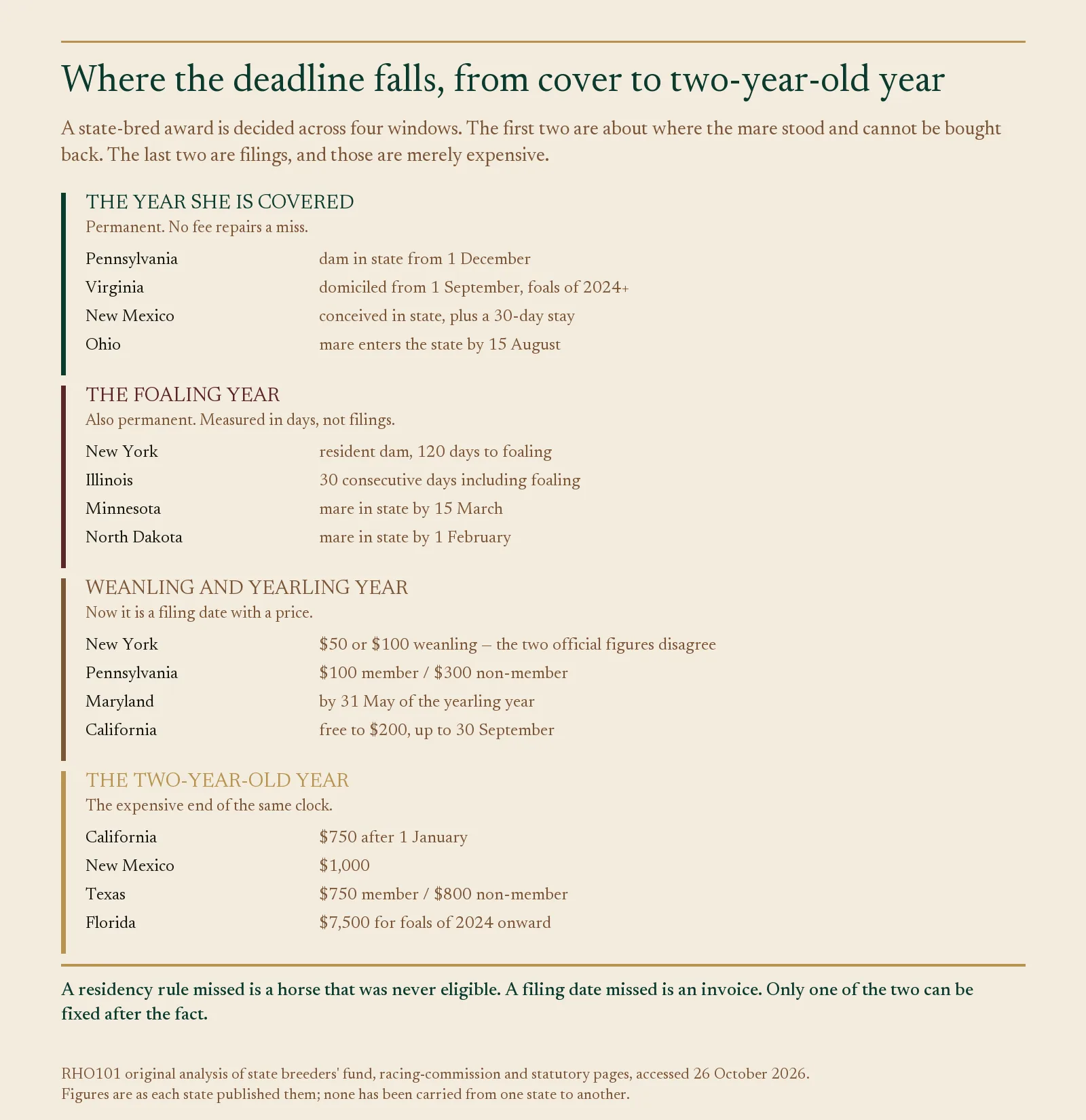
Only in the third window does money fix anything. That is the division worth carrying into a sale ring: ask first whether the horse can be a state-bred, then what it costs to make it one.
Conceived in New Mexico is not the same as foaled in New Mexico
New Mexico requires a foal to have been conceived in the state to an accredited stallion, which is a stricter test than any foaled-in-state rule and the one most likely to catch a buyer out. Most state programs ask where the foal was born, sometimes with a residency rule attached to the mare. New Mexico asks where the mare was covered. A mare bred in Kentucky and shipped to New Mexico in good time to foal produces a New Mexico foal that is not a New Mexico-bred.
Two conditions sit alongside it. From 15 February 2025 the mare must also complete a 30-consecutive-day stay, per the New Mexico Horse Breeders’ Association’s bred-form rules and instructions. And for foals of 2025 onward, foaling out of state costs $500 rather than disqualifying the foal. New Mexico is strict about conception and forgiving about birth, which is the reverse of what most buyers assume.
Most states ask where the foal was born. New Mexico asks where the mare was covered. A horse can satisfy one of those questions and fail the other without anybody noticing until the award is claimed.
What it costs to be late
Late registration is priced on a ladder in every state that publishes one, but the steepness of that ladder is a local decision rather than an industry norm. The four schedules below are published fees for the same act at four ages, taken from each state’s own fee schedule. The spread is the point: a state that charges little to register a weanling may charge thirty times as much for the same horse as a three-year-old, and the buyer of a late-registered horse inherits whichever number applies.
What late registration costs in four states
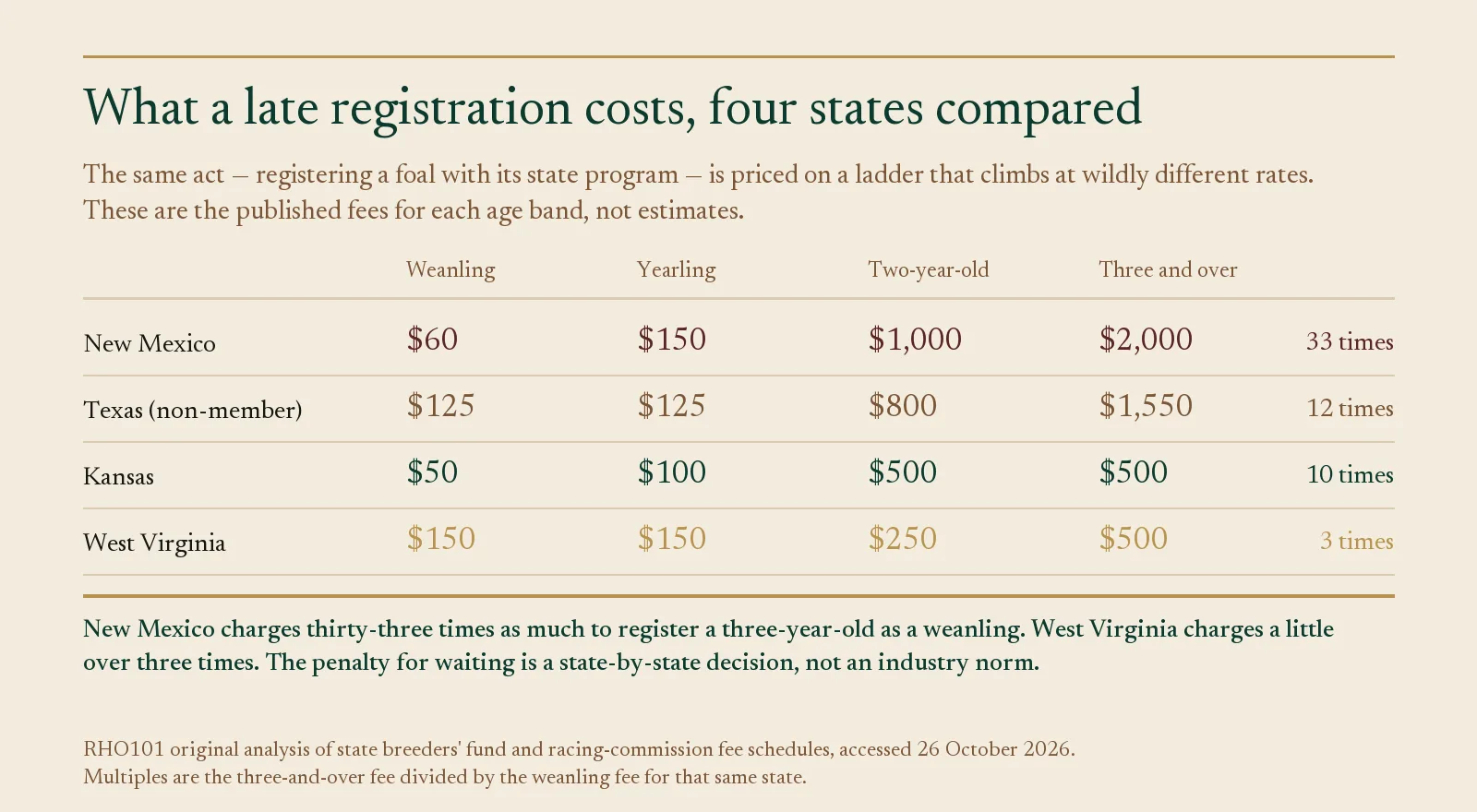
Several other states run the same escalation on different shapes. Pennsylvania charges $100 to members and $300 to non-members for a weanling, then $500 for anything filed after 31 December of the yearling year, per the Pennsylvania Horse Breeders Association’s foal registration process. Florida asks $7,500 for a two-year-old, foals of 2024 onward, or a split between owner and breeder. Oklahoma publishes two different three-year-old figures in two places, which is its own kind of warning.
The New York weanling fee has two official numbers
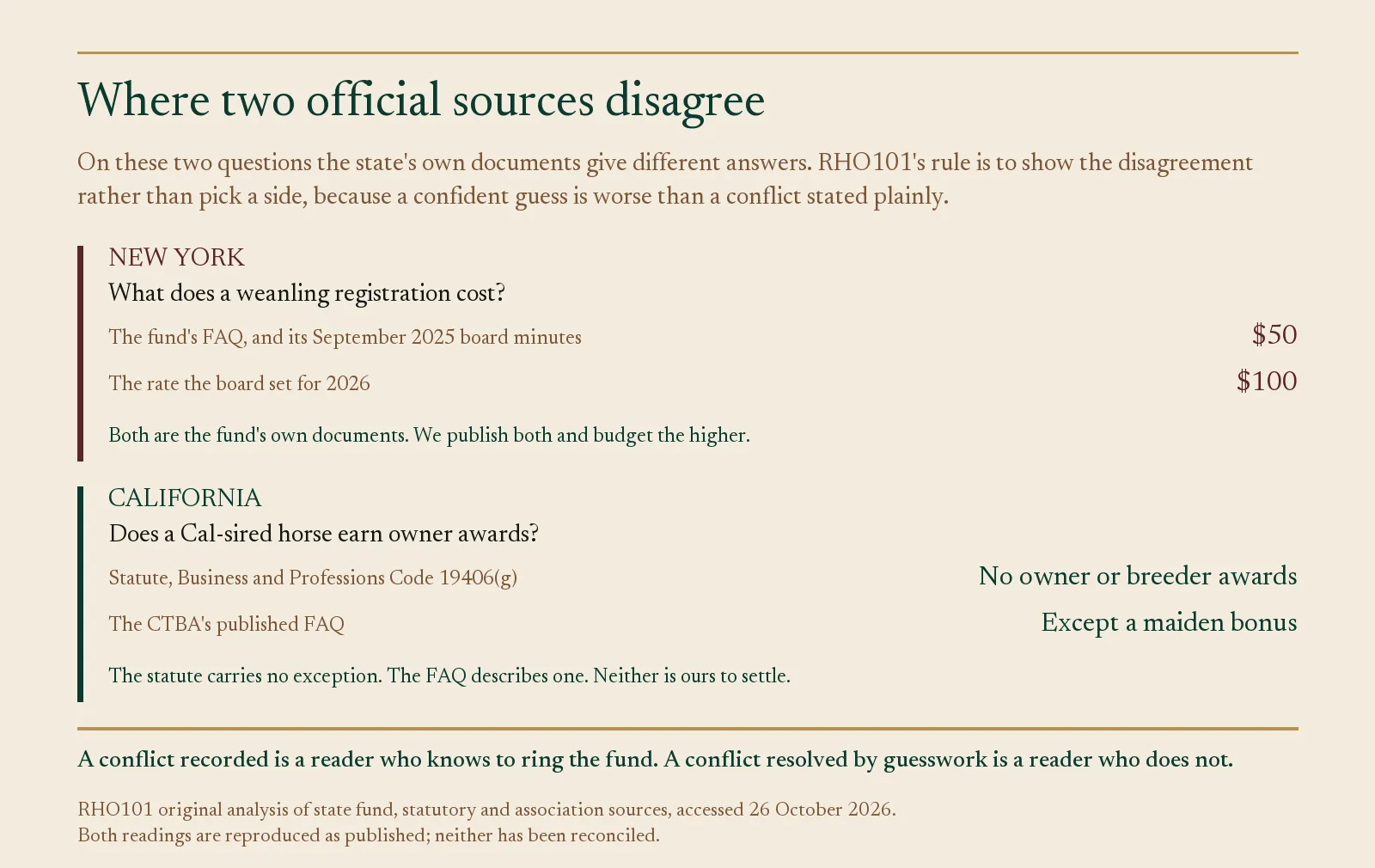
New York publishes a weanling registration fee of $50 and a weanling registration fee of $100, in different official places, and we are not going to pick one for you. The $50 figure appears in the New York Thoroughbred Breeding and Development Fund’s own FAQ and in its September 2025 board minutes. The $100 figure is what the board set for 2026. Both are the fund’s own documents.
We record the disagreement rather than resolving it, because resolving it would mean guessing, and a guess printed confidently is worse than a conflict shown plainly. The practical advice is narrow: budget the higher figure and confirm with the fund before filing. The rest of New York’s schedule is not in dispute — registration is priced by how late you are, at $100 for foals of 2026, $300 for 2025, $500 for 2024 and $1,000 for 2023 or earlier.
Cal-sired is not Cal-bred, and the statute pays owners nothing on it
California runs two designations that sound alike and pay very differently: Cal-bred, and Cal-sired. Under BPC 19406(g) a Cal-sired horse is eligible for restricted races, and the statute provides no owner or breeder awards on that designation at all. A buyer who hears “California-sired” and prices in an owner bonus is pricing in something the statute does not pay.
A second conflict sits on top of that one, and the same rule applies to it. The CTBA’s FAQ describes a maiden-bonus exception the statute does not contain, so both readings stay on the record and neither is ours to settle. The registration side is clearer: under the CTBA’s 2026 Cal-bred foal registration rules, filing is free to members and $200 to non-members up to 30 September of the yearling year, and $750 for everybody once the two-year-old year begins. Virginia’s residency rule, by contrast, is set out plainly in the Virginia Administrative Code at 11VAC10-130, effective 1 January 2024.
Where two official sources disagree
What this does not say
State-bred registration rules are documented unevenly across the 32 US racing states, and the gaps deserve stating as plainly as the findings. This piece covers traps in five of those states; it is not a registration manual for all 32. Several states publish a program without publishing the fee or deadline attached to it, so their absence here reflects a gap in the public record, not free or open-ended registration.
- Fee or deadline not published at the time of sourcing: Louisiana, Colorado, Montana, Nevada, Idaho, Oregon and South Dakota. Washington publishes no separate state foal fee at all, certifying instead from the Jockey Club foal certificate. Virginia’s own registration page returned an error.
- Minnesota contradicts itself, setting late foal fees of $50, $100 and $300 while the breeders’ fund site states there are no fees.
- Delaware is not a thoroughbred state-bred fund. Its certified-thoroughbred program is a residency and certifier scheme, and the statute usually cited alongside it governs harness racing. We keep it out of the comparison rather than labelling it a state-bred registration.
- What each state pays an owner, and in what unit, is a separate question with its own answer — the 17 states that publish an owner figure covers it, and whether a state-bred premium is rational covers the buying decision that follows from it.
- Every figure here is year-stamped as its source published it, mostly 2025 or 2026. Program years reset and fees move with them, so confirm with the fund before you file rather than from any page, including this one.
Questions owners ask about state-bred registration
When do you have to register a state-bred foal?
In most states during the weanling or yearling year, though the binding date is usually earlier. Pennsylvania prices a weanling at $100 for members and $500 once the yearling year has ended. Maryland sets 31 May of the yearling year; California 30 September. The filing deadline is the last of several, not the first.
Which mare-residency deadlines can kill the award outright?
Pennsylvania wants the dam in state from 1 December of the year she was covered. Virginia wants her domiciled there from 1 September of the conception year through foaling, for foals of 2024 onward. New York wants a resident dam to stay 120 days from last cover to foaling. Fail one and the horse is ineligible rather than late.
Does New Mexico require conceived-in-state, or just foaled-in-state?
Conceived in state, to an accredited New Mexico stallion. Foaling is the forgiving half: for foals of 2025 onward, a foal born outside New Mexico can still be registered for $500. Since 15 February 2025 the mare must also complete a 30-consecutive-day stay. Conception is the condition that cannot be bought back.
What is the New York weanling registration fee in 2026?
The fund’s own documents give two answers. Its FAQ and September 2025 board minutes show $50; the board set $100 for 2026. We publish both rather than choosing. Budget $100 and confirm before filing. The wider schedule is undisputed: $100 for foals of 2026, rising to $1,000 for foals of 2023 or earlier.
Do Cal-sired horses get owner awards?
Not under the statute. BPC 19406(g) makes a Cal-sired horse eligible for restricted races and provides no owner or breeder awards on that designation. The CTBA’s FAQ describes a maiden-bonus exception the statute does not contain, and that disagreement is unresolved. Cal-bred carries the owner award; Cal-sired is a narrower thing with a similar name.
What to read next
- State-bred racehorses: what each state actually pays the owner — the 17 states that publish an owner figure, and the 14 that run a program without one.
- Is a state-bred horse worth paying more for? — the three questions a premium has to answer before it is arithmetic.
- Do yearling sale bonus schemes change where you buy? — the sale-scheme bonuses that sit alongside state programs, and the math on them.
- How to buy a racehorse — the buyer’s guide this sits under, covering every ownership path.
About the Author

Calvin Johnson is a Thoroughbred racehorse owner, day trader, and independent racing analyst with more than a decade of firsthand ownership experience. He has participated in nearly every common structure in horse racing — fractional platform shares, traditional syndicates, LLC partnerships, claiming ventures, and outright ownership — across more than two dozen horses. Calvin writes about racehorse ownership the same way he approaches markets: by studying risk, incentives, fees, and whether the people controlling the deal are aligned with the investors behind it.
- Calvin Johnsonhttps://racehorseownership101.com/author/calvin-johnson/
- Calvin Johnsonhttps://racehorseownership101.com/author/calvin-johnson/
- Calvin Johnsonhttps://racehorseownership101.com/author/calvin-johnson/

- Calvin Johnsonhttps://racehorseownership101.com/author/calvin-johnson/