A racehorse owner license costs between $0 and $150 in the 13 US racing states whose commissions publish a readable fee, from Virginia’s $0 permit to $150 a year in California and Kentucky. That range is narrower than it looks and less useful than it sounds, because five of those 13 states sell the license for three years at a time, and the license fee is often not the largest licensing bill an owner pays. The other 19 of the 32 racing states we checked did not give us a usable number at all: three publish only part of a schedule, three commission websites blocked retrieval, and 13 were not retrieved in this first pass.
The short version
- 13 of 32 US racing states publish a readable owner-license dollar figure on the commission’s own site. The published range is $0 (Virginia) to $150 a year (California, Kentucky).
- Florida, Pennsylvania, Nebraska, Louisiana and New Jersey sell multi-year terms, so their sticker price is not an annual price.
- Fingerprinting, workers’ compensation and Washington’s L&I premium sit outside the license fee and can cost more than it.
- The state license is not HISA registration, not your Jockey Club papers, and not a national pass.
The short answer: what an owner license costs
A racehorse owner license costs $0 to $150 in the 13 racing states that publish the figure, and every one of those states sets its own price, term and renewal date. You buy it from the racing commission in the state where your horse will run, and you need it before the horse can be entered. Each commission keeps its own application on its own site. We link to those pages rather than hosting copies of their forms, because a form copied onto a third-party site is the version that goes out of date first.
Imagine your colors on the horse at the front.
Not a bet. Not a ticket. Yours. Thousands of everyday fans own a piece of a racehorse. The free guide is how they started.
I don’t budget a racing circuit from a single commission PDF, and I’d suggest you don’t either. A fee schedule tells you the price of one line item in one state on the day it was posted. It doesn’t tell you the term, the fingerprint charge, the insurance obligation attached to the license, or whether your partners need licenses of their own. If you are still deciding how you will own a horse in the first place, start with our guide to every ownership path, which walks through licensing in the context of the whole purchase. This page is the reference you come back to once you know where the horse will run.
An owner license is not HISA registration and not your papers
A state owner license, HISA registration and a Jockey Club registration certificate are three separate documents, issued by three separate bodies, and having one does not give you the others. The state racing commission licenses you as a participant at its tracks. The Horseracing Integrity and Safety Authority registers you as a covered person in its federal database, which we cover in our guide to HISA registration for owners. The Jockey Club’s certificate is the horse’s identity paper, not yours, and we explain what it does and does not prove in what a racehorse ownership certificate actually means. New owners mix these up constantly. The fee table below covers only the first.
Owner license fees in the 13 states that publish a number
The 13 commissions that publish a readable owner-license fee are California, New York, Kentucky, Florida, Pennsylvania, Louisiana, New Jersey, Indiana, Illinois, Ohio, Washington, Nebraska and Virginia. No commission publishes its neighbors’ fees, and no single source we could find puts these 13 side by side, so we built the comparison ourselves.
RHO101 original analysis: every figure below comes from the state commission’s own fee page, application form, statute or regulation. No figure is carried from one state to another, and a state without a sourced figure is left out of the table, not estimated. The method is set out at the end of this section.
Owner license fee and term, by state (13 commissions)
| State | Owner license fee | Term | Commission source |
|---|---|---|---|
| California | $150 new, $150 renewal | Annual | CHRB fee table |
| Florida | $80 | 3 state fiscal years, from July 1 | Florida Gaming Control Commission; Fla. Admin. Code r. 75-5.001 |
| Illinois | $25 occupation license | Expires December 31 | Illinois Racing Board; 11 Ill. Adm. Code 502.30 |
| Indiana | $35 | Not stated on the fee page | IHRC license fees |
| Kentucky | $150, plus $4 card fee | Annual; renewals open November 1 | KHRC; 810 KAR 3:020 |
| Louisiana | $25 for 1 year, or $75 for 3 years | Expires June 30 | Louisiana State Racing Commission |
| Nebraska | $150 | 3 years | Nebraska Racing and Gaming Commission 2026 license fee schedule |
| New Jersey | $50 for 1 year, or $150 for 3 years | Calendar year | NJ Racing Commission licensing FAQ |
| New York | $100 original, $50 renewal | First license 1 year, expiring on your birthday; renewals for 1, 2 or 3 years at the annual fee per year | NYS Gaming Commission |
| Ohio | $50 | Annual | Ohio Adm. Code 3769-2-24 |
| Pennsylvania | $150 | 3 years | PA State Horse Racing Commission fee schedule, effective May 1, 2024 |
| Virginia | $0 | Participant permit (the whole schedule is $0) | 11VAC10-60-15 |
| Washington | $96, plus a $10 annual fingerprint-processing fee (ages 18 to 69) | Annual | WHRC; WAC 260-36-085 |
Two cautions before you use it. Fee schedules change without notice, and several of these are old: Indiana’s schedule dates from January 2018 and is still the one posted, Pennsylvania’s from May 2024. And Kentucky published a proposed fee amendment on February 11, 2026. The owner fee in that notice is unchanged at $150, but a proposal is not an adopted rule, so check the commission before you rely on the Kentucky line beyond this year.
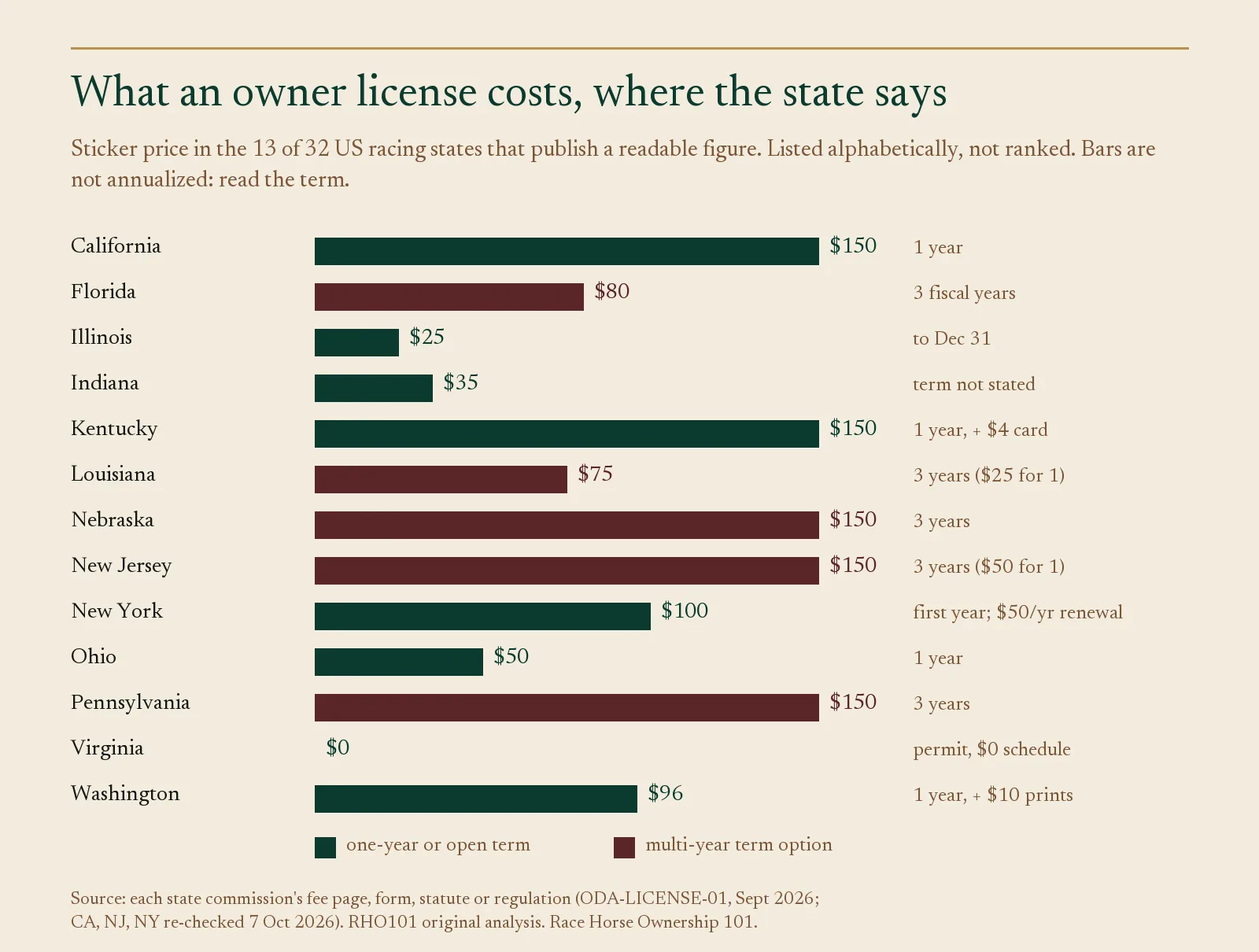
Owner license sticker price in the 13 publishing states (chart)
How we built the table
The universe is the 32 US states that have 2026 Thoroughbred race dates on Equibase and a racing commission listed by the Association of Racing Commissioners International. Massachusetts and Michigan are out because they have no 2026 Thoroughbred dates; Utah is out because it is not on the ARCI list. For each state we looked for the owner-license fee on the commission’s own fee page, application, statute or regulation, and accepted nothing else into the table. A horsemen’s association or a racetrack restating a fee was not enough. The sourcing pass ran in September 2026. The honest edge is the one in the headline: 19 states are not in the table, and 13 of those simply have not been attempted yet by a second method. Until they are, this is a 13-state table, not a national one.
Why you cannot annualize Florida, Pennsylvania, Nebraska, Louisiana or New Jersey
Five of the 13 publishing states sell an owner license for three years, so their sticker price buys three seasons, not one. Florida’s $80 covers three state fiscal years. Pennsylvania’s $150 and Nebraska’s $150 each cover three years. Louisiana sells $25 for one year or $75 for three, and New Jersey $50 for one year or $150 for three.
Line those up against California’s $150 a year and the comparison flips. Read naively, Pennsylvania and California cost the same. Over three seasons, an owner licensed in California pays $450 and one licensed in Pennsylvania pays $150. New York works differently again: $100 for the first year, which expires on your birthday, then $50 a year on renewal for one, two or three years at a time.
Read naively, Pennsylvania and California cost the same. Over three seasons, one is three times the other.
That is why we haven’t ranked the states. A “cheapest state to get licensed in” list would compare a $0 Virginia permit with three-year Florida terms and an annual Kentucky fee, then ignore the costs in the next two sections. Nobody chooses where to race on the license fee anyway. The trainer, the purse structure and where the horse is stabled decide that, and the license follows.
The 19 racing states that did not give us a number
19 of the 32 racing states did not give us a readable owner-license fee: three publish only part of a schedule, three commission websites refused automated retrieval, and 13 were not retrieved in this pass. This is the part of the research I found most useful as an owner, because it tells you where a phone call is unavoidable.
Owner license fee transparency across 32 racing states
| What we found | States | Count |
|---|---|---|
| Readable owner-license fee on the commission’s own site | CA, NY, KY, FL, PA, LA, NJ, IN, IL, OH, WA, NE, VA | 13 |
| Partial: rules published, owner fee not readable. Texas stores its fee schedule as an image (16 TAC §311.5); Maryland’s fee page itemizes only the $100 Jockey Fund line; West Virginia publishes forms with no fee schedule | TX, MD, WV | 3 |
| Blocked: the commission site refused automated retrieval | AZ, AR, DE | 3 |
| Not retrieved in this pass | CO, ID, IA, KS, MN, MT, NV, NM, ND, OK, OR, SD, WY | 13 |
Be careful how you read the last row. Thirteen states not retrieved is a statement about this pass, not an accusation against those commissions; some will turn out to publish a perfectly clear fee in a PDF we have not yet pulled. The middle two rows are different. A fee schedule saved as an image can’t be searched or read by a screen reader. A fee page that lists one fund contribution and nothing else leaves you to ask. If you are heading to Arizona, Arkansas or Delaware, plan to phone the commission office rather than expecting to find the number online.
Washington’s hidden bill: the L&I premium
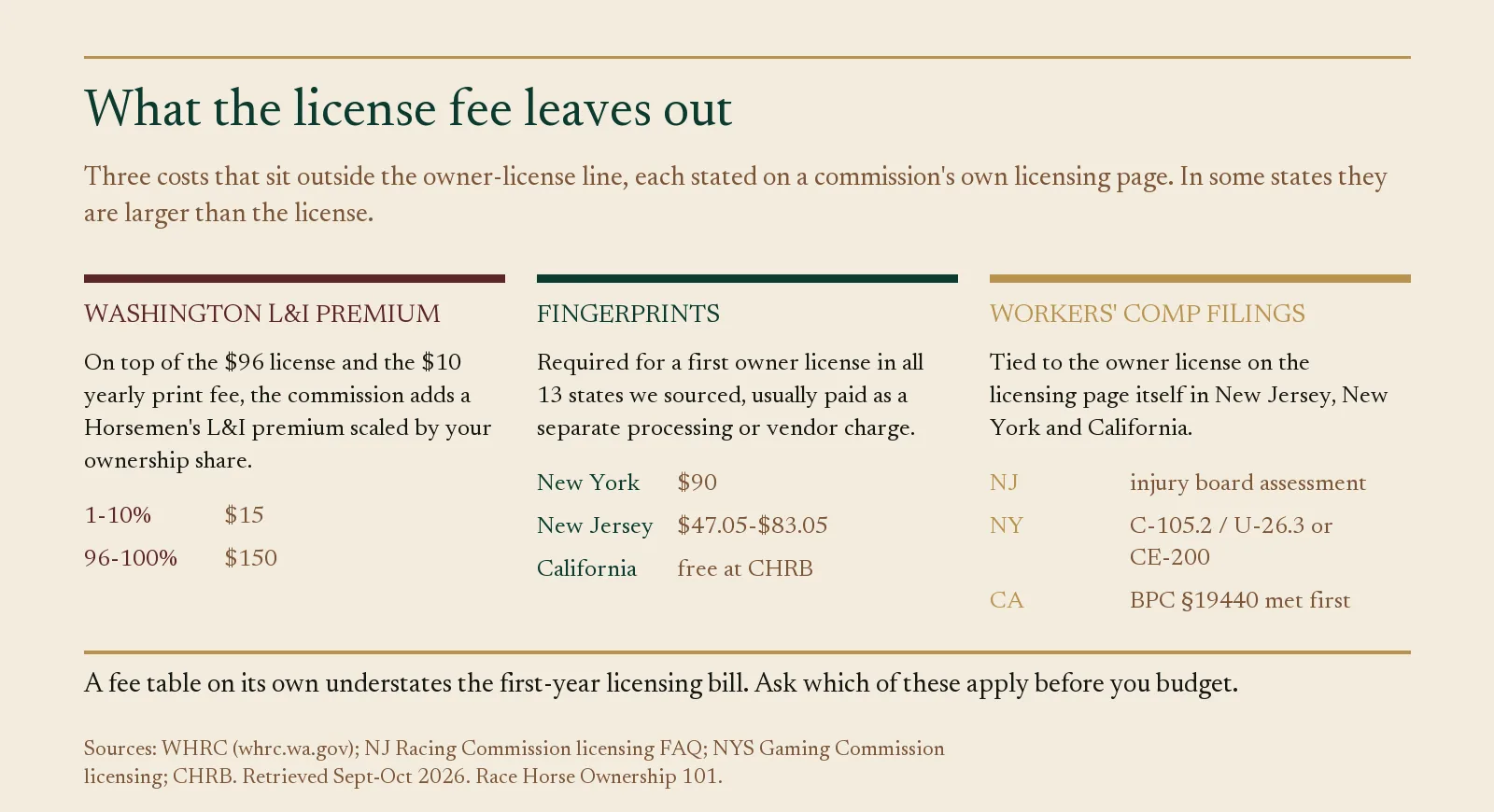
In Washington the owner license can be the smaller bill: the commission adds a Horsemen’s L&I premium scaled by ownership share, from $15 at 1 to 10 percent up to $150 at 96 to 100 percent, on top of the $96 license and the $10 annual print fee. The premium table is on the Washington Horse Racing Commission’s site. For a sole owner, the premium alone can be larger than the license it is attached to.
Washington is the clearest case, but not the only state that ties the owner license to an insurance obligation on the licensing page itself. New Jersey assesses owners for the Horse Racing Injury Compensation Board under N.J.A.C. 13:73. New York requires an owner who employs track or stable workers to file a workers’ compensation certificate (Form C-105.2 or U-26.3), and an owner with no employees to file the CE-200 exemption. California will not issue an owner license unless the workers’ compensation requirements of Business and Professions Code §19440 are met. We found no comparable statement on the licensing pages of the other publishing states, which is not the same as saying none applies there. Ask your trainer which policy covers the people working on your horse, because in most barns the honest answer is the trainer’s, and you should know that before you sign anything.
What the license fee leaves out (graphic)
Fingerprints: usually a vendor charge, not the commission’s
Fingerprinting was required for a first owner license in all 13 states we sourced, but the cost is usually paid to a vendor or a separate processing line rather than built into the license fee. Some commissions print the number; many don’t. Ohio, Kentucky and Virginia will waive new prints or accept prints taken in another racing jurisdiction within a stated window, so an owner already licensed elsewhere may not pay twice.
Fingerprint and background-check costs where the commission states them
| State | Fingerprint cost stated by the commission |
|---|---|
| New York | $90 processing for state and federal prints, first-time applicants (re-checked October 7, 2026) |
| New Jersey | $47.05 state card; $83.05 state and federal; $36 federal reprint every 5 years |
| Illinois | $27 digital; $65 out-of-state card |
| Florida | $36 FD-258 card fee; Live Scan paid to the vendor |
| Virginia | $25 processing |
| Washington | $10 a year processing fee |
| California | Free Live Scan at CHRB offices |
| Kentucky, Indiana, Pennsylvania, Nebraska, Ohio, Louisiana | Prints required; dollar cost not published on the licensing pages |
Notice the spread. A first-time owner in New York pays $90 for prints against a $100 license, so the prints cost almost as much as the license. In California the prints are free at a commission office and the license is the cost. Neither number is large. The point is that a fee table on its own understates the first-year bill, and in some states it understates it by about half.
Does a National Racing Compact license replace these fees?
A National Racing Compact license does not replace the state fee everywhere: 15 of the 32 racing states are Compact members, and New Jersey’s commission says outright that a New Jersey license is not valid in other states. The Compact’s own list of jurisdictions that accept its license is a membership list, not a fee schedule, and several states on it still issue their own license. Nebraska is a useful example of both systems at once: its 2026 schedule lists a $150 three-year owner license and, separately, a $90 National License for owners. The Compact deserves its own explanation, and we give it one in our National Racing Compact license guide.
Partnerships add a second question the fee table cannot answer: whether each partner needs a license, or only the managing partner. We walk the thresholds in who in a racing partnership has to be licensed. The answer ranges from “every partner” in New York on a horse with 35 or fewer owners to a 5 percent threshold in Pennsylvania, Indiana, Virginia, Maryland and Texas. If you are buying into a partnership or syndicate, that rule matters more than the fee, because it decides how many fees get paid.
Owner license fee questions
How much is a racehorse owner license?
Among the 13 US racing states that publish the figure, an owner license costs from $0 in Virginia to $150 a year in California and Kentucky. Five states sell multi-year terms, so check the term before you compare prices.
How much is an owner license in California, New York, Kentucky and Florida?
California charges $150 new and $150 to renew. New York charges $100 for the first license and $50 a year to renew. Kentucky charges $150 a year plus a $4 card fee. Florida charges $80 for a license covering three state fiscal years.
Is a Virginia owner permit really $0?
Yes. Virginia’s entire participant permit schedule under 11VAC10-60-15 is $0. Fingerprint processing is still $25, so a first Virginia permit is cheap but not entirely free.
Are fingerprints included in the license fee?
Usually not. Prints were required for a first owner license in all 13 states we sourced, but the cost is typically a separate processing fee or a vendor charge: $90 in New York, $47.05 to $83.05 in New Jersey, free at CHRB offices in California.
Which states do not publish an owner license fee?
Of the 32 racing states we checked, Texas, Maryland and West Virginia publish only part of the picture, and the Arizona, Arkansas and Delaware commission sites blocked retrieval. Thirteen more states had not been retrieved at the time of writing. In the blocked and partial states, expect to phone the commission.
What to read next
Licensing comes after the decision about how you will own a horse, so if you have not settled that yet, go back to how to buy a racehorse. Once the horse is yours, the federal side of the paperwork is in HISA registration for owners, and the horse’s own identity paper is explained in the ownership certificate guide. The fee is the smallest decision in that sequence. The term, the prints and the insurance line are where first-year licensing costs usually come in higher than the table suggests.
About the Author

Calvin Johnson is a Thoroughbred racehorse owner, day trader, and independent racing analyst with more than a decade of firsthand ownership experience. He has participated in nearly every common structure in horse racing — fractional platform shares, traditional syndicates, LLC partnerships, claiming ventures, and outright ownership — across more than two dozen horses. Calvin writes about racehorse ownership the same way he approaches markets: by studying risk, incentives, fees, and whether the people controlling the deal are aligned with the investors behind it.
- Calvin Johnsonhttps://racehorseownership101.com/author/calvin-johnson/
- Calvin Johnsonhttps://racehorseownership101.com/author/calvin-johnson/
- Calvin Johnsonhttps://racehorseownership101.com/author/calvin-johnson/

- Calvin Johnsonhttps://racehorseownership101.com/author/calvin-johnson/