A HIWU ruling against your horse’s trainer disqualifies the horse’s race result and forfeits the entire purse — and the standard sanction language goes further than the headline suggests, requiring “repayment or surrender (as applicable)” of money that has already been paid out. In the medication cases resolved in late June 2026, the trainer’s own penalty was typically a $500 fine and 1.5 penalty points for each violation. Those numbers land in two different places. The fine and the points attach to the trainer named in the ruling; the disqualification and the lost purse attach to the horse, which means they attach to you. HIWU, the independent enforcement agency for HISA’s Anti-Doping and Medication Control Program, publishes every one of these cases in full. Almost none of it is written for owners.
The short version
- The fine and the penalty points belong to the trainer. The disqualification and the forfeited purse belong to the horse — so the money comes out of the owner’s side, whether or not the owner knew anything.
- A pending case is not a finding. HIWU lists charges before they are resolved, and charges do get withdrawn — one did in the same week as the rulings below.
- Most published medication rulings involve Controlled Medications, not banned doping agents. The distinction is on HIWU’s own substance list, and it should change how you read a headline about your barn.
What a HIWU ruling is, and why it lands on your account
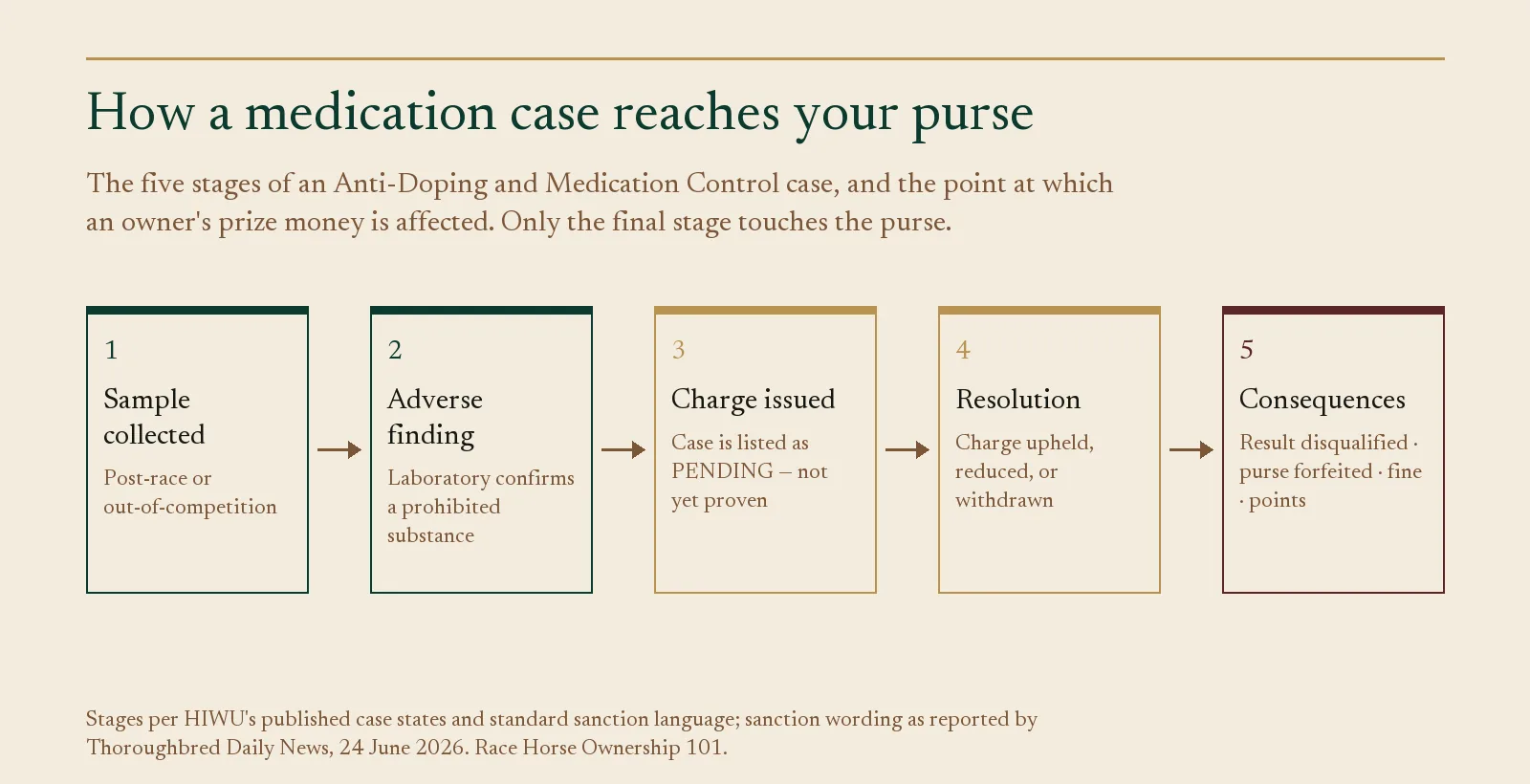
A HIWU ruling is the published outcome of a medication or doping case brought under HISA’s Anti-Doping and Medication Control Program, and it carries consequences for the horse’s race result as well as for the person charged. HIWU — the Horseracing Integrity and Welfare Unit — describes itself as the independent enforcement agency of that program. It was established in 2022 by Drug Free Sport International, and it oversees testing, stakeholder education, laboratory accreditation, investigation of potential violations, and prosecution of them. The ADMC Program itself has been in force since May 22, 2023, as covered in our guide to what HISA is and how it regulates your horse. The practical point for an owner is narrow and unwelcome: a ruling is the moment a laboratory result becomes a financial event on your side of the ledger.
Imagine your colors on the horse at the front.
Not a bet. Not a ticket. Yours. Thousands of everyday fans own a piece of a racehorse. The free guide is how they started.
HIWU splits prohibited substances into two categories, and the difference matters more than most coverage admits. Banned Substances are the agents with no legitimate place in a racehorse. Controlled Medications are therapeutic drugs that are permitted in treatment but restricted around racing. HIWU has warned that both turn up in over-the-counter supplements — naming boldione, glaucine, higenamine and adenosine monophosphate among Banned Substances found in supplement products, and ephedrine among Controlled Medications. A supplement tub in your trainer’s feed room is a plausible route to a ruling with your horse’s name on it.
How a medication case travels from the test barn to your purse
The one sentence in a ruling that costs owners money
Resolved medication rulings carry a standard sanction sentence, and that single sentence is where an owner’s exposure actually lives. Reporting the rulings published for June 18–24, 2026, Thoroughbred Daily News quoted it in full:
Disqualification of Covered Horse’s Race results, including forfeiture of all purses and other compensation, prizes, trophies, points, and rankings and repayment or surrender (as applicable); a fine of $500; imposition of 1.5 Penalty Points
Read it slowly, because it is doing three separate jobs. The disqualification strikes the finish. The forfeiture takes the purse and everything that travelled with it. And then there is the clause almost nobody quotes: “repayment or surrender (as applicable).” Purse money is not held in escrow pending a test result. It is distributed, and it reaches owners. That phrase is the mechanism by which money already in your account can be called back. If you have ever assumed that a cheque cleared means a race is closed, this is the sentence that says otherwise.
What a standard medication sanction does, party by party
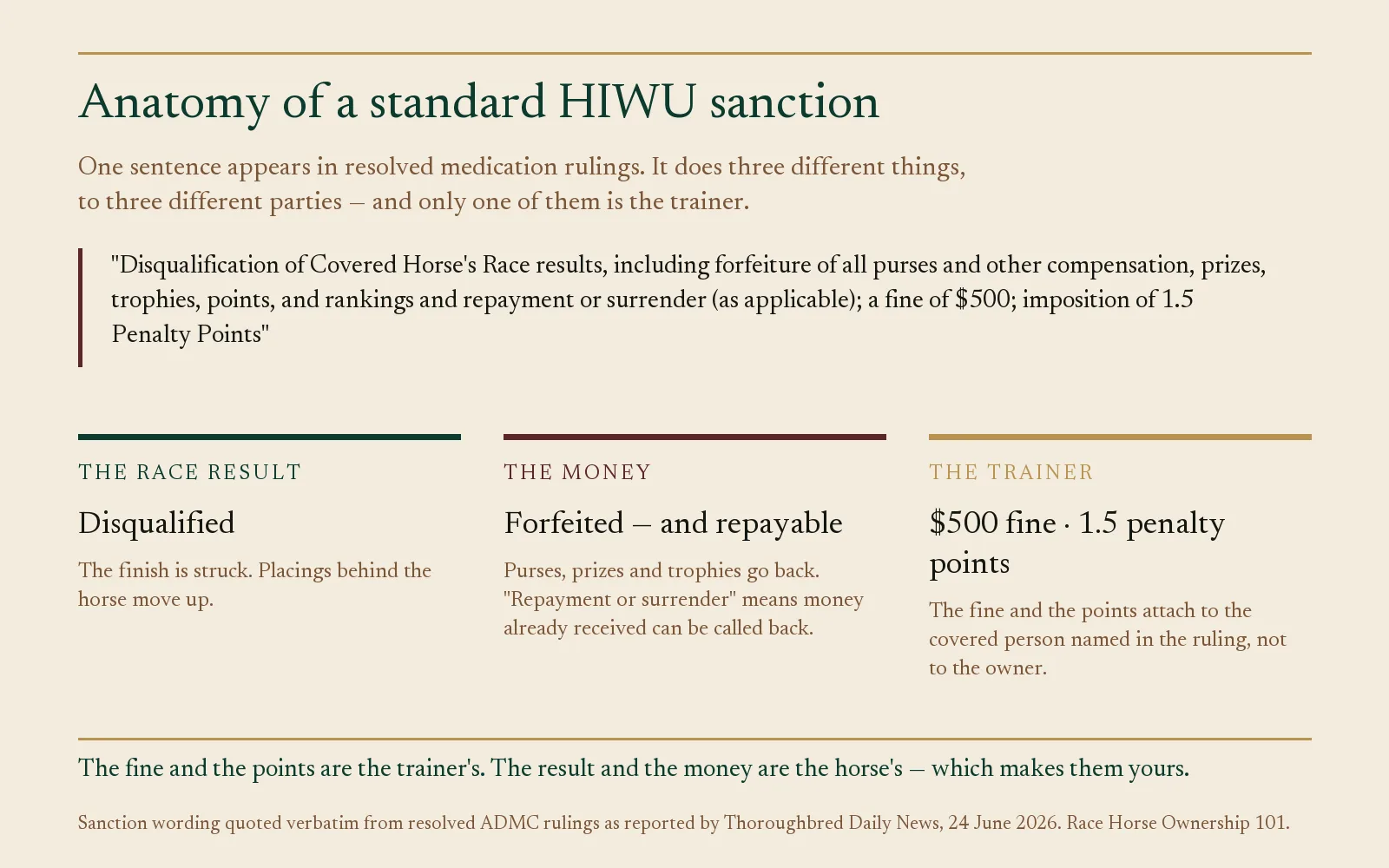
The asymmetry is worth sitting with. A trainer with a $500 fine and 1.5 penalty points has had a bad week. An owner whose horse hit the board in a well-funded race has lost a purse share that can dwarf that fine, and may be asked to send part of it back — the arithmetic of how a purse divides is set out in our breakdown of what racehorse owners actually make from purses and splits. The published number in the ruling is the trainer’s. The unpublished number, which depends entirely on what the race was worth and how the ownership splits it, is the owner’s, and no case page will ever show it to you.
What four June 2026 rulings actually imposed
Four medication cases resolved in the week of June 18–24, 2026 show the standard sanction applied in practice — and one shows a charge collapsing entirely. All four involved substances classified as Controlled Medications rather than Banned Substances, with the exception noted below.
Resolved ADMC rulings, June 18–24, 2026
| Trainer | Substance | Horse and running | Outcome |
|---|---|---|---|
| Ryan Hanson | Dantrolene (Class C) | Potica, 3rd, Apr 30, 2026 — Santa Anita | Result disqualified, purse forfeited; $500 fine; 1.5 penalty points |
| Roshan Samsundar | DMSO (Class C) | Seeker’s Hope, 2nd, May 2, 2026 — Belmont at the Big A | Result disqualified, purse forfeited; $500 fine; 1.5 penalty points |
| Sergio S. Perez | Dexamethasone and methocarbamol (both Class C) | River’s Benchmark, 2nd, May 1, 2026 — Turf Paradise | Result disqualified, purse forfeited; $1,000 in fines; 3 penalty points |
| Jesus Esquivel | Albuterol/salbutamol (banned bronchodilator) | Summonyourcourage and Geno’s Myth, 2025 | Charges withdrawn; no penalty imposed |
Two things stand out. The Perez case shows how the arithmetic scales: two violations on one horse in one race drew double the fine and double the points, but the horse’s result was disqualified once. And the Esquivel case — a banned bronchodilator, the most serious category in the table — ended with the charges withdrawn and no penalty at all. That is the case an owner should remember, because it is the one that never makes a headline.
Pending is not proven, and the difference is your money

HIWU publishes cases before they are resolved, which means a trainer’s name can appear in public while the outcome is still open. The unit maintains separate listings for pending violations, resolutions and archived resolutions. A name under “pending” has been charged. It has not been found against.
In the same week the four rulings above were published, cases were pending against several trainers, including a Class B gabapentin finding involving a graded stakes winner at Keeneland. Those were charges, not conclusions. The Esquivel withdrawal in the resolved column is the proof that the distinction is real rather than procedural politeness. Anyone — a partner, a syndicate member, a prospective buyer — who reads a pending listing as a verdict is reading it wrong, and if they act on it by moving a horse or pulling out of a deal, they may be paying for a violation that is never established.
How to read the HIWU case pages without a lawyer
The HIWU case pages are a regulatory database, organized for the regulator rather than for the person whose horse is in it. Five things make them readable for an owner. I go through them in this order, because the first one changes what the rest of the page means.
- Check which list you are on first. Pending, resolved and archived are separate. The status changes the meaning of everything else on the page.
- Find the horse, not just the trainer. The sanction attaches to a named covered horse and a specific race date. If your horse is not the one named, your purse from a different race is not in the sanction.
- Look up the substance. HIWU runs a substance lookup. Whether the finding is a Banned Substance or a Controlled Medication is the single biggest signal about how serious the case is.
- Read the sanction sentence in full. Specifically, check whether “repayment or surrender” appears, and whether the race named is one your horse was paid for.
- Note the dates. The gap between the race date and the ruling date is often months. A ruling published this week can reach back to a race last spring.
That last point is the one owners underestimate. In the June 2026 rulings, the races involved ran between late April and early May — six to eight weeks before publication. Purse money from a race that long ago is not sitting in a suspense account. It has been paid, split among partners, and in many cases spent.
Penalty points and periods of ineligibility, in plain English
Penalty points are a running tally attached to the person sanctioned, not to the horse or the owner, and they accumulate across separate violations. The June 2026 rulings show the mechanism clearly: 1.5 points for a single Controlled Medication violation, 3 points where two violations were found in the same running. Accumulated points can carry consequences beyond the individual case, including periods during which a trainer cannot act.
We are not going to publish a points-to-days conversion table here, because the thresholds sit in HISA’s rulebook and we could not confirm a specific figure to a primary source at the time of writing. If a trainer’s points total matters to a decision you are about to make, read the current rule text on HISA’s own regulations pages rather than a secondhand summary — including ours. A number quoted confidently from a forum is exactly the kind of thing that is out of date by the time it reaches you.
If your trainer is named: what owners can and can’t do

An owner has no standing in the case itself — the charge runs against the covered person named in the ruling, and the owner is not a party to it. What an owner does control is documentation, placement and timing. Consider an owner who learns from a trade headline that their trainer has a pending finding on a different horse in the barn: the useful moves are unglamorous.
- Get the ruling itself, not the headline. Confirm the horse, the race date and the status before you do anything.
- Ask your trainer directly, in writing. A written answer about what was administered and when is worth having whether or not the case goes anywhere.
- Ask whether any purse you have received is implicated. If your horse is not the covered horse in the ruling, it is not.
- Check your own agreement. Partnership and syndicate documents vary on who absorbs a clawback and how a manager may act without consulting you — our guide to what is actually in a syndicate or partnership agreement covers the clauses that decide this.
- Take advice before moving a horse. Moving in reaction to a pending charge has real costs, and the charge may be withdrawn. I would not move a horse on a pending listing alone, and I would want the ruling’s status confirmed in writing before I did.
What we can’t tell you from the public record is what happens administratively to every horse in a barn when a trainer is suspended, or how a specific state commission will treat a transfer during a period of ineligibility. Those turn on the rule text and on the jurisdiction, and they are worth a call to HISA or your state commission rather than an assumption. This is one of the places where a lawyer who works in racing is cheaper than the alternative.
Watching the rulings before you buy in or move barns
The strongest use of the HIWU case pages is due diligence before you commit money to a barn, well before any question of damage control arises. The pages are free, public and searchable, and almost no prospective owner reads them before signing.
Before you place a horse with a trainer, or buy into a partnership whose trainer is already chosen, the record is there to be read. One resolved Class C finding across a long career is noise. A pattern is information. That check belongs alongside the rest of the work in our owner’s vetting checklist for choosing a trainer, and it costs nothing but the time.
The honest answer. You cannot insure against a trainer’s medication violation, and you cannot appeal a case you are not party to. What you can do is know the record before you commit, read the sanction sentence rather than the headline after, and understand that the purse you were paid is not final until the testing window on that race has closed.
Questions owners ask about HIWU rulings
Can purse money I have already received be taken back?
The standard sanction language in resolved ADMC rulings provides for forfeiture of all purses and other compensation together with “repayment or surrender (as applicable),” which is the mechanism for recovering money already distributed. Whether it is pursued in a given case, and how it reaches an individual partner rather than the ownership entity, depends on the case and on your own ownership agreement. If you are in a partnership, the agreement decides who absorbs it.
Am I liable if my trainer gets a medication violation?
In the published rulings, the fine and the penalty points are imposed on the covered person charged — the trainer — not on the owner. The owner’s exposure runs through the horse instead: the disqualification of the result and the forfeiture of the purse follow the covered horse regardless of who was at fault. That is a financial consequence rather than a finding against you, and the two should not be confused.
What is the difference between a banned substance and a controlled medication?
HIWU divides prohibited substances into Banned Substances and Controlled Medications. Controlled Medications are therapeutic drugs restricted around racing; Banned Substances have no legitimate therapeutic role. Most of the resolved rulings in the June 2026 week involved Class C Controlled Medications. HIWU’s substance lookup is the authoritative place to check any specific drug, and it is the first thing to consult before drawing conclusions about a barn.
Does a ruling affect my horse’s eligibility to run?
The sanction language published in these rulings acts on the race result — disqualification, forfeiture, and the loss of points and rankings earned in that running. It does not, on its face, bar the horse from future racing. A trainer’s period of ineligibility is a separate matter and is what practically affects a barn’s runners. If your horse’s specific eligibility is in question, confirm it with HISA or your state commission rather than inferring it from the ruling text.
The rulings are published the same week they are decided, in full, for anyone to read. In the week of June 18–24, 2026, that meant four resolved medication cases, several pending charges, and one set of charges withdrawn without penalty. The information asymmetry between an owner who reads that page and an owner who waits for a phone call is entirely a matter of ten minutes a week.
About the Author

Calvin Johnson is a Thoroughbred racehorse owner, day trader, and independent racing analyst with more than a decade of firsthand ownership experience. He has participated in nearly every common structure in horse racing — fractional platform shares, traditional syndicates, LLC partnerships, claiming ventures, and outright ownership — across more than two dozen horses. Calvin writes about racehorse ownership the same way he approaches markets: by studying risk, incentives, fees, and whether the people controlling the deal are aligned with the investors behind it.
- Calvin Johnsonhttps://racehorseownership101.com/author/calvin-johnson/

- Calvin Johnsonhttps://racehorseownership101.com/author/calvin-johnson/

- Calvin Johnsonhttps://racehorseownership101.com/author/calvin-johnson/

- Calvin Johnsonhttps://racehorseownership101.com/author/calvin-johnson/