
A horse sale catalog is the single most important document you will read before you bid: it is an advertisement written to a strict standard, not an independent report on the horse, and what is missing from a page often matters more than the bold-faced black type that sells the relatives. The first sale catalog I ever studied looked like a stack of trophies. Every page had a bold-faced name in it somewhere, a black-type race, a stakes-winning cousin. I remember thinking the hard part would be affording one of these horses, not finding a good one. Then a bloodstock agent I trusted took my pen, circled three things on a page I loved, and asked me a question the catalog didn’t answer. The hip I thought was elite was, on paper, a nicely dressed maybe.
A sale catalog is the single most important document you will read before you bid, and almost nobody teaches you to read it. Sale companies produce catalogs to sell horses. Consignors write the pages to present their horse in the best honest light the rules allow. Neither of those jobs is the same as yours, which is to figure out what you are actually buying before the adrenaline and the paddle take over. This guide walks the anatomy of a catalog page, names what the format quietly leaves out, and gives you the pre-bid questions the page can’t fill in.

The short version
- The catalog page is an advertisement written to a strict standard, not an independent report on the horse.
- What’s missing from a page often matters more than what’s on it — unraced foals, thin start counts, and a quiet female family.
- Black type tells you about the relatives, not the horse in front of you.
- A reserve you can’t see sits behind almost every hip, and “RNA” means the horse didn’t sell.
- The real due diligence — vet repository, conformation, the consignor’s answers — happens off the page.
Why the catalog is an advertisement, not a dossier
Start from who wrote the page and why. The sale company sets the format and prints the pedigree; the consignor supplies and arranges the material within the rules. Everything true about the horse’s family that helps the sale tends to appear. Everything true that hurts the sale tends to be technically present but easy to skim past, or absent because the rules don’t require it. That isn’t fraud — it’s marketing operating inside a standardized template. Your job is to read the template the way an editor reads a press release: grateful for the facts, skeptical of the framing.
The Sport of Kings has a side entrance. Here’s the key.
Regular people own racehorses — together, in partnerships — and stand in the paddock like they were born there. The free guide shows you the way in.
The independent read is the whole game here. A consignor will never circle the weak spot on their own page for you, and neither will the auctioneer. That’s not a knock on them; it’s their side of the table. Reading the page yourself — or paying an agent to — is the cheapest protection you will buy in this entire process. It costs an evening. The horse costs the rest.
Anatomy of a hip page
Every horse in a sale is assigned a “hip number” — the running order it sells in — and gets one page, sometimes shared with a photo supplement. North American catalogs follow uniform cataloguing standards, so once you can read one page you can read all of them. Age labels on those pages (foal, yearling, 2-year-old, colt) are their own vocabulary — our racehorse age stages guide unpacks them. The page has four zones worth knowing cold.
The header gives you the identity: hip number, sex, color, foaling date, sire, and dam. The pedigree block is the family tree — sire’s side across the top, dam’s side below — usually three generations. The black type is the formatting itself: a name printed in BOLD CAPITALS is a stakes winner; a name in bold upper-and-lower case placed second or third in a stakes. That convention is set by international cataloguing standards, not by the consignor, which is exactly why it’s trustworthy as far as it goes — and why it’s so easy to over-read. Black type describes the relatives. The horse you’re bidding on, if it’s a yearling, has never run a step — and if you are buying to flip rather than race, see what pinhooking risks and returns actually look like. The produce record and female family — the bottom of the page — is where the real information hides, and we’ll spend the most time there.
Here is the same page read twice: once for what each field advertises, and once for what it can quietly omit.
The hip page, field by field
| Catalog field | What it shows you | What it can hide | The question to ask |
|---|---|---|---|
| Sire line (top) | The fashionable, marketable half of the pedigree | Stud fee and fashion say little about this foal’s ability | Is the sire being used to distract from a plain female family? |
| Black type (bold names) | Stakes winners and stakes-placed horses in the family | How close that black type is — a Grade 1 winner three generations back is nearly decorative | Is the black type in the first two dams, or is it distant cousins? |
| 1st dam produce record | The mare’s foals listed by year, with any winners noted | Foals that never raced, and gaps between foals | How many named foals actually started, and how many won? |
| “Dashes” / blanks in the record | Nothing — and that’s the point | An unraced or unplaced foal is often just left as a bare line | Why did this foal never make it to the races? |
| Race record (2yo+ only) | Starts, wins, and earnings for a horse that has run | A short record can mean soundness problems, not just youth | Few starts for the age — why? |
| Sale/entry conditions | Where and how the horse sells | The reserve — the price below which it won’t sell — is never printed | What happens if bidding stalls below the reserve? |
What the catalog quietly leaves out
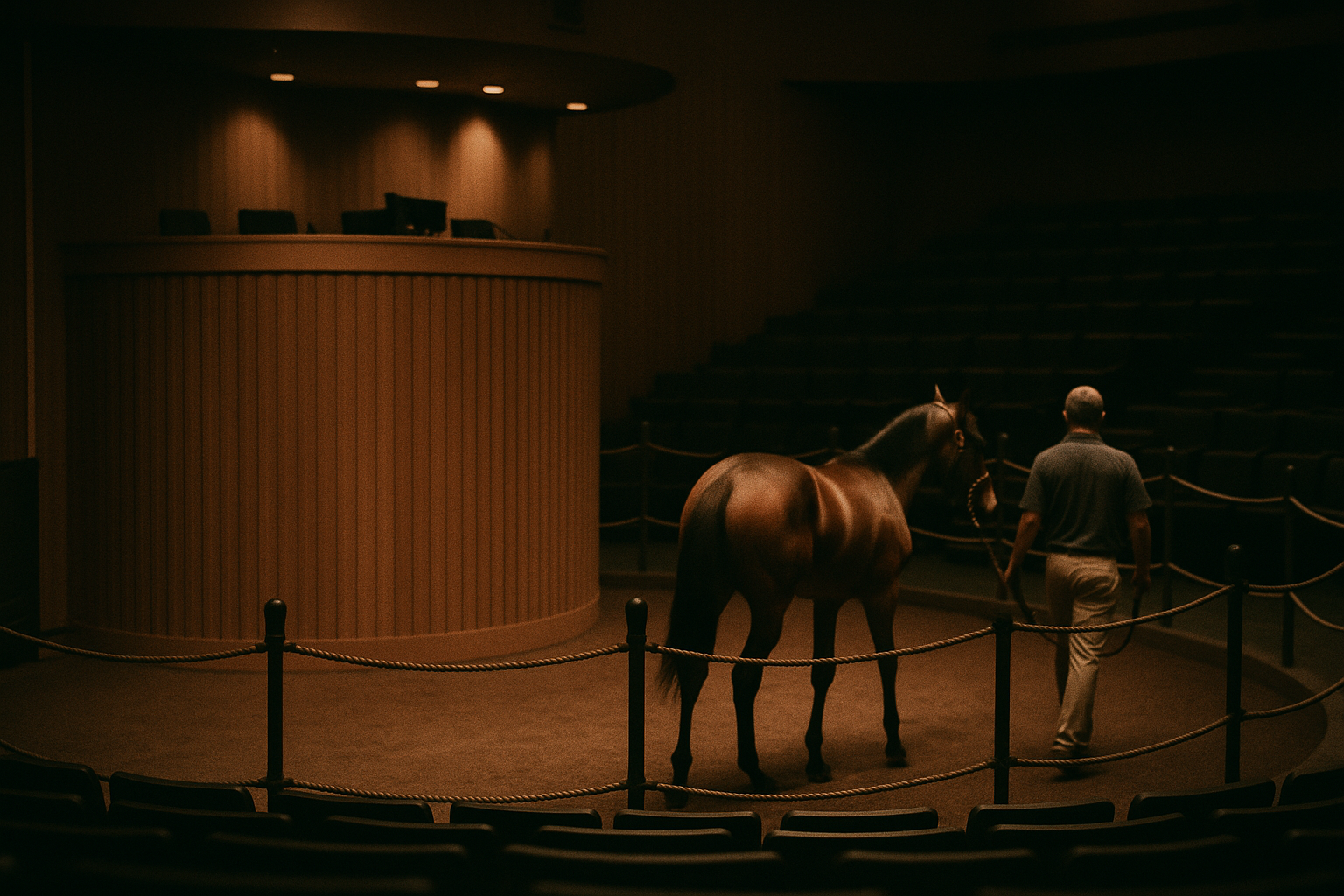
The most useful skill in reading a catalog is noticing an absence. The format rewards what a horse and its family did, and it simply doesn’t have a field for what they failed to do. So failure shows up as blank space, and blank space is easy to skip.
Unraced foals are the clearest example. When a mare’s produce record lists a foal by year with no race record beside it, that horse may simply be too young to have run — or it may have been tried and found wanting. The page won’t distinguish the two. A first dam with several older foals that never started is telling you something, even though every line on it is technically true.
Start counts are the second. For any horse old enough to have raced, the number of starts is a soundness signal as much as an ability signal. A four-year-old with three lifetime starts and no black type isn’t a hard-luck story you need to talk yourself into; it’s a horse whose own record is quietly asking a question. And the reserve — the price the seller has set as a floor — is the largest omission of all, because it’s deliberate. Sellers have the right to set reserves that are not disclosed to buyers, which means every time you raise your hand you are bidding against a number you cannot see.
Reading the female family
If you learn one thing from this piece, make it this: the bottom of the page outranks the top. Sire lines are fashion, and fashion is priced in before you arrive. The female family — the first and second dam and their produce — is where a page is genuinely strong or genuinely thin, and it’s the part consignors have the least room to dress up, because the produce record is just a list of what each mare has actually thrown.
Read the first dam first. How many foals has she had, how many started, how many won, and did any earn black type of their own? A mare whose foals consistently make the races is telling you her family is sound and useful, even without a champion. Then read the second dam for depth. Black type close to the top of the page — in the first two dams — is worth far more than a Grade 1 winner buried three or four generations back, which by then is shared with hundreds of other horses.
Context saves you from over-reacting, though. A young mare with only one or two foals hasn’t failed; she hasn’t had time. A gap in produce can mean a barren year or a lost foal, not unsoundness. The red flag is the pattern — an older mare with many chances and little to show, a family that goes quiet the closer you get to the horse in the ring.
Black type near the top of the page is worth more than a champion buried at the bottom. Fashion sits in the sire line; information sits in the first two dams.
Reserve price and RNA, explained
The mechanic that confuses first-time buyers the most isn’t on the page at all. Before a horse enters the ring, the seller can place a reserve — a confidential minimum price. If the bidding doesn’t reach it, the horse doesn’t sell. In the results you’ll see it marked RNA: “reserve not attained.” Under the standard conditions of sale, reserves are set by the seller and are not disclosed to buyers, and the sale company simply administers them at the ring.
Here’s the part that matters for you: an RNA is not a scandal and not a bargain. It means the seller and the market disagreed on price that day, and the seller kept the horse. Plenty of good horses go through the ring as RNAs; so do plenty of correctly-priced ones the market simply passed on. What an RNA does not tell you is which. Treat the three outcomes below as neutral facts, then do your own homework on the horse regardless of which one the hammer produced.
Sold, RNA, or out — what the hammer actually means
| Outcome | What happened in the ring | What it means for you as a buyer |
|---|---|---|
| Sold | Bidding met or passed the hidden reserve; the hammer fell to a buyer | You own it (and its risks) the moment the hammer drops — the price is real and binding |
| RNA (reserve not attained) | Bidding stopped below the reserve; the seller kept the horse | Not for sale at that level today; a later private deal is sometimes possible, but you’re negotiating blind to the reserve |
| Out / withdrawn | Scratched before selling — often a vet finding or a change of plan | Ask why it came out; a withdrawal after the repository opened can be a meaningful signal |
Print, digital, and the paperwork the page points to

Whether you read a printed catalog or a digital hip page in an app, the content follows the same standard — the digital version just makes it searchable and adds late updates. Consignors also file supplements: a horse’s family can pick up fresh black type between the catalog’s printing and sale day, and those updates appear online and on the boards before they ever reach paper. Always check the digital page last; it’s the current one.
The catalog’s most important job, though, is pointing you off itself. At the major sales, the page is your index into a repository of veterinary information — radiographs and, at many sales, endoscopic exams — that you or your vet can review before bidding. The page tells you the horse exists and who its family is. The repository, a conformation look in the barn, and a straight conversation with the consignor tell you whether to bid. If you take nothing else from a catalog page, take the questions it raises to the people who can answer them.
A pre-bid checklist the catalog can’t fill in
Before you commit a number to a hip, walk this list. Every item is something the page either won’t tell you or won’t volunteer, and every one is fair to ask a consignor directly.
- Of the first dam’s named foals, how many actually started, and how many won?
- Is the black type in the first two dams, or is it distant?
- For a horse of racing age: why the start count it has — youth, or soundness?
- Are there unraced older foals in the produce record, and does the consignor know why?
- Has the repository (X-rays, scope) been reviewed by my vet — not just glanced at?
- What did a conformation look in the barn add or subtract versus the page?
- Is there a reserve, and roughly where is bidding expected to open?
- Any surgeries, wind procedures, or vet notes the consignor will disclose if asked?
- Does my total budget cover the hammer price plus a full year of training and care?
- Am I buying this horse, or am I buying the sire’s name and the room?
Buyer-protection note. Once the hammer falls, the horse is yours — including anything the page didn’t say. That’s precisely why the unglamorous steps (an independent vet on the repository, an agent’s eye on the female family, a hard budget that survives contact with a bidding war) are the ones that protect your money. The catalog is where due diligence starts, never where it ends.
Reading the catalog well is one link in a longer chain. If you’re still mapping how you’d even acquire a horse, start with our independent guide to how to buy a racehorse and every ownership path. To turn a page into a number, pair this with what a racehorse is actually worth; and if you’re weighing what age to buy, our breakdown of yearlings versus two-year-olds for partnership buyers covers how the catalog reads differently at each sale.
How to read a thoroughbred sale catalog, step by step
Open any hip page and work it in this order — top to bottom, then the absences — before you fall for the bold-faced black type.
- Confirm the age and sex line first so you know what animal the pedigree is selling.
- Read the pedigree from the bottom up — first dam’s produce, then second dam — before distant Grade 1 cousins.
- Note the consignor and ask what the page omits, not only what it advertises.
- Treat RNA as “reserve not attained,” not a bargain tag or automatic red flag.
- Close with barn and vet questions the catalog format cannot answer.
Frequently asked questions
What does RNA mean in a sale catalog?
RNA stands for “reserve not attained.” The seller set a confidential minimum price, the bidding didn’t reach it, and the horse didn’t sell. Under the standard conditions of sale, reserves are set by the seller and aren’t disclosed to buyers. An RNA is neither a red flag nor a bargain by itself — it just means seller and market disagreed on price that day.
What does black type mean, and why is some of it bold capitals?
Black type flags stakes-quality relatives. A name in bold capital letters is a stakes winner; a name in bold upper-and-lower case was stakes-placed (second or third). The convention comes from uniform international cataloguing standards, which is why it reads the same across sales — see BloodHorse’s history of how black type evolved. Remember it describes the family, not the individual.
How do I get vet reports and X-rays before I bid?
Major sales maintain a repository where consignors file radiographs and often endoscopic exams; registered buyers and their veterinarians can review it before the horse sells. The catalog page is your pointer to it. The Retired Racehorse Project’s overview of navigating thoroughbred sales is a useful independent primer on how the process fits together. Always have your own vet read the repository — don’t rely on the consignor’s summary.
Do Keeneland, Fasig-Tipton, and OBS use different catalog formats?
The presentation differs, but the substance doesn’t. All North American thoroughbred sales catalog to the same uniform standards, so the black type, pedigree block, and produce record mean the same thing wherever you read them. What changes is the type of sale — a yearling sale, a two-year-olds-in-training sale, a breeding-stock sale — which changes what fields carry weight, not how to read them. Calendar names can mislead: our Lexington Selected Yearling Sale guide explains one Standardbred auction Thoroughbred buyers often mistake for a Fasig-Tipton tier.
The catalog will never tell you the one thing you most want to know — whether this horse can run. What it will do, read honestly, is stop you from paying for a story. Learn the page, notice the blanks, and take your questions to the barn before you take your paddle to the ring.
About the Author

Calvin Johnson is a Thoroughbred racehorse owner, day trader, and independent racing analyst with more than a decade of firsthand ownership experience. He has participated in nearly every common structure in horse racing — fractional platform shares, traditional syndicates, LLC partnerships, claiming ventures, and outright ownership — across more than two dozen horses. Calvin writes about racehorse ownership the same way he approaches markets: by studying risk, incentives, fees, and whether the people controlling the deal are aligned with the investors behind it.
- Calvin Johnsonhttps://racehorseownership101.com/author/calvin-johnson/

- Calvin Johnsonhttps://racehorseownership101.com/author/calvin-johnson/

- Calvin Johnsonhttps://racehorseownership101.com/author/calvin-johnson/

- Calvin Johnsonhttps://racehorseownership101.com/author/calvin-johnson/
