A foal is any Thoroughbred under one year old, of either sex; a colt is a male horse four years old or younger. That is the whole muddle in one line: foal, weanling, yearling, and 2-year-old are age stages, while colt and filly mark sex. The same horse can be a filly, a foal, and a yearling in the space of a year. I learned the difference the way most first-time buyers do — reading a sales catalog, hitting a line like “2024 foal by Constitution,” and trying to work out whether that meant a baby still on the ground or a horse I could put in training by spring.
The short version
- Age words (foal → weanling → yearling → 2-year-old) tell you how old a horse is.
- Sex words (colt, filly) tell you what sex it is — a colt is a young male, a filly a young female.
- Every Thoroughbred in the Northern Hemisphere shares an official birthday of January 1, so “2024 foal” means born in 2024, not “currently a baby.”
- Most owners first buy in as yearlings (public auction) or 2-year-olds (in-training sales) — rarely as foals or weanlings.
Why the age words matter before you spend a dollar
Sale catalogs, partnership offerings, and pinhook pitches all assume you already know what foal, yearling, and 2-year-old mean — and each stage carries a different price and a different risk, so a misread term is a real financial mistake. The vocabulary works as a quiet filter. Operators and consignors rarely stop to define it, partly because it separates the people who have done their reading from the people who haven’t.
The Sport of Kings has a side entrance. Here’s the key.
Regular people own racehorses — together, in partnerships — and stand in the paddock like they were born there. The free guide shows you the way in.
The gap is not academic. The same individual can sell as a weanling one autumn and a yearling the next, and the yearling price is routinely well above what the weanling brought — that spread is the entire business model of pinhooking. If you don’t know which stage you’re looking at, you can’t judge whether a number is fair. Here is the full arc, from the ground to the racetrack.

Foal: the first year
A foal is a Thoroughbred of either sex from birth until it turns one — and in a pedigree, “2024 foal by Sire” tells you the horse’s birth year and its father, not that the animal is a baby right now. This is where the confusion starts. Because The Jockey Club assigns every Northern Hemisphere Thoroughbred an official birthday of January 1, a horse foaled in the spring of 2024 is already a yearling on paper by January 1, 2025, and a two-year-old the January after that — no matter its actual foaling date.
The rule dates to 1833 and exists to keep a cohort aligned for racing and registration; the precise foaling date is still recorded, but the racing age advances on the calendar (Thoroughbred Daily News has a good history of it). For a buyer, the practical takeaway is simple: the word “foal” in a produce record is history, not the horse’s current selling age. What sets the current age is the sale you’re standing in.
Weanling: the in-between stage the professionals trade
A weanling is a foal that has been separated from its dam — usually between four and seven months old — but has not yet turned one, and it is both the cheapest stage to buy and the hardest to project. Weaning is a management step, not an age milestone; the label just tells you the foal is off its mother’s milk and on its own. Weanlings change hands mainly at mixed autumn sales such as Keeneland’s November Breeding Stock Sale, alongside the mares and stallions.
Here is the honest part: almost no first-time owner should be buying a weanling. It is a professional’s game — pinhookers buy at this stage precisely because a well-chosen weanling can be resold as a yearling for a large markup, and they absorb the risk that the horse fails to develop over the intervening months. That risk is real, and it is not one a newcomer is equipped to price.
The word “foal” in a pedigree is history. What sets a horse’s selling age is the sale you’re standing in.
Yearling: the auction staple
A yearling is a horse between one and two years old, and it is the single most common age at which racehorses change hands at public auction. If you have heard of one Thoroughbred sale, it is probably Keeneland’s September Yearling Sale — the benchmark of the market, where most partnerships and trainers assemble their racing strings for the following year.
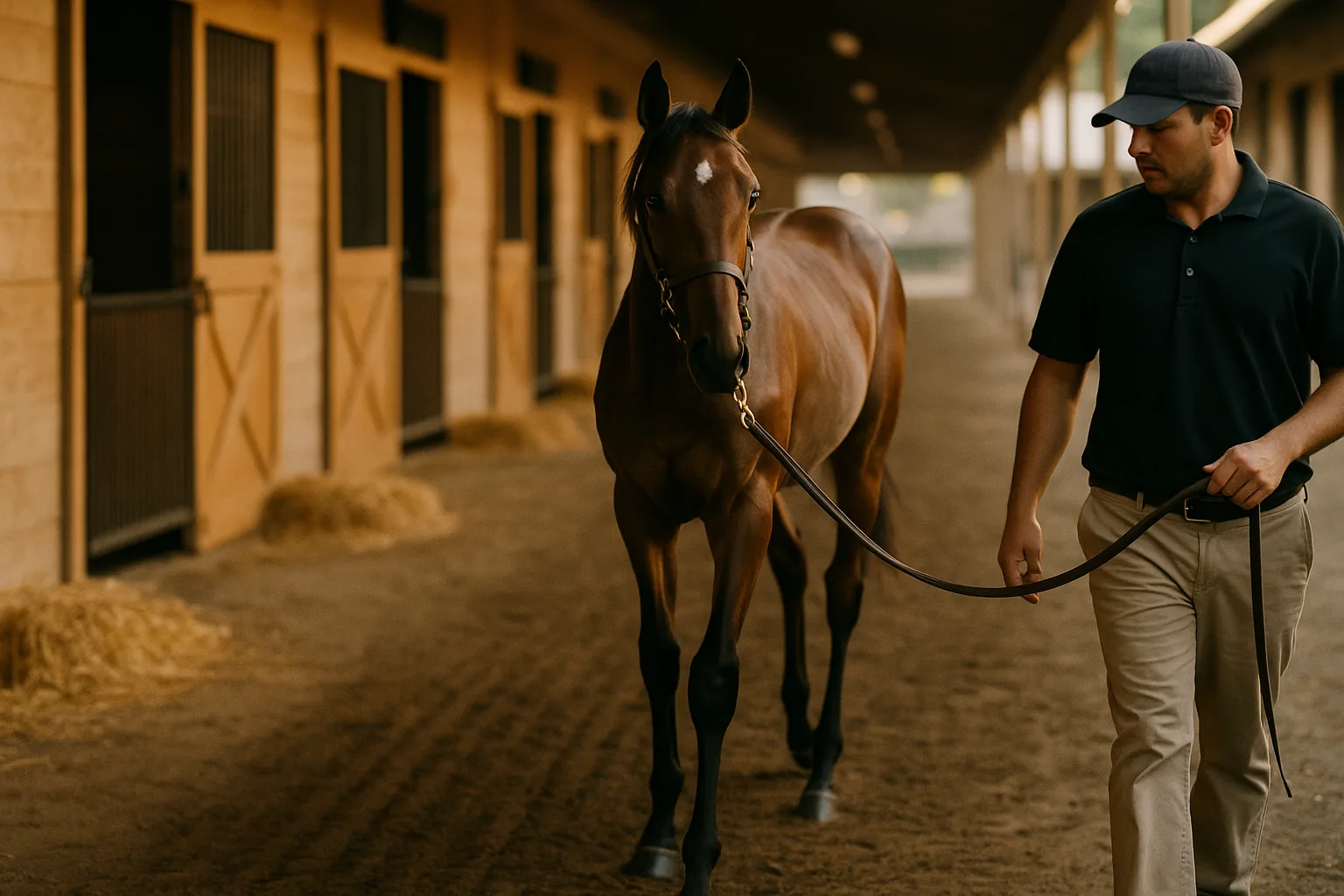
Most yearlings are not yet broken to saddle when they sell — you are buying conformation, pedigree, and a vet’s read of the X-rays, not a horse you have seen run. That is the trade-off of the stage: more unknowns than a 2-year-old, but a lower entry price and first pick of a crop before anyone has seen it move. It is also the stage where the price step-up from weanling is steepest, which is exactly why the professionals who bought last autumn are selling here now. If you are weighing this stage against buying a horse that has already breezed, we cover that fork in detail in yearling vs. 2-year-old for partnership buyers.
Two-year-old: in training and breezing
A 2-year-old is a horse in its second calendar year — old enough to be broken, to breeze, and often to race — and the “2-year-olds in training” sales let you watch a horse work a short, timed distance before you bid. These breeze-up sales, run by outfits such as the Ocala Breeders’ Sales company and Fasig-Tipton, are the market’s answer to yearling uncertainty: you pay more, but you have seen the horse move under tack, and a fast, clean breeze can lift a price sharply.
This is the last stop before the racetrack. Thoroughbreds are bred to debut at two, and most 2-year-olds bought at these sales are pointed at a first start within months. For a buyer who wants to compress the guessing, it is the most reassuring age to buy — and you pay for that reassurance in the hammer price.
Colt vs. filly vs. foal: why one is not the opposite of the other
Colt and filly describe sex; foal, weanling, yearling, and 2-year-old describe age — so “colt vs. foal” is a category error, a little like asking whether someone is male or a teenager. A colt is an entire (that is, un-gelded) male four years old or younger. A filly is a female four years old or younger. Cross the fifth birthday and the vocabulary changes again: an entire male becomes a horse (or “entire”) and a female becomes a mare. A male castrated at any age is a gelding.
So a single animal in its first spring is a foal (age) and a colt or filly (sex) at the same time. None of these words competes with the others — they answer different questions. The reason it feels confusing is that a catalog line stacks them together: “bay colt” in a yearling sale is telling you sex and color, while the sale itself is telling you the age. If sex status is driving your buying decision — for a colt’s breeding upside or a filly’s residual value — that is its own analysis, which we break down in colt vs. filly in Thoroughbred partnerships.
Racehorse age and sex terms at a glance
| Term | What it describes | Sex | Age | Where you meet it |
|---|---|---|---|---|
| Foal | Age | Either | Birth to under 1 yr | Produce records; “2024 foal by…” |
| Weanling | Age | Either | ~4–12 months (weaned) | Autumn breeding-stock sales |
| Yearling | Age | Either | 1 to under 2 yrs | September yearling sales |
| 2-year-old | Age | Either | 2nd calendar year | Breeze-up / in-training sales |
| Colt | Sex | Male (entire) | 4 yrs and under | Any catalog, next to color |
| Filly | Sex | Female | 4 yrs and under | Any catalog, next to color |
| Gelding | Sex | Castrated male | Any age | Race programs; sales |
| Horse / Mare | Sex | Male / Female | 5 yrs and up | Older racing & breeding stock |
| Colt vs foal | Different axes | Colt = young male | Foal = under 1 yr | Search queries mix sex + age words |
| How old is a yearling? | Age | Either | Officially 1 (Jan 1 birthday) | Yearling sales; catalog age line |
When you’re actually likely to buy at each stage
Most first-time owners buy in as yearlings through a partnership or as 2-year-olds, and rarely as weanlings or foals — as a rule, the earlier the stage, the more expertise and patience the game asks of you. A partnership or syndicate does the stage-picking for you: it buys yearlings or 2-year-olds, then sells you a share, so the age decision is effectively made by the manager. Buying privately or at auction on your own puts that decision — and its risk — back in your hands.
What sells at each age, and who’s buying it
| Stage | Typical sale | Who mostly buys | What you’re betting on |
|---|---|---|---|
| Weanling | Autumn breeding-stock sales | Pinhookers, breeders | Development over the next year |
| Yearling | September yearling sales | Trainers, partnerships, agents | Conformation, pedigree, X-rays |
| 2-year-old | Breeze-up / in-training sales | Trainers, partnerships, end owners | A breeze you’ve watched |
| Racing age | Horses-of-racing-age sales; claiming | Owners wanting to run now | A proven (or nearly proven) runner |
How to read age labels in a sale catalog
In a sale catalog, the horse’s current selling age is set by the sale itself, not by the word “foal” anywhere on the page — a September yearling sale sells yearlings, full stop. Once that clicks, a catalog page stops being intimidating. Take a typical hip:
Hip 214 — Bay Colt
Foaled April 3, 2025
By Leading Sire — Broodmare, by Notable Grandsire
Read at a September 2026 yearling sale, that line is a yearling (born in 2025, so one year old by the January-1 rule), a colt (entire male), bay in color, by a named sire and out of a named mare. “Foaled April 3, 2025” is the real birth date; the racing age is set by the calendar and the sale. Nothing on the page calls it a “yearling” because it doesn’t need to — the sale already did. For a full walkthrough of the rest of a catalog page, see how to read a Thoroughbred sale catalog.
The bottom line
Keep two questions separate and the vocabulary stops fighting you: how old (foal, weanling, yearling, 2-year-old — set by the calendar and the sale) and what sex (colt, filly, horse, mare, gelding). Get those straight before you read a single catalog, and you will know exactly what you are bidding on. When you are ready to map the age stage to an actual purchase route, our guide to how to buy a racehorse lays out every ownership path.
What’s the difference between a colt and a foal — and how old is a yearling?
A colt is a young male Thoroughbred — intact, four years old or younger. A foal is any Thoroughbred under one year old, of either sex. They answer different questions: colt names sex; foal names age. The same horse can be both at once in its first year, then stop being a foal while remaining a colt until it turns five or is gelded.
A yearling is a Thoroughbred in its second calendar year. Every Northern-Hemisphere Thoroughbred shares an official birthday of January 1, so a horse foaled in April 2025 becomes a yearling on January 1, 2026 and is sold as a yearling that autumn — even though it is not yet two years old on the calendar of its actual birth. That January 1 rule is why catalog age labels feel off to first-time buyers, and why “how old is a yearling” has a short answer (officially one) and a longer one (physically still a growing two-year-old-to-be).
Frequently asked questions
Is a colt a foal?
It can be both at once. “Colt” describes sex (a young male), while “foal” describes age (under one year). A male horse in its first year is a colt and a foal; the same colt becomes a yearling the January after it’s born while remaining a colt until it turns five (or is gelded).
What age is a yearling?
A yearling is between one and two years old. Because all Northern Hemisphere Thoroughbreds turn a year older every January 1, a horse foaled in 2025 is a yearling for the whole of 2026, regardless of the month it was actually born.
Do you buy foals at a yearling sale?
No. A yearling sale sells yearlings — horses one to two years old. You’ll see the word “foal” on the page in phrases like “2025 foal,” but that just states the birth year. Weanlings and current-year foals sell at separate autumn breeding-stock sales.
What’s the difference between a colt and a filly?
Sex. A colt is an entire (un-gelded) male four years old or younger; a filly is a female four or younger. At five, the colt becomes a “horse” and the filly a “mare.” A male castrated at any age is a gelding.
When can a 2-year-old race?
Thoroughbreds are bred to debut as 2-year-olds, and many start in the spring or summer of that second year. That’s why 2-year-olds-in-training sales exist: the horse is close enough to racing that buyers want to see it breeze before they bid.
About the Author

Calvin Johnson is a Thoroughbred racehorse owner, day trader, and independent racing analyst with more than a decade of firsthand ownership experience. He has participated in nearly every common structure in horse racing — fractional platform shares, traditional syndicates, LLC partnerships, claiming ventures, and outright ownership — across more than two dozen horses. Calvin writes about racehorse ownership the same way he approaches markets: by studying risk, incentives, fees, and whether the people controlling the deal are aligned with the investors behind it.
- Calvin Johnsonhttps://racehorseownership101.com/author/calvin-johnson/

- Calvin Johnsonhttps://racehorseownership101.com/author/calvin-johnson/

- Calvin Johnsonhttps://racehorseownership101.com/author/calvin-johnson/

- Calvin Johnsonhttps://racehorseownership101.com/author/calvin-johnson/