A weanling horse is a foal that has been weaned from its dam and is still in its first calendar year. In practice that means a Thoroughbred between about four and twelve months old. On January 1 it becomes a yearling, whatever month it was born.
A weanling is a Thoroughbred foal that has been separated from its dam and has not yet reached the January 1 that turns it into a yearling — in practice, a horse somewhere between four and twelve months old. Weanlings averaged $109,745 at the 2025 Keeneland November Breeding Stock Sale, a record for the category, against an average of $173,134 for yearlings at Keeneland September the same year. That gap is why buyers look at the stage at all: you pay less because you are buying earlier, before the horse has been broken, prepped or asked to do anything. What you take on for the discount is another ten months of bills and a much shorter list of things you can actually check.
The short answer
- A weanling is a foal that has been weaned and is still in its first calendar year. On January 1 it becomes a yearling, whatever month it was born in.
- Weanlings trade mainly at the November mixed and breeding-stock sales, after the yearling market has cleared. Keeneland November set a record weanling average of $109,745 in 2025.
- The lower average price is not a saving. It is the ten months of board, care and prep you are agreeing to pay before the horse reaches the age at which yearling money gets paid.
What a weanling is, and when a foal becomes one
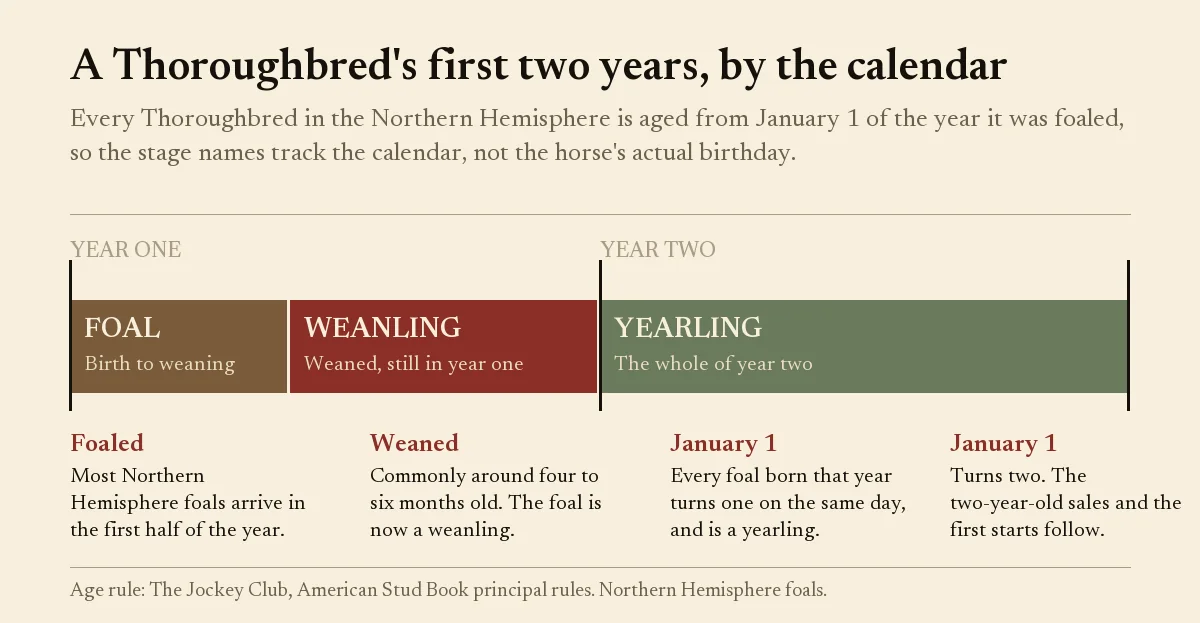
A weanling is a Thoroughbred in its first calendar year that has been weaned from its dam, which on most North American breeding farms happens somewhere around four to six months of age. Before weaning the same animal is simply a foal. From January 1 of the following year it is a yearling, and the word weanling stops applying — not because the horse changed on New Year’s Eve, but because the calendar did. The Jockey Club’s American Stud Book rules age every Northern Hemisphere Thoroughbred from January 1 of the year it was foaled, which is why a February foal and a June foal from the same crop are the same official age for the rest of their lives. Weanling is therefore a stage of seven or eight months at most, and for a horse headed to public auction it is the first time it is offered for sale in its own right.
The Sport of Kings has a side entrance. Here’s the key.
Regular people own racehorses — together, in partnerships — and stand in the paddock like they were born there. The free guide shows you the way in.
The stage sits inside a naming sequence most buyers meet for the first time in a sale catalog. We covered the full run of it in our guide to racehorse age stages for buyers; weanling is the one that piece deliberately left alone, because it is less a description of the animal than a description of where it stands in the selling year.
A Thoroughbred’s first two years, by the calendar
Why the January 1 birthday changes what you are buying
The January 1 rule means two weanlings in the same November catalog can be four months apart in real age and identical on paper, and at this stage four months is an enormous share of a life. A January or February foal standing in a sale barn in November has been alive roughly nine or ten months. A late May foal beside it has been alive six. One of them looks like a racehorse in miniature. The other looks like what it is, which is a baby.
Buyers pay for what they see, and what they see at this age is substantially a function of foaling date. The date is printed in the catalog page, and reading it is free. Three things follow from it:
- An early foal is not necessarily a better horse. It is an older one, being compared to horses the catalog says are the same age.
- A late foal carries a real discount and a real question. The question is whether it is behind because of the date or behind on its own merits, and nobody can answer that in November.
- The gap narrows. By the time these two meet again as two-year-olds the four months matters far less, which is exactly why the market prices it now.
If you have not read a sale page before, our walkthrough of how to read a sale catalog covers where the foaling date sits and what else on that page is doing work.
Where weanlings are sold, and who is in the room
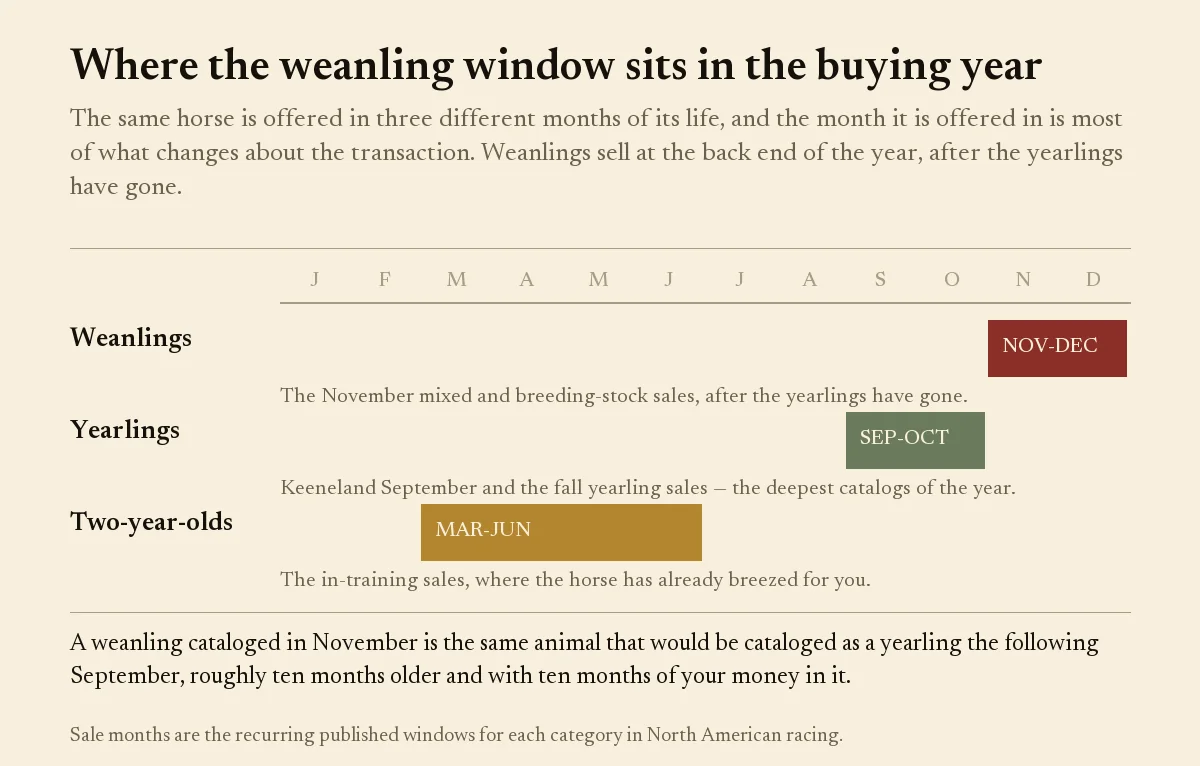
Weanlings sell chiefly at the November mixed and breeding-stock sales, which run after the year’s yearling market has finished. That much is uncontroversial and every consignor will tell you the same. The part worth saying out loud is who else is bidding. A November breeding-stock sale is largely a trade sale: breeders reducing or turning over stock, pinhookers buying inventory to resell, agents working for both. An individual owner buying one horse to race is a minority participant in that room, not its target customer.
The yearling sales are built to sell horses to owners. The November sales are built to sell horses to the trade. You can buy at either, but only one of them is designed with you in mind.
That is not a reason to stay away. It is a reason to bring someone whose full-time job is this. A bloodstock agent earns their commission most clearly at the stage where the least information is public and the most of it is in the room.
Where the weanling window sits in the buying year
What weanlings made at auction in 2025
Weanlings averaged a record $109,745 at the 2025 Keeneland November Breeding Stock Sale, held November 4 to 11. Keeneland’s own summary of the sale reports 58 weanlings sold for $300,000 or more, against 28 the year before, and the three highest-priced foals sold at North American public auction in 2025 all came out of it — a $2.2 million Gun Runner colt, a $1.25 million Curlin filly and a $950,000 Into Mischief colt. Across every category the sale averaged $125,572 through the ring and grossed close to $246 million.
Now the part the recap does not frame for a first-time buyer. Across all its categories that sale had a median of $60,000, under half its $125,572 average. When a median sits that far below an average, a small number of very expensive horses are carrying the arithmetic and the average stops describing anything you are likely to buy. Keeneland did not publish a weanling-only median, so treat the $109,745 weanling average the same way — as a number the top of the catalog moved, not a budget. If you want a weanling-specific middle, the sale company’s session-by-session results are the place to build it, one figure you can defend rather than one headline you inherited.
$109,745 — the record weanling average at Keeneland November 2025. The same sale’s median, across all categories, was $60,000.
What each age group averaged at Keeneland in 2025
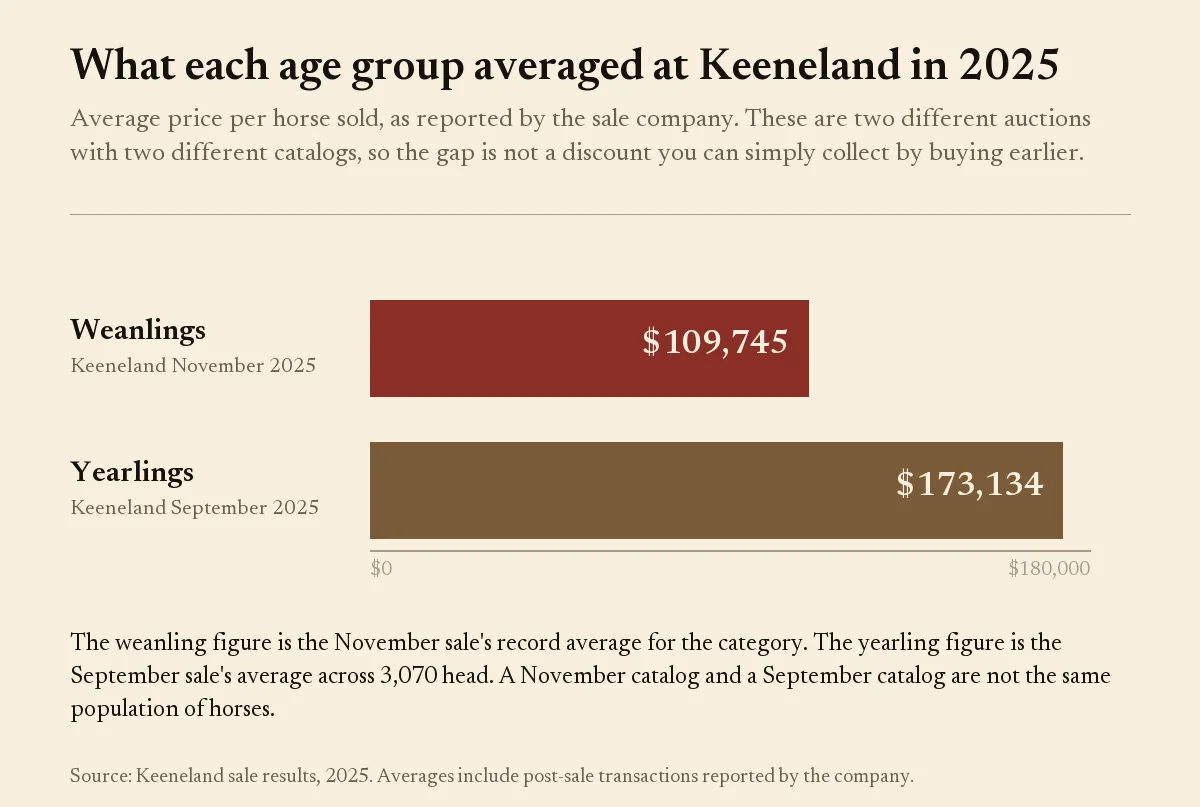
The yearling comparison is the one buyers reach for, and it is worth being careful with. Keeneland September 2025 sold 3,070 head for $531,520,400, an average of $173,134 and a median of $80,000. Set against the November weanling average, that looks like a $63,000 saving for buying ten months earlier. It is not, because the two catalogs are not the same population of horses, and because part of that gap is simply the cost of carrying a horse from one sale to the other in good order — a cost the yearling’s seller has already paid and the weanling’s buyer has not.
What you can and cannot evaluate on a four-month-old
On a weanling you can evaluate pedigree, conformation as it stands today and general veterinary condition, and you cannot evaluate anything that requires the horse to have done work — because it has not done any. There is no breeze time, no training report, no way of going under a rider, no race record. Every performance signal a yearling or two-year-old buyer leans on is simply absent.
Conformation is the awkward one. A weanling is still growing unevenly, and a fault you see in November may correct, and a clean one may not stay clean. Experienced judges of young stock will tell you they are reading a trajectory rather than a photograph. I would put it more bluntly for anyone doing this for the first time: at this age you are buying an opinion about how a horse will grow, and the opinion that matters is not going to be yours.
Veterinary work deserves its own warning. The radiograph repository culture that surrounds the major yearling and two-year-old sales is thinner at the weanling stage, and what a consignor makes available varies. Establish what you can see, and what you are allowed to have looked at, before you build a vetting plan around it — not after you have flown to the sale. Our piece on the pre-purchase exam and the repository covers what those films are and who reads them for you.
What you can check at weanling versus yearling
| What you are checking | At weanling (about 4–12 months) | At yearling (about 12–24 months) |
|---|---|---|
| Pedigree | Fully available, and doing most of the pricing | Fully available, with a year more family results behind it |
| Conformation | Visible but still changing; you are judging a trajectory | Closer to settled; what you see is much nearer what you get |
| Radiographs and repository | Thinner and consignor-dependent; confirm before you travel | Established practice at the major sales |
| Movement under saddle | Not available — the horse is not broken | Not available — yearlings are also unbroken |
| Breeze time | Not available | Not available until the two-year-old sales |
| Sales prep | Minimal; the horse is closer to how it lives | Substantial; prep is part of what you are looking at |
| Months of cost still ahead of you | Roughly ten more before yearling money applies | The yearling has already had them paid for it |
The ten months you are buying, and what they cost
Buying a weanling instead of a yearling means taking on roughly ten additional months of board, routine veterinary care, farrier work and eventual sales or breaking prep before the horse reaches the age at which yearling prices get paid. Those months are the actual product you bought with the lower hammer price, and they are the part no auction result reports.
I am not going to quote you a farm rate as though it were a national figure, because it is not — young-stock board varies by region, by farm and by what the farm is being asked to do. What I will say is that the arithmetic only closes if you cost those months honestly before you bid, at a real quote from a real farm, and add them to the purchase price. Our breakdown of the monthly cost of owning a racehorse is the right shape of thinking even though a weanling’s line items differ from a horse in training.
The honest version: a weanling is not cheaper than a yearling. It is a yearling you have agreed to finance yourself, with the risk of the intervening ten months transferred from the breeder to you.
That transfer of risk is the entire trade, and it is the same question in a different costume as the one we worked through in yearling versus two-year-old for partnership buyers: every step later you buy, the more you know and the more you pay for knowing it.
Pinhooking: buying the weanling to sell the yearling
Pinhooking a weanling means buying it in November and reselling it as a yearling the following September, and the trade returns nothing unless the resale price exceeds the purchase price plus every dollar spent in between. That is a genuine business, run by people who do it at volume, across many horses, in the expectation that some lose money and the book comes out ahead.
The structural problem for a first-time owner is volume. A professional pinhooker survives an individual horse going wrong because there are eleven others. Buy one weanling to flip and you have no book — you have a single outcome, and one veterinary finding in July ends it. We set out the mechanics and the failure modes in our guide to pinhooking for first-time buyers. Read it before you decide the November sale is your entry point, rather than after.
What a share in a weanling actually means
A share in a weanling is a share in roughly two years of expenses before there is any possibility of income, because no Thoroughbred races before its two-year-old year, and plenty do not start the moment they get there. Purses are the only thing that offsets an owner’s costs, and a weanling generates none of them. Everything in those first two years runs one direction.
That does not make it a bad structure. It makes it a structure with specific questions attached, and any offering that cannot answer them plainly is telling you something:
- What is the monthly cost per share during the two years before the horse can run, and is it capped?
- Who decides whether the horse is sold as a yearling instead of raced, and do shareholders vote?
- What happens to your share if you cannot meet a cash call in month fourteen?
- Is the management fee charged during the non-racing years, and on what basis?
Those are prospectus questions, and our guide to reading a horse syndicate prospectus shows where the answers usually hide. If you are still deciding which door into ownership fits you at all, start at the top with how to buy a racehorse — the weanling market is one of the narrowest doors, and it is rarely the right first one.
Weanling questions buyers actually ask
What is the difference between a weanling and a yearling?
A weanling is a foal that has been weaned from its dam and is still in the calendar year it was born in; a yearling is the same horse from January 1 of the following year. The change is a date, not a milestone in the animal’s development. In sales terms the difference is larger than the definition suggests: weanlings trade at the November breeding-stock sales, yearlings at the September and fall yearling sales, to different buyers and at different money.
How old is a weanling horse?
A weanling is usually between four and twelve months old. The lower end is set by weaning, which commonly happens around four to six months, and the upper end by the calendar: on January 1 the horse becomes a yearling regardless of its actual birth date. A weanling offered at a November sale has typically been alive somewhere between six and ten months, depending on whether it was an early or a late foal.
Can you ride or train a weanling?
No. A weanling is not broken to saddle and is nowhere near the physical maturity that would allow it. Thoroughbreds are typically broken as yearlings and put into serious training later, and none of them race before their two-year-old year. Anything a weanling does is handling and turnout, not training, which is precisely why there is no performance information to buy on at this stage.
Is it cheaper to buy a weanling than a yearling?
The purchase price is generally lower — weanlings averaged $109,745 at Keeneland November 2025 against $173,134 for yearlings at Keeneland September — but the total cost is not automatically lower. Between those two sales sits roughly ten months of board, veterinary care, farrier work and prep that the weanling buyer pays and the yearling buyer does not. Whether buying earlier is cheaper depends entirely on what those ten months cost you and whether the horse comes through them sound.
What to read next
- How to buy a racehorse: every ownership path explained — the hub, and the honest comparison of the doors in.
- Foal, colt, yearling and two-year-old: racehorse age stages explained — the rest of the naming sequence a catalog assumes you know.
- Pinhooking for first-time racehorse buyers — the weanling-to-yearling trade, and why volume is the whole game.
- Yearling versus two-year-old for partnership buyers — the same risk-for-price trade one stage further along.
- How to read a sale catalog — where the foaling date sits, and what else on the page is working on you.
About the Author

Calvin Johnson is a Thoroughbred racehorse owner, day trader, and independent racing analyst with more than a decade of firsthand ownership experience. He has participated in nearly every common structure in horse racing — fractional platform shares, traditional syndicates, LLC partnerships, claiming ventures, and outright ownership — across more than two dozen horses. Calvin writes about racehorse ownership the same way he approaches markets: by studying risk, incentives, fees, and whether the people controlling the deal are aligned with the investors behind it.
- Calvin Johnsonhttps://racehorseownership101.com/author/calvin-johnson/

- Calvin Johnsonhttps://racehorseownership101.com/author/calvin-johnson/

- Calvin Johnsonhttps://racehorseownership101.com/author/calvin-johnson/

- Calvin Johnsonhttps://racehorseownership101.com/author/calvin-johnson/